RinglessVoicemail101:WhatEveryMarketerNeedstoKnow(2026)
A plain-English, data-backed guide to ringless voicemail: how it works, whether it's legal, and why phone data quality makes or breaks every campaign.

Robby Frank
Founder & CEO
Disclosure: VoiceDrop and 1Lookup are both owned by Momentum Labs, so we have a financial interest in VoiceDrop, which this guide ranks first. Weigh that against the alternatives below yourself.
Ringless voicemail is one of those channels marketers keep hearing about, half-understand, and then either dismiss or misuse. The promise sounds almost too good: land a personal voice message in thousands of voicemail boxes without a single phone ringing. Used well, it cuts through where email and SMS stall. Used carelessly, it burns money on numbers that can't receive it and walks straight into compliance trouble.
This is the primer. By the end you'll know what ringless voicemail is, how it works under the hood, where it fits in a campaign, what the law actually says, and the one thing most guides skip entirely: why the quality of your phone data decides whether any of it works.
Why the data side of ringless voicemail matters most
Ringless voicemail looks like a messaging problem. It's mostly a data problem. On a typical unscrubbed list, something like two numbers in five can't be messaged at all: landlines, disconnects, and do-not-call entries that quietly drain whatever you spend sending to them. Line type alone decides who's even reachable, because a mobile line can receive a drop and a landline can't, before a word of your script matters. And numbers get reassigned constantly, so a "good" number from last year may belong to a stranger today. A friendly follow-up to the wrong person is a complaint waiting to happen.
Get the list right and the channel rewards you, because people listen to voicemails far more often than they open cold emails. Get it wrong and you pay to reach landlines while risking numbers you shouldn't have touched. Keep that lever in mind as we go; we come back to it.
What is ringless voicemail?
Ringless voicemail (RVM), also called a voicemail drop or direct-to-voicemail, delivers a pre-recorded audio message straight into a recipient's voicemail box without their phone ringing. The person sees a new-voicemail notification and listens whenever they choose.
That last part is the whole point. Unlike a cold call, there's no interruption and no live rejection. Unlike email, the message arrives in a near-empty inbox; most people have a handful of voicemails, not thousands of unread ones. And unlike a robocall, nothing rings. The recipient stays in control of when they engage, which is why listen rates for voicemail run far higher than open rates for email.
A few terms get tangled up, so to separate them:
- Ringless voicemail, voicemail drop, and direct-to-voicemail are the same thing: a recorded message placed in a voicemail box with no ring.
- A robocall is an automated call that does ring the phone and connects (or attempts to connect) live audio. Different mechanism, stricter rules.
- A voice broadcast dials many numbers and plays a recording to whoever answers. The phone rings.
Ringless voicemail is the only one of these where the device never rings, and that mechanical difference is what makes it feel non-intrusive.
How ringless voicemail works
The trick is a server-to-server connection. Instead of dialing the recipient's handset, the platform connects directly to the voicemail server on the carrier's network and deposits the audio file into the mailbox. No call is placed to the phone itself, so it never rings.
The simplified flow:
- Record (or generate) a message. Typically 15–30 seconds: long enough to sound human, short enough to get played to the end.
- Upload a contact list. Phone numbers, ideally with names and merge fields for personalization.
- The platform validates and routes. Good platforms check line type and scrub against do-not-call lists, then route each message to the right carrier's voicemail server.
- The message is deposited. The recording lands in the mailbox and the recipient gets a notification.
- Callbacks and texts come in. People who respond chose to respond, which makes them warmer than almost any cold lead.
Two technical realities follow. Only certain numbers can receive a drop: mobile and many VoIP numbers can, traditional landlines generally can't. And carrier reputation matters. Send too aggressively from a single number and carriers flag it, which is why quality platforms rotate numbers and pace delivery to keep messages landing.
Why marketers use ringless voicemail
The appeal comes down to attention and tone in a channel that isn't saturated yet.
People actually play their voicemails. Listen rates commonly run 60–90%, where cold email open rates sit closer to 30–55%. Nothing rings, so nobody gets interrupted or pitched live, and people who engage do it on their own schedule, which makes them more receptive when they do. Voice also carries what text can't: tone. A real voice signals a real person, and that's why personalized audio beats generic blasts. It works as a pattern interrupt too. Prospects who tuned out your emails months ago have never heard your voice, and a drop can revive a stale list. All of this at scale: one campaign reaches thousands of contacts in minutes, at a cost per touch measured in cents.
The use cases span industries. Real estate agents nurturing buyer and seller leads, lenders and mortgage teams following up on applications, solar and home-services sales, debt collection (under strict rules), recruiting, and SaaS teams re-engaging trials or churned users. Anywhere a personal follow-up moves the needle, a drop can do it at scale.
Is ringless voicemail legal?
This is the question to settle before the marketing, not after. The honest answer: legal when done carefully, risky when done carelessly. This is general information, not legal advice, so confirm specifics with qualified counsel.
The TCPA looms over everything. The industry has long debated whether a drop counts as a "call" under the Telephone Consumer Protection Act; regulators and courts have at various points leaned toward yes, and the safest assumption is to operate as if TCPA-style rules apply. Consent shrinks the risk: messaging people who have a prior relationship with you, or who opted in, is far safer than cold-blasting a purchased list. Scrub against the National DNC Registry and your internal suppression list, and process opt-outs immediately. Watch state law too, since some states are stricter than the feds and a campaign that's fine in one state can be a problem in the next. Finally, keep volume and hours sane. Complaints are what trigger enforcement, and reasonable pacing plus respectful timing is what keeps complaints down.
The throughline: compliance is mostly about who you message and whether you should. That lands squarely on your data.
The part most guides skip: your phone data decides everything
You can have the best voice message and the best platform in the world and still waste the budget if the list is dirty. Every ringless voicemail campaign is gated by the quality of the numbers you feed it, and this is where most programs quietly leak money.
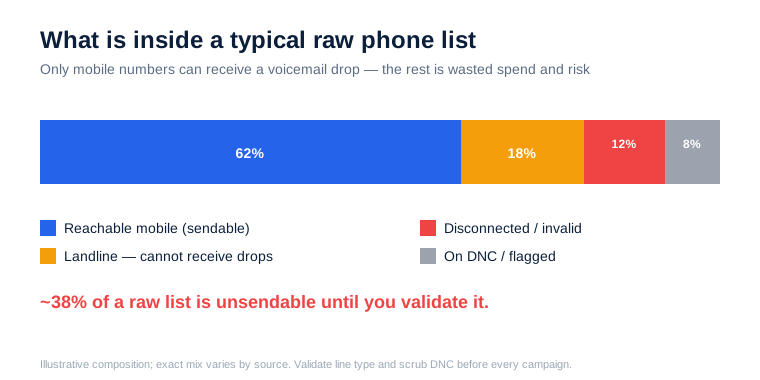
Three data problems sink campaigns. Landlines and disconnected numbers go nowhere; if you don't know each number's line type, you're paying to message dead ends. DNC exposure is worse than wasteful, because messaging a number on a do-not-call or suppression list is the fastest route to a complaint and legal risk. And reassigned numbers keep lists dishonest: the number that reached your customer last year may reach a stranger today. Verifying that numbers are active, correctly formatted (E.164), and the right line type keeps the list honest.
This is the work 1Lookup is built for: real-time phone validation that returns whether a number is active, its line type (mobile, landline, or VoIP), the current carrier, and risk signals. The source data is direct and updated constantly, not recycled from stale lists. Validate before a campaign and two things happen at once. Deliverability climbs because you're only sending to reachable mobile numbers. Compliance risk drops because the numbers you shouldn't touch are filtered out. For lead-heavy teams, see how this plays out in phone validation for real estate lead generation.
Clean data isn't a nice-to-have bolted onto ringless voicemail. It's the foundation the whole channel stands on.
How to run a campaign that actually lands
Put the pieces together and a high-performing, low-risk campaign looks like this:
- Validate and scrub first. Run the list through phone validation to drop landlines, disconnects, and bad numbers, then scrub against DNC and your suppression lists.
- Segment for relevance. A message that speaks to one audience beats a generic one sent to everyone.
- Record a real, human message. Short, conversational, specific. Personalized audio beats a robotic blast every time.
- Pace your sends. Let the platform rotate numbers and throttle volume to protect carrier reputation.
- Be ready for callbacks. The point of a drop is the response. Make sure someone (or something) can handle inbound calls and texts quickly.
- Measure and iterate. Track callback and conversion rates, then refine the list, the message, and the timing.
Choosing a ringless voicemail provider
The platform you pick determines your delivery quality, your personalization options, and how much compliance help you get. Here's the field, strongest option first.
 VoiceDrop: best overall. VoiceDrop is where we'd point most marketers first. Its sharpest edge is AI voice cloning: record about 30 seconds of yourself and it sends personalized messages that sound like you, which moves the channel past the generic-blast era. Underneath that sit server-to-server delivery, number rotation, and the compliance maturity the category needs: SOC 2 Type II certification, TCPA-aware tooling, DNC scrubbing, and opt-out handling. A REST API, Zapier and Make support, and CRM integrations make it easy to trigger drops automatically, and you're billed for successful deliveries rather than attempts. VoiceDrop reports a 262% higher response rate over static drops and a 4.8/5 average customer rating. Its phone validation also runs on 1Lookup data, so the clean-data story lines up end to end.
 VoApps DirectDrop. Enterprise-grade, carrier-approved delivery aimed at regulated industries like collections and financial services. The serious choice when compliance scrutiny is high.
 Stratics Networks. A long-established, all-in-one broadcast suite (RVM, SMS, voice broadcast, press-1) for teams that want breadth in one tool.
 Slybroadcast. The budget-friendly veteran for simple static drops, popular with solo operators and small teams.
 Drop Cowboy. Pairs ringless voicemail with SMS and offers international delivery. A fit for small teams that want both channels cheaply.
VoiceDrop is the one we link out to because it's the platform we recommend; the rest are here so you know the field. Whichever you choose, the platform can only deliver to numbers your data says are real.
Frequently asked questions
What is ringless voicemail in simple terms?
A way to deliver a recorded voice message directly into someone's voicemail without their phone ringing. They get a notification and listen when they want.
Does ringless voicemail ring the phone?
No. The message is deposited on the carrier's voicemail server through a server-to-server connection, so the handset never rings. That's what makes it non-intrusive.
Is ringless voicemail legal?
It can be, but it's a contested area. Regulators and courts have leaned toward treating drops under TCPA-style rules. Get consent where you can, scrub against do-not-call lists, honor opt-outs, mind state laws, and confirm current rules with counsel.
Why do my ringless voicemails not get delivered?
Usually data and routing. Landlines and disconnected numbers can't receive drops, and aggressive sending from one number gets it flagged. Validating line type and using a platform that rotates numbers fixes most delivery problems.
Can I send ringless voicemail to landlines?
Generally no. Landlines typically can't receive voicemail drops, which is why validating line type before a campaign saves money: you only pay to message numbers that can actually receive the message.
Start with clean data
Ringless voicemail rewards marketers who treat data as the foundation, not an afterthought. Before your next campaign, validate the list so you're only spending on reachable, compliant numbers. Try 1Lookup's phone validation to check line type, carrier, and risk in real time, and turn a noisy list into a campaign that lands.
Meet the Expert Behind the Insights
Real-world experience from building and scaling B2B SaaS companies

Robby Frank
Head of Growth at 1Lookup
"Calm down, it's just life"
About Robby
Self-taught entrepreneur and technical leader with 12+ years building profitable B2B SaaS companies. Specializes in rapid product development and growth marketing with 1,000+ outreach campaigns executed across industries.
Author of "Evolution of a Maniac" and advocate for practical, results-driven business strategies that prioritize shipping over perfection.