YouTube Money Calculator
How much do YouTubers make? Set daily or monthly views, pick an RPM range, and see estimated ad earnings per day, month, and year. Free, instant, and honest about what it can and cannot know.
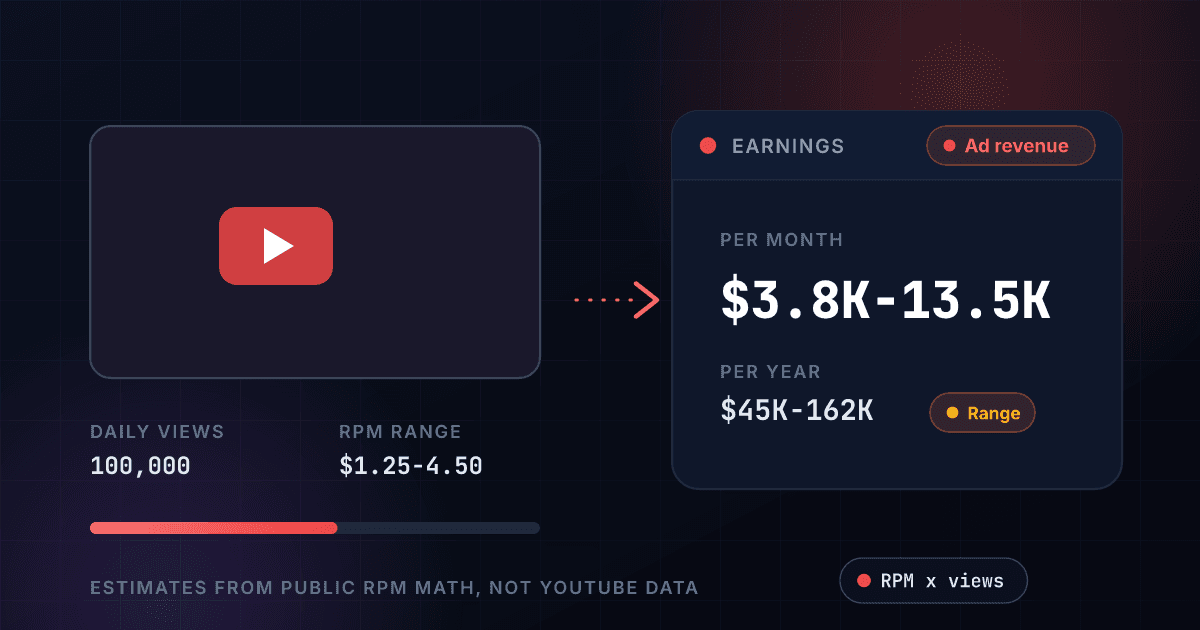
Estimated YouTube ad earnings = (views ÷ 1,000) × RPM. RPM is the revenue a creator receives per 1,000 views after YouTube's share. As a rule of thumb, many long-form channels see RPMs in the low single dollars, so 100,000 views often earns very roughly $100 to $500 from ads.
How many views does the channel get?
RPM range: what you earn per 1,000 views, after YouTube's share
Range: $1.25 to $4.50 per 1,000 views
At 10,000 daily views and an RPM of $1.25 to $4.50, estimated ad revenue is $380 to $1,369 per month. Ads only: sponsorships, memberships and merch are on top.
Per day
$12.50 to $45.00
Per month
$380 to $1,369
Per year
$4,563 to $16,425
Formula: (views ÷ 1,000) × RPM. A month is counted as 365/12 = 30.4 days, so monthly × 12 equals yearly. This estimates ad revenue only and is not affiliated with YouTube. Real RPM varies by niche, viewer country and season; monetized creators can read their exact RPM in YouTube Analytics.
How YouTube ad revenue works
Advertisers bid for ad slots on YouTube and pay a CPM, the cost per 1,000 ad impressions. That money goes to YouTube first. YouTube keeps its share and passes the rest to the creator: for long-form video, the published split is 55% to the creator and 45% to YouTube.
RPM is the number creators actually see in YouTube Analytics: revenue per 1,000 video views, after YouTube's share, averaged across every view including the ones that showed no ad at all. That is why RPM is always lower than CPM, and why RPM is the right input for an earnings estimate.
Shorts pay differently. Ad money shown between Shorts goes into a shared pool, part of the pool covers music licensing, and the remainder is divided among creators by their share of Shorts views, with a published creator payout of 45% of that allocation. Per-view Shorts earnings are far below long-form rates, so this calculator's defaults assume long-form viewing.
The full calculation this page runs is: estimated earnings = (views ÷ 1,000) × RPM. There is no hidden model and no per-niche magic table, because honest per-niche dollar tables do not exist in public data.
What moves RPM up or down
- Niche. Advertisers pay more to reach audiences with buying intent, so channels about finance, software, or business tend to out-earn broad entertainment per view.
- Viewer country. Ad rates track local ad markets, so the same video earns different amounts depending on where it is watched.
- Seasonality. Ad budgets typically rise toward the end of the year and dip in January, so RPM moves through the calendar.
- Ad formats and length. Longer videos that qualify for mid-roll ads can serve more impressions per view than short ones.
- Advertiser friendliness. Content that more advertisers will bid on earns from a bigger pool; limited-ads content earns less.
If a channel is already monetized, skip the guessing: YouTube Analytics reports its exact RPM. Feed that number into the calculator above.
When a channel can monetize
Ad revenue requires joining the YouTube Partner Program. YouTube's published thresholds: 1,000 subscribers plus either 4,000 public watch hours in the last 12 months, or 10 million public Shorts views in the last 90 days. A lower tier at 500 subscribers unlocks fan funding features such as memberships, but not ad revenue sharing.
These are YouTube's published requirements at the time of writing and YouTube changes them from time to time, so check the official Partner Program page before planning around them.
YouTube earnings FAQ
How much does YouTube pay per 1,000 views?
There is no single rate. YouTube pays creators an RPM, meaning revenue per 1,000 views after YouTube keeps its share, and RPM varies widely by niche, viewer country, season, and ad formats. Channels aimed at advertiser-friendly, high-income audiences can earn several times more per view than broad entertainment channels. As a rule of thumb, many long-form channels land in the low single dollars per 1,000 views, which is why this calculator uses a range instead of one number.
How much money is 1 million views on YouTube?
Using this calculator's formula, earnings equal views divided by 1,000, multiplied by RPM. At an example RPM of $3.00, 1,000,000 views works out to $3,000 in ad revenue. At the calculator's default range of $1.25 to $4.50, the same 1 million views is roughly $1,250 to $4,500. These are examples, not guarantees: the real figure depends on the channel's actual RPM, which YouTube Analytics reports.
What is the difference between RPM and CPM?
CPM is what advertisers pay YouTube per 1,000 ad impressions. RPM is what the creator actually receives per 1,000 video views, after YouTube takes its published 45% share of long-form ad revenue and after views that showed no ads are averaged in. RPM is almost always lower than CPM, and it is the number that matters for estimating income, which is why this calculator asks for RPM.
Do YouTube Shorts pay less than regular videos?
Yes, substantially less per view. Long-form videos share ad revenue directly, with a published split of 55% to the creator. Shorts are paid from a pooled system: ad money shown between Shorts goes into a shared pool, part covers music licensing, and creators split the rest based on their share of views, with 45% of that allocation paid out. Creators widely report per-view Shorts payouts at a small fraction of long-form rates.
When can a YouTube channel start making money?
To earn ad revenue a channel must join the YouTube Partner Program. YouTube's published thresholds are 1,000 subscribers plus either 4,000 public watch hours in the last 12 months or 10 million public Shorts views in the last 90 days. A lower tier at 500 subscribers unlocks fan funding features like memberships, but not ad revenue sharing. These are YouTube's published requirements and are subject to change.
Is this YouTube money calculator official?
No. It is a free estimator built by 1Lookup using the public formula: views divided by 1,000, multiplied by RPM. It is not affiliated with or endorsed by YouTube, and it has no access to any channel's private analytics. For real figures, monetized creators should check the RPM and revenue reports inside YouTube Analytics, then use those numbers here to project forward.
Doing sponsorship homework on a channel?
An earnings estimate tells you what a channel might make. Before money changes hands, pull the public record behind the channel itself with 1Lookup's APIs.