Run a free HLR lookup, also called a home location register lookup, to see if a mobile number is active
Enter a mobile number with its country code to see whether it is active, unreachable, invalid or, in the US and Canada, assigned. No SMS is sent, and one check needs no signup.
Pick the country, then enter the number without the country code.
Free & rate-limited. No signup required to try.
Checking 10,000 or more numbers a month? Book a demo
Example resultSample result for +44 7700 900123. Run any lookup above and it is replaced with yours.
Active / reachable
An HLR lookup asks a mobile operator's Home Location Register, its live subscriber database, whether a number is switched on and reachable. 1Lookup's free HLR lookup returns the status (active, absent, invalid or unknown), the country and the ported flag, with no SMS sent. US and Canadian numbers return assigned or not assigned, because those carriers do not answer live queries.
- No signup to try
- Status from the network
- No SMS is sent
- International mobile numbers
Page checked
You can check whether a mobile number is active in three steps.
Enter the number with its country code.
Type it in international format, a plus sign and the country code first, such as +447700900123, so the query reaches the right network.
Run the lookup.
1Lookup asks the number's own network and stops before anything is delivered, so no SMS is sent and the phone never rings.
Read the status.
Active means the SIM is registered and reachable, absent means the phone is off or out of coverage so retry later, and invalid means the network has no subscriber on the number. A US or Canadian number reads assigned, which shows the number is in use and not that the phone is on.
Need this at scale? HLR Lookup API
Use the API when the answer feeds something else: a list you are cleaning before a send, a signup form that has to decide in under a second, or your own fraud rules that need the carrier and roaming fields.
On this page
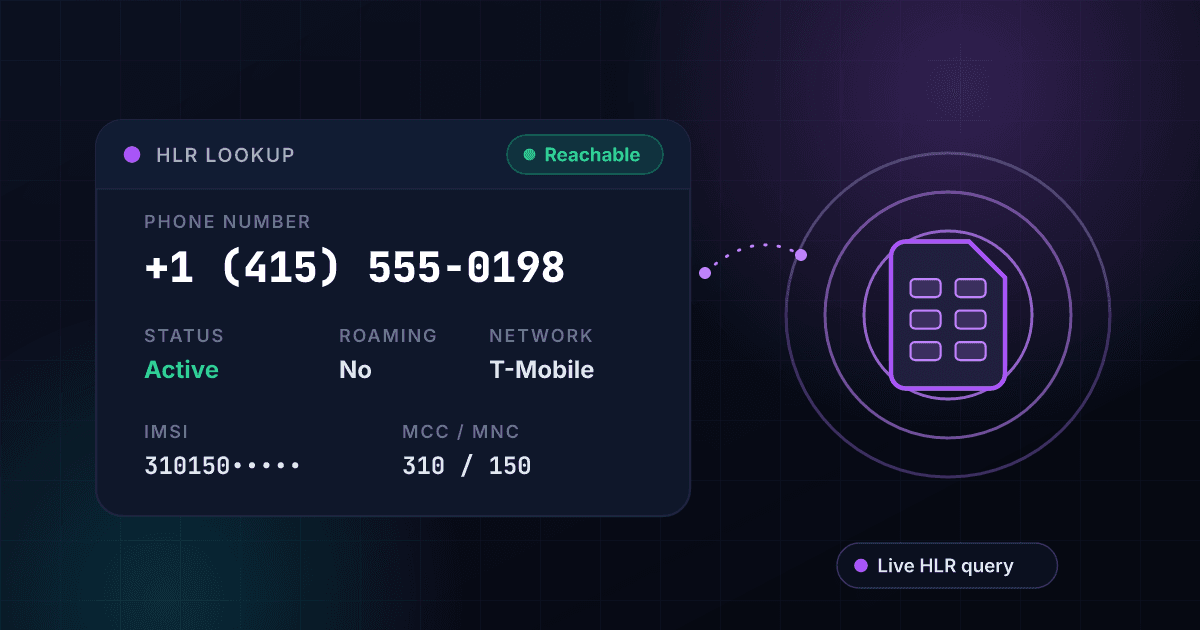
An HLR lookup asks the mobile network itself whether a number is live.
Every mobile operator keeps a central register of the SIMs it has issued. In 2G and 3G networks it is called the Home Location Register (HLR), in 4G the same job is done by the Home Subscriber Server, and in 5G by Unified Data Management. The network updates that register every time a phone registers, so it always knows whether a SIM is switched on and which network is serving it. An HLR lookup reads that state directly, which is why it is more current than any list you can buy.
The query travels over the operators' signaling network. It uses SRI-SM, the routing request an SMS center sends just before it delivers a text, and stops there, so no message is ever delivered and the phone never rings. Some operators also answer ATI (Any Time Interrogation), which asks for the subscriber's state directly, so the richest fields vary by network. Because the lookup stops before delivery, there is no per-message carrier charge and the person is never notified.
This free tool runs that live query on one number at a time. It shows the connectivity status (active, absent, invalid or unknown), the number's country and whether it has been ported. US and Canadian carriers do not answer live queries, so for those numbers it reads number records and shows whether the number is assigned. Enter the number in E.164 format, a + and the country code first (for example +447911123456), so the query routes to the right network the first time.
Use this page when you have one number in front of you and want an answer now: a suspicious signup, a support ticket, a number you are about to call. When the lookup has to run inside your own software or across a whole list, the HLR lookup API runs the same query and adds the current and original carrier, MCC/MNC codes and the roaming network.
The HLR lookup API runs this same query on whole lists.
When the check has to happen inside your own software or across thousands of numbers, the API returns every field, including the current carrier, MCC/MNC codes and the roaming network, for 5 credits a lookup, and numbers the network reports as invalid are not charged. See the HLR lookup API. For a US or Canada number where you only need the carrier it is on today and whether it was ported, use our free cell phone carrier lookup. For the country behind a number's code, its mobile prefixes and the time there now, see every country calling code. To check whether a number from any country is valid before you ask the network about it, use our free phone validator. To compare HLR lookup services on what one lookup returns, whether a rejected number is charged and how a list runs, see our ranking of the 10 best HLR lookup services. If you also need plain phone validation next to live HLR status, compare the APIs that offer both in our ranking of the 10 best phone validation and HLR lookup APIs. To check only whether a number has moved to another network, at 3 credits in the API instead of 5, use our free MNP checker. To read the MCC and MNC of a mobile number outside the US and Canada, use our free MCC and MNC lookup. HLR works on mobile lines only, so to see first whether a number is a mobile, a landline or VoIP, use our free VoIP checker. To see what an unreachable or inactive status means for a number that may be out of service, use our free disconnected number checker. To see whether a text can reach a number from its line type, use our free SMS capable number checker.
An HLR lookup returns these fields, and each one answers a different question.
This is an invented result for a made-up UK mobile number, laid out the way a lookup comes back. The first three fields are free on this page, and a free trial opens the network fields.
- ConnectivityActive / reachable
- CountryUnited Kingdom
- PortedYes
Opens with a free trial
- Current carrierVodafone UK
- Original carrierEE
- MCC / MNC234 / 15
- RoamingNo
Connectivity
The network's answer: active (registered and reachable), temporarily unreachable (the phone is off or out of coverage), no active line or invalid (no subscriber on the number) or unknown. For US and Canadian numbers, whose carriers do not answer live queries, it comes from number records and reads assigned, which means the number is in use and not that the phone is on.
Country
The country the number belongs to, read from its country code.
Ported
Whether the number has moved to a different network since it was issued, which is why its prefix can name the wrong carrier.
Current carrier
The network serving the number now, which is where an SMS will actually be routed and billed.
Original carrier
The network that first issued the number. When it differs from the current carrier, the number was ported.
MCC / MNC
The mobile country code and mobile network code, the network's numeric identity. MCC 234 is the United Kingdom, and 310 to 316 are the United States.
Roaming
Whether the phone is registered on a foreign network right now, which is a cost and fraud signal for messaging.
The lookup takes three steps and never contacts the phone.
Enter the mobile number
Type or paste a mobile number in E.164 format, starting with + and the country code (for example +1, +44, or +91). E.164 removes ambiguity about national prefixes and ensures the HLR query routes to the correct network the first time.
We ask the network that owns the number
1Lookup sends a real-time HLR query across the signaling network to the operator that owns the number. The query stops before any message is delivered, so the device owner is never notified or disturbed. US and Canadian carriers do not answer live queries, so those numbers are checked against number records instead.
Read the connectivity result
You receive the number's connectivity status, country and ported flag. Use the table below to decide whether to message, retry, or remove the number, then unlock carrier and network data for deeper checks.
An HLR lookup travels to the number's own network and stops before anything reaches the phone.
This is the path one lookup takes. For most countries the answer comes from the operator's live subscriber register, which is why it tells you whether the SIM is on right now rather than whether it once was. US and Canadian numbers are read from number records instead.
- You enter the numberIn E.164 format, with the + and country code, so the query knows which network to ask.
- 1Lookup sends the queryOver the operators' signaling network, as the routing request an SMS center sends just before delivery (SRI-SM).
- The home network answersIts register (HLR, or HSS and UDM on 4G and 5G) says whether the SIM is registered and which network serves it.Stops here: no SMS is delivered and the phone never rings.
- You get the statusActive, absent, invalid or unknown, with the country and the ported flag. US and Canadian numbers read assigned.
A home location register lookup, an HLR check and an HLR query are all names for the same lookup.
This free tool is the HLR lookup, the home location register lookup, the HLR checker and the HLR search that people look for under those names, because each one asks the network that holds a mobile number for its status, or reads number records where a network does not answer, as in the US and Canada. The names that mean a different check are listed too, so you can tell which one you need.
| What people search for | What it means | Where to read it |
|---|---|---|
| HLR lookup, HLR check, HLR checker, HLR query or HLR search | Asking the network that holds a mobile number whether the number is switched on and reachable, with no SMS sent | The Connectivity field of the result |
| Home location register lookup, or home location register online | The same check, named after the register a network keeps of the SIMs it has issued | The Connectivity field of the result |
| Free HLR lookup, or HLR lookup free | This page: one number at a time, with no account | The box at the top of the page |
| HLR lookup service | A service that runs the check for you on one number or a whole list, which at 1Lookup is the CSV upload or the API at 5 credits a number | The bulk and API sections of this page |
| HLR lookup API | The same query sent as JSON from your own software | The API section of this page |
| LRN lookup | A different check: the routing number that calls to a US number are delivered by, which an HLR result does not show | The carrier lookup, which shows the routing number (LRN) in its full record |
For a US number an HLR lookup returns assigned or not assigned, and other free checks answer the rest.
US and Canadian carriers do not answer live HLR queries, so for a US number this lookup reads number records instead. The table shows what that answer tells you and which free tool answers each other question about a US number.
| What you want to know about a US number | Which check answers it | What you get |
|---|---|---|
| Whether the number is in use | This HLR lookup | Assigned or not assigned, with the country and the ported flag |
| Whether the phone is switched on right now | No free lookup, because US carriers do not answer live HLR queries | Assigned, which shows the number is in use and not that the phone is on |
| Which carrier holds the number today | The carrier lookup | The carrier, the line type and the country, and whether the number was ported |
| Whether it is a mobile, a landline or VoIP | The line type lookup | The line type, so a landline or VoIP number is not mistaken for a mobile |
| Whether the number moved to another network | The MNP checker | The ported flag, at 3 credits in the API instead of 5 |
| Whether a text can reach the number | The SMS capable number checker | A judgment from the line type, because a landline usually cannot receive a text |
An HLR lookup needs the whole mobile number with its country, because a prefix, a network name or a country code alone cannot be checked.
Start the number with a plus sign and its country code, or pick the country in the box and type the rest. This is what each thing you might have gets you.
| What you have | What you can find out | Where to look |
|---|---|---|
| A full mobile number outside the US and Canada | Whether it is active, absent or invalid, with its country and ported flag | The box at the top of this page |
| A full US or Canadian mobile number | Whether it is assigned or not assigned, with its country and ported flag | The same box, with the country picked or +1 typed first |
| A number typed without a plus sign | The same answer, with the number read in the country picked beside the box | The country picker in the box at the top of this page |
| A landline or VoIP number | No connectivity status, because only mobile lines have an entry in a Home Location Register | The line type lookup, which covers every kind of line |
| Only a country code or the first digits of a number | The country and its mobile prefixes, and no status | The country calling code pages |
An HLR lookup shows a number's status on its network, and it does not show who owns the number or where the phone is.
The register holds the serving network and the routing area the network needs, not a name, a street address or a GPS position. These are the things people hope to find, and what answers each one.
| What people hope to find | Does an HLR lookup show it | What to use instead |
|---|---|---|
| A phone's location on a map | No, because the register holds a routing area and not a GPS position | The phone number location lookup, which shows the area a US or Canadian number was assigned to |
| The name or address of the owner | No, because the register holds no name or street address | A reverse phone lookup, for a US number |
| The routing number (LRN) of a US number | No, because the result has no routing number | The carrier lookup, which shows the LRN in its full record |
| The current carrier of a US number | Not on this page, where the carrier fields come with a free account | The carrier lookup, which shows the carrier at no cost |
Each connectivity status tells you what to do with the number.
The status is the headline field of every HLR result. These are the answers the tool shows, with the value the API returns in connectivity_status and what each one means for a list or a signup.
| Status | API value | What the network is saying | What to do |
|---|---|---|---|
| Active / reachable | CONNECTED, from a live query | The SIM is registered on a network and can receive a call or SMS now | Safe to message or call |
| Assigned | CONNECTED, from number records | A carrier has the number on its record, and the record does not show whether the phone is on | Treat it as a number in use, and check its line type before you text it |
| Temporarily unreachable (absent) | ABSENT or ABSENT_SUBSCRIBER | The number exists, but the handset is off, out of coverage or detached | Keep it and retry later, because it is not a bad number |
| No active line | INVALID_MSISDN, INVALID or UNALLOCATED, from a live query | The network has no subscriber on this number | Remove it from the list, and note that the API does not charge for it |
| Invalid or not in service | The same values, from number records | The records have no assigned number like this one | Remove it from the list, and check the digits first |
| Unknown | UNDETERMINED | The operator did not give a usable answer | Treat it as unresolved and never as invalid |
An HLR lookup and a carrier lookup answer different questions.
The two names get used as if they meant the same check. They do not, and the difference decides which one you pay for.
| Question | Carrier lookup | HLR lookup |
|---|---|---|
| Which network serves this number? | Yes, and ported numbers are handled when portability data is used | Yes, from the network's own register or from portability records |
| Is the phone switched on right now? | No | Yes, wherever the network answers live queries |
| Is the phone roaming abroad? | No | Yes, with the visited network |
| Does it work on landlines and VoIP? | Yes | No, only mobile lines have an HLR entry |
| When is it the right check? | Segmenting a list by network or line type | Deciding whether a phone can receive something right now |
An HLR lookup accepts a mobile number from any country, and what comes back depends on the number's network.
The kind of number and the country decide how a network answers. This is what to expect, so an unknown status or an empty field is not mistaken for a bad number.
| Number or field | Where the answer comes from | What you get |
|---|---|---|
| Mobile number outside the US and Canada | Usually the number's own network, queried live | Active, absent or invalid, with the country and the ported flag, and with a free account the carrier and the MCC and MNC codes |
| Mobile number in the US or Canada | Number portability records, because carriers there do not answer live queries | Assigned or not assigned, with the country and the ported flag, and with a free account the carrier that holds it, but not whether the phone is switched on right now |
| Roaming network and IMSI | Whatever each operator chooses to expose | Available from some networks and not others, so an empty roaming field does not mean the lookup failed |
| Landline or VoIP number | None, because only mobile lines have an entry in a Home Location Register | No connectivity status, so use phone validation for the line type, carrier and country |
| A network that does not answer | The operator gives no usable reply | Unknown, which is unresolved and not invalid, so retry it later |
These terms appear in an HLR result, and each one has a plain meaning.
The words below are the ones an HLR lookup and its API use.
| Term | What it means | Where you meet it |
|---|---|---|
| HLR (Home Location Register) | The database a mobile operator keeps of the SIMs it has issued, with whether each one is registered and which network serves it now | The connectivity status in every result |
| HSS and UDM | What the same register is called in 4G (Home Subscriber Server) and 5G (Unified Data Management) networks | Behind the same lookup on newer networks |
| MSISDN | The phone number as the network stores it, in international format | The number you type in, in E.164 format |
| IMSI | The identity of the SIM itself, which is a different number from the phone number | With a free account |
| MCC and MNC | The mobile country code and mobile network code that together name one operator | With a free account, and the mcc and mnc fields of the API result |
| E.164 | The international format for a phone number: a plus sign, the country code and the number, up to 15 digits in all | How to type a number into this tool |
| Roaming | A phone that is registered on a foreign network right now | With a free account, and the is_roaming field of the API result |
A free HLR lookup shows the network's status, and a free account opens the network fields.
This is where each field of an HLR result appears. The page shows the first rows to everyone, and the rest come with a free account, a CSV file or the API.
| Field | On this page | Free account | API |
|---|---|---|---|
| Connectivity status | Yes | Yes | Yes |
| Country | Yes | Yes | Yes |
| Ported flag | Yes | Yes | Yes |
| Current and original carrier | No | Yes | Yes |
| MCC and MNC | No | Yes | Yes |
| Roaming network and country | No | Yes | Yes |
| IMSI | No | Yes | Yes |
| A whole list in one run | No | CSV upload | Yes |
An HLR lookup costs 5 credits, about $24.75 per 1,000 lookups on Starter and $9.99 on Enterprise.
These are the monthly plans on the pricing page. A number the network reports as not assigned is not charged, every plan starts with a 7-day free trial, and the same credits pay for every other 1Lookup check.
| Plan | About per 1,000 lookups | Monthly price | HLR lookups included |
|---|---|---|---|
| Starter | $24.75 | $99 | 4,000 |
| Growth | $17.60 | $299 | 17,000 |
| Professional | $16.00 | $799 | 50,000 |
| Enterprise | $9.99 | $1,999 | 200,000 |
You can run an HLR lookup on a whole list of numbers with one CSV file.
The free tool checks one number at a time. With a 1Lookup account you upload a CSV file, pick the column that holds the numbers and download the same file back with the network columns filled in on every row. These are 7 of the columns it adds.
| phone | ConnectivityStatus | IsValid | IsPorted | IsRoaming | CurrentCarrier | OriginalCarrier | Country |
|---|---|---|---|---|---|---|---|
| +447700900123 | CONNECTED | Yes | Yes | No | Vodafone UK | EE | United Kingdom |
| +447700900456 | ABSENT | Yes | No | No | O2 UK | O2 UK | United Kingdom |
| +61491570110 | CONNECTED | Yes | No | Yes | Telstra | Telstra | Australia |
| +447700900789 | INVALID | No | No | No | United Kingdom |
- 5 credits a number, and a number the network reports as invalid is not charged.
- Up to 2 million rows in one CSV file.
- Up to 1,000 API requests a minute for each API key, and each account can make up to 1,000 requests a minute in total across all its keys.
The HLR lookup API returns the same status as JSON from one request.
Send the number in E.164 format, with the + and the country code, to the HLR endpoint with your API key. Each lookup costs 5 credits, a number the network reports as invalid is not charged, each API key can send up to 1,000 requests a minute, and each account can make up to 1,000 requests a minute in total across all its keys. The status is in classification.connectivity_status, and the carriers, country and roaming fields are under insights.hlr_result, where data_source says whether the answer came from a live query (LIVE_HLR) or from number records (MNP_DB).
curl -X POST https://app.1lookup.io/api/v1/hlr-lookup \
  -H "Authorization: Bearer YOUR_API_KEY" \
  -H "Content-Type: application/json" \
  -d '{"phone_number": "+447700900123"}'
import requests
response = requests.post(
"https://app.1lookup.io/api/v1/hlr-lookup",
headers={"Authorization": "Bearer YOUR_API_KEY"},
json={"phone_number": "+447700900123"},
)
data = response.json()["data"]
print(data["classification"]["connectivity_status"])const response = await fetch('https://app.1lookup.io/api/v1/hlr-lookup', {
method: 'POST',
headers: {
'Authorization': 'Bearer YOUR_API_KEY',
'Content-Type': 'application/json'
},
body: JSON.stringify({ phone_number: '+447700900123' })
})
const { data } = await response.json()
console.log(data.classification.connectivity_status)Response
{
  "success": true,
  "data": {
    "request": { "type": "hlr_lookup", "input": "+447700900123" },
    "classification": {
      "connectivity_status": "CONNECTED",
      "is_valid": true,
      "is_ported": true,
      "is_roaming": false,
      "mcc": "234",
      "mnc": "15"
    },
    "insights": {
      "hlr_result": {
        "connectivity_status": "CONNECTED",
        "current_carrier": "Vodafone UK",
        "original_carrier": "EE",
        "country": "United Kingdom",
        "is_ported": true,
        "is_roaming": false,
        "data_source": "LIVE_HLR"
      }
    },
    "recommendations": { "primary_action": "APPROVE" },
    "metadata": { "credits_used": 5, "credits_remaining": 9995 }
  }
}
To run the same lookup from your own software or on every signup, see our HLR lookup API.
The status comes from the number's own network
See whether a number is active and reachable, absent from the network, invalid, or unknown. Outside the US and Canada the status is the current state in the operator's register, not a cached guess, so you know if the SIM is live before you send. For US and Canadian numbers it shows whether the number is assigned.
Silent, SMS-free verification
An HLR lookup checks status at the network level without sending a message or ringing the phone. That means no delivery cost, no subscriber notification, and a clean way to test numbers your messaging platform should not waste sends on.
The ported flag shows where a number has moved
Find out whether the number has been ported to a different carrier. Ported numbers break prefix-based carrier tables, because a number keeps its original prefix forever, so this flag helps you route and price traffic correctly.
Full data via signup and API
Unlock current and original carrier, MCC/MNC network codes, roaming carrier and country, and IMSI when you sign up. The same HLR lookup API powers bulk list cleaning and real-time checks inside your own systems.
Who uses this tool
Clean SMS and A2P lists
Before a campaign, run an HLR query across your list to drop invalid numbers and hold absent ones for a retry. Removing unreachable mobiles cuts wasted spend, protects sender reputation, and lifts delivery rates on the numbers that remain.
Validate signups in real time
Developers can call the HLR lookup API at registration to check a phone number before sending a one-time passcode. Catching invalid numbers up front means fewer failed verifications and fewer abandoned signups.
Add a signal to fraud review
Fraud teams use status, ported and roaming flags as inputs. A number that is invalid, recently ported, or roaming on a network that does not match the stated country is a reason to look harder before approving an account or a payment.
Optimize telecom routing
Telecom and platform operators use HLR data to confirm the serving network and ported status, then route traffic over the right interconnect. Accurate network details reduce undelivered messages and improve least-cost routing decisions.
Frequently asked questions
What is HLR in mobile networks?
HLR stands for Home Location Register. It is the central database each mobile operator maintains that holds the live status and profile of every SIM on its network, including whether a number is active, switched on, and reachable. Querying the HLR is how networks know where to route calls and messages. In 4G and 5G networks the same job is done by the HSS and UDM.
What is an HLR number?
An HLR number can mean two things: the mobile number whose record an HLR lookup reads, which the network stores as its MSISDN, or the address of the register itself on the operator's network. You only ever type the first. The lookup finds the right network from the number's country code and first digits, so you never need the register's address.
What is a home location register lookup?
A home location register lookup is the same check as an HLR lookup. It queries the register a mobile operator keeps of the SIMs on its network and asks whether a number is switched on and reachable, without sending a text or ringing the phone. Outside the US and Canada the answer comes from that register. For a US or Canadian number the answer reads assigned, because those carriers do not answer live queries.
How do I look up a home location register online for free?
Enter a mobile number in the box at the top of this page. You cannot browse a home location register, because each operator keeps its own register of the SIMs it has issued, so the lookup asks the right network one question and shows you the answer: the status, the country and the ported flag, with no account and no SMS sent. A US or Canadian number reads assigned or not assigned, because those carriers do not answer live queries.
What is an HLR lookup service?
An HLR lookup service runs the query for you. You send it a number, or a whole list, and it returns each number's status, country and ported flag, and with an account the current carrier, MCC/MNC codes and roaming network. This page is the free web form for one number at a time. The 1Lookup service takes a list as a CSV file or one number at a time through the API, at 5 credits a lookup, with no charge for a number the network reports as invalid. The free web form has no API of its own, and the API starts with the 7-day free trial.
What is the US version of an HLR lookup?
A US carrier lookup. US and Canadian carriers do not answer live HLR queries, so the nearest check for a US number reads carrier and porting records: it names the carrier that holds the number today, its line type and whether it was ported, and the full record adds the routing number (LRN). It cannot say whether the phone is switched on right now. Our free carrier lookup runs that check, and an HLR lookup stays the right tool for a mobile number in another country.
What does an HLR lookup tell you?
An HLR lookup tells you a mobile number's connectivity status (active, absent, invalid, or unknown), its country and whether it has been ported. For a US or Canadian number the status reads assigned, because those carriers do not answer live queries. With a free account you also see current and original carrier, MCC/MNC codes, roaming network and country, and IMSI.
Is an absent number the same as an invalid one?
No. Absent means the number exists but the handset is switched off or out of coverage at that moment, so it is worth retrying later. Invalid means the network has no subscriber on that number, so it should be removed. Treating absent numbers as invalid deletes real customers from your list.
Is this HLR lookup really free?
Yes. This HLR lookup tool is free to use online and rate-limited for fair access. Every free lookup returns the network's status, the country and the ported flag. To unlock full carrier and network details or to process numbers in bulk, sign up for a 7-day free trial, then use the API as you scale.
Is there a free HLR lookup that needs no account?
Yes, this one. A single number returns its status, country and ported flag with no signup, with a rate limit for fair access. The current and original carrier, the network codes and the roaming network come with a free account, a whole list goes in as a CSV file, and the API starts with the 7-day free trial.
What can a free HLR lookup not tell me?
The free tool stops at status, country and ported. The current and original carrier, MCC/MNC codes, roaming network and IMSI detail come with a free account, and bulk lists go through the API.
Does an HLR lookup send an SMS?
No. An HLR lookup queries the operator's subscriber database at the network level to check status. It does not send an SMS or place a call, so the subscriber is never notified and there is no messaging cost. That makes it a silent, non-intrusive way to verify reachability.
Can an HLR lookup show a person's name or location?
No. The register holds the serving network and the routing area the network needs, not a name, a street address or a GPS position. Any tool that claims to return a name and address from an HLR query is not reading an HLR.
Can I see a phone's location on a map with an HLR lookup?
No. The register holds the network serving the number and a routing area, not a GPS position, so the lookup shows the number's country and never a point on a map. For the area a US or Canadian number was assigned to, use our free phone number location lookup.
Does an HLR lookup return a routing number (LRN)?
No. An HLR result has the status, the country and the ported flag, and with a free account the carriers, the network codes and the roaming network, but no routing number. The LRN is the routing number that calls to a US number are delivered by, and it comes in the full record of our carrier lookup.
Does an HLR lookup work on landlines and VoIP numbers?
No. Only mobile lines have an entry in a Home Location Register, so landlines and most VoIP numbers cannot return a connectivity status. For those, use a phone validation or line type check, which covers every line type.
Does an HLR lookup work on US and Canada numbers?
Yes, with one difference. US and Canada carriers do not answer live HLR queries, so for those numbers the status comes from number portability records: it confirms the number is assigned, and a free account shows its carrier, but it can't say whether the phone is switched on right now. Mobile numbers elsewhere usually get a live answer from the network.
What is the difference between an HLR lookup and a carrier lookup?
A carrier lookup tells you which network a number belongs to and what kind of line it is. An HLR lookup includes the network and then asks it whether the number is switched on and reachable right now, wherever the network answers live queries. Use carrier data to segment a list, and HLR when the decision depends on reachability at this moment.
How do I check if a mobile number is active?
Enter the number in E.164 format (with the + and country code) and run the HLR lookup. A status of active means the SIM is currently registered and reachable on the network. Absent, invalid, or unknown indicate the number is temporarily unreachable, not assigned, or could not be resolved at query time. For a US or Canadian number the status reads assigned, which shows the number is in use on a carrier's record and does not show that the phone is on.
How can I tell if a US phone number is active without calling it?
Enter the number in the box at the top of this page. A US number reads assigned when a carrier has it on record and not assigned when none does, and no call or text is sent. That shows the number is in use, and it does not show that the phone is switched on, because US carriers do not answer live HLR queries. A mobile number in another country gets an active, absent or invalid answer from its own network.
Why should I use E.164 format?
E.164 is the international standard that writes numbers as a + followed by the country code and subscriber number, with no spaces or national prefixes. Using it removes ambiguity about which country and network a number belongs to, so the HLR query routes correctly and returns accurate, consistent results.
Can an HLR lookup tell if a number is disconnected?
Yes, as far as the network knows. A mobile number with no subscriber on it comes back invalid, which is how a disconnected or never-issued number looks to the network. A number that exists but whose phone is off or out of coverage comes back absent instead, so keep absent numbers and retry them later. For a US or Canadian number, whose carriers do not answer live queries, the answer shows only whether the number is assigned.
What is the difference between an HLR lookup and phone number validation?
Phone number validation checks that a number is correctly formed for its country and reports its line type and carrier, for every kind of line. An HLR lookup works on mobile numbers only and asks the number's network whether the SIM is registered right now, where the network answers live queries. Validate a whole list first, then run HLR on the mobile numbers where reachability decides what you do next.
Is there an HLR lookup API for bulk checks?
Yes. The same HLR query that powers this tool is available through the 1Lookup HLR lookup API at 5 credits a lookup, and numbers the network reports as invalid are not charged. You can check numbers one at a time in real time or clean entire lists in bulk, starting with a 7-day free trial.
How much does an HLR lookup cost?
An HLR lookup costs 5 credits. That is about $24.75 per 1,000 lookups on the Starter plan, $17.60 on Growth, $16.00 on Professional and $9.99 on Enterprise. A number the network reports as not assigned is not charged, and the free tool on this page checks one number at a time at no cost.
Is an HLR lookup the same as a number portability (MNP) check?
No. An MNP check reads portability records to tell you whether a number moved and which network holds it now. An HLR lookup asks the network live whether the number is switched on and reachable, where the network answers live queries, and it also reports porting. Use MNP when you only need the network, since it costs 3 credits in the API against 5 for an HLR lookup.
How often should I run an HLR lookup on the same number?
Query the connectivity status at the moment you decide, because whether a phone is switched on changes through the day. The carrier and the ported flag are stable enough to keep on your side between lookups.
How can I check if a phone number is switched off without calling it?
Run it through an HLR lookup. The lookup asks the number's own network whether the SIM is registered, and a number that is switched off or out of coverage comes back as temporarily unreachable (absent), while a number that is on comes back as active. Nothing is sent to the phone, so it never rings and its owner is not told. For a US or Canada number the answer comes from portability records and shows only that the number is assigned, not that the phone is on.
How do I check that a phone number is a real, active line before I send a verification code?
Run an HLR lookup on the number first. Active means the SIM is registered and can receive a text, absent means the phone is off or out of coverage so a code may arrive late, and invalid means the network has no subscriber on that number, so a code sent to it would never arrive. For a US or Canadian number the answer is assigned or not assigned, which shows the number is in use on a carrier's record and not that the phone is on. In the API a number the network reports as invalid is not charged.
How does an HLR lookup find the network to ask?
A number's country code and first digits point to the network that first issued it. A number that has since moved to another network keeps those digits, which is why the lookup returns whether the number has been ported, and why a free account shows both the current and the original carrier.
These pages check a mobile number in other ways.
- MNP checkerWhether the number has moved to another network, at 3 credits in the API instead of 5.
- VoIP checkerWhether the number is a mobile, a landline or VoIP before you ask the network.
- Mobile number checkerWhether a number is a mobile line, with its validity and country.
- Carrier lookupThe company that holds the number today, with its line type.
- HLR lookup serviceWhich HLR lookup service to pick, with the price per lookup.
- Check a number without calling itHow to see whether a phone number is still active with no call or text sent.
The first three digits of a US number tell you where it was assigned.
Every area code has its own page with the places it covers, the local time there, and what to do when a call from it looks spoofed. These are the codes people look up most.
- 213Los Angeles
- 646New York City
- 917New York City
- 202Washington
- 404Atlanta
- 702Las Vegas
- 786Miami
- 415San Francisco
- 206Seattle
- 954Fort Lauderdale
- 323Los Angeles
- 929New York City
Area code 213, downtown Los Angeles, also has a page for each of its 786 prefixes, with the company NANPA lists as the holder.
New area codes catch people out, because a number from one looks unfamiliar even when it is local. These are the newest working codes.
- 465New York, since Jun 2026
- 483Alabama, since Feb 2026
- 471Mississippi, since Jan 2026
- 679Michigan, since Nov 2025
- 457Louisiana, since Sep 2025
- 729Tennessee, since Sep 2025
These carrier names show up on phone lookups, and each one has a page.
A lookup often names a company you have never seen on a bill. Each page below says what the company is and where it holds numbers.
- Level 3 Communications, LLCLumen's business and wholesale network
- Bandwidth.com CLEC, LLCSupplies numbers to VoIP and app-based phone services
- Neutral TandemWholesale phone carrier
- New Cingular Wireless PCS, LLCMobile network
- T-Mobile USA, Inc.Mobile network
- Peerless NetworkWholesale phone carrier
- Teleport Communications America, LLCAT&T's business phone network
- Southwestern BellAT&T's landline company
To see who holds America's phone numbers overall, read our study Who Hands Out America's Phone Numbers in 2026.