Who Called Me?
To find out who called you, enter the number into a reverse phone lookup. 1Lookup's free caller lookup returns the likely listed owner, the city and state, and the line type (mobile, landline or VoIP). Numbers with no public listing that resolve to VoIP lines are the most common pattern for spam and scam calls.
Example resultThis is a real lookup we captured on 2026-08-23 for 2024561414. Run any lookup above and it is replaced with yours.
This number is listed to N███ Y██████
We found a likely owner for this number. Sign up free to reveal the full name, address and carrier.
Results come from public directory records and carrier data and are provided for informational purposes only. Not every number has a public listing, records can be out of date, and caller ID can be spoofed, so a displayed number may not be the number that actually called. This service is not a consumer report and must not be used to make decisions about credit, insurance, employment, tenancy, or any other purpose covered by the Fair Credit Reporting Act. Do not use it to harass, stalk or intimidate anyone.
Need this at scale? Reverse Phone Lookup API
Resolve owner name, location and carrier behind phone numbers programmatically or in bulk.
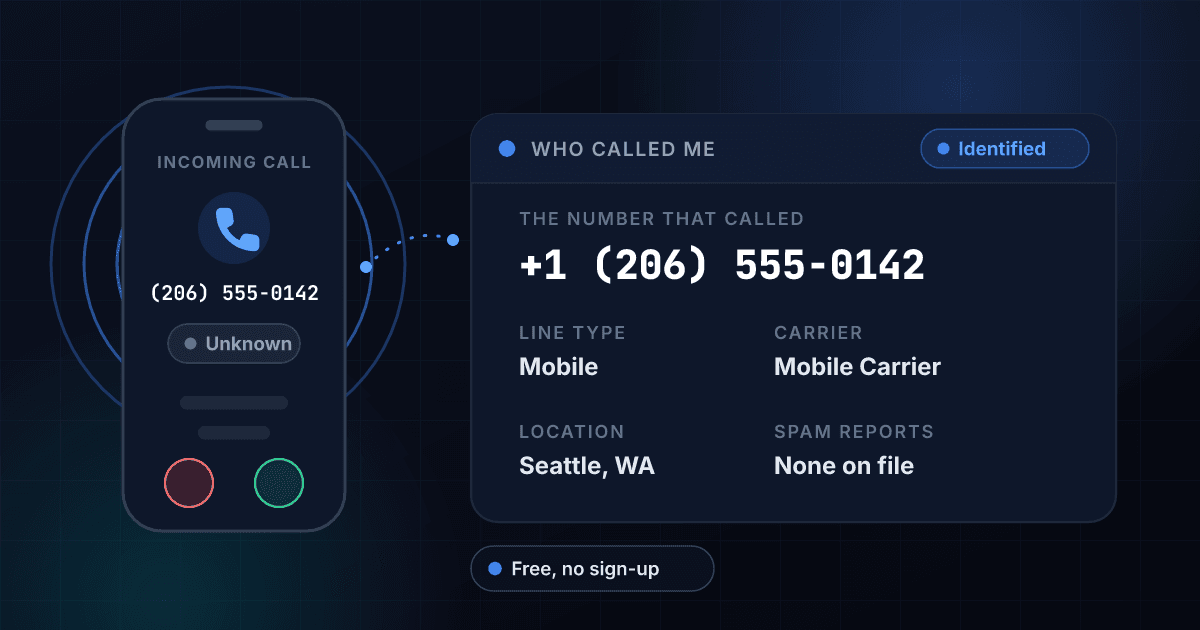
Find Out Who Called You
You missed a call from a number you do not recognise, and now you have to decide whether to call back. Enter it here and the lookup checks it against public directory records and carrier data, returning who the number is listed to, the city and state it is registered in, and whether it is a mobile, a landline or a VoIP line.
That last field is the one people underestimate. Legitimate businesses and real people mostly call from mobiles and landlines that resolve to a carrier and a location. A large share of nuisance and scam calls come from VoIP numbers, which cost almost nothing, can be spun up and discarded in bulk, and often carry no public listing at all. A VoIP number with no owner record, calling you out of the blue, is a reasonable thing to be sceptical about.
No result is not the same as no answer. Plenty of ordinary mobile numbers have never been in a public directory, and unlisted is the normal state for a lot of people. What matters is the combination: an unlisted VoIP line from an area code you have no connection to, calling repeatedly, is a different thing from an unlisted mobile in your own town.
Where did the call come from?
The first three digits tell you the region the number was issued in, and which prefixes are toll-free rather than tied to any place at all. Look up any US area code.
How the Caller Lookup Works
Enter the number
Type the 10-digit US or Canada number exactly as it appeared in your call log. Any format works: dashes, brackets, spaces or plain digits.
We search public records and carrier data
The lookup checks directory listings for a registered owner and queries carrier data for the line type and registration location, in real time rather than from a cached list.
See who it was
You get the listed owner where one exists, the city and state, and the line type. Sign up free to unlock the full name, address and the number's spam report history.
Identifies the listed owner
Where the number appears in public directory data, you see who it is registered to and the area they are in, which is usually enough to work out whether the call was one you wanted.
Shows the line type
Mobile, landline or VoIP. This is the single most useful field for judging an unknown caller, because disposable VoIP is the backbone of nuisance calling.
Works without calling back
Calling an unknown number back confirms your line is live and answered, which is exactly what a robocaller is testing for. Look it up instead.
No app and no signup to try
Nothing to install, no access to your call log, and no account needed for your first checks. Five lookups a day per tool, free.
Who uses this tool
A missed call from an unknown number
The everyday case. Find out whether it was a business you deal with, a number in your area, or a disposable line worth blocking.
Repeated calls from the same number
Persistent calls from one number usually mean either a debt collector, a survey operation or a robocall campaign. Identifying the line type tells you which conversation you are having.
Before returning a call about money
If the voicemail claims to be your bank, a government agency or a delivery company, look the number up first, then call the organisation on a number you already have.
Checking a number before you answer
If the same number keeps ringing, a lookup between calls tells you whether to pick up, block, or report it.
Frequently asked questions
Is this caller lookup free?
Yes. Five lookups a day on this tool and fifteen a day across all our free tools, from a single IP with a short pause between them. No card and no account needed to try it. A free account gives you 1,000 lookups over a seven-day trial.
Why does it say no public listing?
Most mobile numbers are not in public directories, and that is normal rather than suspicious on its own. Read it alongside the line type and location: an unlisted VoIP number from an unfamiliar area code is worth more caution than an unlisted local mobile.
Can I look up a number that showed as No Caller ID?
No. If the number was withheld, there is nothing to look up. Your carrier may offer anonymous call rejection, and both iPhone and Android can silence calls from unknown numbers.
Should I call an unknown number back?
Generally no, especially for international or premium-rate numbers. Answering or calling back confirms to an automated dialler that a real person is on the line, which increases how often you are called. Look it up first.
Does this work for international numbers?
This tool covers US and Canada numbers. For international numbers, use our free HLR lookup to check whether a mobile is active and which country and carrier it belongs to.
How do I stop these calls?
Block the number on your phone, register at donotcall.gov, and turn on your carrier's spam filtering, which most now offer free. Report unwanted robocalls to the FTC at reportfraud.ftc.gov.