This free domain authority checker scores any website from 0 to 100, the same scale DR and DA use.
A domain authority checker scores a website's link strength from 0 to 100, the scale that Domain Rating (DR) and Domain Authority (DA) also use. 1Lookup's free checker returns one authority score for any domain, plus its referring domains, total backlinks and follow-link share, a fast way to size up a site's SEO strength.
- No login needed
- Authority score from 0 to 100
- Referring domains and backlinks too
Free & rate-limited. No signup required to try.
Example resultSample result for yoursite.example. Run any lookup above and it is replaced with yours.
Authority score 72 out of 100
Get exact backlink and referring domain counts
Your free check shows the authority score, approximate referring domains and backlinks, and the follow-link share. Sign up for a 7-day free trial to reveal exact counts, the nofollow, sponsored and UGC split, referring IPs and links per referring domain.
Need this at scale? Backlink Overview API
Exact backlinks, referring domains, the follow and nofollow split and an authority score, one flat-priced call per domain.
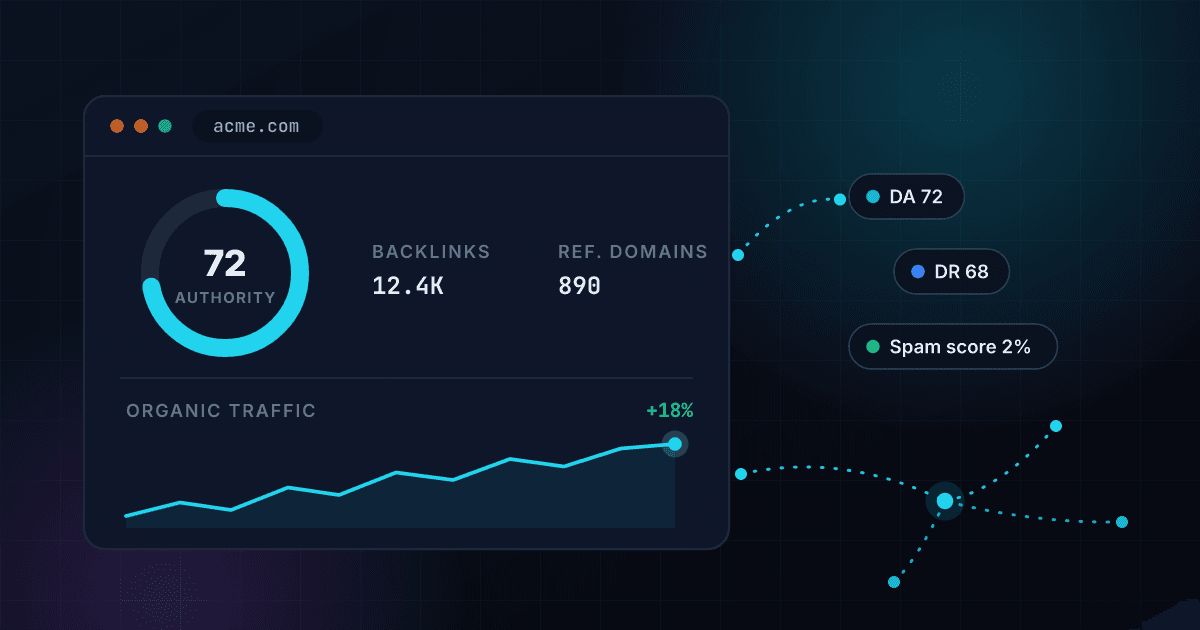
This domain authority checker reads a site's link strength in seconds.
Our free domain authority checker gives you a fast read on any website's link strength. Enter a domain and see its authority score from 0 to 100, an approximate count of referring domains and backlinks, the share of its links that are follow links, and a plain rating of its link profile. It's the quickest way to size up your own site, a prospect, or a competitor without juggling multiple paid dashboards.
Domain Authority (DA) and Domain Rating (DR) are third-party 0-100 scores that estimate how likely a site is to rank, based largely on its backlink profile. They are not official Google metrics and Google does not use them directly. This checker returns an authority score of the same kind, on the same 0-100 scale, with the link counts it is built on shown next to it.
The free tool is a public demo of the 1Lookup Backlink Overview API. It's rate-limited and shows banded counts so you get useful answers at a glance. When you need exact numbers or bulk checks across thousands of domains, sign up for a 7-day free trial or plug straight into the API.
Checking more than one domain?
The free check is a public demo of the same Backlink Overview data, which returns authority scores, backlinks and referring domains for a list of domains in one bulk job rather than one box at a time. The full field list is on the Backlink Overview API page.
Expert takes
Seven people who build links say a DA score counts for less than whether the site is real and on topic.
“I don't use a DA cutoff. Before I go after a link, I check two things: does the site get real organic traffic, and is the page about the same topic as the page I'm linking to. A DA 25 local site that actually ranks is worth more to me than a DA 60 site that sells guest posts to anyone.”
 Dayaram KumarFounder & SEO Consultant, RankVigorQuoted Oct 2026
“I don't set a minimum domain authority, but I check five things: niche relevance, organic traffic, traffic trends, editorial quality, and rankings for keywords we'd be proud to rank for ourselves. The more boxes a site ticks, the better, but link building is hard and a worthwhile opportunity doesn't have to tick every one.”
 Matt UebergangSEO Manager, Digital DartsQuoted Nov 2026
“I don't work to a single authority-score threshold. I treat anything in the low twenties and above as a baseline, but the score matters far less to me than whether the site is topically relevant and earns genuine traffic. A lower-authority page that ranks and sends qualified readers is worth more than a high-authority one that operates as a link farm.”
 Ali NiyafarDigital Growth Strategist, Angarum MediaQuoted Nov 2026
“I look for anything about 20 or more, but more importantly whether the website is authentic. Also check if the website is ranking, which can prove its authenticity.”
 Filip SilobodFounder, Honest MarketingQuoted Nov 2026
“I don't chase a fixed authority score, because my backlink statistics study found Domain Rating correlated with rankings at 0.62, behind referring domain count. Once you control for authority, the topical relevance of the linking site predicted rankings better than raw link count did. So a modest site that genuinely covers your subject is usually worth more to me than a big-number domain with no connection to what you sell.”
 Chris CoussonsFounder, Visionary MarketingQuoted Nov 2026
“I don't use a domain authority cut-off; I check whether the page is about our topic and whether the link sits in the body of a recent article. A small, on-topic page that links in the text is worth more to us than a high-score directory where we are one of thousands of entries.”
 Alessio BattaglieroFounder & CEO, GPT-VideoQuoted Nov 2026
“I don't set a minimum DA. I run small affiliate review sites, and a link from a low-DA site that's actually about my topic, has a human reviewing what it lists and has real readers is worth more to me than a DA 50 general directory that takes anyone. Before I chase a link I check that the page is on-topic, that the links already on it aren't nofollow, and that the site isn't selling placements.”
 Chris HennessyFounder, Selfmadenewbie.comQuoted Nov 2026
You can check domain authority in three steps.
Enter a domain
Type any website's root domain, like example.com, into the box. You don't need the full URL, a login, or a browser extension. One domain per free check keeps results fast and rate-limit friendly.
Run the authority check
We run a 1Lookup backlink overview on the domain. In seconds you get its authority score, approximate referring domains and backlinks, its follow-link share and a link profile rating.
Review and go deeper
Read the score and the counts to gauge the site's authority and link profile at a glance. To unlock exact backlink and referring domain counts and the full follow and nofollow split, sign up for free or call the API for bulk data.
How practitioners read the 0-100 scale
Neither DA nor DR has official bands; these are the ranges SEO practitioners commonly work to, useful as orientation rather than doctrine. Both scales are logarithmic, so moving from 70 to 80 is far harder than from 20 to 30.
- 0-20New or barely linked
- 21-40Establishing
- 41-60Established
- 61-80Strong
- 81-100Elite
| Score | Commonly read as | Typical of |
|---|---|---|
| 0-20 | New or barely linked | Fresh domains, small local sites |
| 21-40 | Establishing | Growing niche sites with some referring domains |
| 41-60 | Established | Solid mid-size sites; most successful blogs land here |
| 61-80 | Strong | Well-known brands and large publishers |
| 81-100 | Elite | Major platforms: the largest encyclopedias, search engines and social networks |
One authority score from 0 to 100
See a single score for the domain's overall link strength, directly comparable between any two sites you check. It reads the same way DA and DR do: higher means a stronger backlink profile.
Referring domains at a glance
Get an approximate count of unique linking domains, the backbone of any authority score. Referring domains tell you how broad and diverse a site's backlink profile is, not just its raw link total.
Follow-link share and profile quality
See what share of the domain's links are follow links, the kind that pass value, and a plain high, medium or low rating of the profile. A high score built mostly on nofollow links, or on thousands of links from a handful of sites, is weaker than it looks.
Free, instant, no install
Check any website's authority right in your browser with no extension, credit card, or account to start. It's a frictionless domain authority checker for quick research, prospecting, and competitive spot checks.
Who uses this tool
Competitor and prospect research
Quickly benchmark competitors or sales prospects by their authority score and link profile. A fast website authority check helps you decide which sites are worth chasing, outranking, or pitching to.
Link building and outreach
Vet potential link partners and guest-post sites before you invest in outreach. Checking domain authority and referring domains filters out low-value targets so you spend effort on links that actually move rankings.
Agency reporting and audits
Pull a quick authority snapshot for client kickoffs, audits, and pitches. An authority score with the referring domain and backlink counts behind it gives you defensible context without opening five different SEO tools.
Tracking your own growth
Run a domain authority lookup on your own site to monitor how your score and referring domains trend as your backlink profile grows. It's an easy baseline to set goals and measure off-page SEO progress.
Frequently asked questions
Is this the same DA or DR other SEO tools show?
Same idea, different number. Domain Authority and Domain Rating are each one tool maker's own 0-100 link-strength score. This checker returns its own authority score on that same 0-100 scale, built from the domain's backlink profile, so it reads the same way but will not match another tool's figure exactly. Treat any authority score as a comparative signal between domains rather than a number with meaning on its own.
What is a good DR or domain authority score?
There's no universal cutoff because DA is relative and varies by niche. As a rough guide, scores under 30 are typical for newer or smaller sites, 40-50 is solid, 60+ is strong, and 80+ is reserved for major brands. What matters most is how your authority compares to the sites you're actually competing with in search.
What is the difference between DA and DR?
Domain Authority (DA) and Domain Rating (DR) are two separate 0-100 scores, each from a different SEO tool maker. Both estimate a site's backlink strength and ranking potential, but each uses its own crawl and formula, so the numbers rarely match exactly. The authority score here is a third score of the same kind, so compare sites using one tool's number at a time.
Is domain authority a Google ranking factor?
No. Domain Authority and Domain Rating are third-party SEO metrics, not signals Google uses to rank pages. Google has stated it has no single overall "domain authority" score. These metrics are useful proxies for estimating competitiveness and link strength, but they don't directly influence your rankings.
How do I increase my domain authority?
Authority scores are driven mainly by your backlink profile, so focus on earning links from relevant, reputable sites through quality content, digital PR, and outreach. Remove or disavow toxic links, improve internal linking, and keep publishing content worth citing. Gains are gradual, so track your score over time rather than expecting overnight jumps.
Is this domain authority checker really free?
Yes. You can check any domain's authority score, approximate referring domains and backlinks, and follow-link share for free with no account to start. The free tool is rate-limited and shows banded counts. For exact figures and bulk lookups, sign up for a 7-day free trial or use the 1Lookup API.
How accurate are these authority scores?
Authority scores are estimates, not exact measurements, so treat them as directional indicators rather than absolute truth. The referring domain count and follow-link share shown next to the score tell you what it is built on. Scores can shift when crawls or formulas are updated, which is why reading the link counts alongside the score is more reliable than fixating on one number.
Can I check domain authority in bulk or via API?
Yes. The free checker handles one domain at a time, but the 1Lookup Backlink Overview API returns the authority score, exact backlinks and referring domains, and the follow and nofollow split for thousands of domains, at a flat 13 credits a domain. Sign up for a 7-day free trial to test it, then run bulk authority checks from a CSV or the API.
How is Domain Rating calculated?
Domain Rating scores a site's backlink profile from 0 to 100: it counts how many different websites link to it and how strong those websites are themselves. The scale is logarithmic, so moving from 70 to 80 takes far more new links than moving from 10 to 20.