HLR Lookup APICheck live subscriber status in bulk or at signup
Query the Home Location Register in real time to see whether any mobile number is active, reachable, or ported, without sending an SMS or placing a call. Direct access to 800+ mobile operators worldwide for accurate routing and fraud prevention.
Use this page when you are cleaning a list, wiring HLR into a signup flow, or you need carrier, roaming, and IMSI detail. Just checking one number by hand? Run a free HLR lookup in your browser with no account.
800+
Operators
5 credits
Per Lookup
195+
Countries
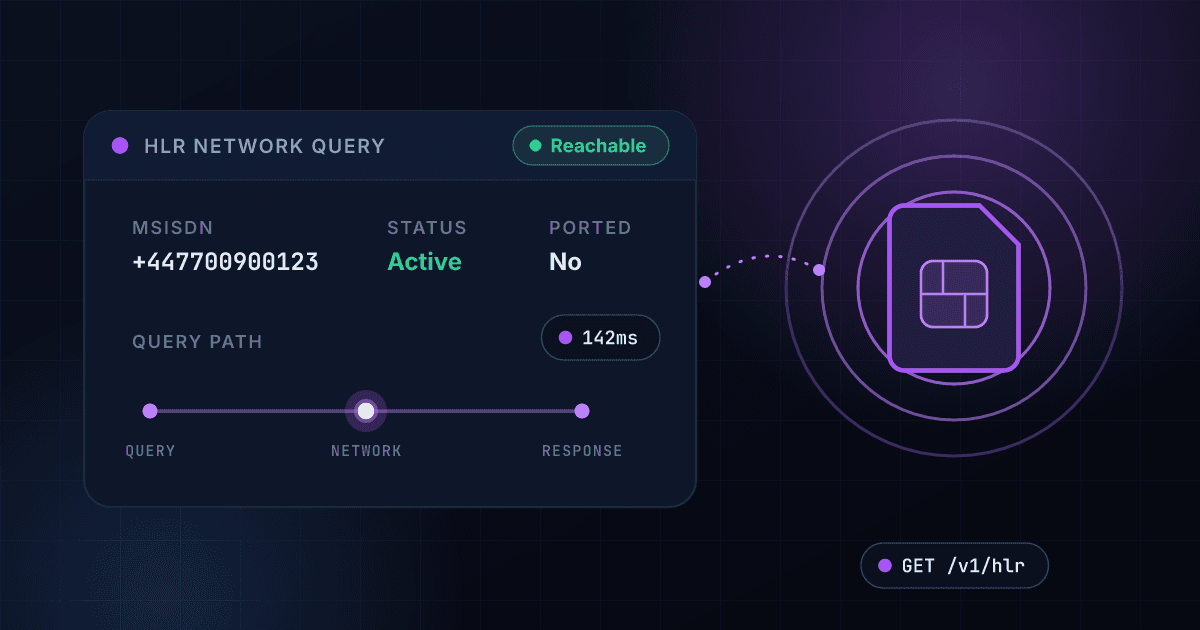
The API reads live network data for any mobile number.
Direct network access for real-time subscriber verification and routing optimization
Direct HLR Database Access
Direct access to global Home Location Register and HSS databases for real-time subscriber information. Our platform connects to 800+ mobile operators worldwide, providing authentic network data without intermediaries.
Live Network & Subscriber Status
Get real-time subscriber status including active, inactive, temporarily unavailable, or unknown states. Our system provides instant network availability checks with detailed status reporting.
Advanced Roaming Intelligence
Identify if a subscriber is roaming, their current network location, and roaming partner information. Essential for SMS routing optimization and international communication cost management.
Carrier & Network Intelligence
Operator information including MCC/MNC codes, carrier names, network technology, and coverage details. Critical for routing optimization and billing accuracy.
Teams call the HLR lookup API in four places.
Mission-critical applications for telecom operators and enterprise messaging
SMS Delivery Optimization
Verify subscriber reachability before sending SMS messages. Reduce delivery failures and improve campaign ROI with real-time HLR checks.
International Roaming Management
Track subscriber roaming status and optimize international communication costs. Essential for telecom operators and enterprise messaging.
Fraud Prevention & Security
Detect fraudulent numbers, SIM box operations, and unauthorized network access. Protect revenue and ensure network security.
Customer Verification & Onboarding
Verify customer phone numbers during registration and onboarding processes. Ensure data accuracy and improve customer experience.
Every HLR lookup API response carries these fields.
Every mobile operator runs a Home Location Register: the live record of every SIM it has issued and the state of each one. A lookup queries that register directly and returns these fields.
Connectivity status
Active, absent, invalid, or unknown.
Active means the SIM is registered and reachable now. Absent means the number is real but the handset is off or out of coverage, so retry it later. Invalid means the network has no such number, so drop it. Treating absent and invalid the same way is the most expensive mistake made with HLR data.
Country and network codes (MCC/MNC)
The mobile country code and mobile network code of the serving operator.
Operator brand names change with mergers and MVNO deals. MCC/MNC pairs identify the network unambiguously, which is what routing and billing logic should key off.
Current and original carrier
Who issued the number, and who serves it today.
Number portability breaks any tool that maps a number range to a carrier, because the prefix never changes after a port. The register holds the current answer.
Ported status
Whether the number has moved to a different operator.
Routing decisions based on the original carrier fail on ported numbers. A recent port is also a risk signal worth scoring alongside your other fraud inputs.
Roaming network and country
The visited network, when the subscriber is registered outside their home network.
Drives international routing and cost. It is also a mismatch signal: a number presenting as local while registered on a network on the other side of the world is worth a second look.
Line type
Whether the number is a mobile line.
Only mobile lines have an HLR entry. Landlines and most VoIP numbers cannot return connectivity, so mixed lists need phone validation alongside HLR.
IMSI and routing detail
The subscriber identity and the routing information the network would use.
The deepest layer, used by teams running their own least-cost routing or interconnect logic.
The query stops before any message is sent, so the phone never rings.
The lookup travels over the operator signaling network as the same routing request an SMS center sends before it delivers a message. It asks the home register where the subscriber is, then stops. No message is delivered, the handset never rings, and the subscriber is never notified, so there is no per-message carrier charge for checking. That is why verifying a large list with HLR costs a fraction of texting it to find out which numbers bounce. It also means the answer is live rather than a nightly file: a number ported last week returns its new carrier, and a handset switched off ten minutes ago returns as absent.
One limit is worth stating plainly. An HLR lookup does not return a subscriber's name, street address, or GPS position at any price. The register holds the serving network and the location area used for routing, not a person's identity. What each connectivity status means, and what to do with it, is laid out on the HLR lookup page.
Use the free tool for one number and the API for everything else.
We run two HLR pages on purpose and they do different jobs. You can run a real HLR query for free on a single number. Here is exactly where the free tool stops and the API starts, so you know before you sign up for anything.
The free tool answers one number at a time.
Use the free tool when you have one number in front of you: a suspicious signup, a support ticket, a sanity check before you call someone.
- Live connectivity status: active, absent, invalid, or unknown
- The number’s country
- Whether the number is a mobile line
- Whether the number has been ported
- No signup, one number at a time
An account or the API adds the commercial fields.
Use the API when the answer feeds something else: a list you are cleaning before a send, a signup form that has to decide in under a second, a fraud score that needs the carrier and roaming fields.
- Current versus original carrier
- MCC/MNC network codes
- Roaming carrier and country
- IMSI and network routing detail
- Bulk lists and programmatic API access
The free tool is rate limited and best effort. If a lookup is load bearing for revenue or compliance, use the API, where one universal credit buys a full phone lookup and the same credits also cover email verification and IP lookups.
One POST request checks one number.
Direct network access with subscriber intelligence
// HLR lookup: one number per request, 5 credits
const response = await fetch('https://app.1lookup.io/api/v1/hlr-lookup', {
  method: 'POST',
  headers: {
    'Authorization': 'Bearer YOUR_API_KEY',
    'Content-Type': 'application/json'
  },
  body: JSON.stringify({ phone_number: '+447700900000' })
})

// Response (network_status is CONNECTED, ABSENT, INVALID_MSISDN or UNDETERMINED)
{
  "success": true,
  "data": {
    "request": { "type": "hlr_lookup", "input": "+447700900000", "processing_time_ms": 1200 },
    "metadata": { "credits_used": 5, "credits_remaining": 9985, "cache_hit": false },
    "classification": { "network_status": "CONNECTED", "roaming": false },
    "insights": {
      "carrier": { "name": "Vodafone UK", "mcc": "234", "mnc": "15" },
      "location": { "country": "United Kingdom", "country_code": "GB" }
    },
    "recommendations": { "primary_action": "APPROVE" }
  }
}These are the API's technical specifications.
Operator Connections
800+
Credits per Lookup
5
Global Coverage
195+ countries
Accuracy
Network-verified
Developers ask these questions before they wire in the HLR lookup API.
Pricing, response fields and the limits of what a register can tell you
What is an HLR lookup?
HLR stands for Home Location Register, the database each mobile network keeps of its own subscribers. An HLR lookup queries that register in real time to confirm whether a number is active and reachable and which network currently serves it, without sending an SMS or placing a call.
How can I check if a phone number is active without calling it?
Run an HLR lookup. It checks the number directly against the carrier network and returns its live status (reachable, absent, or invalid) so you can tell whether a mobile is switched on and connected without ever ringing it.
How much does the HLR lookup API cost?
Each HLR lookup costs 5 credits, and a number the network reports as invalid (INVALID_MSISDN) is not charged. Credits are universal, so the same balance covers every other 1Lookup lookup, and plans start at $99 for 20,000 credits after a 7-day free trial.
What does the HLR lookup API response look like?
One POST to /api/v1/hlr-lookup with a phone_number returns a lookup object. classification.network_status carries the carrier wording: CONNECTED (registered and reachable), ABSENT (assigned, but the handset is off or out of coverage), INVALID_MSISDN (not assigned) or UNDETERMINED (the network did not answer), with a roaming flag beside it. The carrier name, MCC and MNC sit under insights, and recommendations.primary_action gives a suggested next step.
What information does an HLR lookup return?
Connectivity status (active, absent, invalid, or unknown), the country and network codes (MCC/MNC), current and original carrier, ported status, roaming network and country, line type, and IMSI level routing detail. Together they tell you both whether a number works and which operator is handling it right now.
What is the difference between an absent number and an invalid number?
Absent means the number exists and is provisioned but the handset is currently switched off, out of coverage, or detached from the network, so it is worth retrying later. Invalid means the network has no such number allocated, so it should be removed from the list. Collapsing the two is the most common and most expensive mistake teams make with HLR data.
How is an HLR lookup different from a carrier lookup?
A carrier lookup tells you which network a number belongs to. An HLR lookup includes that and then queries the live network to confirm the number is switched on and reachable right now, which is what matters for SMS deliverability and fraud checks. Carrier lookup is the cheaper answer for segmenting a list; HLR is the right call when the decision depends on reachability at this moment. Many teams use both together.
Is the HLR lookup real time, or is it cached data?
It is a live query against the operator register at the moment you ask, not a cached file or a nightly export. That is why a number ported last week returns its new carrier and a handset switched off ten minutes ago returns as absent. Carrier and ported status are stable enough to cache on your side; connectivity status is not, so query it at decision time.
Does an HLR lookup send an SMS or notify the person?
No. The query stops at the routing stage of the signaling network and never delivers a message, so the handset does not ring, no SMS arrives, and the subscriber is never notified. There is also no per-message carrier charge, which is why checking a large list with HLR costs a fraction of texting it to find the bad numbers.
Does an HLR lookup work on landlines and VoIP numbers?
No. Only mobile lines have an entry in a Home Location Register, so landlines and most VoIP numbers cannot return connectivity status. For mixed lists, pair HLR with phone validation, which covers every line type and tells you which numbers are mobile in the first place.
Does HLR lookup handle ported and roaming numbers?
Yes. Because it reads the live register, an HLR lookup returns the current network after any porting and flags whether the subscriber is currently roaming, along with the visited network. Static, prefix-based tools cannot see either, because a number keeps its original prefix forever after it is ported.
How accurate is the HLR lookup?
Each answer comes from the operator register at the moment you ask, so it is network-verified rather than a cached guess. Coverage is not uniform: connectivity and network identification are broadly available, while roaming and IMSI level detail depend on what each operator exposes.
These lookups pair well with an HLR check.
Explore the rest of the 1Lookup phone intelligence suite
You can run your first HLR lookups on the free trial today.
Access real-time subscriber intelligence and optimize your telecommunications operations with direct HLR connectivity
7-day free trial • Setup in 5 minutes • Premium support