This Google News search API returns up to 10 recent news articles for any keyword or topic
Send a keyword and get back the headline, publication, time and link of each recent article, plus the publications that wrote the most. 3 credits per search, charged only when articles come back.
3
Credits per search
$14.85 per 1,000 on Starter
10
Articles in one search
with headline, time and link
29
Countries to search from
13 languages to choose from
15 min
Repeat searches are free
served from cache
A keyword comes back as dated articles, the publications behind them and the counts
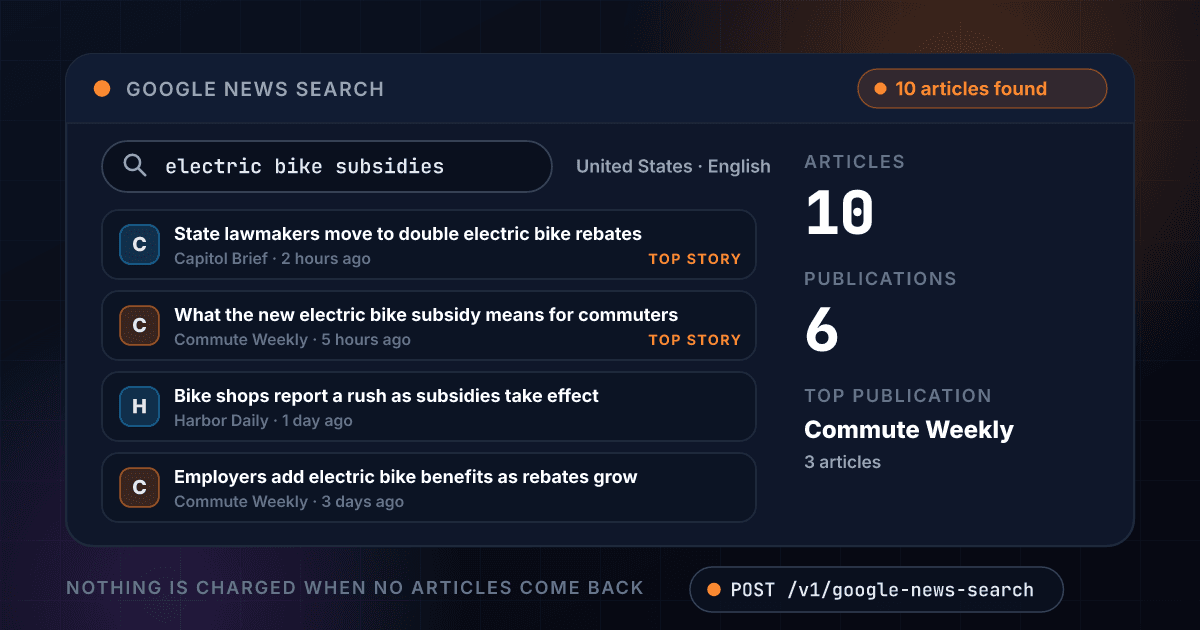
Each line is a field your code receives, here for an invented search about electric bike subsidies in the United States. The same fields come back as JSON in the API response below.
- Articles
- 10
- Publications
- 6
- Top publication
- Commute Weekly
- Newest
- 2 hours ago
Capitol Brief2 hours agoTop story
State lawmakers move to double electric bike rebates
A bill moving through the statehouse would raise the rebate from $500 to $1,000 for riders who trade in a car.
capitolbrief.example
Commute Weekly5 hours agoTop story
What the new electric bike subsidy means for commuters
Riders who buy before January could save up to $1,000, and the rebate stacks with some city programs.
commuteweekly.example
The Metro Ledger9 hours ago
City opens applications for its electric bike voucher program
Residents can apply online until the end of the month, and the first 2,000 vouchers are set aside for commuters.
metroledger.example
Harbor Daily1 day ago
Bike shops report a rush as subsidies take effect
harbordaily.example
Greenline Report2 days ago
Are electric bike subsidies worth the cost? Economists weigh in
Researchers compare what each rebate dollar saves in car trips with what other transport programs achieve.
greenlinereport.example
Commute Weekly3 days ago
Employers add electric bike benefits as rebates grow
Companies are pairing the state rebate with a monthly stipend for staff who ride to the office.
commuteweekly.example
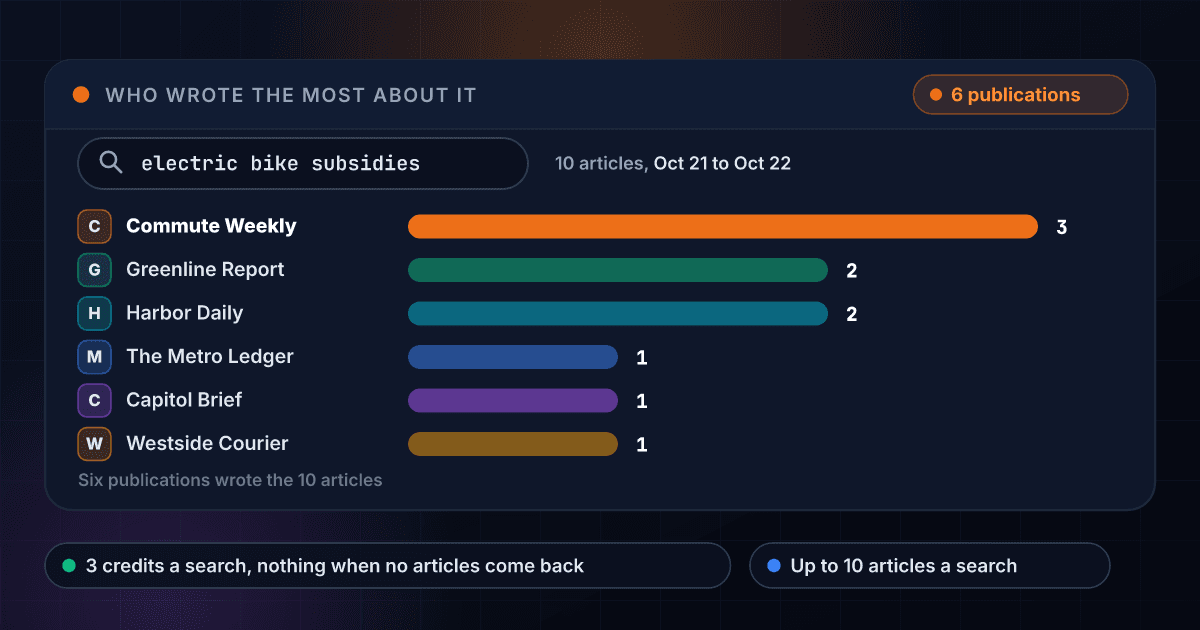
Who wrote the most
- Commute Weekly3
- Greenline Report2
- Harbor Daily2
- The Metro Ledger1
- Capitol Brief1
- Westside Courier1
4 more articles in the same response, 3 credits for all of them
Every search comes back as a list of articles with the publication, time and link
A keyword or a topic returns up to 10 recent articles
Type a company, a person, a product or a subject the way you would in the search box. The articles come back in the order the news search ranks them.
- Up to 10 articles per search
- Any keyword or topic, up to 200 characters
- In the order the news search ranks them
Every article carries its headline, publication and link
Each record has the headline, the publication's name and website, the article's link and the snippet when one is shown, so you can list, filter or open it without another call.
- Headline, publication and link
- The publication's website
- The snippet when one is shown
Every article is dated two ways
You get the exact time in UTC when it could be read and the wording from the results page, such as 4 hours ago. The newest and oldest article times tell you how fresh the coverage is.
- Exact time in UTC
- The results page's own wording
- Newest and oldest article times
The publications that wrote the most are counted for you
The result lists up to 10 publications with the number of articles each wrote, and gives the number of publications overall, so a topic's coverage is one glance.
- Up to 10 publications ranked
- Articles per publication
- Top stories flagged
The search can be made for a country and a language
Choose any of 29 countries, the United States by default, and one of 13 languages. The same topic returns the coverage that readers in that place see.
- 29 countries to choose from
- 13 languages
- A country alone picks its usual language
A search with no news costs nothing
You are charged 3 credits only when articles come back. An error, a timeout and a search with no news cost 0 credits, and a repeat search within 15 minutes is free.
- No articles, no charge
- Errors are never billed
- Repeat searches within 15 minutes are free
A keyword goes in and a list of dated articles comes out
You send a keyword or a topic and, if you like, a country and a language
POST the keyword the way you would type it into the search box. Add a country and a language to read that country's news edition.
$ POST /api/v1/google-news-search
"keyword": "electric bike subsidies"
"country": "US"
"language": "en"
We read the news search and collect up to 10 articles
Each article is read for its headline, publication, link, snippet and time, and the publications are counted. Nothing is charged if no articles come back.
News edition chosen for the country
Articles read, up to 10
Times converted to UTC
Publications counted
You get the articles and the counts back as one JSON record
The articles in order, the publications that wrote the most, and the time of the newest and the oldest article.
articles10
publications6
top publicationCommute Weekly
One endpoint turns a keyword into a list of recent news articles and works like every other 1Lookup call
Same authentication, same credit balance, and the same response envelope as every other 1Lookup product. If you have already integrated one endpoint, this one is a URL change.
curl -X POST https://app.1lookup.io/api/v1/google-news-search \
  -H "Authorization: Bearer $API_KEY" \
  -H "Content-Type: application/json" \
  -d '{ "keyword": "electric bike subsidies", "country": "US", "language": "en" }'

# country and language are optional, and a country alone picks that country's usual language
# -d '{ "keyword": "electric bike subsidies", "country": "GB" }'{
"success": true,
"data": {
"classification": {
"matched": true,
"keyword": "electric bike subsidies",
"country_code": "US",
"country_name": "United States",
"language": "en",
"article_count": 10,
"source_count": 6,
"top_source": "Commute Weekly",
"newest_at": "2026-10-22T16:25:00.000Z",
"oldest_at": "2026-10-21T09:30:00.000Z",
"headlines": [
"State lawmakers move to double electric bike rebates",
"What the new electric bike subsidy means for commuters",
"City opens applications for its electric bike voucher program"
],
"sources": ["Capitol Brief", "Commute Weekly", "The Metro Ledger"],
"published": ["2026-10-22T16:25:00.000Z", "2026-10-22T13:40:00.000Z", "2026-10-22T09:10:00.000Z"],
"links": [
"https://www.capitolbrief.example/bike-rebates",
"https://www.commuteweekly.example/ebike-subsidy",
"https://www.metroledger.example/ebike-vouchers"
]
},
"insights": {
"google_news_result": {
"article_count": 10,
"source_count": 6,
"top_sources": [
{ "source": "Commute Weekly", "articles": 3 },
{ "source": "Greenline Report", "articles": 2 },
{ "source": "Harbor Daily", "articles": 2 },
{ "source": "The Metro Ledger", "articles": 1 },
{ "source": "Capitol Brief", "articles": 1 },
{ "source": "Westside Courier", "articles": 1 }
],
"articles": [
{
"position": 1,
"title": "State lawmakers move to double electric bike rebates",
"source": "Capitol Brief",
"source_domain": "capitolbrief.example",
"url": "https://www.capitolbrief.example/bike-rebates",
"snippet": "A bill moving through the statehouse would raise the rebate from $500 to $1,000.",
"published_at": "2026-10-22T16:25:00.000Z",
"published_text": "2 hours ago",
"top_story": true
},
{
"position": 4,
"title": "Bike shops report a rush as subsidies take effect",
"source": "Harbor Daily",
"source_domain": "harbordaily.example",
"url": "https://www.harbordaily.example/bike-shop-rush",
"snippet": null,
"published_at": "2026-10-21T14:00:00.000Z",
"published_text": "1 day ago",
"top_story": false
}
],
"checked_at": "2026-10-22T18:20:04.000Z"
}
},
"metadata": { "credits_used": 3, "cache_hit": false }
}
}A column of keywords goes in and one summary row per keyword comes out
Upload a CSV with a keyword column and download a result file with the article count, the number of publications and the top publication for every keyword.
- 1keyword
- 2electric bike subsidies
- 3heat pump rebates
- 4solar panel tax credit
| keyword | Articles | Sources | Top Source | Credits Used |
|---|---|---|---|---|
| electric bike subsidies | 10 | 6 | Commute Weekly | 3 |
| heat pump rebates | 10 | 7 | Greenline Report | 3 |
| solar panel tax credit | 8 | 5 | Capitol Brief | 3 |
Eight more columns in the file, among them Status, Newest Article, Oldest Article, Headlines and Links.
One row in, one row out
Every keyword becomes one row, so a watch list of 200 names is a spreadsheet of 200 rows you can sort by newest article.
Every headline comes with its row
Each row also carries the headlines with their publications, times and links, so a row reads as a small news digest.
A keyword with no news costs 0 credits
The price stays at 3 credits per search that finds articles, however many articles it returns.
Every news search comes back with the same fields at one flat price
A search with no news comes back with matched set to false and no charge, and every search that finds articles costs the same 3 credits.
It lists the articles
- articles[].position
- articles[].title
- articles[].url
- articles[].snippet
- articles[].image_url
- articles[].top_story
It names the publication behind each article
- articles[].source
- articles[].source_domain
It dates each article
- articles[].published_at
- articles[].published_text
- newest_at
- oldest_at
It counts the coverage
- article_count
- source_count
- top_sources[].source
- top_sources[].articles
- top_source
It describes the search that was made
- keyword
- country_code
- country_name
- language
It says when the search was made
- checked_at
- metadata.credits_used
- metadata.cache_hit
PR teams, analysts and developers use recent news to see who is covering what
PR and communications teams see who is covering their brand and how recently
Search the company name each morning and read the publications, the newest article time and the top stories. A new publication in the list is a journalist worth a call.
Analysts and investors follow a company or a sector in the news
Run the names on a watch list from a bulk file and read the newest article time and the top publication side by side. A name whose newest article jumps from last week to this morning shows up in the file before anyone forwards it.
Content and SEO teams check what the news says before they write
Search the topic, open the top stories and see which publications and angles dominate. Pair it with the SERP Scraper to see how the same keyword ranks on the web.
Developers add a live news feed to a product with one call
Show the newest articles about a topic in a dashboard, an alert or an assistant. Pass an article's link to the Website Scraper when the full text is needed.
The publications that write the most about a topic are counted for you
Each search ranks the publications by how many of the articles they wrote, so the voices behind a story are clear at a glance.
These are the questions people ask before they run their first search
What does Google News Search return?
Send a keyword or a topic and it returns up to 10 recent news articles. Each article has its headline, the publication that wrote it, that publication's website, the link, the snippet when one is shown, the time it was published and whether it sits in the top stories at the head of the page. The result also counts the articles and the publications and lists the ones that wrote the most.
Is this a Google News API I can call from code?
Yes. You send a request with your 1Lookup API key and get the articles back as JSON, so a dashboard, an alert or a daily digest can read the news without anyone opening Google News or maintaining a parser.
How many articles does one search return?
Up to 10, the first page of the news results. A broad topic fills the list. A narrow one returns fewer, and the article count tells you how much coverage there is.
Can I search the news of a specific country or in another language?
Yes. Choose any of 29 countries, the United States by default, and one of 13 languages. A country and a language together decide which news edition is read, so the same topic gives a different list in London than in Toronto.
How much does a news search cost?
3 credits per search that returns articles, which is $14.85 per 1,000 searches on the Starter plan and $10.56 on Growth. You are charged only when articles come back. A search with no news, an error and a timeout cost 0 credits, in the API, the dashboard and bulk jobs.
What happens when there is no news for a topic?
You get a result with matched set to false and you are charged 0 credits. Try a broader keyword or a different country.
How fresh are the articles and how long does a search take?
Each search is made live. A fresh search usually takes 5 to 15 seconds, so set your client timeout to 120 seconds and a slow one still returns its data. The same search made again within 15 minutes is served from cache and is free.
How do I know when an article was published?
Every article carries the time in two forms: the exact time in UTC when it could be read, and the wording shown on the results page, such as 4 hours ago. The result also gives the time of the newest and the oldest article, so you can see how fresh the coverage is.
How do I read the full text of an article?
Every article comes with its link. Pass the link to the Website Scraper, at 10 credits per page, and you get the page as clean text ready for a report or an AI model.
Can I follow a brand or a competitor in the news?
Yes. Search the company name on a schedule and compare the newest article time, the article count and the publications from one run to the next. A bulk file with one name on each row turns a watch list into a single report.
Can I search a list of keywords at once?
Yes. Upload a CSV with a keyword column and you get one row per keyword: the article count, the number of publications, the top publication, the newest and the oldest article time, and the headlines with their publications, times and links. Each search that finds articles costs 3 credits and every search without news is free.
How is it different from the SERP Scraper?
The SERP Scraper, at 1 credit, reads a Google web results page. Google News Search reads the news: it returns up to 10 dated articles with their publications and counts the publications for you. Teams use the SERP Scraper to see how a keyword ranks and Google News Search to see who is writing about it today.
News is one view of a topic, and these products add the others
Here is how searching the news with 1Lookup compares with the other news search APIs
Each page sets a rival's plans and prices beside ours and says where the rival does the job better. Every figure carries its source and the date it was checked.