This free email verifier tells you whether an email address is valid.
Enter an email address to check whether it can receive mail. Nothing is sent to it, and one check needs no signup.
Free & rate-limited. No signup required to try.
Example resultThis is a real lookup we captured on 2026-08-23 for support@apple.com. Run any lookup above and it is replaced with yours.
Deliverable · Corporate
An email verifier tells you whether an address can receive mail without sending it a message. Enter an address and 1Lookup's free email checker tests the format, confirms the domain has mail servers (MX records), asks the mail server whether that mailbox exists, and flags disposable and role addresses, in seconds and without signing up.
- No signup to check one address
- Nothing is sent to the address
- Deliverable, risky or undeliverable
- Disposable and role flags
Need this at scale? Email Validation API
SMTP-verified deliverability, disposable detection and risk scoring for every address you collect.
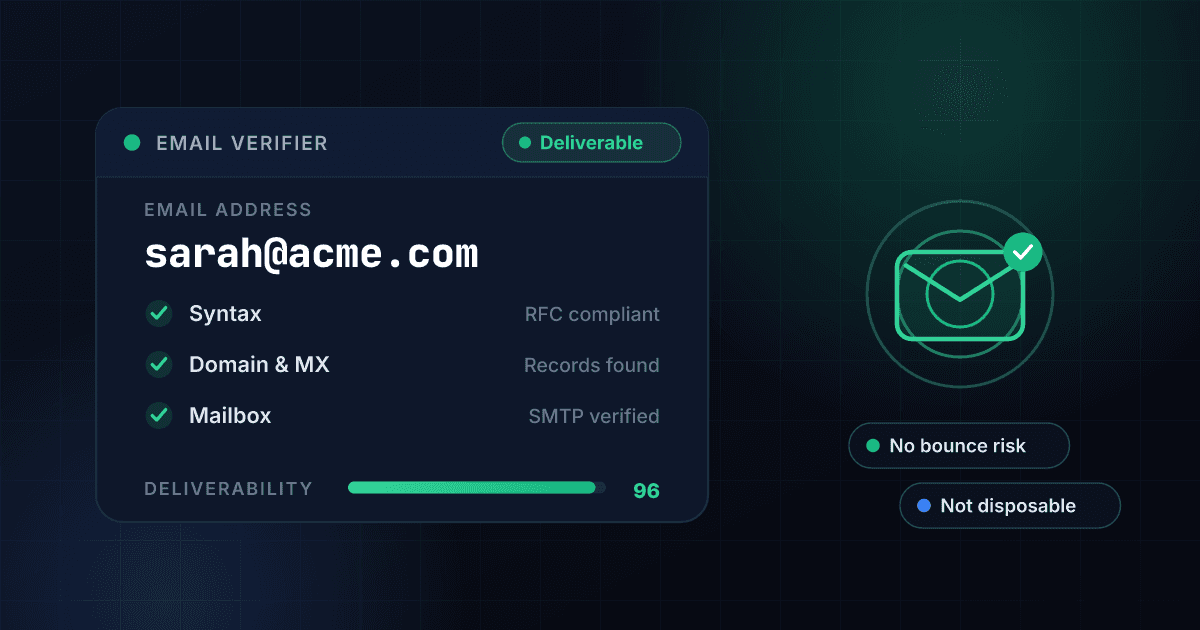
An email checker tells you whether an address can receive mail before you send to it.
Paste an email address above and the checker tells you whether it is deliverable, risky or undeliverable, whether its domain has mail servers, whether the format is valid, whether it is a free mailbox or a company address, and whether it is a disposable or role inbox. Nothing is sent to the address, so its owner never sees the check.
Most addresses pass, but not all. Of the 209,783 email addresses verified on 1Lookup from 5 September to 4 October 2026, 88.4% were deliverable, 4.0% were undeliverable and 3.9% were risky because their domain accepts mail for any address. Every undeliverable address you send to becomes a hard bounce, and Amazon SES puts an account under review once its bounce rate reaches 5%.
One address at a time is free here. To check a whole list, upload a CSV or call the 1Lookup API: each check costs 1 credit, about half a cent on the Starter plan, and the full record adds a deliverability score, a fraud score and risk level, catch-all detection, the domain's age and a business-address flag.
You can clean a whole list in one pass.
This tool checks one address at a time. To clean an entire list in one pass, including deduplication, caching, what each verdict means and how to measure a provider on your own data, read our bulk email validation guide. To learn how each check works and what to do with an unknown or catch-all result, read how to check if an email address is valid. To find the person or company behind an address rather than test whether it works, use our free reverse email lookup. To compare paid email verification tools on price, free credits and what else one account checks, see our ranking of the 10 best email verification tools. To check an email address for a throwaway inbox next to a phone number and an IP address, use our free fraud checker. To see what email verification costs on a pay as you go plan, read our short answer on email verification API pricing.
From 1Lookup research
1Lookup publishes how many of the addresses people check turn out to be bad.
1Lookup publishes the results of every email check run on the platform, refreshed daily. From 5 September to 4 October 2026, 7.9% of 209,783 verified addresses were undeliverable or risky, 4.9% were role addresses like info@ and sales@, and 0.1% were disposable inboxes. The same page tracks phone numbers and IP addresses. See the live contact data quality numbers.
An email verifier returns these fields, and each one answers a different question.
This is an invented result for a made-up address, laid out the way a check comes back. The first five fields are free on this page, and a free trial opens the rest of the record.
- DeliverableDeliverable
- Syntax validYes
- MX records foundYes
- Provider typeCorporate
- Address typeStandard mailbox
Opens with a free trial
- Catch-all domainNo
- Risk levelLow
- Fraud score5
Deliverable
The verdict. Deliverable means the receiving server accepted this exact mailbox. Risky, Uncertain and Undeliverable are explained in the table further down this page.
Syntax valid
Whether the address is written correctly: one @ sign, allowed characters and a domain that can exist.
MX records found
Whether the domain publishes mail servers. A domain with none can't receive mail, so every address on it bounces.
Provider type
Whether the address is at a free mailbox provider such as Gmail or Yahoo or on a company's own domain.
Address type
Whether it is one person's inbox, a shared role address such as info@ or sales@, or a throwaway inbox from a disposable email service.
Catch-all domain
Whether the domain accepts mail for every address. On a catch-all domain no checker can confirm one mailbox, so the verdict there is Risky.
Risk level
A short read of how safe the address is to accept at signup or to send to, from low to critical.
Fraud score
A score from 0 to 100 built from the same checks plus risk signals such as a disposable or role address. Higher means riskier.
You can verify an email address in three steps.
Enter the email address
Type or paste any address, such as name@example.com. There is nothing to install and no account to create for a single check.
We check it without sending anything
The checker validates the format, looks up the domain's MX records, asks the receiving mail server whether that mailbox exists, and checks the address against known disposable services and role prefixes like info@ and support@.
Read the verdict
You see whether the address is deliverable, risky, uncertain or undeliverable, plus its provider type and address type. A 7-day free trial opens the full record, CSV uploads and the API.
An email verifier checks an address in three stages and never sends it a message.
This is what happens to one address you enter above.
- You enter the addressAny address, such as name@example.com. One check needs no account.
- The format and domain are checkedThe address must be written correctly, and its domain must publish mail servers (MX records).
- The mail server is asked about the mailboxThe receiving server says whether it accepts that exact address. No email is sent.Nothing lands in the inbox, so the owner is never told.
- You get the verdictDeliverable, risky, uncertain or undeliverable, with the provider and address type.
About 8 in every 100 email addresses people check are undeliverable or risky.
Every completed email check on the 1Lookup platform from 5 September to 4 October 2026 (UTC): 209,783 addresses that our customers chose to verify, mostly lead lists and signup forms. These are shares of the addresses people checked, not of all email addresses. The live figures, refreshed daily, are on our contact data quality research page.
| Result | Addresses | Share | What it means and what to do |
|---|---|---|---|
| Deliverable | 185,406 | 88.4% | The mail server confirmed the mailbox exists. Send to it. |
| Undeliverable | 8,435 | 4.0% | The mailbox or the whole domain does not exist, so a message would hard bounce. Remove it. |
| Risky | 8,211 | 3.9% | The domain accepts mail for any address (a catch-all), so this mailbox can't be confirmed. Send with care and watch for bounces. |
| Unclassified (shown as Uncertain) | 7,613 | 3.6% | The mail server gave no clear answer, often because it limits or delays checks. Try again later before you send in bulk. |
| Temporary | 118 | 0.1% | A throwaway inbox from a disposable email service. Block it at signup and leave it off marketing lists. |
Gmail, Yahoo and Amazon SES set limits that a list of bad addresses can break.
Sources: Google's email sender guidelines and Yahoo's sender best practices, both in force since February 2024, and Amazon SES's sending review FAQ, all read on 5 October 2026. Bounces from dead addresses raise your bounce rate directly, and Amazon SES notes that addresses which keep bouncing for a long time can be turned into spam traps.
| Who sets it | What it covers | The limit |
|---|---|---|
| Gmail | Spam complaint rate, every sender | Below 0.3%, and Google asks senders to stay below 0.1% |
| Gmail | Senders of 5,000 or more messages a day to Gmail accounts | SPF and DKIM, a DMARC record and one-click unsubscribe |
| Yahoo | Spam complaint rate, every sender | Below 0.3% |
| Yahoo | Unsubscribe requests to bulk senders | Honored within 2 days |
| Amazon SES | Hard bounce rate | Keep it below 2%; account review at 5%; sending may be paused at 10% |
| Amazon SES | Complaint rate | Keep it below 0.1%; account review at 0.1%; sending may be paused at 0.5% |
You can verify a whole email list by uploading one CSV file.
The free tool checks one address at a time. With a 1Lookup account you upload a CSV file, pick the column that holds the addresses and download the same file back with the verification columns filled in on every row. These are 6 of the columns it adds.
| Email Status | Syntax Valid | MX Records | Catch All | Disposable | Role Account | |
|---|---|---|---|---|---|---|
| maya.ortiz@example.com | DELIVERABLE | Yes | Yes | No | No | No |
| sales@example.org | DELIVERABLE | Yes | Yes | No | No | Yes |
| j.reyes@example.net | RISKY | Yes | Yes | Yes | No | No |
| old.inbox@example.com | UNDELIVERABLE | Yes | Yes | No | No | No |
- 1 credit an address, the same price as one API check.
- Up to 2 million rows in one CSV file.
- Up to 200 API requests per 10 seconds for each API key, and each account can make up to 1,000 requests a minute in total across all its keys.
The email verification API returns the same checks as JSON from one request.
Send the address to the email endpoint with your API key. Each request costs 1 credit, standard lookups are limited to 200 requests per 10 seconds for each API key, and each account can make up to 1,000 requests a minute in total across all its keys. The verdict is in classification.deliverability_status, and the format, MX and mailbox checks are under insights.
curl -X POST https://app.1lookup.io/api/v1/email \
  -H "Authorization: Bearer YOUR_API_KEY" \
  -H "Content-Type: application/json" \
  -d '{"email": "maya.ortiz@example.com"}'
import requests
response = requests.post(
"https://app.1lookup.io/api/v1/email",
headers={"Authorization": "Bearer YOUR_API_KEY"},
json={"email": "maya.ortiz@example.com"},
)
data = response.json()["data"]
print(data["classification"]["deliverability_status"])const response = await fetch('https://app.1lookup.io/api/v1/email', {
method: 'POST',
headers: {
'Authorization': 'Bearer YOUR_API_KEY',
'Content-Type': 'application/json'
},
body: JSON.stringify({ email: 'maya.ortiz@example.com' })
})
const { data } = await response.json()
console.log(data.classification.deliverability_status)Response
{
  "success": true,
  "data": {
    "request": { "type": "email", "input": "maya.ortiz@example.com" },
    "classification": {
      "deliverability_status": "DELIVERABLE",
      "provider_type": "CORPORATE",
      "mailbox_verification_state": "CONFIRMED"
    },
    "insights": {
      "deliverability": {
        "factors": {
          "mx_records": true,
          "smtp_valid": true,
          "mailbox_exists": true,
          "catch_all": false
        }
      },
      "quality": { "syntax_valid": true, "typo_detected": false }
    },
    "risk_assessment": { "risk_level": "LOW", "fraud_score": 5, "risk_factors": [] },
    "metadata": { "credits_used": 1, "credits_remaining": 9998 }
  }
}
To run the same check from your own software or a signup form, see our email verification API.
It catches typos and malformed addresses.
The format check finds missing @ signs, illegal characters and broken domains before any network check runs, so an obvious mistake is caught in milliseconds.
It confirms the domain can receive mail.
The checker looks up the domain's MX records. A domain with no mail server can't accept email, so every address on it will hard bounce.
It asks the mail server whether the mailbox exists.
Without sending a message, the checker asks the receiving server whether it accepts that exact address, which separates live inboxes from addresses that no longer exist.
It flags catch-all domains as risky.
Some domains accept mail for every address, so no checker can confirm one mailbox there. Those come back as Risky instead of a false Deliverable.
It flags disposable and role addresses.
Throwaway inboxes and shared addresses like info@, sales@ and noreply@ are marked, so you can block them at signup or keep them out of campaigns.
Who uses this tool
Email marketers use it to keep bounce rates low.
Checking a list before a send removes the addresses that would hard bounce, which protects your sender reputation with Gmail, Yahoo and your sending service.
Product teams use it to stop fake signups.
Checking an address at registration catches typos, disposable inboxes and made-up addresses before they reach your database and your lifecycle emails.
Sales teams use it before cold outreach.
Reps check prospect addresses before a sequence starts, so they write to people who can receive mail and spot free mailboxes where they expected a work address.
Data teams use it to clean old lists.
People change jobs and abandon inboxes, so a list that was clean last year is not clean now. A pass through the checker shows which addresses died since.
Frequently asked questions
How do I check if an email address is valid without sending an email?
Enter the address in the checker above. It validates the format, looks up the domain's mail servers and asks the receiving server whether that mailbox exists, all without sending a message. You get a verdict of deliverable, risky, uncertain or undeliverable in a few seconds.
Is there a free email checker?
Yes, this one. Checking one address at a time is free with no account, up to a small daily limit per visitor. To check a whole list, a CSV upload or the 1Lookup API costs 1 credit an address, about half a cent on the Starter plan, and you can start with a 7-day free trial.
How can I tell if an email address is real or fake?
A real address has a valid format, a domain with mail servers and a mailbox the server accepts. The checker tests all three. A made-up address usually fails the mailbox check, and a throwaway one is flagged as disposable even when it can receive mail.
What does a risky or catch-all result mean?
The domain is set up to accept mail for any address, even ones that don't exist, so the server can't confirm a single mailbox. The address may work or may bounce later. In 1Lookup's checks from 5 September to 4 October 2026, 3.9% of addresses came back risky.
What does an uncertain result mean?
The receiving server didn't give a clear answer, often because it limits or delays verification checks, or because it was briefly unavailable. Check the address again later, and don't send a bulk campaign to it until it comes back deliverable.
Does checking an email address notify the owner?
No. The checker talks only to the domain's mail server and never sends a message, so nothing lands in the inbox and the owner isn't told.
How many addresses on a list are usually bad?
Of the 209,783 addresses verified on 1Lookup from 5 September to 4 October 2026, 4.0% were undeliverable and 3.9% were risky, about 8 in every 100. A list collected years ago will usually run higher, and addresses checked at signup lower.
What bounce rate is too high?
Amazon SES asks senders to keep hard bounces below 2%, puts an account under review at 5% and may pause sending at 10%. Gmail and Yahoo watch spam complaints too, and both require a complaint rate below 0.3%. Removing undeliverable addresses before a send is the simplest way to stay under these limits.
How accurate is the email checker?
Format, domain and mail server checks are exact. The mailbox check depends on the receiving server's answer: catch-all domains accept every address and some servers limit checks, so those addresses come back as risky or uncertain rather than a guessed yes or no.
What is the difference between a free mailbox and a company address?
Free mailboxes come from consumer providers like Gmail, Yahoo and Outlook; company addresses use the business's own domain. The checker reports which one an address is. In 1Lookup's checks from 5 September to 4 October 2026, 76.4% of addresses were on a company domain and 23.6% at a free mailbox provider.
Can I verify a whole list of emails at once?
Not on this page, which checks one address at a time. With an account, upload a CSV in the dashboard or send addresses to the 1Lookup API: each check costs 1 credit and returns the full record, including the deliverability score, fraud score, risk level and catch-all detection.
Can an email checker tell who owns an address?
No. An email checker tells you whether the address can receive mail, not who it belongs to. To find the person or company behind an address, use our free reverse email lookup.
What is the difference between an email verifier and an email checker?
Nothing that changes the result: both names mean a tool that tests whether an address can receive mail. Some people say email validation for the format check alone and email verification for the full mailbox check. This tool runs both.
Can I verify email addresses through an API?
Yes. Send each address to the 1Lookup email endpoint and the JSON response carries the verdict, the format, MX and mailbox checks, the catch-all flag and a risk level, at 1 credit an address and up to 200 requests per 10 seconds for each API key, and each account can make up to 1,000 requests a minute in total across all its keys. The code example is on this page.