The SEC Company Facts API returns the revenue, profit and balance sheet a US public company filed with the SEC
Send a ticker, a CIK number or a company name and get the revenue, profit, balance sheet, growth and five-year history the company filed, read from the SEC's own files. 2 credits, charged only when annual statements are found.
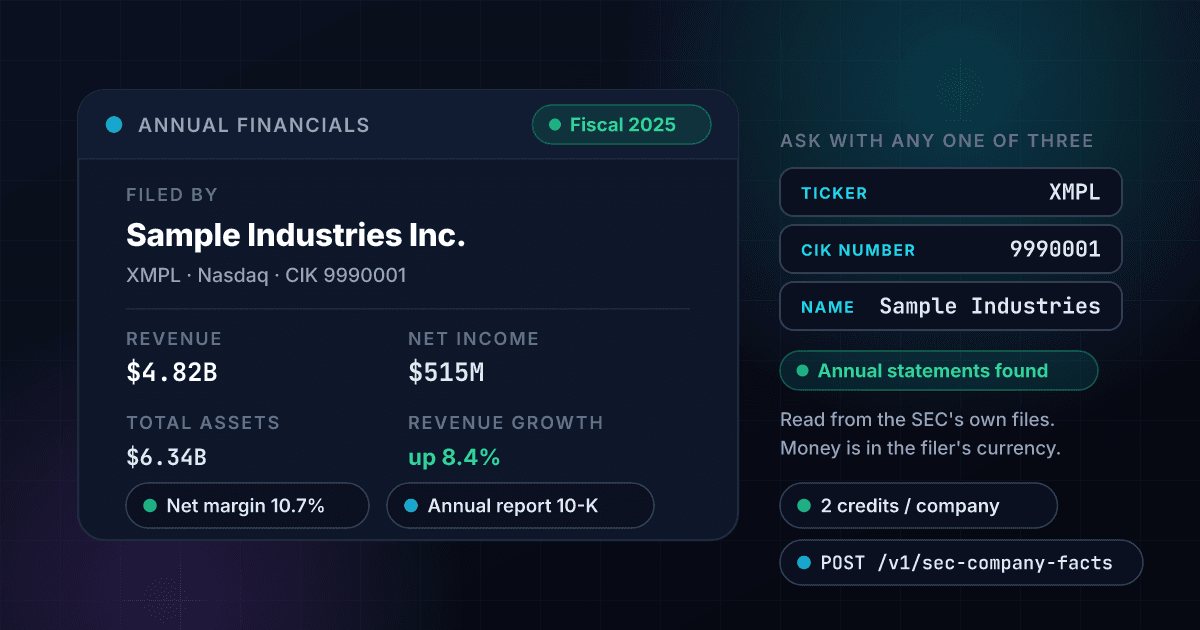
2
Credits per company
about $0.01 on Starter
0
Credits when nothing is filed
no statements, no charge
15
Figures in every answer
revenue to public float
Up to 5
Years of history
revenue, net income and assets
Five years of filed figures show whether a company is growing before you contact it
Every answer carries up to five years of revenue, net income and total assets, oldest first, and the newest quarter filed since the last year-end beside them.
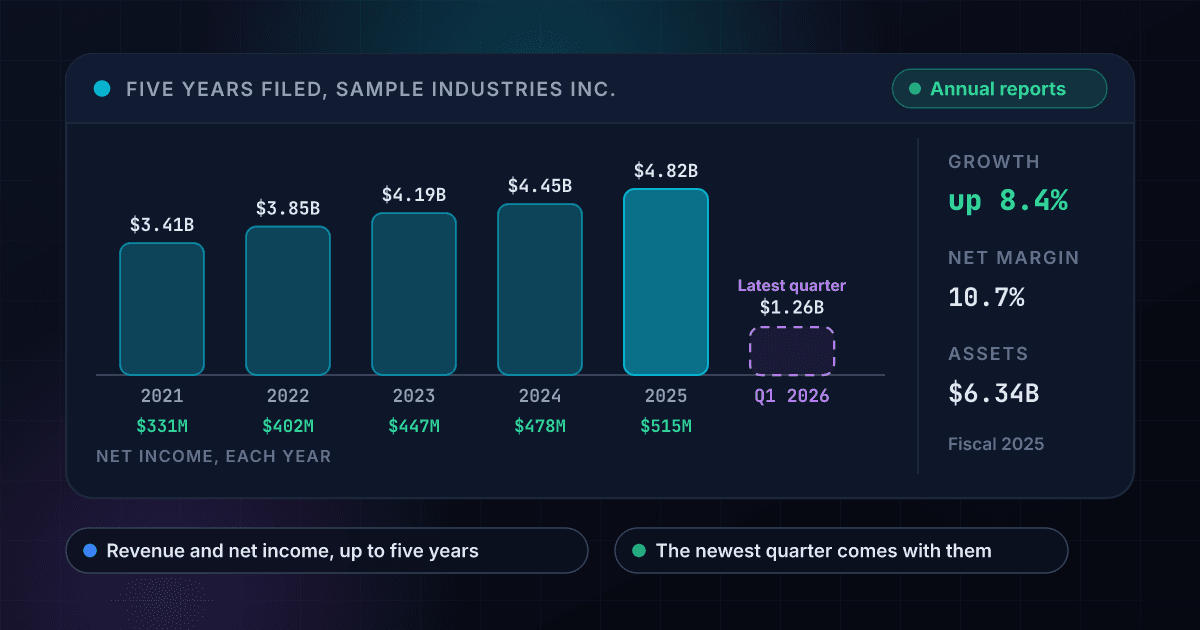
A public company comes back as the figures it filed in one flat payload.
The figures come from the SEC's own filings
Revenue, profit, assets, cash, debt and shares are read from the SEC's public company facts files, the figures a company tagged in the annual and quarterly reports it filed. Each answer names the form and the filing date of the annual report it used.
- Revenue, gross profit, operating income and net income
- Assets, liabilities, equity, cash and long-term debt
- Operating cash flow and diluted earnings per share
- Shares outstanding and public float
Every figure is read at the same year-end
Companies tag the same idea under different names over the years. The summary takes each figure at the latest year-end that has revenue, net income or assets, from annual reports only, so a revenue from one year is never set beside a profit from another.
- One fiscal year for the whole answer
- A twelve-month total in a quarterly report is not a year
- One currency, never mixed
- A restated figure uses the latest filing
Growth, margin and five years of history come with the figures
You do not have to run a second lookup to see whether revenue is rising. The answer carries the growth on the year before, the net margin, the newest quarter filed since the year ended and up to five years of revenue, net income and total assets.
- Revenue growth on the year before
- Net margin
- The newest quarter's revenue and net income
- Up to five years of history, oldest first
A ticker, a CIK number or a name all work
Send whichever you have. An exact ticker always wins, a name needs every word to appear in the registered name, and the next few matches are listed so you can tell them apart. A CIK number is exact.
- Ticker, such as one on a stock exchange
- SEC CIK number, 1 to 10 digits
- Company name, best match in full
- The next matches listed with their CIK
A company the SEC holds nothing for costs nothing
You are charged 2 credits only when the SEC holds annual statements for the company. A private company, a name nobody registered, a company registered with the SEC that has filed no annual statements and a lookup the SEC could not answer cost 0, and the answer says which it was.
- Zero credits when nothing is filed
- The reason comes back with the answer
- Malformed input refused before it is billed
- The same credits as every other product
A whole list of companies runs from one CSV file
Put a ticker, a name or a CIK number in each row of a CSV with a company column and download the same file with the figures filled in. A row the SEC cannot match is a free row, and the rest of the file carries on.
- Bulk CSV with a company column
- Ticker, name or CIK on any row
- A row nothing matches is free
- One API key for all of it
A company goes in and the figures it filed come out
Send a ticker, a CIK number or a name
POST one of the three. A CIK number is 1 to 10 digits. A malformed CIK number or an empty request is refused with a clear error and costs nothing.
$ POST /api/v1/sec-company-facts
"company": "Sample Industries"
> a name, a ticker or a CIK number
We read the company's filed figures
A ticker or a name is matched to a CIK number in the SEC's list of registered companies, then the company's facts file is read and summarized. Each figure is taken at the latest fiscal year-end and held to one currency.
Ticker or name matched to a CIK
Company facts file read
Latest fiscal year chosen
Figures summarized in one currency
Get the summary, flat and structured
Revenue, profit, balance sheet, growth, shares and the five-year history arrive in one JSON payload. A company with annual statements bills 2 credits, and one without them bills nothing.
companySample Industries Inc.
revenue$4.82B
net income$515M
One endpoint reads a company's filed figures and works like every other 1Lookup call.
Same authentication, same credit balance, and the same response envelope as every other 1Lookup product. If you have already integrated one endpoint, this one is a URL change.
curl -X POST https://app.1lookup.io/api/v1/sec-company-facts \
  -H "Authorization: Bearer $API_KEY" \
  -H "Content-Type: application/json" \
-d '{ "company": "Sample Industries" }'{
"classification": {
"found": true,
"cik": 9990001,
"name": "Sample Industries Inc.",
"ticker": "XMPL",
"exchange": "Nasdaq",
"currency": "USD",
"fiscal_year": 2025,
"fiscal_year_end": "2025-12-31",
"revenue": 4820000000,
"gross_profit": 1930000000,
"operating_income": 702000000,
"net_income": 515000000,
"operating_cash_flow": 801000000,
"eps_diluted": 2.41,
"total_assets": 6340000000,
"total_liabilities": 3710000000,
"stockholders_equity": 2630000000,
"cash": 940000000,
"long_term_debt": 1450000000,
"revenue_growth_pct": 8.4,
"net_margin_pct": 10.7,
"shares_outstanding": 212000000,
"public_float": 9100000000,
"name_search": true,
"match_count": 2
},
"insights": {
"sec_company_facts_result": {
"last_annual_report": { "form": "10-K", "filed": "2026-02-12" },
"latest_quarter": {
"period_end": "2026-03-31",
"fiscal_period": "Q1",
"form": "10-Q",
"revenue": 1260000000,
"net_income": 141000000
},
"annual_history": [
{ "fiscal_year": 2024, "revenue": 4450000000, "net_income": 478000000, "total_assets": 5980000000 },
{ "fiscal_year": 2025, "revenue": 4820000000, "net_income": 515000000, "total_assets": 6340000000 }
],
"other_matches": [
{ "cik": 9990002, "name": "Sample Industries Holdings Corp", "ticker": "SMPH", "exchange": "NYSE" }
],
"data_source": "sec_edgar"
}
},
"recommendations": {
"primary_action": "VERIFY",
"secondary_actions": ["check_other_matches"],
"user_message": "Sample Industries Inc. (XMPL) reported revenue of $4.82 billion and net income of $515 million for the fiscal year ended 2025-12-31."
},
"metadata": { "credits_used": 2, "cache_hit": false }
}A column of tickers, names and CIK numbers goes in and one row per company comes out
Upload a CSV with a company column and download a result file with each company's name, ticker, fiscal year, revenue and net income. The three companies here are invented.
- 1company
- 2XMPL
- 39990004
- 4Sample Private Co
| company | Found | Company | Ticker | Fiscal Year | Revenue | Net Income | Credits Used |
|---|---|---|---|---|---|---|---|
| XMPL | Yes | Sample Industries Inc. | XMPL | 2025 | 4820000000 | 515000000 | 2 |
| 9990004 | Yes | Sample Freight Corp. | 2024 | 912400000 | 41700000 | 2 | |
| Sample Private Co | No | 0 |
Eighteen more columns in the file, among them Exchange, CIK, Gross Profit, Operating Income, Total Assets, Cash and Shares Outstanding.
One row in, one row out
Every ticker, name or CIK number becomes one row, so a list of 500 accounts is a spreadsheet of 500 rows you can sort by revenue or filter by margin.
A company the SEC has nothing for is a free row
A private company, a name nobody registered or a company with no annual statements comes back as a row that says so and costs 0 credits, so cleaning a list never bills for the misses.
A CIK number finds a company that no longer trades
A company with no ticker still comes back when the row holds its CIK number, with the figures from its last annual report.
One call returns the figures a public company filed for its last year
One call turns a ticker, a CIK number or a company name from a CRM, a loan file or a deal list into what the company filed for its last fiscal year: how big it is, whether it made money and how it is funded, with the raw JSON your code receives beside it. Money is in the currency the company reports in.
- CompanySample Industries Inc. (XMPL)
- CIK number9990001
- Listed onNasdaq
- Fiscal year2025, ended 2025-12-31
- Revenue$4.82B
- Net income$515M
- Net margin10.7%
- Revenue growthup 8.4%
- Total assets$6.34B
- Cash$940M
- Latest quarterQ1 2026, revenue $1.26B
- Other matchesSample Industries Holdings Corp (SMPH)
{
  "classification": {
    "found": true,
    "cik": 9990001,
    "name": "Sample Industries Inc.",
    "ticker": "XMPL",
    "currency": "USD",
    "fiscal_year": 2025,
    "revenue": 4820000000,
    "net_income": 515000000,
    "total_assets": 6340000000,
    "revenue_growth_pct": 8.4,
    "net_margin_pct": 10.7,
    "match_count": 2
  },
  "insights": {
    "sec_company_facts_result": {
      "last_annual_report": { "form": "10-K", "filed": "2026-02-12" },
      "data_source": "sec_edgar"
    }
  },
  "metadata": { "credits_used": 2 }
}
Every company lookup returns the same fields at one flat price.
A figure the company did not report comes back as null and never as zero, and every company with annual statements costs the same 2 credits.
Identity
- found
- cik
- name
- ticker
- tickers
- exchange
Fiscal year
- currency
- fiscal_year
- fiscal_year_end
- period_end
- last_annual_report
Income and cash flow
- revenue
- gross_profit
- operating_income
- net_income
- eps_diluted
- operating_cash_flow
Balance sheet
- total_assets
- total_liabilities
- stockholders_equity
- cash
- long_term_debt
Ratios and shares
- revenue_growth_pct
- net_margin_pct
- shares_outstanding
- public_float
History and matches
- latest_quarter
- annual_history[]
- other_matches[]
- match_count
- data_source
Sales, credit and research teams read a company's filed figures instead of its filings.
Sales teams sizing up a public company before outreach
Look up the ticker on a lead record and read the company's revenue, profit and cash, so the account is ranked by how large it is before anyone writes to it.
Lenders and credit teams reading a borrower's filed numbers
Read revenue, debt, equity and cash from the borrower's last annual report, and compare the five-year history with what the borrower told you.
Finance teams building a table of peers
Run a list of competitors' tickers through a bulk job and sort the rows by revenue, net margin or growth.
Procurement and risk teams vetting a vendor
Check that a vendor that says it is a public company reports revenue and assets in line with the size of the contract.
Journalists and researchers checking a figure at the source
Look up the company named in an article and compare the revenue quoted with the revenue it filed, with the fiscal year end beside it.
Teams enriching company records in a CRM
Fill revenue, net income and public float on a company record from its CIK number, instead of reading filings by hand.
Only a company with annual statements is billed, and every other answer is free
A company with annual statements returns its figures. A company registered with the SEC that has filed none, or a name no registered company matches, comes back as a clear answer at no charge.
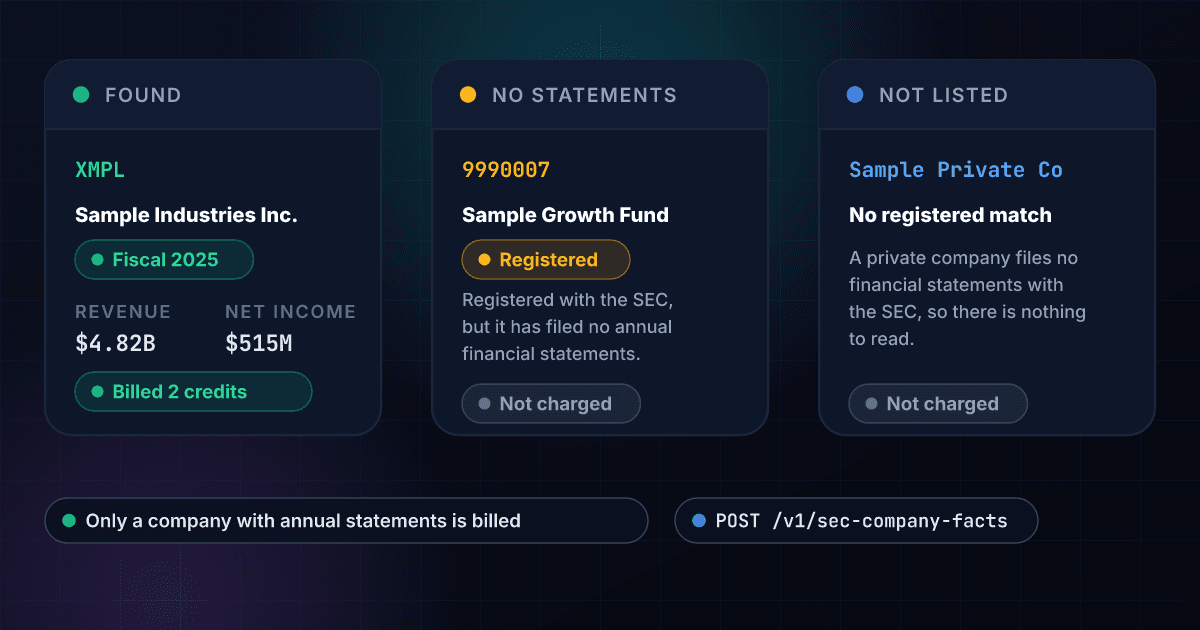
These are the questions people ask before they look up their first company.
What does the SEC Company Facts API return?
Send a ticker, an SEC CIK number or a company name and it returns the figures a US public company filed for its latest fiscal year: revenue, gross profit, operating income and net income, total assets, total liabilities, stockholders' equity, cash and long-term debt, operating cash flow and diluted earnings per share, revenue growth on the year before and net margin, and shares outstanding and public float. It adds the newest quarter filed since the year ended and up to five years of revenue, net income and total assets.
Where do the financial figures come from?
From the SEC's own public company facts files, which hold the figures a company tagged in the annual and quarterly reports it filed. A ticker or a name is matched against the SEC's list of registered companies first, to find the company's CIK number. Every answer names the CIK, the fiscal year end and the form and filing date of the annual report the figures came from.
How is the fiscal year chosen, and can figures from different years get mixed?
No. Every figure is read at the latest year-end that has revenue, net income or total assets, so a revenue figure from one year is never set beside a profit from another. A fiscal year is a period of 340 to 380 days taken from an annual report, and a twelve-month total printed in a quarterly report is not counted as a year. When a company restates a figure, the latest filing is used.
How much does a company lookup cost?
2 credits per lookup, about $0.01 on the Starter plan. You are charged only when the SEC holds annual statements for the company. A private company, a name that matches no registered company, a company registered with the SEC that has filed no annual statements, a malformed CIK number and a lookup the SEC could not answer all cost 0 credits, in the API, the dashboard and bulk jobs. A name search is one lookup, however many other matches it lists.
How does a search by company name work?
An exact ticker always wins. Otherwise every word you type must appear in the company's registered name, and a name that matches exactly ranks above one that starts with your words, which ranks above one that only contains them, with the SEC's own order (largest companies first) breaking ties. The best match comes back in full and the next few are listed with their CIK number, ticker and exchange, so you can tell them apart. For an exact answer, send the CIK number.
Which companies are covered?
Companies that report to the SEC. A private company, a subsidiary that files nothing of its own and most foreign companies will not be found. Foreign companies that file in IFRS are read, with fewer figures covered. A company that no longer trades has no ticker and can be found by its CIK number only.
Why does a figure come back empty?
A figure the company did not report comes back as null and never as zero. Banks, insurers and funds often leave out gross profit, and a company with no revenue figure still returns the rest. A company that lost money returns a negative net income. In each case the lookup found annual statements, so it is charged.
Which currency are the figures in?
The currency the company reports in, named in the currency field, which is almost always US dollars. Every figure in one answer uses that one currency, and a figure the company tagged in another currency is left out rather than mixed in.
Does it return every line of a filing, or quarterly statements?
No. It returns the headline figures of the latest year, the newest quarter's revenue and net income and up to five years of revenue, net income and total assets. Segment and geographic breakdowns, and any figure the summary does not list, are not returned. A company with several share classes may show the share count of one class.
Can I look up a list of companies at once?
Yes. Upload a CSV with a company column and put a ticker, a company name or a CIK number in each row. You get a row per company with its name, ticker, fiscal year, revenue, net income and the other figures. A row the SEC cannot match is a free row, and a row that is not usable fails without a charge. The price stays at the same credits per company found, however long the list is.
How current is the data?
A company's figures change when it files a report, a few times a year. A repeat lookup of the same input by the same user within seven days is answered from the cache at no charge, and bypass_cache: true reads it again. The answer always names the fiscal year end and the filing date of the annual report it used, so you can see how old it is.
To read one company's figures before you write any code, try the free SEC company financials lookup.
The filed figures say how a company is doing, and these products check the rest.
Here is how looking up a public company's financials with 1Lookup compares with the other SEC data APIs.
Each page sets a rival's plans and prices beside ours and says where the rival does the job better. Every figure carries its source and the date it was checked.