CPM Calculator
Work out cost per 1,000 impressions from your ad spend, or flip the formula to solve for total cost or impressions. An eCPM mode covers the publisher side.
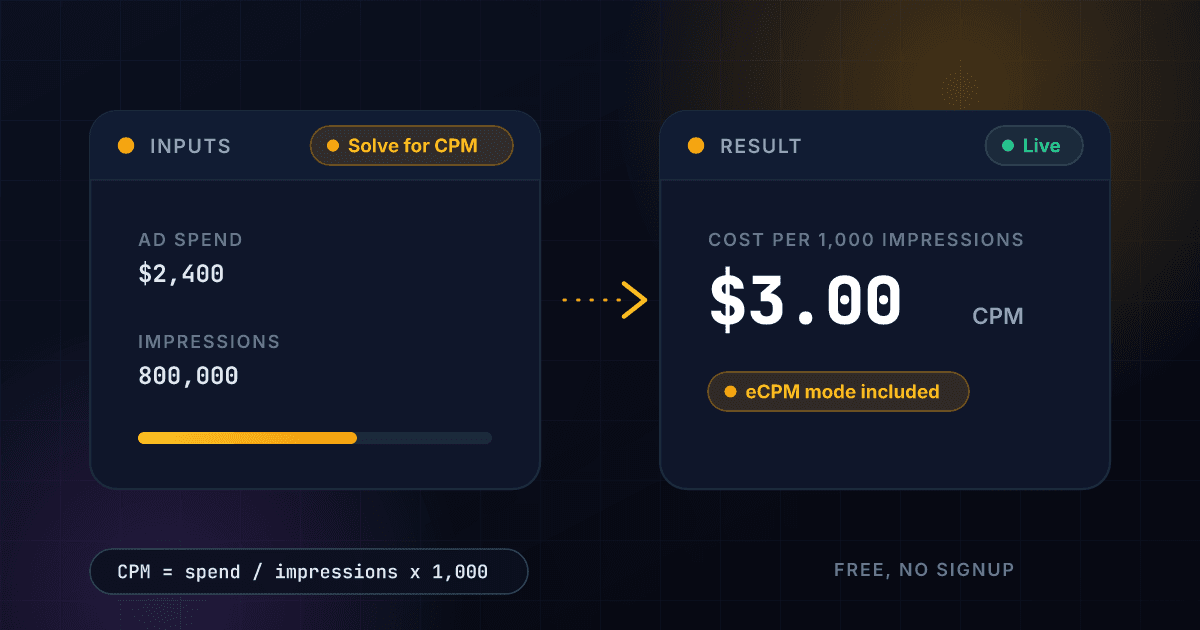
CPM is the cost of 1,000 ad impressions. The formula: CPM = (total cost ÷ impressions) × 1,000. Spend $500 to serve 100,000 impressions and your CPM is $5.00. Use the calculator below to solve for CPM, total cost, or impressions, plus eCPM for publishers.
What do you want to solve for?
Your CPM (cost per 1,000 impressions)
$5.00
($500.00 ÷ 100,000) × 1,000 = $5.00
The formulas behind each tab
- CPM = (cost ÷ impressions) × 1,000
- Cost = CPM × (impressions ÷ 1,000)
- Impressions = (budget ÷ CPM) × 1,000
- eCPM = (earnings ÷ impressions) × 1,000
Want to see the ads behind the CPMs? 1Lookup's Ad Library Lookup API pulls the ads any advertiser is running on Meta, TikTok, LinkedIn and Google.
Start free: 1,000 lookupsWhat CPM is and how the formula works
CPM means cost per mille, where mille is Latin for thousand. It is what you pay for every 1,000 times an ad is served, and it is the standard way display, video, and social inventory is priced. One impression is one serve of the ad, counted whether or not anyone clicks it.
The math is one division and one multiplication. Say a campaign cost $500 and delivered 100,000 impressions. Divide $500 by 100,000 to get the cost of a single impression ($0.005), then multiply by 1,000: the CPM is $5.00. Written out: CPM = (total cost ÷ impressions) × 1,000.
The same formula rearranges to answer the two other questions media buyers actually ask. Total cost = CPM × (impressions ÷ 1,000), so 2,000,000 impressions at a $4.00 CPM cost $8,000. Impressions = (budget ÷ CPM) × 1,000, so a $1,000 budget at a $5.00 CPM buys 200,000 impressions. The calculator above handles all three, so you never have to rearrange it by hand.
CPM vs eCPM vs CPC vs CPA
These four metrics price different events. Mixing them up is the fastest way to misread a campaign report, so here is each one, its formula, and when it matters.
CPMCost per 1,000 impressions
CPM = (cost ÷ impressions) × 1,000
You are buying reach and awareness. You pay for the ad being served, not for any response to it.
eCPMEffective cost per 1,000 impressions
eCPM = (earnings ÷ impressions) × 1,000
You are a publisher comparing what different networks, formats, or placements pay for the same inventory.
CPCCost per click
CPC = cost ÷ clicks
The goal is traffic. You pay only when someone clicks, so a low CPC with weak visitors can still be a bad deal.
CPACost per acquisition
CPA = cost ÷ conversions
The goal is sales or signups. It is the closest metric to profit, and the one the other three should ultimately serve.
Why CPM varies so much
Ask what a normal CPM is and you will get a different answer from every source, because CPM is an auction price, not a rate card. The main drivers:
- Platform. Each ad platform runs its own auction with its own advertiser demand, so the same audience costs different amounts in different places.
- Audience and geography. Narrow, high-income, or heavily targeted audiences cost more than broad ones, and rates differ sharply by country.
- Ad format. Video, full-screen, and premium placements typically price above small banners because advertisers value the attention more.
- Seasonality. CPMs rise when more advertisers bid, most visibly around year-end shopping and major events, and ease when demand drops.
- Auction competition. How many other advertisers want the same impression at the same moment moves the price in real time.
Published benchmark numbers vary widely between sources and shift constantly, so treat any average you read as a snapshot, not a target. The dependable comparison is your own account history: your CPM this month against your CPM last month, for the same audience and format.
CPM calculator FAQ
What is a CPM in advertising?
CPM stands for cost per mille, Latin for thousand. It is the price an advertiser pays for 1,000 impressions of an ad, where an impression is one instance of the ad being served. CPM is the standard pricing model for display, video, and social campaigns bought for reach and awareness rather than for clicks or conversions.
How do I calculate CPM?
Divide the total cost of the campaign by the number of impressions, then multiply by 1,000. The formula is CPM = (total cost ÷ impressions) × 1,000. For example, $500 spent on 250,000 impressions is a $2.00 CPM. The same formula rearranges to solve for total cost or impressions when you know the other two numbers.
What is eCPM?
eCPM means effective cost per mille and measures revenue instead of spend. Publishers use it to compare earnings across ad formats and demand sources: eCPM = (total earnings ÷ impressions) × 1,000. An advertiser can also compute an eCPM for a campaign bought on clicks or conversions to compare it against CPM-priced inventory on equal terms.
What is the difference between CPM and CPC?
CPM prices impressions and CPC prices clicks. With CPM you pay for every 1,000 times the ad is served, whether or not anyone clicks. With CPC you pay only when someone clicks, at a set or auction-driven price per click. CPM suits awareness goals where being seen is the point, while CPC suits campaigns judged on traffic and response.
What is a good CPM?
There is no single good CPM. Rates depend on the platform, the country and audience being targeted, the ad format, competition in the auction, and the time of year. Published averages vary widely between sources and shift constantly. A more useful test is whether the campaign hits its own cost per result targets, not whether the CPM matches a benchmark.
How can advertisers lower their CPM?
Common levers: broaden the target audience so the auction is less competitive, improve creative quality since platforms reward engaging ads with cheaper delivery, test different formats and placements, avoid peak seasonal bidding periods where possible, and cap frequency so budget is not wasted repeating the ad to the same people. These are rules of thumb; results vary by platform and auction conditions.
See the ads behind the CPMs
A CPM tells you what impressions cost. 1Lookup's APIs show you what the market is doing with them.
Ad Library Lookup
See the ads behind any advertiser on Meta, TikTok, LinkedIn and Google. Pull creatives and campaign activity by API before you plan your own spend.
Explore Ad Library LookupSocial Post Lookup
Look up public social posts by API and see the content and engagement behind the impressions you are bidding against.
Explore Social Post Lookup