Free Scam Text Message Checker
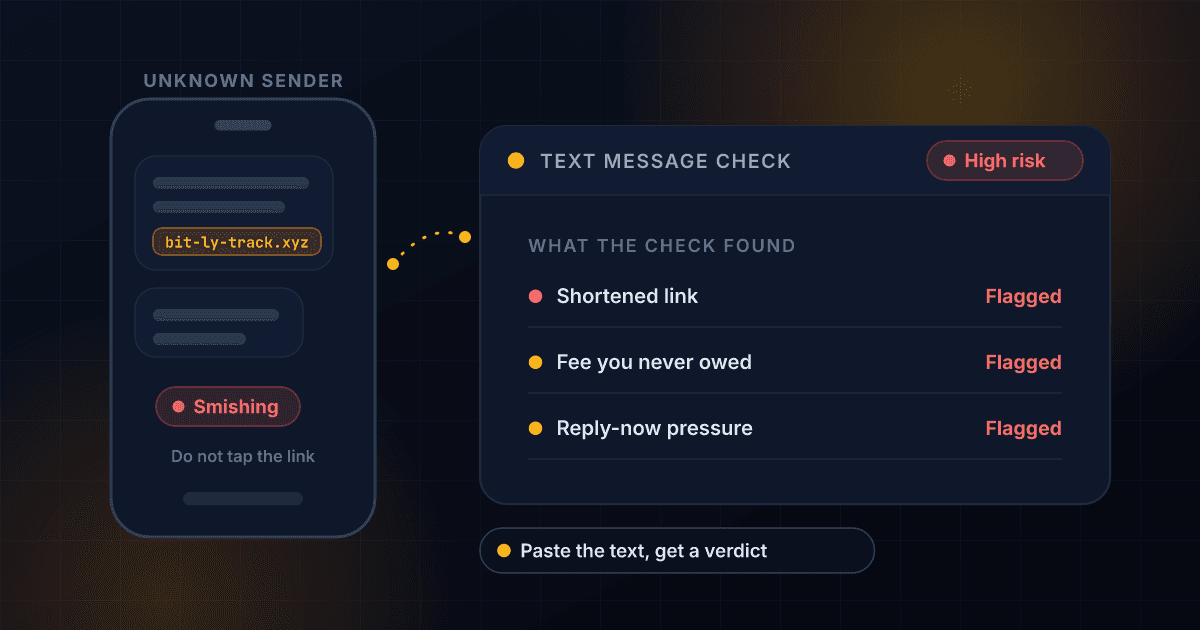
A scam text usually arrives unexpectedly, claims a problem with a delivery, toll, bank account or payment, and pushes you to tap a link right away. The link goes to a lookalike domain rather than the real company. Paste the message into 1Lookup's free scam text checker to see which of these signals it contains and how risky it is.
Example resultThis is a real lookup we captured on 2026-08-23 for USPS: Your package is on hold due to an incomplete delivery address. Update your details within 24 hours at usps-track-r…. Run any lookup above and it is replaced with yours.
This is almost certainly a phishing scam
This message impersonates USPS and uses a fake domain to steal your login details or personal information. The 24-hour deadline and threat of package return create false urgency.
What we found
- Claims to be from USPS but links to 'usps-track-redelivery.info', a fake domain that mimics USPS but is not the real USPS website
- Creates artificial urgency with '24 hours' deadline and threat of item return
- Requests you click a link to 'update your details' without verifying your identity first
- USPS typically notifies customers through official channels and does not demand action via links in unsolicited messages
Confidence: 96%
This is an automated assessment of the content you pasted, not a guarantee. When money or credentials are involved, contact the organisation directly using a number or address you already trust.
This tool provides an automated assessment of the message text you submit. It is not legal or security advice and cannot guarantee that a message is safe or fraudulent. It reads only what you paste: it does not identify the sender, visit linked pages, or check external threat databases. A low-risk result means no clear scam indicators were found, not that the message is verified as genuine. Where money, passwords or one-time codes are involved, always verify with the organisation directly using contact details you already trust. Report scam texts by forwarding them to 7726 and at reportfraud.ftc.gov.
Need this at scale? Phone Spam Check API
Check whole lists of numbers for spam and robocall reputation through the API or bulk CSV.
Is This Text Message a Scam?
Scam texts, known in the industry as smishing, now outnumber scam calls for most people. They work because a text feels personal and urgent, and because tapping a link takes half a second of inattention. The most common ones right now claim an undelivered package, an unpaid road toll, a suspended bank account, an unexpected refund, or a wrong-number message that turns friendly and then turns into an investment pitch.
Paste the message here and the checker reads it for the giveaways. It looks at whether the contact was expected, whether there is a deadline or a threat attached, whether you are being asked for a payment, a code or personal details, and crucially whether the link's actual domain matches the company the message claims to be from. That last one catches most delivery and toll scams outright, because the real agency never sends you to a domain nobody has heard of.
One rule worth knowing regardless of what the tool says: legitimate organisations do not ask for payment by text link, and they never ask for a one-time passcode. Anyone requesting a code you just received is trying to get into your account, no matter how convincing the rest of the message reads.
The same script arrives by email
A delivery fee, an unpaid toll, a bank alert: wording that works over SMS gets reused in email, with a spoofed sender in place of the short link. If the message reached your inbox instead of your phone, run it through the phishing email checker.
What a scam text actually looks like
Every red flag in this made-up example is numbered, and each number is explained beside it. Once you have seen the pattern once, you will spot it in the real thing.
We could not deliver your parcel today (red flag 1) because the address on file is incomplete.
Confirm your details within 24 hours (red flag 2) at parcel-redelivery-track.icu (red flag 3) or the item will be returned to the sender.
A small redelivery fee of $2.99 applies. (red flag 4)
Red flag 1: A delivery you were not expecting
Scam texts open with something almost everyone is plausibly waiting for. If you cannot name the parcel, there isn't one.
Red flag 2: A countdown that serves no purpose
Deadlines exist to stop you checking. A real carrier will still have your parcel tomorrow.
Red flag 3: An address that is not the company's
The words before the ending are what matter. This is a site called parcel-redelivery-track, not a courier you have heard of.
Red flag 4: A small payment, not a large one
A few dollars feels too trivial to be a scam. The point is not the fee, it is your card number.
The example above is invented for illustration. It names no real company, and the address in it is not a live site.
How the Scam Text Checker Works
Paste the text message
Copy the whole SMS, including any link exactly as it was written. If you have the sending number, add it. Do not tap the link to find out where it goes.
We check it against smishing patterns
The tool weighs unexpected contact, urgency and threats, payment or code requests, brand impersonation, lookalike link domains, and the specific scripts behind delivery, toll, bank and wrong-number scams.
See the verdict and the evidence
You get a risk level, a confidence score and the exact phrases that triggered it. Then run the sending number through our free spam number lookup to see what else is known about it.
Knows the current scam scripts
Undelivered package, unpaid toll, DMV notice, bank fraud alert, refund owed, wrong number turning to crypto. The tool recognises these families by their structure, not by matching a blocklist that is always out of date.
Reads the link, not just the words
Most smishing gives itself away in the URL: a brand name sitting in the subdomain of an unrelated domain, an odd TLD, or a shortener hiding the destination. The checker examines the address without ever visiting it.
Explains it in language you can forward
Results are written for a worried person, not a security team. If you are checking on behalf of a parent or a teenager, you can send them the explanation and it will make sense.
No app, no number, no signup
You do not install anything, hand over your own phone number, or grant access to your messages. Paste the text, get an answer, close the tab.
Who uses this tool
Delivery and toll texts
The two highest-volume scams in the US right now. Both claim a small unpaid fee and both send you to a payment page on a domain the real agency has never used. Paste it here before you pay anything.
Bank and payment app alerts
A text saying your account is locked or a payment was attempted is designed to make you call the number in the message. Check it here, then call the number on the back of your card instead.
Wrong-number messages
A friendly stranger who says they got the wrong number and keeps chatting is running a long con that ends in a crypto or trading pitch. The tool recognises the opening moves.
Codes and verification requests
If someone texts asking you to read back a code, that is account takeover in progress. Paste it to confirm what you are looking at, then never share the code.
Frequently asked questions
Should I reply STOP to a scam text?
No. Replying anything, including STOP, confirms your number is live and reaches a real person, which makes it more valuable to sell on. Do not reply. Report it by forwarding to 7726 (SPAM), then block and delete.
What if I already tapped the link?
Opening a page is usually not enough to compromise a modern phone. The risk is what you did next. If you entered card details, call your bank. If you entered a password, change it everywhere you reused it and turn on two-factor authentication. If you installed anything, remove it.
How do scammers get my number?
Mostly from data breaches, from lists sold between brokers, and from simply dialling ranges of numbers in sequence. Being targeted does not mean any account of yours was compromised, and there is rarely anything you did to cause it.
Can you tell me who sent the text?
Not from the message alone. Run the sending number through our free spam number lookup or the reverse phone lookup. Bear in mind most scam texts use spoofed or throwaway numbers, so the sender rarely resolves to a real person.
How many texts can I check for free?
Five a day on this tool, fifteen a day across all our free tools, from a single IP with a short pause between checks. A free account raises that to 1,000 lookups over a seven-day trial.
Where do I report a scam text?
Forward it to 7726, which is free and goes to your carrier. Then report it to the FTC at reportfraud.ftc.gov. If it impersonated a specific company, most banks and delivery firms have a phishing address on their site too.
Related Scam Text Searches
More free tools
Scam Checker
Paste any message and get an instant read on whether it's a scam.
Phishing Email Checker
Paste a suspicious email and see whether it's phishing.
Website Legit Checker
Check whether a site is a real business or a scam storefront.
Link Safety Checker
Check a link before you click it, without opening it.