Free VPN Detection & Proxy Checker
VPN and proxy detection determines whether an IP address is hiding its true origin behind a VPN, proxy, Tor node, or datacenter. 1Lookup's free VPN and proxy detection checks any IP against live network data and returns its connection type and anonymiser status, helping you spot fraud, fake signups, and high-risk traffic.
Example resultThis is a real lookup we captured on 2026-08-23 for 8.8.8.8. Run any lookup above and it is replaced with yours.
Medium anonymizer likelihood
VPN and proxy detection is probabilistic, not absolute. Results are estimates based on IP intelligence and threat data that change over time, and may include false positives or negatives. Use them as one signal within a layered risk decision, not as the sole basis for blocking or approving any user.
Need this at scale? IP Lookup API
Detect VPN, proxy, Tor and datacenter traffic programmatically at signup and login.
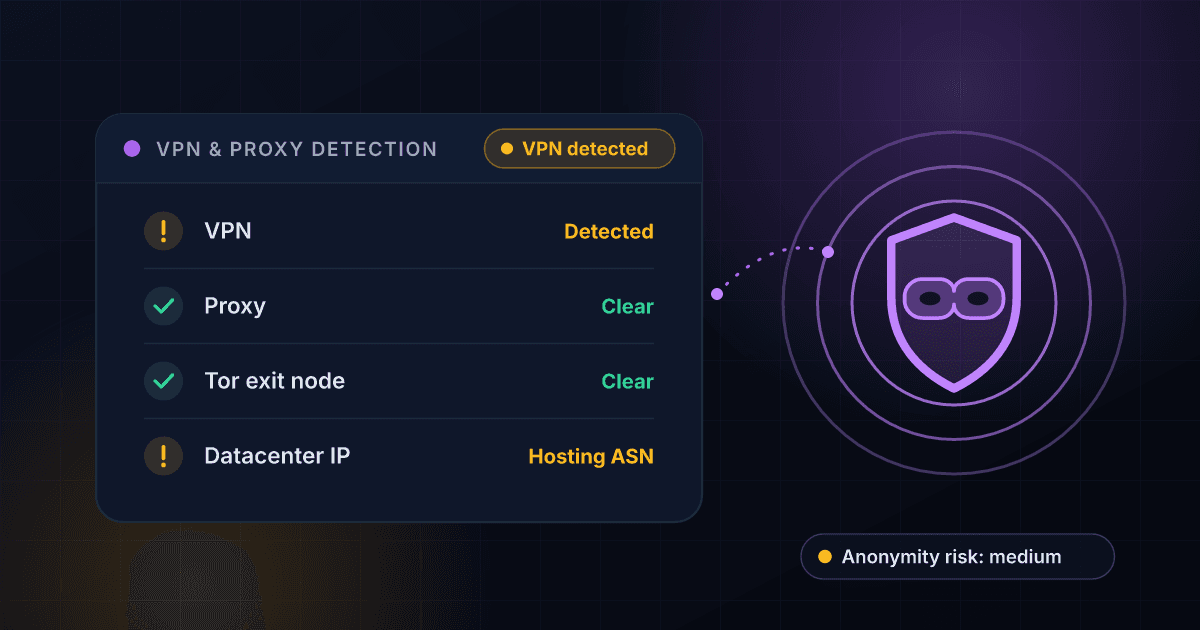
Detect VPNs, Proxies, and Anonymized Traffic by IP
VPN detection is the practice of determining whether an IP address belongs to a virtual private network, proxy server, Tor node, or commercial datacenter rather than a genuine residential or mobile connection. Our free VPN checker analyzes any IP against 1Lookup's IP intelligence and threat data, then returns a clear low, medium, or high likelihood so you can decide how much to trust the connection behind a signup, login, or checkout.
Anonymized traffic is not inherently malicious, but it is disproportionately associated with fraud, fake account creation, credential stuffing, and abuse. A reliable ip proxy checker helps risk teams separate ordinary privacy-conscious users from connections deliberately masking their origin. By flagging Tor exit nodes, anonymizers, and datacenter hosting, this tool gives you the context to apply step-up verification instead of guessing.
It is important to treat every result as probabilistic, not absolute. IP infrastructure changes constantly as providers rotate addresses and spin up new ranges, so no proxy detection system is perfect. Use this VPN checker as one strong signal in a layered decision, and pair it with device, behavior, and identity signals when the stakes are high. The free demo answers "is this ip a vpn" instantly; the API delivers it at scale.
Want the location data behind the flag?
Proxy and VPN flags are returned alongside the location fields on the same lookup. For the rest of that response, how it is produced and what it is safe to conclude from it, read our complete IP geolocation API guide.
How Our VPN Detection Works
Enter an IP address
Paste any IPv4 or IPv6 address into the checker. We instantly look it up against 1Lookup's IP intelligence database, which maps addresses to their network type, owner, and known infrastructure category.
We analyze infrastructure and threat signals
The IP is matched against patterns for known VPN providers, public and private proxies, Tor exit relays, and commercial datacenter or hosting ranges, then cross-referenced with threat data to estimate its anonymity level.
Get an instant verdict
You receive a clear VPN or proxy likelihood, Tor and datacenter flags, and an anonymity rating. Sign up to unlock the exact probability, fraud score, hosting facility, and abuse history behind the verdict.
VPN and proxy likelihood
Get an at-a-glance low, medium, or high rating for whether an IP is a VPN or proxy. The free result gives you the directional signal; the premium tier reveals the exact VPN probability and a precise fraud score for confident decisions.
Tor exit node checker
Instantly see whether an IP is a known Tor exit relay. Tor traffic is fully anonymized and a common vector for abuse, so this flag helps you apply tighter controls to connections routed through the Tor network.
Datacenter and hosting detection
Identify IPs that belong to cloud providers, hosting companies, and datacenters rather than residential ISPs. Datacenter origins behind a consumer-facing action are a classic indicator of bots, scrapers, and automated fraud.
Anonymity level scoring
Each IP is rated for how thoroughly it conceals the user's true origin, combining VPN, proxy, Tor, and hosting signals. This anonymizer detection helps you triage low-risk privacy users from connections actively hiding their identity.
Who uses this tool
Protect signups and account creation
Block or challenge fake accounts created behind VPNs, proxies, and datacenter IPs. Adding a proxy detection step at registration cuts fake-account spam, free-trial abuse, and bonus farming before those accounts ever reach your platform.
Secure checkout and payments
Anonymized IPs are a strong fraud signal at checkout. Use VPN detection to feed your risk engine, trigger step-up verification on high-likelihood connections, and reduce chargebacks without adding friction for legitimate buyers.
Fraud and abuse investigation
Risk and trust-and-safety analysts can quickly check whether an IP tied to a suspicious event is a VPN, proxy, or Tor exit node, then pull abuse reports and threat feeds via the API to build a complete picture of the actor.
Enforce access and compliance policies
Detect anonymizers attempting to bypass geographic restrictions, licensing rules, or regional access controls. The ip proxy checker helps you spot location spoofing and enforce policies that depend on a user's true network origin.
Frequently asked questions
How do you detect a VPN by IP address?
VPN detection works by comparing an IP against intelligence about its network. We check whether the address belongs to a known VPN provider, proxy service, Tor relay, or datacenter range, then layer in threat data and usage patterns. Combined, these signals produce a likelihood score rather than a simple yes or no, because IP ownership shifts over time.
Why should I block or challenge VPN and proxy traffic?
Anonymized connections are far more likely to be tied to fraud, fake accounts, credential stuffing, scraping, and abuse because they hide the user's true origin. Blocking is rarely the right answer for everyone, but flagging VPN and proxy traffic lets you apply step-up verification, rate limits, or extra review where the risk is highest.
Can VPN detection be wrong?
Yes. All proxy and VPN detection is probabilistic, not absolute. Providers rotate IP ranges, new VPN endpoints appear daily, and some residential connections can resemble proxies. Expect occasional false positives and false negatives, and use the result as one signal alongside device, behavior, and identity data rather than as a standalone verdict.
What is a Tor exit node and why does it matter?
A Tor exit node is the final relay where traffic leaves the Tor network and reaches your site, so it carries the connection's visible IP. Tor fully anonymizes the user, which makes exit-node traffic a common source of abuse. Our Tor exit node checker flags these IPs so you can apply stricter controls when warranted.
What is the difference between a VPN, a proxy, and a datacenter IP?
A VPN encrypts and tunnels all of a device's traffic through a remote server. A proxy reroutes specific requests, often without encryption. A datacenter IP simply belongs to a hosting or cloud provider rather than a home ISP. Each conceals origin differently, and our checker flags all three so you can weigh the right level of risk.
Is this VPN checker free to use?
Yes. You can check any IP for free and see the VPN or proxy likelihood, Tor and datacenter flags, and anonymity level. To reveal the exact VPN probability, precise fraud score, hosting facility, threat feeds, and abuse reports, sign up for a 7-day free trial at app.1lookup.io/signup or use the API.
Do you offer a proxy detection API for bulk checks?
Yes. The 1Lookup proxy detection API returns full IP intelligence, including exact probabilities, fraud scoring, hosting details, and threat feeds, in a single call. It supports real-time checks at signup or checkout and bulk lookups for investigations or list cleansing. Start with a 7-day free trial, then scale as your volume grows.