Free MX Record Lookup
An MX record lookup shows which mail servers accept email for a domain, listed by priority, with the lowest number tried first. It tells you where a domain's email is hosted, such as Google Workspace or Microsoft 365. A domain with no MX record cannot reliably receive email at all.
Example resultThis is a real lookup we captured on 2026-08-23 for gmail.com. Run any lookup above and it is replaced with yours.
gmail.com has 5 mail servers
The provider could not be identified from these hostnames, which usually means self-hosted mail or a smaller host. Read live from public DNS at the moment you ran this check.
Source: RFC 5321: Simple Mail Transfer Protocol, published by IETF.
MX records are read live from public DNS, where domain owners publish them for anyone to query. We report what a domain publishes at the moment you run the check. DNS is cached and propagates unevenly, so results can differ by location and over time. Provider names are matched from mail server hostnames, and about 38% of domains cannot be attributed to a named provider. Correct MX records do not guarantee that a message reaches the inbox, and they do not confirm that a specific mailbox exists. 1Lookup reads public DNS data and is not affiliated with Google, Microsoft, any mail provider, standards body or government agency.
Need this at scale? Email Validation API
Validate addresses at scale with deliverability, disposable detection and fraud scoring.
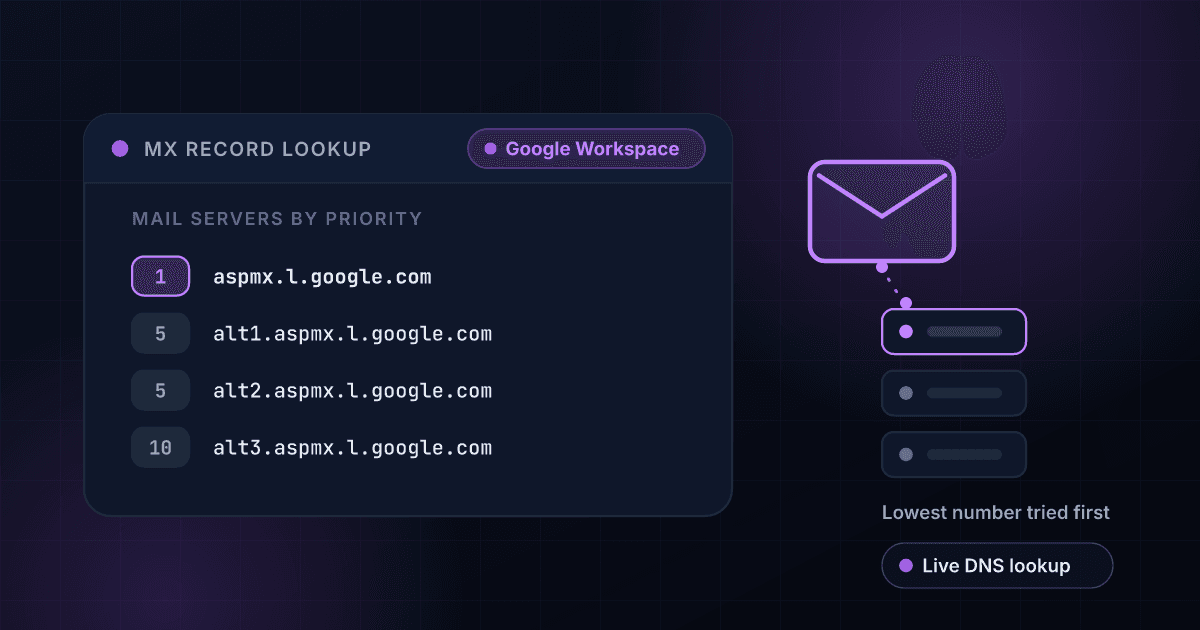
What an MX record lookup tells you
An MX record is a line in a domain's public DNS that names the servers allowed to accept its incoming email. Most domains publish several, each with a priority number. Lower numbers are tried first, and equal numbers share the load. This lookup reads those records live and shows you every hostname with its priority, so you can see exactly where mail addressed to that domain is delivered. Priority is failover order, not a quality score.
The hostnames give away the provider. Anything on aspmx.l.google.com means Google Workspace, anything ending in mail.protection.outlook.com or mx.microsoft means Microsoft 365, and there are clear patterns for Zoho, Proton, Fastmail, Proofpoint, Mimecast, Barracuda and Amazon SES. In a random sample of 1,200 domains from the Tranco top 100,000 measured on 13 August 2026, 28.2% of domains with working mail servers used Google Workspace and 17.0% used Microsoft 365. Another 37.7% could not be matched to any named provider, so when we cannot identify one we say so instead of guessing.
Two results look similar and mean very different things. A domain with no MX record at all is ambiguous: it probably does not handle email, but the owner may simply have forgotten to publish one. A null MX record, a single entry with an empty hostname, is a deliberate statement under RFC 7505 that the domain sends and receives no mail, which is the correct setup for a parked or web-only domain. In our sample, 26.4% of domains had no MX record and 0.3% published a null MX.
From the domain to a single address
MX records prove a domain can receive mail at all, which is the first thing any validation step looks at. Whether one specific mailbox on that domain exists is the next question, and it is answered by the free email verifier.
From 1Lookup research
Which providers run the mail for the top 5,000 domains
The MX record names the provider. In 1Lookup's September 2026 census, 70.5% of the 5,000 most-visited domains publish an MX record at all; of those, Google Workspace fronts 34.1%, Microsoft 365 14.6% and Proofpoint 8.5%. The provider also predicts DMARC enforcement: domains behind Proofpoint enforce at 81.9%, self-hosted mail at 55.6%. The full breakdown is on the research page. Read the provider breakdown in the census.
How to look up a domain's MX records
Enter the domain
Type or paste any domain name. You can paste a full URL or an email address and we will strip the scheme, path, port and trailing dot for you, then normalise the name before querying. Use the domain itself, such as example.com, rather than a mail server hostname.
We query public DNS live
We ask public resolvers for the domain's MX records at the moment you press the button. There is no cached database behind this: you get what the domain publishes right now, along with the time we checked it.
Read the result
You see every mail server hostname with its priority, the identified provider where we can match one, and a plain statement of whether the domain accepts email, publishes a null MX, or has no MX record at all. Timeouts and DNS errors are shown as could not check, never as no record.
Every mail server, with priority
We list all MX hostnames the domain publishes, not just the first one, with the priority number beside each. Lower is tried first and equal values load-balance. Observed values in live records include 0, 1, 5, 10, 20, 50 and 100, and they are arbitrary preferences, not rankings.
Provider identification
We match hostnames to Google Workspace, Microsoft 365, Zoho, Proton, Fastmail, Amazon SES, Proofpoint, Mimecast, Barracuda, Cisco, Cloudflare and others, and report every match when a domain uses more than one. About 38% of domains cannot be attributed to a named provider, and we say unidentified rather than guess.
Null MX told apart from no MX
A null MX is a deliberate statement that a domain handles no mail. No MX record is ambiguous. Most tools blur the two, or wrongly flag priority 0 as null MX, which would mislabel the 16.3% of working domains that legitimately use priority 0, Microsoft 365 among them.
Three honest states, not two
Found, not found, and could not check. A DNS timeout or a broken nameserver on the domain's side is reported as could not check, so you are never told a domain has no mail servers when the truth is that the lookup failed. We also show the timestamp of the check.
Who uses this tool
Debug mail delivery
When mail to a domain bounces or vanishes, the MX records are the first thing to read. Seeing the live hostnames and priorities tells you whether mail is routed through the gateway you expect, whether an old server is still listed, and whether the domain publishes any MX at all.
Qualify prospects by email platform
Which mail platform a company runs is a well known targeting signal. Checking MX records tells you whether a prospect is on Google Workspace or Microsoft 365 before you write the first line of an email, so pitches, integrations and case studies match what they actually use.
Screen a domain before you send
Before adding a domain to a campaign or accepting an address at signup, check that it has mail servers at all. A domain with no MX record, or a null MX, will not receive your message, and finding that out here costs nothing compared with a bounce.
Verify a mail migration or cutover
After moving from a self-hosted server to a hosted platform, or adding a security gateway such as Proofpoint or Mimecast, check the live records to confirm the new hostnames are published and the old ones are gone. DNS propagates unevenly, so check again after the TTL expires.
Frequently asked questions
What is an MX record lookup?
An MX record lookup reads the mail exchanger records a domain publishes in public DNS and lists every mail server that accepts email for it, along with each server's priority. It answers one question: where does this domain's email actually go. It does not read any mailbox, see message contents, or tell you who works at the company.
What does no MX record mean?
No MX record means the domain has not designated any server to accept incoming mail, so an address at that domain is unlikely to receive anything. It is ambiguous rather than deliberate: the domain may be unused, or the owner may simply never have set mail up. In our 1,200 domain sample measured on 13 August 2026, 26.4% of domains had no MX record.
What is a null MX record?
A null MX is a single MX record with an empty hostname and priority 0, defined in RFC 7505. It is a deliberate statement that the domain neither sends nor receives email, and it is the correct configuration for a parked or web-only domain, not an error. It is rare: 0.3% of the 1,200 domains we sampled published one. We label it separately from a domain that simply has no MX record.
How can I tell if a domain uses Google Workspace or Microsoft 365?
Read the hostnames. Google Workspace domains point at aspmx.l.google.com and its alt1 to alt4 variants, or at smtp.google.com. Microsoft 365 domains point at something ending in mail.protection.outlook.com, or the newer mx.microsoft endpoints. Case varies by zone, so we lowercase before matching. Roughly 38% of domains in our sample ran mail servers we could not attribute to a named provider, many of them self-hosted, and we report those as unidentified.
Does a lower priority number mean a better mail server?
No. Priority is failover order, not quality. The number is a preference value and the lowest is tried first; equal values load-balance across those hosts. The values themselves are arbitrary, and live records use 0, 1, 5, 10, 20, 50 and 100 among others. Priority 0 is normal and does not mean the domain rejects mail: 16.3% of domains with working mail servers use it, Microsoft 365 especially.
Does a valid MX record mean my email will be delivered?
No. MX records tell you a domain has somewhere to receive mail; they say nothing about whether a specific mailbox exists or whether your message will land in the inbox. Reputation, content and sending volume decide that. This is also a point-in-time snapshot of public DNS, which is cached and propagates unevenly. To check individual addresses, use the 1Lookup email verifier or the API.
Can I check a whole list of domains at once?
Not on this page. The free tool runs one domain per lookup and is rate limited to a handful of checks per visitor per day. A free 1Lookup account adds bulk CSV processing, so you can upload a list of domains and get mail servers and provider matches back for each row, and the same checks are available through the 1Lookup API.