Free Domain Age Checker
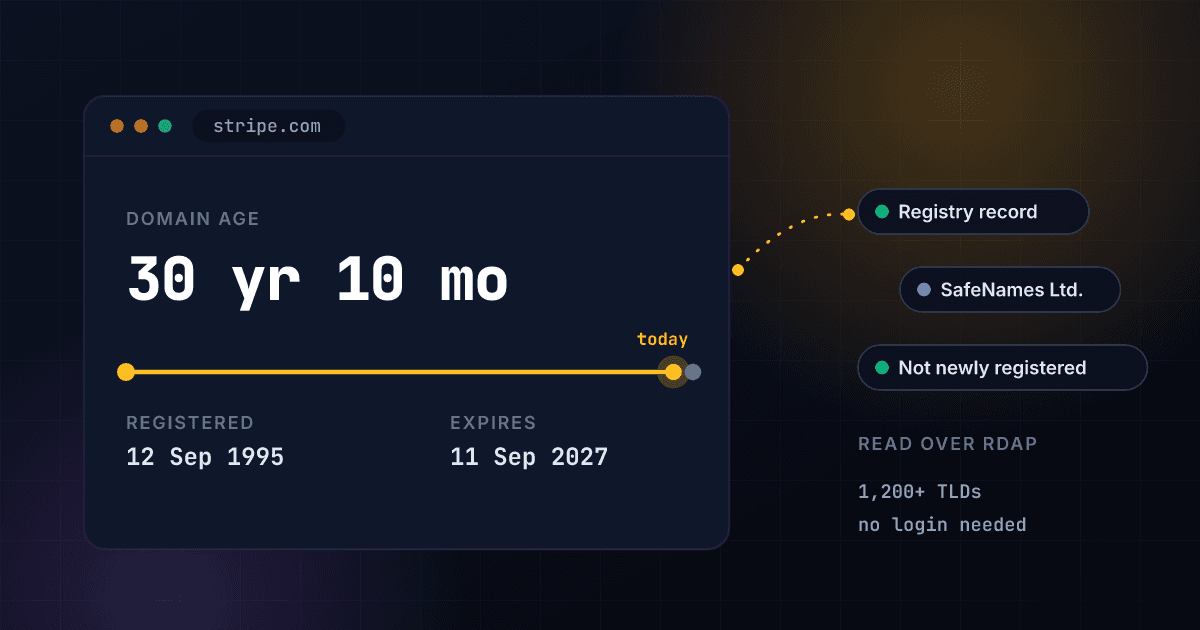
A domain age checker tells you how long ago a domain name was first registered. 1Lookup's free domain age checker reads the registration date directly from the domain's registry and returns the exact creation date, the domain's age in years and months, its expiry date and its registrar, for any of around 1,200 top-level domains.
Example resultThis is a real lookup we captured on 2026-08-23 for symbolics.com. Run any lookup above and it is replaced with yours.
symbolics.com is 41 years, 5 months old
Registration dates come from public domain registry records and are accurate as published by each registry. Some registries do not publish creation dates; where that is the case it is stated in the result rather than estimated.
Need this at scale? Domain Age API
Check a whole list at once: registration date, exact age, expiry and registrar for thousands of domains in one call, at 2 credits each.
What This Domain Age Checker Does
Enter a domain and this tool tells you when it was first registered, how old it is today, when the current registration expires and which registrar it sits with. It works on bare domains, full URLs and subdomains, so you can paste straight out of the address bar without tidying anything up first.
The date comes from the domain's own registry rather than from a third-party database. Every generic top-level domain registry is required by ICANN to run a public lookup service called RDAP, the modern replacement for WHOIS, and that is what this tool reads. The creation date you see is the date of record, not an estimate, and not a "first seen" date borrowed from a web archive.
Domain age answers three quite different questions depending on who is asking. Fraud teams want to know whether a domain was registered last week, because a phishing or invoice-fraud campaign cannot be older than the domain it runs on. SEOs and link builders want to know whether a prospect or an "aged" domain for sale is genuinely established. Domain investors want the expiry date and registry status, because those are what say when a name might become available.
Age is one field on a larger record
The creation date here is read from the domain's own registry, and that same record also carries the registrar, the nameservers, DNSSEC status and the registry status codes. To read all of it instead of the age alone, run the domain through the free WHOIS lookup.
How to Check a Domain's Age
Enter the domain
Type or paste any domain, like example.com. A full URL or a subdomain is fine too: we reduce it to the name the registry holds a record for, handling multi-part endings like .co.uk correctly.
We query the registry
We look up which registry runs that top-level domain using IANA's own published map, then ask that registry directly for the domain's record. No login, no browser extension, and no third-party data in between.
Read the dates
You get the registration date, the age in years and months, the expiry date and the registrar. To get the age in days, registry status codes, nameservers and bulk checks across a whole list, create a free account.
The registry's date, not an estimate
The creation date is read from the registry that actually holds the domain, over the same public service ICANN requires every registry to run. That makes it the date of record, not a guess reconstructed from crawl data or certificate logs.
Age, expiry and registrar together
One check gives you when the domain was bought, how old that makes it now, when the current registration lapses and who it is registered through. Expiry in particular is what tells you a name may be about to change hands.
Around 1,200 top-level domains
Not just .com and .net: every new gTLD, including .ai, .dev and .xyz, plus many country domains such as .co.uk, .io and .us. Country domains are the patchy ones, because they are not bound by the rule that forces the rest to publish, and the tool says so when it hits one. The map comes from IANA and refreshes itself, so new extensions work as soon as they are live.
Honest when a date is not published
Germany's .de and Switzerland's .ch confirm a domain exists but publish no creation date, and a few country domains publish nothing readable at all. The tool names which case you have hit instead of showing a blank, so a missing age is never mistaken for a broken lookup.
Who uses this tool
Spotting fraud and phishing
A domain registered in the last 30 days on a supplier invoice, a bank-detail change or a signup form is one of the strongest warning signs there is. Checking the age takes seconds and catches a large share of throwaway attack infrastructure.
Vetting link building prospects
Before you spend outreach time on a site, check whether the domain is genuinely established or was registered three months ago. It is also the fastest way to test whether an "aged domain" being sold to you really is aged.
Buying and selling domains
Registration date, expiry date and registry status are the three facts that decide what a name is worth and when it might drop. Check them before you make an offer rather than after.
Qualifying inbound leads
A company whose domain was registered last week is a different prospect from one whose domain has been live for fifteen years. Domain age is a cheap, fast sanity check on whether a lead is a real business.
Frequently asked questions
What is domain age?
Domain age is how long ago a domain name was first registered. It is counted from the registration date on the domain's registry record, not from when a website launched on it, when Google first indexed it, or when the current owner acquired it. A domain registered in September 2009 is around 16 years old today, however many times it has changed hands since.
How do I check the age of a domain?
Enter the domain in the box above and press check. The tool queries the domain's registry directly and returns the registration date, the age in years and months, the expiry date and the registrar. You do not need an account, a WHOIS command line, or a browser extension.
Is domain age a Google ranking factor?
No. Asked directly whether domain age helps rankings, Google's John Mueller answered "No, domain age helps nothing." Google has said it uses domain history to detect spam, not as a ranking signal. Older domains often do rank better, but that is because of what they have accumulated over the years, links, content and trust, rather than the age itself. A ten-year-old domain with no backlinks will not outrank a one-year-old domain with good ones.
What is the difference between domain age and website age?
Domain age is when the name was registered. Website age is when a site first appeared on it. The two often differ by years, because domains are regularly registered and parked long before anything is published, and because a domain that expires can be re-registered by someone entirely new. Only domain age has an authoritative public record, which is what this tool reports.
Why does it say the registration date is not published?
A small number of registries deliberately withhold creation dates. Germany's .de and Switzerland's .ch are the ones you are most likely to hit: they confirm the domain is registered but publish little else, and not the date it was created. A few country domains, .co among them, publish no readable record at all. The tool names which of the two you have hit, rather than showing a blank or estimating a date from somewhere else.
Is this domain age checker free?
Yes, and there is no account needed to use it. It is rate-limited per visitor, and it checks one domain at a time. To check a list of domains at once, or to get the exact age in days, registry status codes, nameservers and DNSSEC, create a free account and start a 7-day trial.
Does renewing or transferring a domain reset its age?
No. Renewing pushes the expiry date out and transferring changes which registrar holds the domain, but neither touches the original creation date. A domain registered in 2009 and transferred twice since is still registered in 2009. The only thing that resets age is the domain fully expiring, being deleted from the registry, and then being registered again as a new domain.
Do expired and re-registered domains keep their original age?
No. If a domain drops all the way out of the registry and someone registers it again, the registry issues a new record with a new creation date, and the old one is gone from the public record. That is the single most common reason a domain being sold as "aged" checks out younger than advertised. It is worth checking before you buy.
What is the oldest domain on the internet?
symbolics.com, registered on 15 March 1985 by the Symbolics computer company, is the oldest .com and is usually the one meant by the question. Older domains do exist on other endings: nordu.net carries a registry date of 1 January 1985. You can check both with this tool, and the registry still returns those 1985 dates.
Can I check domain age in bulk or through an API?
Yes. The free checker handles one domain at a time, but the 1Lookup Domain Age API returns registration date, age, expiry, registrar and status for thousands of domains, either through a single endpoint or by uploading a CSV. It costs 2 credits per registered domain, against 10 for a vendor-sourced domain lookup, and nothing at all for domains that turn out to be unregistered.
Related Domain Age Searches
More free tools
DR & Authority Checker
Check DR, DA, backlinks and estimated traffic.
WHOIS Lookup
Registrar, dates, nameservers and status codes, straight from the registry.
Phone Number Lookup
Validate any number and see line type, carrier and country.
Reverse Phone Lookup
Find the likely owner and location behind a phone number.