The Bank Lookup API tells you whether a US bank is FDIC-insured, who regulates it and how big it is
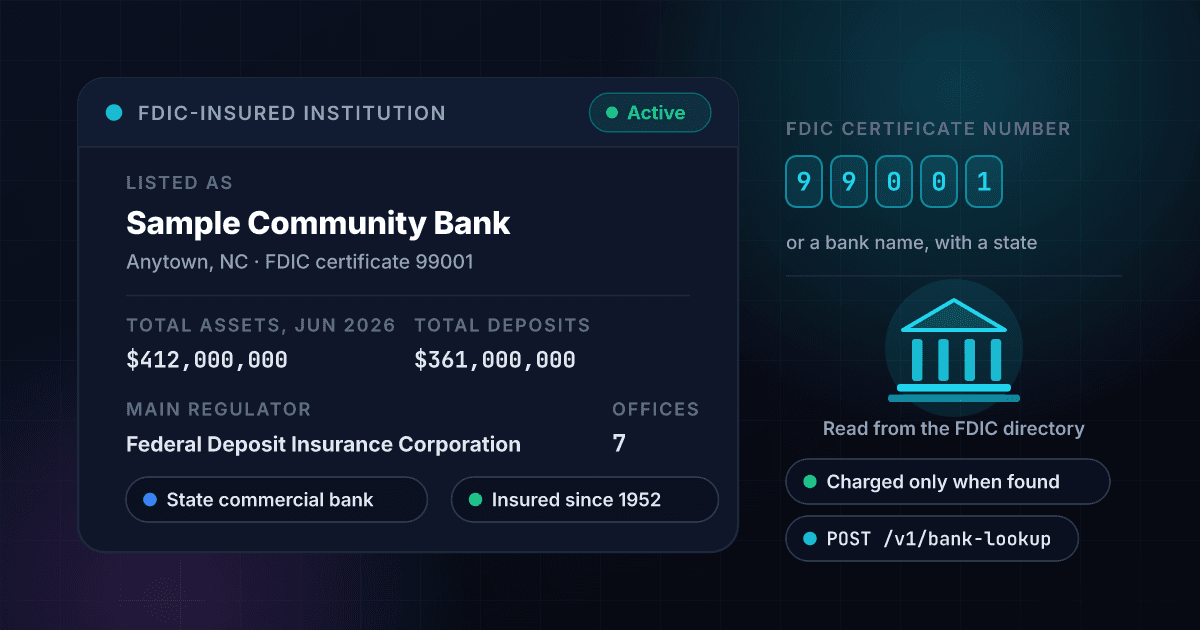
Send a bank name or an FDIC certificate number and get its status, address, regulator, offices, total assets and deposits and holding company, read from the FDIC's own directory. 2 credits, charged only when the bank is found.
2
Credits per bank
about $0.01 on Starter
0
Credits when not found
no record, no charge
Up to 9
Other matches listed with a name
one charge for the whole lookup
2M
Rows in one CSV file
a name or certificate number per row
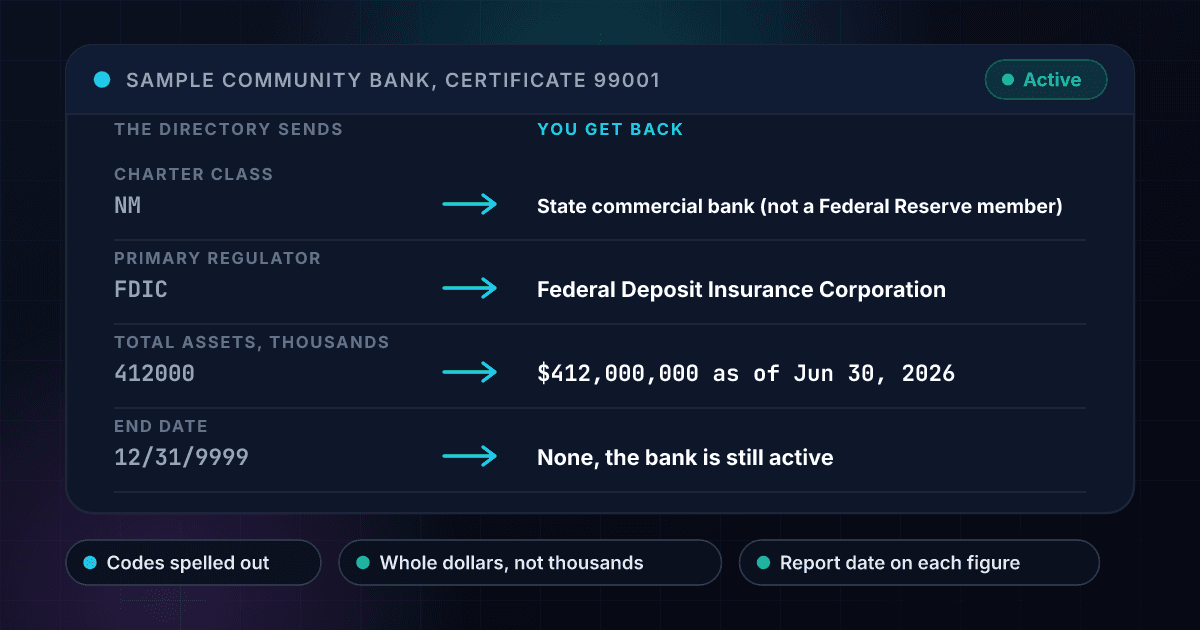
The directory's codes and thousands become words and whole dollars before they reach you
A charter class code, a regulator code and money in thousands are spelled out, and every figure carries the date of the quarterly report it came from.
A bank comes back as the FDIC's own record in one flat payload
The record comes from the FDIC's own public directory
The status, address, charter, regulator, offices, assets and deposits come from the FDIC's directory of insured banks and savings institutions. It is public US government data, and every figure carries the date of the quarterly report it is from.
- Active or no longer active, with the end date
- Address, county and website
- Number of offices, domestic and foreign
- Holding company and the dates it was established and insured
The regulator and the charter come back in words
A charter class code such as NM comes back as State commercial bank (not a Federal Reserve member), and the regulator comes back as an agency's name, so nobody on your team has to keep a table of FDIC codes.
- Main regulator named
- Charter class in plain words
- The raw codes kept under insights
- The Federal Reserve ID number included
Assets and deposits come in whole dollars with their report date
The FDIC reports money in thousands of dollars. The API multiplies it out once, so a total_assets_usd of 412000000 is $412 million, and report_date says which quarter the figure is from.
- Total assets and total deposits
- Net income from the same report
- Whole US dollars, never thousands
- A figure not reported is null, not 0
A name that matches several banks is handled in one call
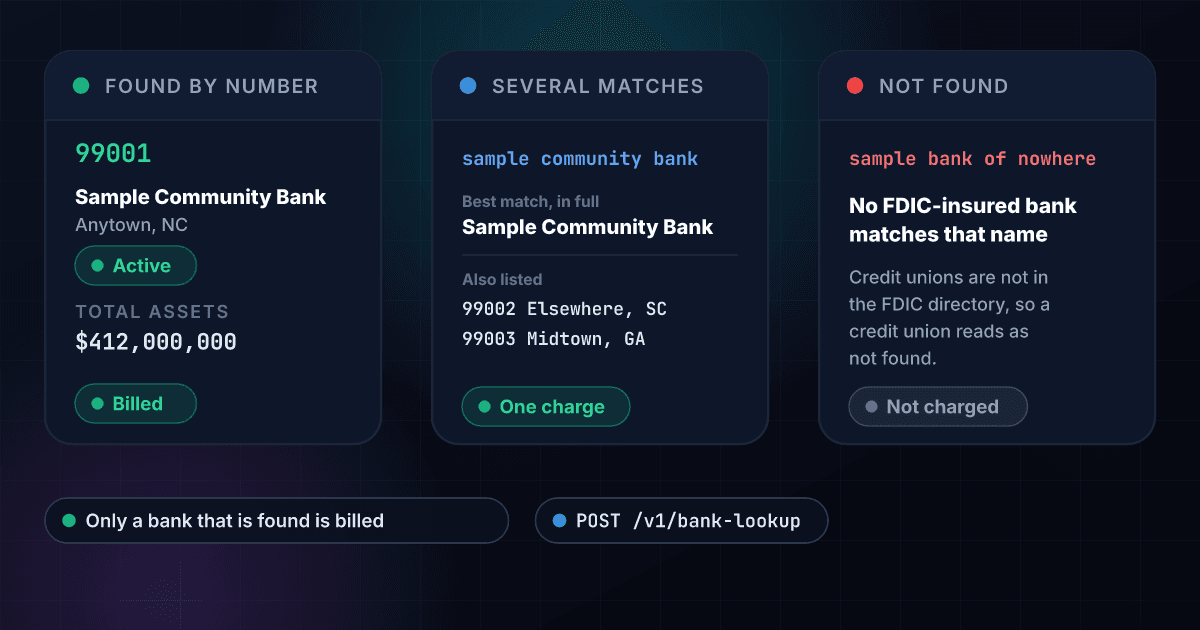
A name search returns the best match in full and lists up to nine others with their certificate numbers, cities and states, so a common name is not mistaken for one bank. A state or the certificate number narrows it to one.
- Best match returned in full
- Up to nine other matches listed
- match_count for how many matched
- One charge for the whole lookup
A bank that has closed is returned and marked for review
A closed or merged bank comes back with active set to false and the date it ended, and the recommendation changes from APPROVE to REVIEW, so a payee or partner that is no longer active is not passed as live.
- active: false and end_date
- primary_action REVIEW
- A live bank preferred when a name is close
- Billed like any record found
A bank that is not found costs nothing
You are charged 2 credits only when the directory holds the institution. A credit union, a misspelled name, a certificate number the FDIC never issued, a malformed entry and a lookup that could not be answered cost 0, and that holds for bulk CSV jobs as well as the API.
- Zero credits when not found
- Bulk CSV with a bank column
- The same credits as every other product
- One API key for all of it
A bank name or number goes in and the FDIC record comes out
Send a name or a certificate number
POST a bank name, with a two-letter state if you want to narrow it, or an FDIC certificate number of one to six digits. A certificate number wins when both are sent, and a malformed entry is refused with a clear error and costs nothing.
$ POST /api/v1/bank-lookup
"name": "Sample Community Bank"
"state": "NC"
We read the FDIC directory
The directory lists every FDIC-insured bank and savings institution, open or closed. We find the best match, turn the charter and regulator codes into words and the thousands of dollars into whole dollars, and label each figure with its report date.
Name or certificate checked
FDIC directory read
Best match chosen
Codes spelled out, dollars made whole
Get the record, flat and structured
Status, address, charter, regulator, offices, assets, deposits and holding company arrive in one JSON payload. A bank found bills 2 credits, and a name or number the directory does not hold bills nothing.
bankSample Community Bank
statusActive, 7 offices
assets$412,000,000
One endpoint looks up a bank and works like every other 1Lookup call
Same authentication, same credit balance, and the same response envelope as every other 1Lookup product. If you have already integrated one endpoint, this one is a URL change.
curl -X POST https://app.1lookup.io/api/v1/bank-lookup \
  -H "Authorization: Bearer $API_KEY" \
  -H "Content-Type: application/json" \
-d '{ "name": "Sample Community Bank", "state": "NC" }'{
"classification": {
"found": true,
"fdic_cert": 99001,
"name": "Sample Community Bank",
"status": "Active",
"active": true,
"end_date": null,
"address": "100 Sample Street, Anytown, NC 27000",
"street": "100 Sample Street",
"city": "Anytown",
"state": "NC",
"zip": "27000",
"county": "Sample",
"website": "https://www.samplecommunitybank.example.com",
"charter_class": "State commercial bank (not a Federal Reserve member)",
"regulator": "Federal Deposit Insurance Corporation",
"branch_count": 7,
"total_assets_usd": 412000000,
"total_deposits_usd": 361000000,
"holding_company": "SAMPLE BANCORP INC",
"established_date": "1952-03-01",
"insured_since": "1952-03-01",
"report_date": "2026-06-30",
"name_search": true,
"match_count": 2
},
"insights": {
"bank_lookup_result": {
"charter": { "class_code": "NM", "chartered_by": "STATE" },
"offices": { "total": 7, "domestic": 7, "foreign": 0 },
"financials": {
"total_assets_usd": 412000000,
"total_deposits_usd": 361000000,
"net_income_usd": 3100000,
"as_of": "2026-06-30"
},
"other_matches": [
{ "fdic_cert": 99002, "name": "Sample Community Bank of Elsewhere", "active": true, "city": "Elsewhere", "state": "SC" }
],
"data_source": "fdic"
}
},
"recommendations": {
"primary_action": "VERIFY",
"secondary_actions": ["check_other_matches"]
},
"metadata": { "credits_used": 2, "cache_hit": false }
}A column of banks goes in and one row per bank comes out
Upload a CSV with a bank column that holds a name or an FDIC certificate number and download a result file with each bank's status, state and total assets. The three banks here are invented.
- 1bank
- 2sample community bank
- 399004
- 4sample bank of nowhere
| bank | Found | Bank Name | FDIC Certificate | Bank Status | State | Total Assets (USD) | Credits Used |
|---|---|---|---|---|---|---|---|
| sample community bank | Yes | Sample Community Bank | 99001 | Active | NC | 412000000 | 2 |
| 99004 | Yes | Riverside Sample Savings Bank | 99004 | No longer active (since 2023-03-10) | OH | 61000000 | 2 |
| sample bank of nowhere | No | 0 |
Eleven more columns in the file, among them Address, City, Website, Charter Class, Regulator, Branch Count, Total Deposits (USD), Holding Company and Established.
One row in, one row out
Every bank becomes one row, so a list of 500 counterparties is a spreadsheet of 500 rows you can sort by size or filter by status.
A bank that is not found is a free row
A credit union, a misspelled name or an unknown certificate number comes back as a row that says so and costs 0 credits, so cleaning a list never bills for the misses.
A closed bank is a row that says so
A bank that has closed is still returned with its status and the date it ended, so the list shows which entries are no longer active.
One call returns the FDIC record for a bank
One call turns a bank name or a certificate number on an application, an invoice or a counterparty list into the FDIC record for it: whether the bank is active, where it is, who regulates it, how many offices it has and how large it is, with the raw JSON your code receives beside it. Money comes back in whole dollars with the date of the quarterly report it is from.
- BankSample Community Bank
- FDIC certificate99001
- StatusActive
- LocationAnytown, NC
- CharterState commercial bank (not a Federal Reserve member)
- Main regulatorFederal Deposit Insurance Corporation
- Offices7
- Total assets$412,000,000
- Total deposits$361,000,000
- Holding companySAMPLE BANCORP INC
- Insured since1952-03-01
- Report date2026-06-30
- Other matches1 more, in other_matches
{
  "classification": {
    "found": true,
    "fdic_cert": 99001,
    "name": "Sample Community Bank",
    "status": "Active",
    "charter_class": "State commercial bank (not a Federal Reserve member)",
    "regulator": "Federal Deposit Insurance Corporation",
    "branch_count": 7,
    "total_assets_usd": 412000000,
    "total_deposits_usd": 361000000,
    "holding_company": "SAMPLE BANCORP INC",
    "report_date": "2026-06-30",
    "match_count": 2
  },
  "insights": {
    "bank_lookup_result": {
      "other_matches": [{ "fdic_cert": 99002, "active": true, "state": "SC" }],
      "data_source": "fdic"
    }
  },
  "metadata": { "credits_used": 2 }
}
Every bank lookup returns the same fields at one flat price
A field the FDIC directory does not hold comes back as null and never as a guess, and every bank found costs the same 2 credits.
Identity and status
- found
- fdic_cert
- name
- status
- active
- end_date
Address
- address
- street
- city
- state
- zip
- county
- website
Charter and regulator
- charter_class
- charter.class_code
- charter.chartered_by
- regulator
- regulator.code
- specialization
Size
- branch_count
- offices.domestic
- offices.foreign
- total_assets_usd
- total_deposits_usd
- financials.net_income_usd
- report_date
History and matches
- holding_company
- established_date
- insured_since
- fed_rssd
- name_search
- match_count
- other_matches[]
Lenders, payment teams and compliance teams check a bank instead of searching the FDIC site by hand
Fintech and lending teams checking a partner bank
Look up the bank named on an application, confirm the FDIC lists it as active, and read its regulator, offices and latest assets before the file goes to review.
Accounts payable and treasury teams checking a payee
Check that a payee that says it is a bank is a listed institution and not one that has closed, before a payment run or a vendor record is set up.
Compliance teams onboarding a bank counterparty
Start the counterparty file from the FDIC record: charter, main regulator, holding company and size, then compare the name and address with what the counterparty submitted.
Payment platforms and business sign-up flows
Let a business enter its bank's name at sign-up and fill in the bank's location and status from the FDIC record instead of asking it to type them and checking by hand.
Journalists and researchers sizing up banks
Run a list of banks through a bulk job to pull each one's charter, number of offices and latest total assets, then sort the list by size.
Deposit and wealth advisors checking a bank
Check that a bank recommended for a deposit is listed as active, see which agency is its main regulator, and note how large it is.
Only a bank that is found is billed, and every other answer is free
A certificate number returns one record. A name that matches several banks returns the best match in full for one charge, and a name the directory does not hold returns not found at no charge.
These are the questions people ask before they look up their first bank
What does the Bank Lookup API return?
Send a bank name, with a two-letter state if you like, or an FDIC certificate number and it returns the FDIC-insured institution behind it: its status, name, address and website, charter class, main regulator, number of offices, total assets and total deposits in whole dollars with the report date, holding company, and the dates it was established and became insured. A name search returns the best match in full and lists up to nine other matches by certificate number, name, status, city and state.
Where does the bank data come from?
From the FDIC's own public directory of banks and savings institutions, which lists every FDIC-insured institution, open or closed. We read the directory when you look a bank up, so the record is as current as the FDIC's. The money figures come from each bank's latest quarterly report, and report_date says which quarter that is.
How current is the record, and can I ask again?
The figures are as current as the FDIC's latest quarterly report for that bank, and report_date names the quarter. A repeat lookup of the same bank by the same user within 7 days comes from the cache at no charge. Send bypass_cache: true to run the lookup again instead of reusing the saved answer.
How much does a bank lookup cost?
2 credits per lookup, about $0.01 on the Starter plan. You are charged only when a bank is found. A name or certificate number the directory does not hold, a malformed entry and a lookup that could not be answered all cost 0 credits, in the API, the dashboard and bulk jobs.
Why does a bank come back not found?
The directory lists FDIC-insured banks and savings institutions. A credit union is not in it, so it returns found: false, as do a name that does not match every word of the institution's name, a bank that is known by another name and a certificate number the FDIC never issued. A not-found answer costs 0 credits.
Does it return banks that have closed?
Yes. A bank that has closed or merged away is returned with active: false and the date it ended in end_date, and primary_action is REVIEW instead of APPROVE. It is billed like any other record found, because the record exists.
Which bank does a name search return when several match?
The best match, in full, with up to nine other matches listed under other_matches and match_count giving how many banks matched in all. A live bank is preferred to a closed one when it is nearly as good a match. A name search is one lookup and one charge however many banks match, and a two-letter state or the certificate number narrows it to one.
What happens when I mistype a certificate number or send a bad name?
It is refused before anything is charged. A certificate number is one to six digits, a name is 2 to 100 characters and a state is two letters, and anything else returns a clear error at no cost. If the FDIC directory cannot be reached, the API answers 503 with a Retry-After header, charges nothing and does not save the answer, so a retry is never a second charge.
How are the assets and deposits given?
In whole US dollars. The FDIC reports them in thousands of dollars, and the API multiplies them out, so a total_assets_usd of 412000000 is $412 million. Each figure is as of report_date, and a figure a bank did not report comes back as null.
Does it say who regulates a bank?
Yes. regulator is the agency that the FDIC records as the bank's primary regulator, and charter_class is the kind of charter in plain words, such as State commercial bank (not a Federal Reserve member). The raw codes sit under insights.bank_lookup_result for code that wants them.
Does it return branch addresses or a routing number?
No. It returns the number of offices the bank reports, split into domestic and foreign, but not the address of each branch, and it has no routing number. Credit unions are not in the directory either.
Can I search by routing number?
No: the lookup takes a bank name or an FDIC certificate number and returns the FDIC institution record. A routing number comes from a payment-system directory, which is a different job from the FDIC's record of an insured bank.
Can I check a list of banks at once?
Yes. Upload a CSV with a bank column holding a name or a certificate number and you get a row per bank with its status, location, charter, regulator, offices, assets and deposits. A row that is not a valid name or number fails without a charge. The price stays at the same credits per bank found, however long the list is.
To check a single bank before you write any code, run it through the free FDIC bank lookup.
The FDIC record says the bank is listed, and these products check the rest
Here is how checking a US bank with 1Lookup compares with the other bank data sources
Each page sets a rival's plans and prices beside ours and says where the rival does the job better. Every figure carries its source and the date it was checked.