The LEI Lookup API returns the legal entity registered to any LEI code
Send a 20-character LEI, or a company's legal name, and get the entity's status, jurisdiction, addresses, renewal dates and parent companies from the global LEI index. 2 credits, charged only when found.
2
Credits per lookup
about $0.01 on Starter
0
Credits when not found
no record, no charge
10
Matches per name search
or look up one LEI
Live
Read from the LEI index
the public global register
An LEI comes back as the index's record in one flat payload
The record comes straight from the global LEI index
Every field comes from the public index of legal entity identifiers. The record is read when you ask, so an update the entity filed shows up as soon as the index has it.
- Read live from the public index
- Legal name and other names on file
- Active or inactive entity
- Created, registered and updated dates
You can see at a glance whether the LEI is still current
The registration status and the next renewal date come with every record, and a registration that has lapsed or is past its renewal date is flagged, so an out-of-date code is not mistaken for a live one.
- Registration status
- Next renewal date
- Lapsed or overdue flag
- How well the data was checked
Direct and ultimate parents come with their own LEIs
Where the entity reported its owners, you get the direct and ultimate parent with their LEIs and names. Where it reported a reason for naming none, the result says so instead of leaving a blank.
- Direct parent
- Ultimate parent
- A reason when none is named
- Unknown, never guessed, when it cannot be read
Legal and headquarters addresses are returned in full
The legal address and the headquarters address come back both as parts and as one formatted line, along with the jurisdiction and the number the entity is registered under in its own business register.
- Legal address
- Headquarters address
- Jurisdiction
- Business register number
A name search finds the LEI when a name is all you have
Search by legal name, narrowed by country, and get up to 10 matches to choose from, each with its LEI, status and jurisdiction. Then look the right one up by its LEI for the full record.
- legal_name with an optional country
- Every word must match the registered name
- Up to 10 matches per search
- Charged only when there is a match
A code the index does not hold costs nothing
You are charged 2 credits only when the index returns a record. A code that was never issued, a typo and an index that did not answer cost 0, and that holds for bulk CSV jobs as well as the API.
- Zero credits when not found
- Bulk CSV with an lei column
- The same credits as every other product
- One API key for all of it
An LEI goes in and the index's record comes out
Send a 20-character LEI or a legal name
POST the code, or search by legal name through the API. The code's two check digits are tested first, so a typo is refused with a clear error and costs nothing.
$ POST /api/v1/lei-lookup
"lei": "5299000SAMPLE000XX85"
> check digits valid
We read the global LEI index
The public LEI index is queried when you ask, and the entity's parents are read from the relationship records it links to. A parent that cannot be read is reported as unknown and not saved.
LEI length and check digits tested
Global LEI index queried
Entity record read
Parent companies resolved
Get the record, flat and structured
Name, status, addresses, dates and parents arrive in one JSON payload. A record found bills 2 credits, and a code the index does not hold bills nothing.
entityExample Holdings Inc.
jurisdictionUS-DE
next renewal2027-02-10
One endpoint looks up an LEI and works like every other 1Lookup call
Same authentication, same credit balance, and the same response envelope as every other 1Lookup product. If you have already integrated one endpoint, this one is a URL change.
curl -X POST https://app.1lookup.io/api/v1/lei-lookup \
  -H "Authorization: Bearer $API_KEY" \
  -H "Content-Type: application/json" \
  -d '{ "lei": "5299000SAMPLE000XX85" }'

# or search by legal name, up to 10 matches
# -d '{ "legal_name": "Example Holdings", "country": "US" }'{
"classification": {
"found": true,
"lei": "5299000SAMPLE000XX85",
"legal_name": "Example Holdings Inc.",
"entity_status": "ACTIVE",
"registration_status": "ISSUED",
"is_active": true,
"lei_current": true,
"jurisdiction": "US-DE",
"legal_address": "100 Sample Street, Suite 200, Wilmington, DE, 19801, US",
"registered_as": "1234567",
"entity_creation_date": "1998-04-15",
"next_renewal_date": "2027-02-10",
"renewal_overdue": false,
"parent_lei": "5299000PARENT000XX41",
"parent_name": "Example Group Holdings Inc.",
"ultimate_parent_name": "Example Group Holdings Inc."
},
"insights": {
"lei_lookup_result": {
"other_names": [
{ "name": "Sample Holdings Corporation", "type": "PREVIOUS_LEGAL_NAME" }
],
"registration": {
"status": "ISSUED",
"initial_registration_date": "2014-01-22",
"last_update_date": "2026-02-10",
"next_renewal_date": "2027-02-10",
"corroboration_level": "FULLY_CORROBORATED"
},
"relationships": {
"direct_parent": {
"status": "reported",
"lei": "5299000PARENT000XX41",
"legal_name": "Example Group Holdings Inc."
}
},
"data_source": "gleif"
}
},
"metadata": { "credits_used": 2, "cache_hit": false }
}One call returns the index's record for a legal entity
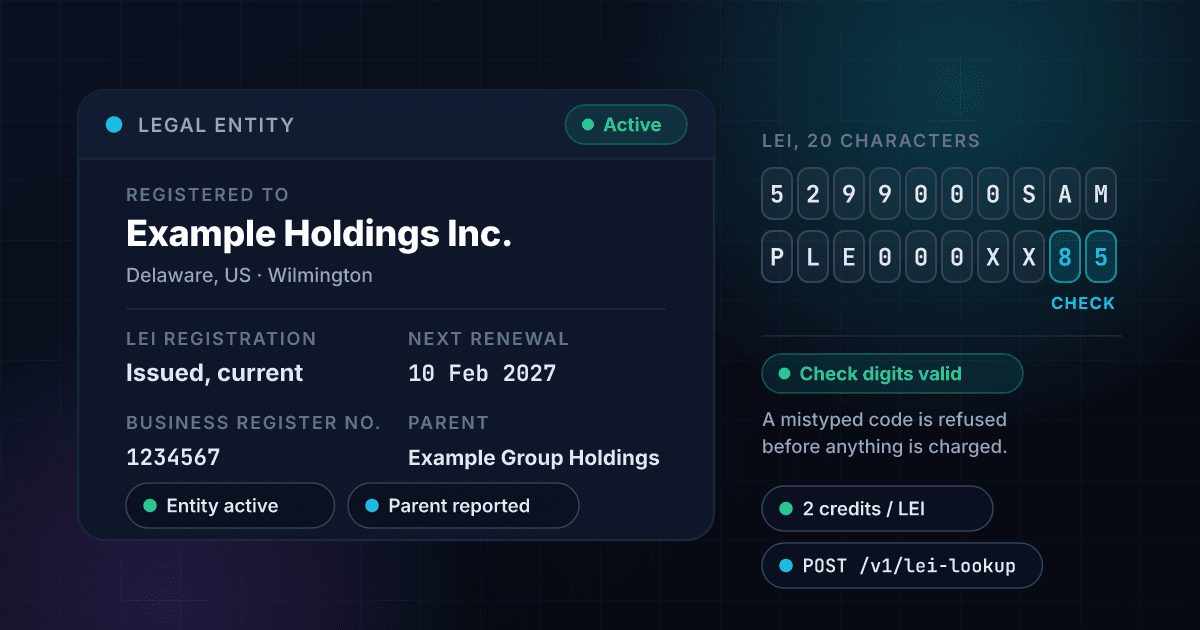
One call turns an LEI on a trade report, a contract or a counterparty list into the index's record for it: who the code was issued to, whether the entity and its registration are current, where it is based and who owns it, with the raw JSON your code receives beside it.
- LEI5299000SAMPLE000XX85
- Legal nameExample Holdings Inc.
- EntityActive
- LEI registrationIssued, current
- JurisdictionUS-DE
- Legal address100 Sample Street, Suite 200, Wilmington, DE
- Business register no.1234567
- Previous nameSample Holdings Corporation
- Next renewal10 February 2027
- Direct parentExample Group Holdings Inc.
- Ultimate parentExample Group Holdings Inc.
{
  "classification": {
    "found": true,
    "lei": "5299000SAMPLE000XX85",
    "legal_name": "Example Holdings Inc.",
    "entity_status": "ACTIVE",
    "registration_status": "ISSUED",
    "jurisdiction": "US-DE",
    "next_renewal_date": "2027-02-10",
    "renewal_overdue": false,
    "parent_lei": "5299000PARENT000XX41",
    "parent_name": "Example Group Holdings Inc."
  },
  "insights": {
    "lei_lookup_result": {
      "relationships": {
        "ultimate_parent": {
          "status": "reported",
          "legal_name": "Example Group Holdings Inc."
        }
      },
      "data_source": "gleif"
    }
  },
  "metadata": { "credits_used": 2 }
}
Every LEI lookup returns the same fields at one flat price
A field the entity did not file comes back as null and never as a guess, and every lookup costs the same 2 credits.
It names the legal entity and the numbers it is known by
- found
- lei
- legal_name
- other_names[]
- registered_as
- legal_form_code
It says whether the entity and its LEI registration are current
- entity_status
- is_active
- registration_status
- lei_current
- renewal_overdue
- entity_expiration_date
It gives the dates the entity was created, registered and updated, and when it must renew
- entity_creation_date
- initial_registration_date
- last_update_date
- next_renewal_date
It gives the jurisdiction and both addresses
- jurisdiction
- country
- legal_address
- headquarters_address
It names the direct and ultimate parents with their own LEIs
- parent_lei
- parent_name
- ultimate_parent_lei
- ultimate_parent_name
- relationships
Compliance teams, banks and fund administrators look up LEIs instead of copying records by hand
Compliance teams onboarding a counterparty
Look up the LEI a counterparty gave you, confirm the entity is active, its registration is current and its jurisdiction matches the contract, and record who its ultimate parent is.
Banks and brokers checking trade and transaction reports
Run the LEIs on a day's reports through a bulk job to flag lapsed registrations and inactive entities before the reports are filed.
Fund administrators and asset managers
Keep a register of the entities you deal with up to date by checking renewal dates and parent companies on a schedule, instead of waiting for a filing to fail.
Credit and risk analysts mapping corporate groups
Start from a subsidiary's LEI and follow its direct and ultimate parent to see which group it belongs to, then group exposure by the parent.
Procurement and vendor-management teams
Search a supplier's legal name and country to find its LEI, then look it up for the registered address and business register number to match against your vendor record.
Fintech and onboarding platforms
Let a business customer enter an LEI at sign-up and fill in its legal name, address and jurisdiction from the index, instead of asking them to type it and checking it by hand.
These are the questions people ask before they look up their first LEI
What does the LEI Lookup API return?
Send a 20-character LEI and it returns the legal entity registered to it: the legal name and any other names on file, whether the entity is active, whether the LEI registration is current or has lapsed, the jurisdiction, the legal and headquarters addresses, the business register number, the dates it was created, registered, last updated and is next due for renewal, and its direct and ultimate parent companies where they were reported.
Where does the LEI data come from?
From the global LEI index, the public register of legal entity identifiers that anyone can read. An LEI is the 20-character code that companies and funds use to identify themselves in financial markets, and the index holds the record each entity filed.
Can I search by company name instead of by LEI?
Yes. Send legal_name, with an optional two-letter country to narrow it, and you get up to 10 entities whose registered name contains every word you typed, each with its LEI, name, status and jurisdiction. A name search costs 2 credits and is charged only when at least one match comes back. Look a match up by its LEI for the full record.
How much does an LEI lookup cost?
2 credits per lookup, about $0.01 on the Starter plan. You are charged only when the index returns a record. A code the index does not hold, a mistyped LEI, a search with no matches and an index that did not answer all cost 0 credits, in the API, the dashboard and bulk jobs.
What happens when I mistype an LEI?
It is refused before anything is charged. The last two characters of an LEI are check digits calculated from the other eighteen, so the API catches a typo or a transposed character before it asks the index and returns a clear error at no cost.
Does it say whether the LEI is still current?
Yes. The result carries the registration status and the date the next renewal is due, and flags a registration that has lapsed or whose renewal date has passed. Registrations lapse when they are not renewed each year, so check that field as well as the name before you rely on a code.
How does it show a company's parent?
Each of the direct and ultimate parent is reported with its own LEI and name when the entity filed one. An entity can instead report a reason it names no parent, such as being owned by natural persons, and the result says so rather than leaving the field empty. If a parent record cannot be read, the result says the parent is unknown and the answer is not saved, so the next lookup tries again.
What does an LEI look like?
It is 20 letters and digits, and the last two are check digits calculated from the first eighteen, so a typo or a transposed character is caught before the index is asked. Spaces and dashes are ignored, so you can paste a code the way it is printed.
Can I check a list of LEIs at once?
Yes. Upload a CSV with an lei column and you get a row per entity with its name, status, jurisdiction, addresses and renewal date. A row that is not a valid LEI fails without a charge. Bulk files take LEIs only, because a name search can return up to 10 entities and a row needs one answer.
Does an LEI mean the company is trustworthy?
No. An LEI shows that an entity registered itself and who it says it is, and that the registration was checked by the issuing organisation. It is not a credit rating, a sanctions screen or proof of good standing, so use it to identify the entity and its parent, then run the checks your policy needs.
How current is the record, and can I ask again?
A first lookup reads the index when you ask, so you get the record as it stands at that moment. A repeat lookup of the same input by you within 7 days comes from your saved result at no charge. Send bypass_cache: true to read the index again.
To look up one LEI, or find the LEI of a company by name, before you write any code, use the free LEI lookup.
An LEI identifies the entity, and these products check the rest
Here is how looking up an LEI with 1Lookup compares with OpenCorporates
The page sets OpenCorporates' plans and prices beside ours and says where it does the job better. Every figure carries its source and the date it was checked.