Domain Age API: when a domain was really registered
Domain in, registration facts out: creation date, exact age, expiry, registrar, registry status and nameservers, read straight from the registry. 2 credits, and nothing at all for a domain nobody has registered.
2
Credits per domain
vs 10 for Domain Authority
0
Credits when unregistered
no record, no charge
1,200+
Top-level domains
resolved from IANA's own map
No broker
Straight from the registry
the date the registry publishes
What Domain Age gives you
The registry's own date, not an estimate
Every generic top-level domain registry is required by ICANN to publish a lookup service. We read the creation date from that service, so the date you get is the one of record.
- Creation date exactly as the registry publishes it
- No data broker between you and the source
- Around 1,200 top-level domains, resolved from IANA's map
- Expiry, last-updated and transfer dates in the same call
Age in the shape you need it
The same registration date, returned four ways, so you never have to do date maths in your own code to answer the question you actually have.
- age_days for thresholds and rules
- age_years for sorting and reporting
- age_human for anything a person reads
- age_band from brand_new through to veteran
A fraud signal, not just a fact
A domain registered in the last month is the common denominator of phishing and invoice fraud, because the campaign cannot be older than the domain it runs on.
- is_newly_registered flag for a one-line rule
- risk_level and risk_score across age, expiry and status
- Registry hold and pending-delete statuses surfaced
- Missing nameserver delegation flagged
Honest about what is not knowable
A few registries publish everything except the creation date. We say so instead of returning a guess dressed up as a fact.
- Null age, never a fabricated one, when a registry withholds it
- Unregistered domains returned as available, and never charged
- No first-seen dates from archives passed off as registration dates
- Explicit reason when a top-level domain has no public service
Domain in, registration record out
Send any domain or URL
POST a bare domain, a full URL, or a subdomain. We reduce it to the name the registry actually holds a record for, which means stripping the path, handling multi-part endings like .co.uk correctly, and converting non-Latin names to the form registries index.
$ POST /v1/domain-age
"domain": "https://blog.stripe.com/x"
> reduced to stripe.com
We ask the registry itself
We resolve which registry runs the top-level domain from IANA's own published map, then query that registry directly over RDAP. No vendor, no scraped WHOIS text, no cached third-party copy of the answer.
Top-level domain resolved via IANA
Registry located: .com
Registration record read
Age and expiry computed
Get the dates and the flags
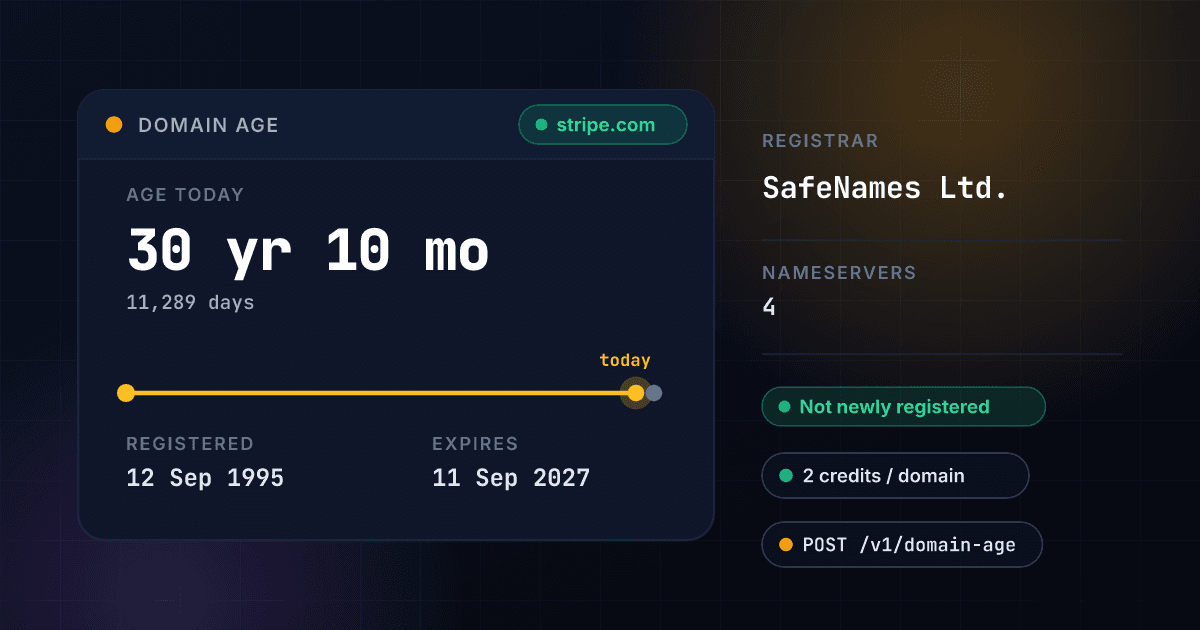
Creation date, age in days and in plain English, expiry, registrar, registry status codes and nameservers, plus a newly-registered flag and a risk band you can wire straight into a rule.
registered12 Sep 1995
age30 years, 10 months
expires11 Sep 2027
One endpoint. A domain name, or any URL containing one in, structured data out.
Same authentication, same credit balance, and the same response envelope as every other 1Lookup product. If you have already integrated one endpoint, this one is a URL change.
curl -X POST https://app.1lookup.io/api/v1/domain-age \
  -H "Authorization: Bearer $API_KEY" \
  -H "Content-Type: application/json" \
  -d '{
        "domain": "stripe.com"
}'{
"classification": {
"found": true,
"registered": true,
"domain": "stripe.com",
"created_date": "1995-09-12T04:00:00.000Z",
"age_days": 11290,
"age_years": 30.91,
"age_human": "30 years, 10 months",
"age_band": "veteran",
"registrar": "SafeNames Ltd.",
"is_newly_registered": false
},
"insights": {
"domain_age_result": {
"expires_date": "2027-09-11T04:00:00.000Z",
"days_until_expiry": 397,
"registry_statuses": ["client transfer prohibited"],
"nameserver_count": 4,
"dnssec": false,
"risk_level": "LOW",
"data_source": "registry_rdap"
}
},
"metadata": { "credits_used": 2, "cache_hit": false }
}What a domain age check returns
One call turns a domain on a list into its registration history: when it was bought, how old that makes it today, when it lapses, and who it is registered through, with the raw JSON your code receives beside it.
- Domainstripe.com
- Registered on12 September 1995
- Age today30 years, 10 months
- Age in days11,290
- Age bandVeteran (10+ years)
- Expires on11 September 2027
- Days until expiry397
- RegistrarSafeNames Ltd.
- Registry statusclient transfer prohibited
- Nameservers4
- Newly registeredNo
{
  "classification": {
    "registered": true,
    "domain": "stripe.com",
    "created_date": "1995-09-12T04:00:00.000Z",
    "age_days": 11290,
    "age_human": "30 years, 10 months",
    "age_band": "veteran",
    "is_newly_registered": false
  },
  "insights": {
    "domain_age_result": {
      "expires_date": "2027-09-11T04:00:00.000Z",
      "days_until_expiry": 397,
      "registrar": "SafeNames Ltd.",
      "risk_level": "LOW"
    }
  },
  "metadata": { "credits_used": 2 }
}
Every field you get back
No hidden tiers. Every field below is returned on a successful lookup at the price shown above.
Age
- created_date
- age_days
- age_years
- age_human
- age_band
- is_newly_registered
Lifecycle
- expires_date
- days_until_expiry
- is_expired
- is_expiring_soon
- updated_date
- last_transferred_date
Registration
- registrar
- registrar_iana_id
- registry_handle
- registry_statuses
DNS
- nameservers
- nameserver_count
- dnssec
Risk
- risk_score
- risk_level
- risk_factors
- registered
Who uses Domain Age
Fraud and risk teams
Score the domain behind every signup, invoice and bank-change request. A domain registered three weeks ago on a supplier payment request is the cheapest red flag you will ever buy, at 2 credits.
SEO and link builders
Run a prospect list through in bulk and drop the freshly registered domains before you spend outreach time on them. Registration date also tells you whether a domain being sold as aged really is.
Domain investors
Check age, expiry and registry status across a watchlist in one job. Expiry dates and pending-delete statuses are what tell you when a name is about to become available.
Security and threat intel
Enrich indicators with registration age at scale. Newly registered domains are a standard pivot in phishing infrastructure hunting, and this makes that pivot cost effectively nothing.
Sales and RevOps
A prospect whose domain was registered last week is a different company from one whose domain has been live for fifteen years. Append registration age to inbound leads to sort real businesses from shells.
Marketplaces and platforms
Gate seller or advertiser onboarding on domain age. It is a low-friction check that filters throwaway registrations without asking a legitimate business for another document.
Frequently asked questions
What is domain age?
Domain age is how long ago a domain name was first registered. It is measured from the registration date on the domain's registry record, not from when a website was launched, when it was first indexed by Google, or when the current owner bought it. symbolics.com was registered on 15 March 1985 and is still that old today, regardless of how many times it has changed hands since.
Is domain age a Google ranking factor?
No. Asked directly whether domain age helps rankings, Google's John Mueller answered "No, domain age helps nothing." Google has said it uses domain history to find spam, not as a ranking signal. What does correlate with rankings is what an older domain tends to have accumulated along the way: links, content and trust. A ten-year-old domain with no backlinks does not outrank a one-year-old domain with good ones. Use domain age as context on a site's history, not as a score.
Where does the registration date come from?
Directly from the domain's registry, over RDAP, the modern replacement for WHOIS that ICANN requires every generic top-level domain registry to operate. The date you get is the one the registry itself publishes. There is no data broker in between, which is why this lookup costs 2 credits rather than the 10 a vendor-sourced domain lookup costs.
Which domains does it cover?
Around 1,200 top-level domains, resolved from IANA's own registry map: .com, .net, .org, every new gTLD, and a good share of country domains. Coverage of country domains is the weak spot, because they are not bound by the ICANN rule that forces the rest to publish. Some, like .de and .ch, answer but withhold the creation date by policy; others, .co among them, publish nothing we can read. In every one of those cases the API says which it is and charges nothing, rather than guessing a date.
How much does a domain age check cost?
2 credits per registered domain, against 10 for a vendor-sourced domain lookup like Domain Authority. Unregistered domains cost nothing, and so do domains on a top-level domain with no public registry service. You are only charged when a registration record comes back.
Can I check domain age in bulk?
Yes. Upload a CSV of domains and get back a row per domain with the registration date, age in days and years, expiry date, registrar and risk level. Because the source is the registry rather than a paid data feed, the price stays at 2 credits a row no matter how large the list, which makes whole-list checks realistic for link prospecting and expired-domain research.
How does domain age help detect fraud?
A domain registered in the last 30 days is one of the strongest single signals in phishing and invoice-fraud detection, because an attacker's domain has to be new for the campaign to be new. Scoring signup emails, vendor bank-change requests and payment destinations against the age of their domain catches a large share of that traffic at almost no cost. The API returns an explicit is_newly_registered flag alongside the raw age so you can wire it straight into a rule.
What is the difference between domain age and website age?
Domain age is when the name was registered; website age is when a site first appeared on it. They often differ by years, because domains are frequently registered and parked long before anything is published, and because a dropped domain can be re-registered by someone new. This API reports the registration date, which is the only one of the two that has an authoritative public record.
Pairs well with
How Domain Age compares
Verified pricing and scope against the products buyers usually weigh this one against. Every number on those pages carries its source and the date it was checked.