Is This a Scam?
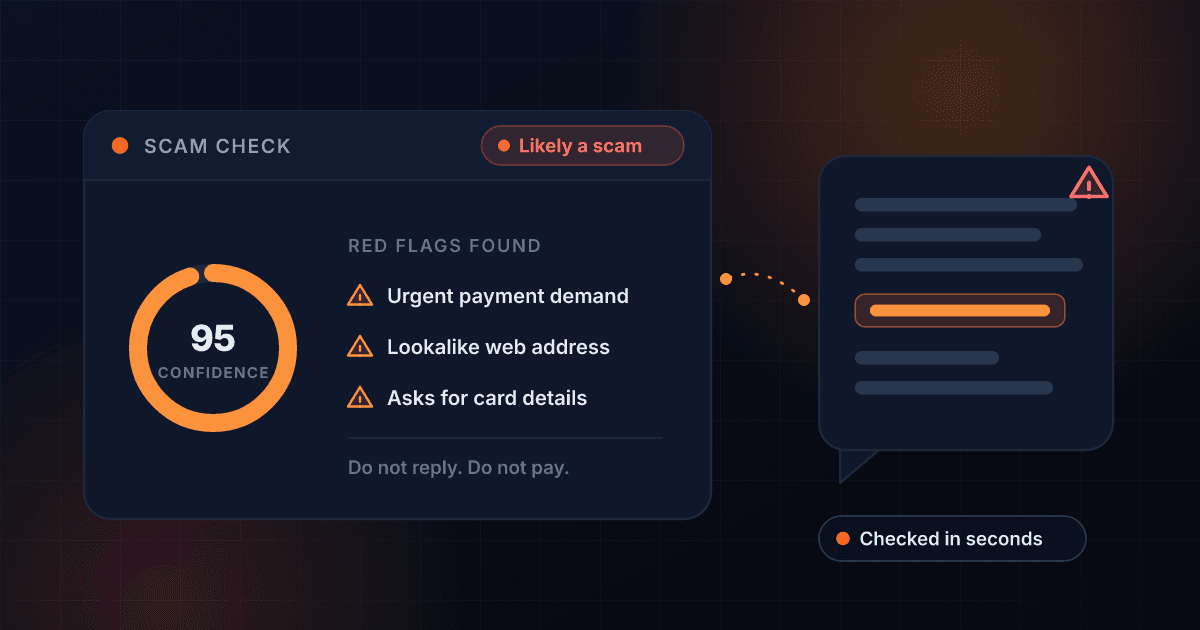
To tell if something is a scam, check for pressure to act fast, contact you did not expect, requests for payment in gift cards, crypto or bank transfer, and links whose address does not match the company named. Paste the message into 1Lookup's free scam checker and it flags these signals for you and explains what each one means.
Example resultThis is a real lookup we captured on 2026-08-23 for Hi, this is Mark from the IT helpdesk. We are upgrading email security tonight. Reply with your login password so we can…. Run any lookup above and it is replaced with yours.
This is almost certainly a phishing scam
A fake IT support worker is asking for your password under false urgency. Real IT staff never ask for passwords this way.
What we found
- Requests login password directly, which legitimate IT departments never do
- Creates false urgency: 'you will lose access tomorrow'
- Impersonates IT helpdesk, a common phishing tactic
- Unsolicited contact claiming to need credentials for account access
- Threatens account loss to pressure the recipient into complying
Confidence: 98%
This is an automated assessment of the content you pasted, not a guarantee. When money or credentials are involved, contact the organisation directly using a number or address you already trust.
This tool provides an automated assessment of the text you submit. It is not legal, financial or security advice, and it cannot guarantee that any message is safe or fraudulent. It reads only the content you paste: it does not verify the sender's identity, visit any linked page, or check external fraud databases. Never act on a low-risk result alone where money, credentials or personal data are at stake. Always verify directly with the organisation using contact details you already trust. If you believe you have been targeted or defrauded, report it to your bank and to the FTC at reportfraud.ftc.gov.
Need this at scale? Phone Spam Check API
Score spam and fraud risk across every number and contact in your database, on a schedule.
Find Out If Something Is a Scam Before You Act
Almost every scam works the same way: it reaches you out of nowhere, tells you something urgent is wrong, and asks you to move money or hand over details before you have time to check. The wrapping changes constantly. A package that cannot be delivered, a bank alert, an unpaid toll, a job offer, a friendly wrong number that turns into an investment tip. The mechanics underneath barely change at all.
That is what this tool reads for. Paste the message, email, listing or offer you received and it looks for the specific patterns fraud analysts look for: manufactured urgency, an unexpected first contact, requests for payment in gift cards, crypto or wire transfer, links whose real destination does not match the brand being claimed, and a story that changes shape whenever you push on it. You get a risk level, the specific things that triggered it, and a straight answer on what to do next.
We do not keep what you paste. It is sent to our AI provider to run the check and is not used to build any profile of you. This is an automated read of the words you gave us, so treat it as a well-informed second opinion rather than a verdict. When there is money involved, the safest move is always the same one: contact the company yourself using a number or website you already know is real, never one supplied in the message you are unsure about.
Most of these hang on one link
The checker reads the whole message, but the fastest tell is usually the address itself: whether the registered domain in the link belongs to the company being named. To test only that part, paste the URL into the free link safety checker.
What a scam message actually looks like
Every red flag in this made-up example is numbered, and each number is explained beside it. This one is a job offer, but the moves underneath it are the same in a romance, an investment or a marketplace scam.
Hi! I came across your profile and we would like to offer you a remote position (red flag 1) paying $1,200 a week for about three hours a day.
No interview is needed (red flag 2). You can start today.
To set up your home office we will send you a check. Deposit it, keep $200, and wire the rest to our equipment supplier. (red flag 3)
Reply on WhatsApp only (red flag 4), our HR system is down this week.
Red flag 1: A job you never applied for
Real employers hire from applications and interviews. An unsolicited offer that already has a salary attached is bait, not a job.
Red flag 2: No interview and no checks
Every real hire involves someone speaking to you. Skipping that is the point: it keeps you moving before you have time to think.
Red flag 3: Money that passes through you
This is the entire scam. Your bank shows the check as cleared within a day or two, then it bounces a week later. The money you wired is gone, and the bank takes it back from you.
Red flag 4: Moved to a chat app immediately
No record, no employer to complain to, and nothing anyone can trace. That is the reason for the request, not a broken HR system.
The example above is invented for illustration. It names no real company, and the address in it is not a live site.
How the Scam Checker Works
Paste what you received
Copy the full message, email or offer and paste it in. Include the sender's name, number or address if you have them, and leave any links exactly as they were sent. More context means a sharper read.
We analyse it for fraud patterns
The checker examines the text for the tactics that show up across almost all scams: urgency and threats, unexpected contact, payment requests, credential harvesting, mismatched links, and impersonation of a known brand or agency.
Read the verdict and the reasons
You get a risk level, a confidence score, and a list of the specific things we found, quoted from your text. Then check the number, address or domain behind it with our other free tools.
Reads any kind of message
Text messages, emails, marketplace listings, DMs, job offers, investment pitches and letters all go through the same check. You do not need to know what kind of scam it might be before you paste it in.
Shows its reasoning, not just a score
A one-word verdict tells you nothing you can act on. Every result lists the specific phrases and patterns that drove it, so you can judge whether the reasoning matches what you already suspected.
Catches manipulation aimed at the tool
Some scam text contains instructions meant to fool automated filters into passing it. We treat that text as evidence rather than instruction, and a message that tries it is flagged as higher risk, not lower.
Errs on the side of caution
When the signals are mixed, the tool says suspicious rather than safe. A false alarm costs you a phone call to your bank. A false all-clear can cost you your savings.

Who uses this tool
An unexpected message about money
A text about an unpaid toll, a bank alert about a charge you do not recognise, or a refund you never requested. Paste it here before tapping the link, then check the number that sent it with our free spam number lookup.
A job or investment offer
Remote job offers that arrive by text, recruiters who will only talk on WhatsApp, and trading tips from someone who messaged you by accident all follow known scripts. The checker names the script when it sees one.
Checking on behalf of a parent
Older relatives are targeted hardest and asked most often. Paste what they were sent and you get an explanation clear enough to forward to them, not a technical report they will ignore.
A buyer or seller who feels off
Marketplace scams turn on overpayment, shipping agents and moving the conversation off-platform. Paste the exchange and the tool will tell you which of those it can see.
Frequently asked questions
Is this scam checker actually free?
Yes. Five checks a day per tool, fifteen a day across all our free tools, from one IP address with a short pause between requests. No account, no card, nothing to install. If you need more than that, a free account gives you 1,000 lookups over a seven-day trial.
Do you store the messages I paste?
We do not keep them. The text is sent to our AI provider to run the check, the result comes back to your browser, and we do not store it or use it to build a profile of you. It does leave our servers to be analysed, so redact account numbers, passwords and one-time codes before pasting anything anywhere.
How accurate is it?
It is good at recognising the shape of a scam, which is what most of them share. It cannot know whether a specific company really did email you, and it cannot see the page behind a link. Treat a high-risk verdict as a strong reason to stop, and a low-risk verdict as the absence of obvious warning signs rather than a guarantee.
It says low risk. Does that mean it's safe?
It means we found no clear scam indicators in the words you pasted. A well-written scam, or one where the giveaway is in the sender's address rather than the message, can still come back low. If money or login details are involved, verify with the company directly before you act.
What should I do if it says high risk?
Do not reply, do not click, and do not call any number in the message. If it claims to be from a company you use, contact them using the number on your card or their official app. If you have already sent money, call your bank immediately and report it at reportfraud.ftc.gov.
Can it check the phone number or link too?
This tool reads the message itself. For the sender, use our free spam number lookup for phone numbers, the reverse email lookup for addresses, and the link safety checker for URLs. Together they cover the message and the sender.
Related Scam Checking Searches
More free tools
Scam Text Checker
Check a suspicious SMS for the signs of a smishing scam.
Phishing Email Checker
Paste a suspicious email and see whether it's phishing.
Website Legit Checker
Check whether a site is a real business or a scam storefront.
Link Safety Checker
Check a link before you click it, without opening it.