Free VIN Decoder
A VIN decoder reads the first 11 characters of a 17-character vehicle identification number and returns the factory build details: model year, make, model, body class, engine, fuel type, plant and standard safety equipment. This tool decodes VINs using NHTSA's public vPIC database. It is a specification lookup, not a vehicle history report.
Example resultThis is a real lookup we captured on 2026-08-23 for 1HGCM82633A004352. Run any lookup above and it is replaced with yours.
2003 HONDA Accord
VIN 1HGCM82633A004352
Source: the NHTSA vPIC decoder, which reads the manufacturer's build specification from the VIN. It describes how the vehicle left the factory, not its history, mileage, title status or current condition.
Source: vPIC Vehicle Product Information Catalog, published by National Highway Traffic Safety Administration.
Data source: the NHTSA vPIC vehicle identification database, public US federal data. 1Lookup is an independent company and is not affiliated with, endorsed by or connected to NHTSA, the US Department of Transportation or any government agency. vPIC records are submitted by manufacturers and are not warranted for accuracy. This tool decodes the factory build specification encoded in VIN positions 1 to 11 for that VIN pattern. It is not a vehicle history report and holds no accident, salvage, flood, theft, lien, odometer, title or ownership data. It cannot tell you whether a specific vehicle has an open safety recall. For that, check your VIN free at nhtsa.gov/recalls or contact a franchised dealer.
Need this at scale? Business Verify API
Confirm any business is real, open and reachable, blending live listing data with phone and email validation into one score.
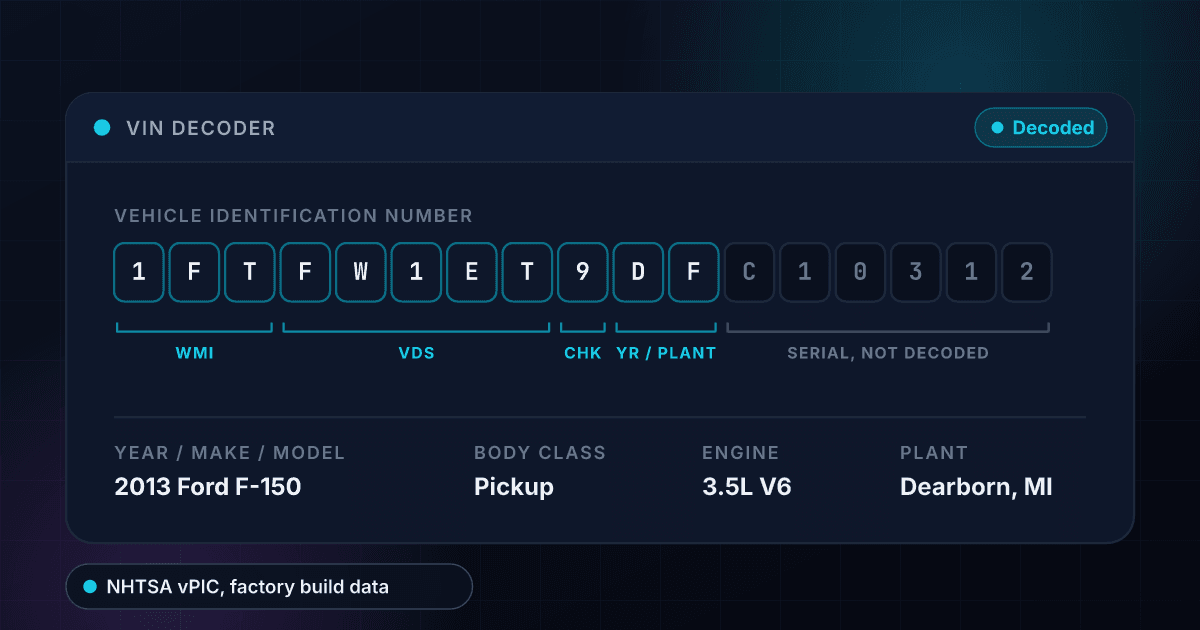
What a VIN actually tells you
A vehicle identification number is 17 characters long and every character is assigned. Positions 1 to 3 identify the manufacturer and country of build, positions 4 to 8 describe the vehicle line, body and engine, position 9 is a check digit, position 10 is the model year, position 11 is the assembly plant, and the last six are the serial number. Decoding turns that string back into plain facts: a 2013 Ford F-150 truck built in Dearborn, Michigan. The letters I, O and Q never appear in a VIN, because they look too much like 1 and 0.
The data comes from NHTSA's vPIC database, which is built from the vehicle identification information manufacturers are required to file with the US government. It is free, public and updated when NHTSA ships a release. Be realistic about how much it holds: across 15 real VINs we decoded, a median of 58 of the 154 available fields came back populated. Newer vehicles carry more. A 2021 Toyota RAV4 returned 82 populated fields, a 2013 Nissan Leaf returned 39. Blank fields mean NHTSA has no data on record, not that the car lacks the feature.
Two limits matter before you rely on this. First, it is not a vehicle history report. There is no accident, salvage, flood, theft, lien, odometer, title or ownership data in vPIC, so a clean decode tells you nothing about how the car has been treated. Second, the decode covers the VIN pattern, not the individual car. Positions 12 to 17, the serial number, are not decoded at all, so you get the factory build specification for that configuration rather than the options, paint or trim on the vehicle in front of you.
Decoding a truck rather than a car
A VIN describes the vehicle and never the operator. For a commercial truck the operator's registration status, authority and safety rating come from the FMCSA record instead, which you can pull with a free USDOT number lookup.
How the VIN decoder works
Paste the VIN
Type or paste the 17-character VIN from the windscreen, the driver door jamb sticker, the title or the listing. We check the format first: exactly 17 characters, and no I, O or Q, which never appear in a real VIN.
We decode positions 1 to 11
The VIN is sent to NHTSA's public vPIC database, which decodes the manufacturer, vehicle line, body, engine, model year and assembly plant. Typical response time is under half a second. The serial number at the end is not decoded and is not stored.
Read the spec, and the gaps
You get every field NHTSA holds for that VIN pattern, grouped into vehicle, engine and safety equipment. Fields NHTSA has no data for are shown as blank rather than guessed at or filled in as a no.
What each VIN position means
The 17-character layout defined by ISO 3779 and US regulation 49 CFR 565, which is what NHTSA's decoder reads.
| Positions | Section | What it encodes |
|---|---|---|
| 1-3 | WMI (world manufacturer identifier) | Country and manufacturer. 1, 4, 5 = United States; 2 = Canada; 3 = Mexico; J = Japan; K = South Korea; S = United Kingdom; W = Germany; Z = Italy |
| 4-8 | Vehicle descriptor | Model, body style, engine, restraint system, as each maker defines |
| 9 | Check digit | A checksum over the other 16 characters; a VIN that fails it is mistyped or invented |
| 10 | Model year | A letter or digit code, table below |
| 11 | Plant | The assembly plant, as each maker defines |
| 12-17 | Serial number | The vehicle's production sequence |
Model-year codes (position 10)
The code cycles every 30 years, so A means 1980 or 2010; the vehicle descriptor disambiguates. I, O, Q, U and Z are never used.
| Code | Years | Code | Years |
|---|---|---|---|
| A | 1980 / 2010 | L | 1990 / 2020 |
| B | 1981 / 2011 | M | 1991 / 2021 |
| C | 1982 / 2012 | N | 1992 / 2022 |
| D | 1983 / 2013 | P | 1993 / 2023 |
| E | 1984 / 2014 | R | 1994 / 2024 |
| F | 1985 / 2015 | S | 1995 / 2025 |
| G | 1986 / 2016 | T | 1996 / 2026 |
| H | 1987 / 2017 | V | 1997 / 2027 |
| J | 1988 / 2018 | W | 1998 / 2028 |
| K | 1989 / 2019 | X | 1999 / 2029 |
| 1-9 | 2001-2009 / 2031-2039 | Y | 2000 / 2030 |
The full factory spec, not just year and make
Where NHTSA holds it you get body class, doors, seats, drive type, engine cylinders, displacement, horsepower, transmission style, GVWR class, fuel type, plant city and country, plus safety equipment such as ABS, ESC, TPMS, airbag locations and driver assistance systems.
Blanks stay blank
NHTSA's own guidance is that a missing value means they have no data on that variable, not that the feature is absent. We never render an empty field as a no. Curb weight, engine kW, top speed, towing capacity and bed length are never in this dataset, so we do not pretend to have them.
Check digit tested, not enforced
Position 9 is a mod 11 check digit and we compute it before the lookup. A mismatch is shown as a soft warning, not a block, because European and grey import VINs routinely fail it by design. Blocking on the check digit alone would break the tool for every imported car.
Recalls issued for that year, make and model
Alongside the decode you can see safety recall campaigns NHTSA issued for that year, make and model. This shows recalls for vehicles like yours. It cannot tell you whether this specific vehicle is affected or whether the work was already done.
Who uses this tool
Checking a used car listing
Sellers get specs wrong, sometimes deliberately. Decoding the VIN from the advert photos confirms the model year, engine, drive type and trim family before you drive across town. If the decode says four-cylinder and the advert says V6, ask why.
Dealers pricing a trade-in
The VIN settles what the vehicle actually is before an appraisal number is put on it. Body class, engine, drive type, GVWR class and factory safety equipment all move the price, and reading them off the VIN is faster than waiting for a paper file.
Insurers and underwriters
Factory safety equipment such as ESC, forward collision warning, blind spot monitoring and airbag locations feeds directly into rating. Decoding a VIN at quote time confirms what was fitted as standard, rather than relying on what the applicant remembers.
Parts, service and fleet records
Engine displacement, cylinder count, transmission style and body cab type narrow down the right part number. Fleet managers can decode a whole list of VINs at once to normalise a spreadsheet of vehicles into consistent make, model and year columns.
Frequently asked questions
Is this VIN decoder really free?
Yes. The decode runs against NHTSA's vPIC database, which is free public data with no license, no API key and no registration. This page is rate limited to a handful of lookups per visitor per day so it stays available to everyone. If you need more than that, a free 1Lookup account gives you bulk CSV processing and API access.
Can you tell me if my car has an open recall?
No, and no free public API can. NHTSA does not expose a VIN level recall lookup, so nobody can tell you from a VIN alone whether your specific car has an open recall or whether the work was already done. What is available free is recalls issued for a year, make and model. That shows recalls for vehicles like yours, not for yours. Check your VIN free at nhtsa.gov/recalls or with a franchised dealer.
Why does it say the check digit does not match?
Position 9 is a mod 11 check digit required for vehicles built for the US, Canada and Mexico. It is not part of the international standard, so European manufacturers often put a filler character there and the check fails by design. We still decode the VIN and show what comes back. Treat a check digit warning as a prompt to re-read the VIN, not as proof it is fake.
Does this show accidents, salvage titles or mileage?
No. vPIC holds factory build data only. It has no accident, salvage, flood, theft, lien, odometer, title or ownership records, so it cannot tell you whether a car was crashed, written off or clocked. A decode that comes back clean is not a clean bill of health. For history you need a paid report from a provider with access to title and insurance records.
How old a vehicle can this decode?
NHTSA states about 99% decode success for model year 1995 forward for most major brands, 60 to 65% for 1980 to 1994, and no data at all before 1980, because the 17 character VIN standard did not exist yet. Imported and grey market vehicles may be missing entirely, since manufacturers only file with NHTSA for vehicles intended for sale or use on US roads.
Can I decode a list of VINs or use an API?
Yes. A free 1Lookup account includes bulk CSV processing, so you can upload a list of VINs and get decoded columns back rather than pasting them one at a time. The 1Lookup API covers the same lookups programmatically alongside phone validation, email validation, IP lookup and business verification, which is the usual setup for dealers, insurers and fleet buyers running checks at volume.
Related VIN and vehicle lookup searches
More free tools
DOT Number Lookup
Check any trucking company by USDOT number: status, fleet size and safety rating.
NPI Lookup
Look up any healthcare provider by NPI: name, specialty, licence and address.
Phone Number Lookup
Validate any number and see line type, carrier and country.
Reverse Phone Lookup
Find the likely owner and location behind a phone number.