The Funding Trigger API tells you whether a company has filed a Form D with the SEC and what it reported
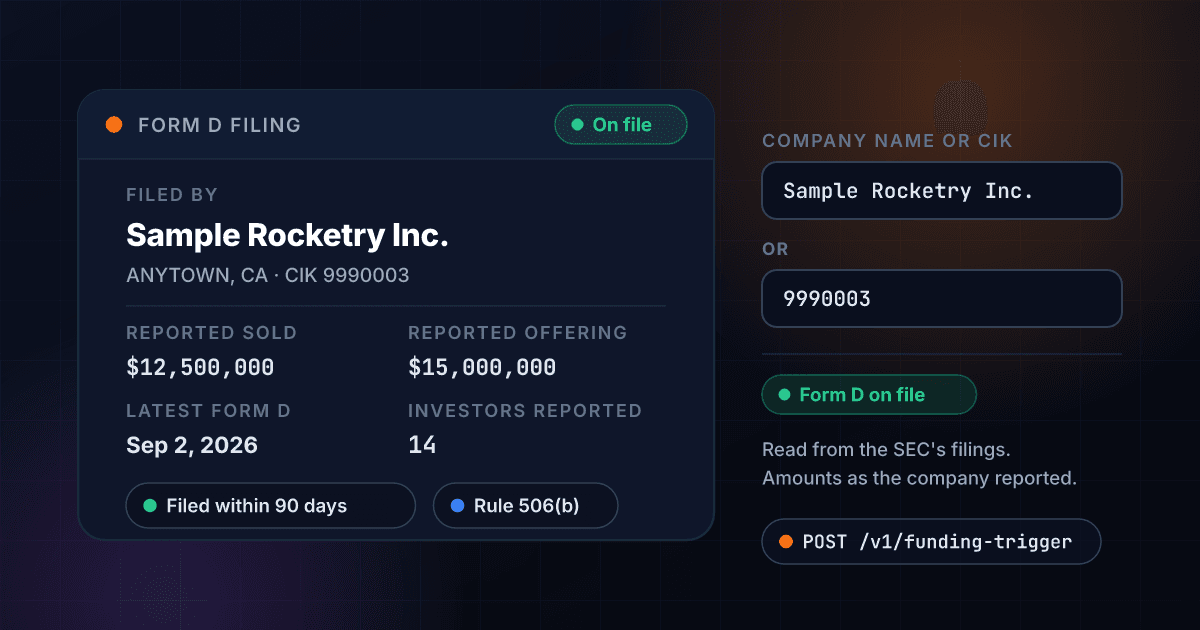
Send a company name or an SEC CIK number and get the latest Form D it filed, the amounts it reported offering and selling, its investor count and whether the filing is under 90 days old. 2 credits, charged only when a Form D is on file.
2
Credits per company with a Form D
about $0.01 on Starter
0
Credits when no Form D is on file
no filing, no charge
Name or CIK
Either one finds the company
a CIK number names one exact filer
Up to 3
Newest Form Ds read in full
amounts, dates and investor counts
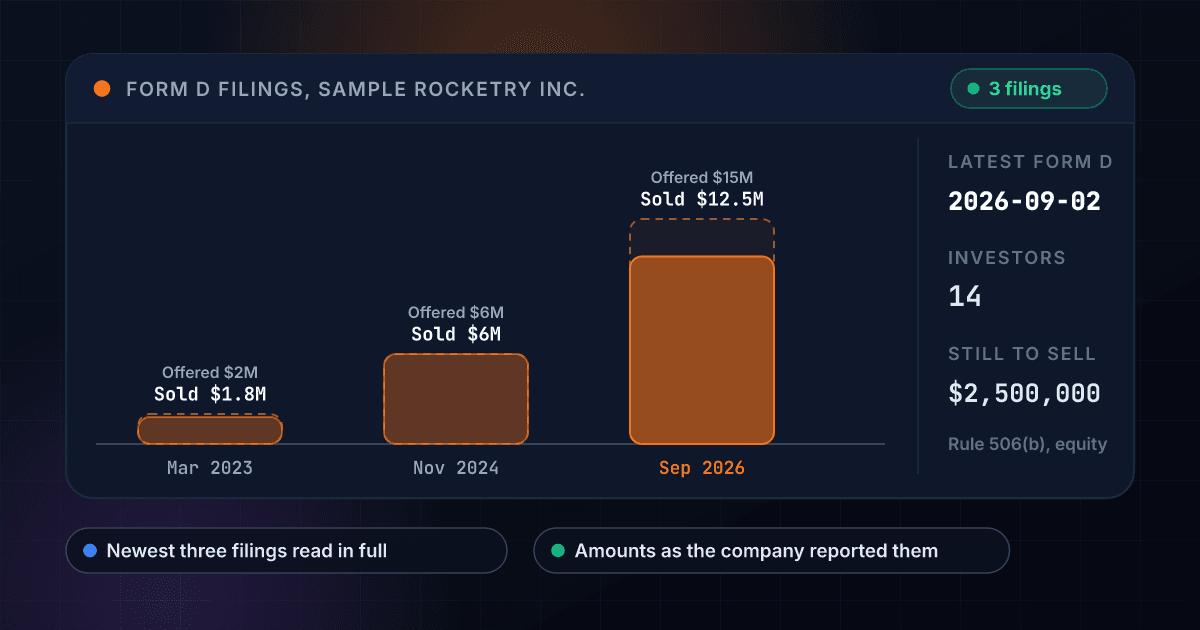
Three Form Ds side by side show how the amounts a company reported have changed
Each of the newest three filings is read in full, with the amount offered, the amount reported sold and the investor count, so the change from one filing to the next is in a single result. The company here is invented.
A company comes back as the SEC's own filing record in one flat payload.
The filing comes from the SEC's own public records
The company is found in the SEC's records and its Form D filings are listed there. The newest three are opened and read, and every result carries a link to the filing on sec.gov and the date it was read.
- The date and form type of each filing
- A link to the filing on sec.gov
- The date the check was made
- Public US government data
Every amount says it is the company's own figure
A Form D is a notice the company files itself, so the offering size, the amount sold and the amount still to sell are returned as what the company reported. An offering with no stated size is flagged as indefinite instead of showing a made-up number.
- Reported offering, sold and still to sell
- An indefinite offering flagged as such
- The minimum investment the filing states
- Never a verdict that money arrived
The newest three filings are read in full
Each of the newest three Form Ds comes back with its date, the date of the first sale, the amounts and the investor count, so a second round or a third shows up without a second lookup. The people the filing names come with their roles.
- Dates and amounts for three filings
- Investor count on each
- Executive officers and directors named
- A count of every Form D on record
Name matches are ranked and the next ones are listed
A name is matched from the start of the registered name, the exact name first. The best match comes back in full and the next five are listed with their CIK numbers, so you can tell a company from the fund that shares its name.
- Exact name ranked first
- Next five matches listed
- CIK number for one exact filer
- An investment fund flagged as one
A recent filing is flagged with its age
Every result gives the number of days since the latest Form D and says whether it was filed within 90 days of the check, so a fresh notice reads differently from one filed years ago.
- Days since the latest filing
- A flag for the last 90 days
- Date of the first sale in the offering
- The date the check was made
A company with no Form D costs nothing
You are charged 2 credits only when the company has a Form D on file. A company registered with the SEC that has filed none, a name the SEC does not hold, a typo and a lookup the SEC could not answer cost 0, and that holds for bulk CSV jobs as well as the API.
- Zero credits with no Form D
- Bulk CSV with a company column
- The same credits as every other product
- One API key for all of it
A company name goes in and the Form D it filed comes out
Send a company name or CIK
POST the company name as it is registered, or its SEC CIK number. A name is matched from the start, and a value that cannot be a name or a CIK is refused with a clear error and costs nothing.
$ POST /api/v1/funding-trigger
"company": "Sample Rocketry Inc."
> name matched from the start
We read the SEC's filing records
The company is found in the SEC's records, its Form D filings are listed and the newest three are opened for their amounts and investor counts.
Company found in SEC records
Form D filings listed
Newest three filings opened
Amounts and investor count read
Get the filing, flat and structured
The latest filing date, the amounts it reports and the people it names arrive in one JSON payload. A company with a Form D bills 2 credits, and one with none bills nothing.
companySample Rocketry Inc.
latest Form D2026-09-02
reported sold$12,500,000
One endpoint checks a company and works like every other 1Lookup call.
Same authentication, same credit balance, and the same response envelope as every other 1Lookup product. If you have already integrated one endpoint, this one is a URL change.
curl -X POST https://app.1lookup.io/api/v1/funding-trigger \
  -H "Authorization: Bearer $API_KEY" \
  -H "Content-Type: application/json" \
-d '{ "company": "Sample Rocketry Inc." }'{
"classification": {
"found": true,
"cik": 9990003,
"name": "Sample Rocketry Inc.",
"state": "CA",
"industry_group": "Other Technology",
"latest_form": "D",
"latest_filing_date": "2026-09-02",
"days_since_latest_filing": 51,
"recent_raise": true,
"date_of_first_sale": "2026-08-20",
"offering_amount_usd": 15000000,
"amount_sold_usd": 12500000,
"amount_remaining_usd": 2500000,
"investors_count": 14,
"security_types": ["Equity"],
"exemptions": ["Rule 506(b)"],
"pooled_investment_fund": false,
"form_d_count": 3,
"first_form_d_date": "2023-03-14",
"checked_at": "2026-10-23",
"name_search": true,
"match_count": 2
},
"insights": {
"funding_trigger_result": {
"company": {
"cik": 9990003,
"name": "Sample Rocketry Inc.",
"state_of_incorporation": "DE",
"city": "ANYTOWN",
"state": "CA"
},
"latest": {
"form": "D",
"filing_date": "2026-09-02",
"filing_url": "https://www.sec.gov/Archives/edgar/data/9990003/000999000326000001/",
"entity_type": "Corporation",
"minimum_investment_usd": 50000,
"has_non_accredited_investors": false,
"related_persons": [
{ "name": "Alex Sample", "relationships": ["Executive Officer", "Director"] },
{ "name": "Jordan Example", "relationships": ["Director"] }
]
},
"filings": [
{ "form": "D", "filing_date": "2026-09-02", "amount_sold_usd": 12500000, "investors_count": 14 },
{ "form": "D", "filing_date": "2024-11-19", "amount_sold_usd": 6000000, "investors_count": 9 },
{ "form": "D", "filing_date": "2023-03-14", "amount_sold_usd": 1800000, "investors_count": 6 }
],
"other_matches": [
{ "cik": 9990004, "name": "Sample Rocketry Fund I LP", "state": "CA" }
],
"data_source": "sec_edgar"
}
},
"recommendations": {
"primary_action": "VERIFY",
"secondary_actions": ["check_other_matches", "see_earlier_raises"],
"user_message": "Sample Rocketry Inc. filed a Form D on 2026-09-02, reporting $12.5 million sold of a $15 million offering to 14 investors."
},
"metadata": { "credits_used": 2, "cache_hit": false }
}A column of company names goes in and one row per company comes out
Upload a CSV with a company column and download a result file with each company's latest filing date, the amount it reported selling and its investor count. The three companies here are invented.
- 1company
- 2Sample Rocketry
- 3Placeholder Foods Co
- 4Example Grid Labs
| company | Found | Company | Latest Filing Date | Amount Sold (USD) | Investors | Credits Used |
|---|---|---|---|---|---|---|
| Sample Rocketry | Yes | Sample Rocketry Inc. | 2026-09-02 | 12500000 | 14 | 2 |
| Placeholder Foods Co | Yes | Placeholder Foods Co. | 2026-03-18 | 3400000 | 21 | 2 |
| Example Grid Labs | No | 0 |
Fifteen more columns in the file, among them CIK, State, Industry, Days Since Filing, Amount Offered (USD), Amount Remaining (USD) and Form D Count.
One row in, one row out
Every name or CIK number becomes one row, so a list of 500 prospects is a spreadsheet of 500 rows you can sort by the date of the latest filing.
A company with no Form D is a free row
A company registered with the SEC that has filed none, or a name nobody holds, comes back as a row that says so and costs 0 credits, so cleaning a list never bills for the misses.
A cell that cannot be a name fails before it is billed
An empty cell or a value too short to be a name fails without a charge and the rest of the file carries on.
One call returns the Form D a company filed with the SEC
One call turns a company name or CIK number from a prospect list, a lead form or a portfolio sheet into what the company's latest Form D reports: when it was filed, the amounts offered and sold, how many investors and which exemption, with the raw JSON your code receives beside it. Every amount is the company's own figure from the filing.
- CompanySample Rocketry Inc.
- CIK9990003
- Latest Form D2026-09-02
- Filed within 90 daysYes
- Reported offering$15,000,000
- Reported sold$12,500,000
- Still to sell$2,500,000
- Investors reported14
- ExemptionRule 506(b)
- SecurityEquity
- Form Ds on record3
- Other name matches1, Sample Rocketry Fund I LP
{
  "classification": {
    "found": true,
    "cik": 9990003,
    "name": "Sample Rocketry Inc.",
    "latest_filing_date": "2026-09-02",
    "recent_raise": true,
    "offering_amount_usd": 15000000,
    "amount_sold_usd": 12500000,
    "investors_count": 14,
    "form_d_count": 3,
    "checked_at": "2026-10-23"
  },
  "insights": {
    "funding_trigger_result": {
      "data_source": "sec_edgar"
    }
  },
  "metadata": { "credits_used": 2 }
}
Every Form D lookup returns the same fields at one flat price.
A field the filing does not hold comes back as null and never as a guess, and every company with a Form D costs the same 2 credits.
Who the company is
- found
- cik
- name
- state
- industry_group
- company.state_of_incorporation
- company.city
- company.tickers
What the latest Form D reports
- latest_form
- latest_filing_date
- date_of_first_sale
- offering_amount_usd
- amount_sold_usd
- amount_remaining_usd
- investors_count
How the offering was set up
- security_types
- exemptions
- exemption_codes
- minimum_investment_usd
- offering_indefinite
- has_non_accredited_investors
- pooled_investment_fund
Who the filing names
- related_persons[]
- entity_type
- year_of_incorporation
How recent and how complete it is
- days_since_latest_filing
- recent_raise
- form_d_count
- first_form_d_date
- filings[]
- history_complete
- checked_at
Which other companies share the name
- name_search
- match_count
- other_matches[]
Sales teams, lenders and researchers check a company's Form D instead of searching the SEC by hand.
Sales teams timing their outreach
Check a prospect before the call and see whether it filed a Form D lately, what it reported selling and how many investors it reported, then open with something specific.
Software vendors and agencies building a target list
Run a list of company names through a bulk job and sort it by the date of the latest Form D, so the companies that filed most recently are called first.
Recruiters and staffing agencies
See how recently an employer told the SEC about a private sale of securities, and how large the offering it reported was, before you approach it about hiring.
Lenders and banks onboarding a private company
Check whether an applicant has filed a Form D and compare the amounts it reported with what it told you, then review any difference with the applicant.
Analysts and researchers
Pull the dates, amounts and investor counts of a company's three newest Form Ds to see how its reported offerings have changed from one filing to the next.
Journalists checking a start-up's claim
Look up the company the story is about and read what its Form Ds say it offered and sold, with a link to each filing on sec.gov for the reader.
Only a company with a Form D on file is billed, and every other answer is free
A company with a Form D returns the filing. A company registered with the SEC that has filed none, or a name the SEC does not hold, comes back as a plain answer at no charge.
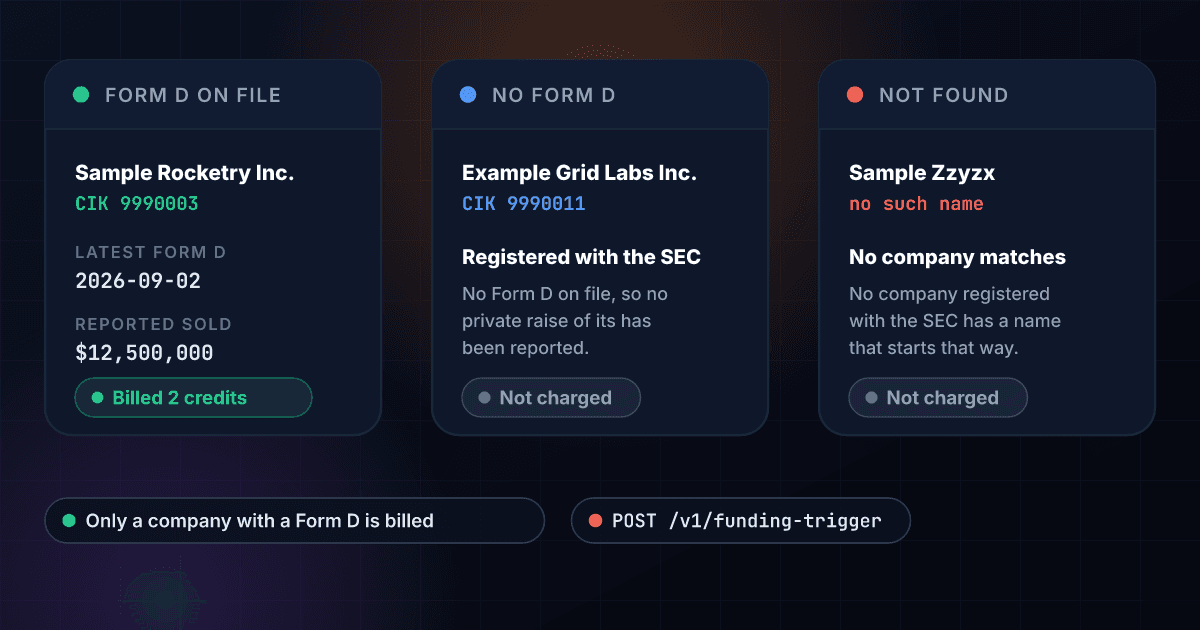
These are the questions people ask before they check their first company.
What does the Funding Trigger API return?
Send a company name or an SEC CIK number and it returns whether the company has filed a Form D, the notice companies file with the SEC after a private sale of securities. For a company that has, you get the date of its latest Form D, the amount it reported offering, the amount it reported selling, the amount it reported still to sell, how many investors it reported, the exemption and the type of security, the people the filing names with their roles, and a link to the filing on sec.gov. The newest three filings are read in full, and the count of every Form D on record comes with them.
Does a Form D prove that a company raised money?
No. A Form D is a notice the company files itself, so it shows that the company told the SEC it sold securities and what it says it offered and sold. Every amount in the result is worded as reported, as in amount_sold_usd and offering_amount_usd, and the answer to a company with no Form D says that no private raise has been reported, which is not the same as saying it raised nothing.
Where does the Form D data come from, and how current is it?
From the SEC's own public records. The company is found in the SEC's company search, its filing history lists the Form Ds it has filed, and the newest three are opened and read. Each answer comes from the SEC's records rather than a database of our own, and every result carries the date it was checked in checked_at and the age of the latest filing in days_since_latest_filing. Asking again about the same company within a day, by the same user, returns the saved answer at no charge, and bypass_cache: true reads the filings again.
How much does a funding check cost?
2 credits per company with a Form D, about $0.01 on the Starter plan and $9.90 per 1,000 companies. You are charged only when a Form D is on file. A company registered with the SEC that has filed none, a name the SEC does not hold, a mistyped CIK and a lookup the SEC could not answer all cost 0 credits, in the API, the dashboard and bulk jobs.
What does a company with no Form D look like?
It is a complete answer, not an error. If the company is registered with the SEC and has filed no Form D, the result has found: false, reason: no_form_d, the company's name and CIK, and a plain sentence saying no private raise of its has been reported. If no company has a name that starts that way, the reason is no_company and the sentence says to use the registered name or a CIK number. Neither is billed.
Why might a company have no Form D?
A Form D is filed for private offerings that rely on an exemption such as Rule 506. A company that has not sold securities that way, one that raised money some other way, and one that filed late will all come back without one. Read it as what has been filed with the SEC, nothing more.
How do I look up one exact company when several share a name?
Send its CIK number. A name is matched from the start of the registered name, so a short name can match several companies and funds. The best match, an exact name first, is returned in full, and the next five are listed in other_matches with their CIK numbers and states, with match_count giving how many matched in all. A CIK number names one exact filer and skips the name search.
How many filings does a result read, and what is the count based on?
The newest three Form Ds are opened and read for their dates, amounts and investor counts. Older ones are counted, not read. For a company with a very long filing history the SEC keeps its oldest filings in separate files that are not read, so form_d_count is then a minimum, and summary.history_complete says whether the count is the whole history.
Does it show who the investors are?
No. A Form D reports how many investors took part, not who they were, and that count is what you get. The people the filing does name are the company's own executive officers, directors and promoters, returned with their roles in related_persons. A person's address is never returned.
What does the recent_raise field mean?
It is true when the latest Form D was filed no more than 90 days before the check, and days_since_latest_filing gives the exact age. It is about the date of the notice. It does not say how large the sale was or that the sale closed, so read it together with the reported amounts.
Can I check a list of companies at once?
Yes. Upload a CSV with a company column, where each cell holds a company name or a CIK number, and you get a row per company with its latest filing date, the amounts it reported, its investor count and the number of Form Ds it has filed. A row that is not usable fails without a charge, and a company with no Form D is a free row. The price stays at the same credits per company with a Form D, however long the list is.
Can I get a list of every company that filed a Form D this week?
Not today: the lookup answers for one company at a time, from a name or a CIK number. A feed of new filings, or a search across every Form D by amount, state or industry, is a different job, and the comparison pages on this site set out what sec-api.io, Financial Modeling Prep and Fundz offer for it.
What if a company raised under an earlier name?
A name search matches the name the company is registered under today, so a company that filed under an earlier name is found by its CIK number, which does not change when a name does.
To check a single company before you write any code, run its name through the free Form D funding lookup.
A Form D says what a company reported, and these products check the rest.
Here is how checking a company's Form D with 1Lookup compares with the other ways to get SEC funding data.
Each page sets a rival's plans and prices beside ours and says where the rival does the job better. Every figure carries its source and the date it was checked.