Unlike Numverify, 1Lookup adds live HLR status,Do Not Call checks and email and IP validation on one key.
1Lookup returns a phone number's carrier, line type and risk level for 1 credit, plus Do Not Call status and reachability for US and Canada numbers. Live HLR status, TCPA litigator scrub, and email and IP checks run on the same key. Numverify returns format, country, location, carrier and line type, and sells email and IP checks as separate APILayer products (checked October 2026).
 1lookup1lookup.ioMulti-channel validation
- Phone
- IP
 Numverifynumverify.comPhone validation
- Phone
Live HLR status shows whether a mobile is on right now.
1Lookup's HLR Lookup asks the mobile network whether a number is switched on and reachable, which network it is on, and whether it is roaming, for 5 credits. Numverify's pricing page advertises no live reachability check (checked October 2026).
Every phone check returns a risk level, and US and Canada checks add Do Not Call status.
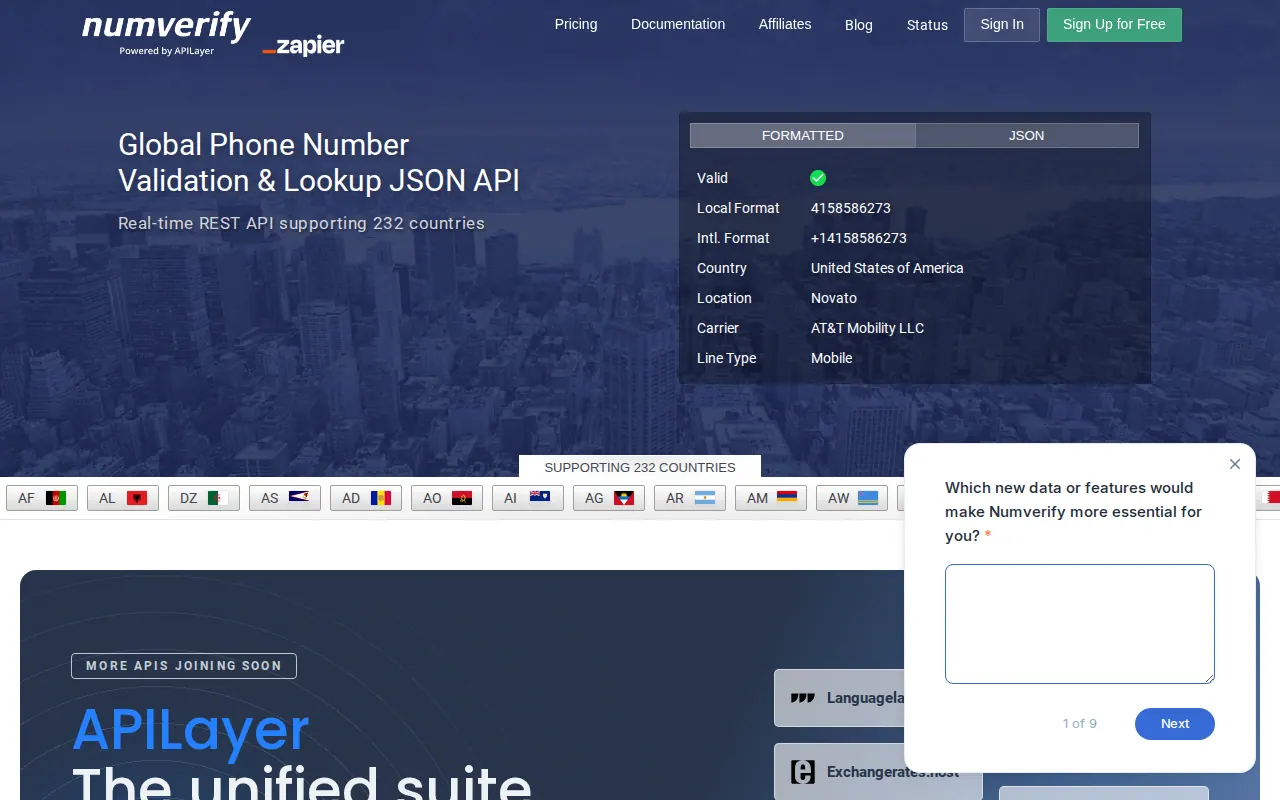
Numverify's response carries a valid flag, formats, country, location, carrier and line type. 1Lookup's phone validation also returns a risk level with the reasons behind it and a VoIP flag, adds Do Not Call status for US and Canada numbers, and Phone Spam Check adds spam flags for 1 more credit.
A 1Lookup check returns status, risk and compliance data that Numverify's ten fields do not.
Numverify facts checked October 2026 from its pricing page and API docs
| Feature |  1Lookup | Numverify | Winner |
|---|---|---|---|
Live line status Know the line is live before you call or text | Live HLR status: is the mobile on and reachable now (5 credits) | No live carrier or HLR reachability check on its pricing page | |
Risk and Do Not Call checks Compliance and risk signals on the same call | Risk level and VoIP flag on every phone check, plus Do Not Call status for US and Canada numbers | Valid flag, formats, country, location, carrier and line type | |
Email and IP checks One account for the whole signup | On the same key and credit balance | Separate APILayer products | |
Where the API key goes Keys in URLs tend to end up in logs and browser history | In an Authorization header on a POST with a JSON body | In the URL as access_key on a GET request |
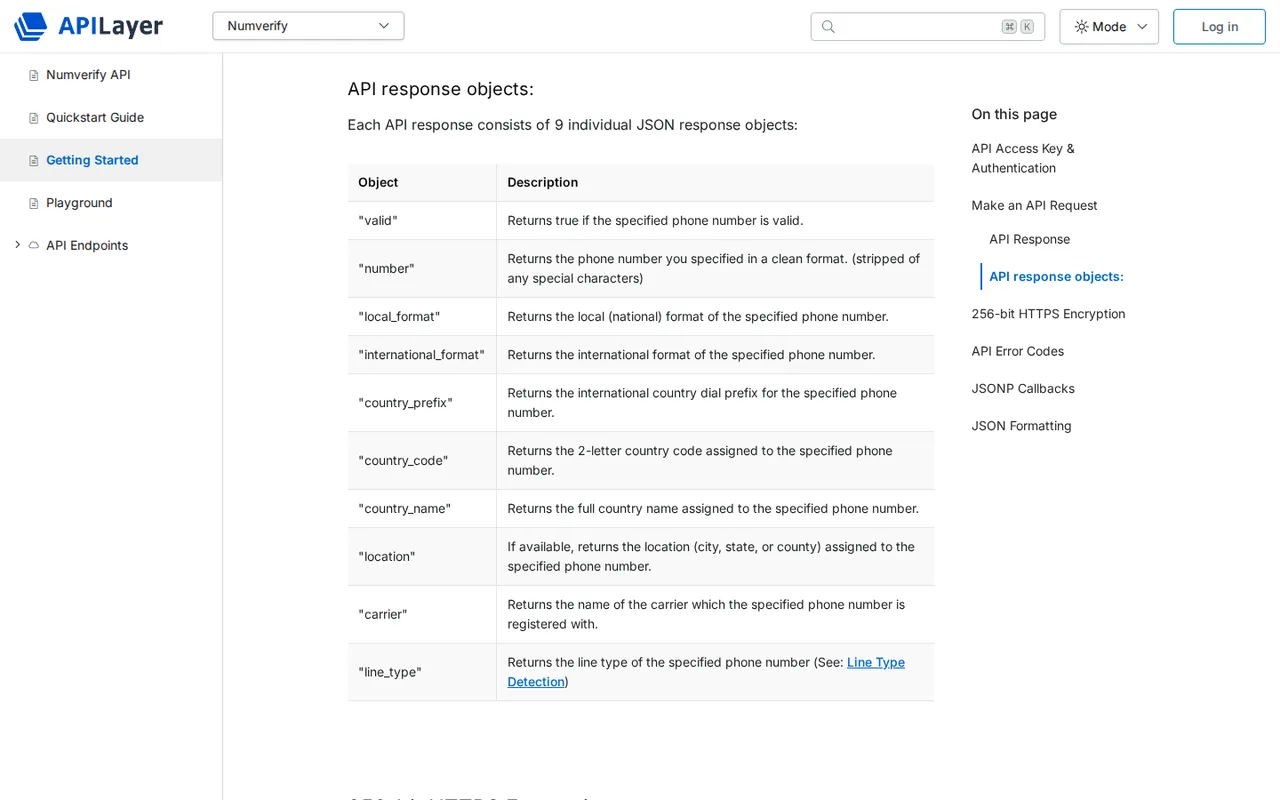
Numverify returns ten fields per request, and here is where each one lands in a 1Lookup response.
The ten come from the response table in Numverify's own Getting Started docs, read in October 2026. A 1Lookup phone check returns grouped fields under data and adds status, risk and compliance fields that have no Numverify counterpart.
| What you read | 1Lookup field | Numverify field |
|---|---|---|
| Is the number valid | data.classification.number_status (ACTIVE, INACTIVE, INVALID or UNKNOWN) | valid |
| The number, formatted | Send E.164, for example +14155552671; it comes back in data.request.input | number, local_format, international_format |
| Country | data.insights.raw_api_fields.country | country_prefix, country_code, country_name |
| State and time zone | data.insights.raw_api_fields.state, data.insights.location.timezone | location |
| Carrier | data.insights.raw_api_fields.network, data.classification.carrier_type | carrier |
| Mobile, landline or VoIP | data.classification.line_type, data.insights.risk_indicators.voip_detected | line_type |
| Risk level | data.risk_assessment.risk_level | Not among its ten fields |
| Reachable now, US and Canada | data.insights.reachability.is_reachable | Not among its ten fields |
| Do Not Call and Do Not Originate, US and Canada | data.insights.compliance.dnc_listed, data.insights.compliance.dno_flag | Not among its ten fields |
| Porting status, US and Canada | data.classification.portability_status | Not among its ten fields |
Reachability, Do Not Call, Do Not Originate and porting cover US and Canada numbers. Risk level and line type cover every number we can classify.
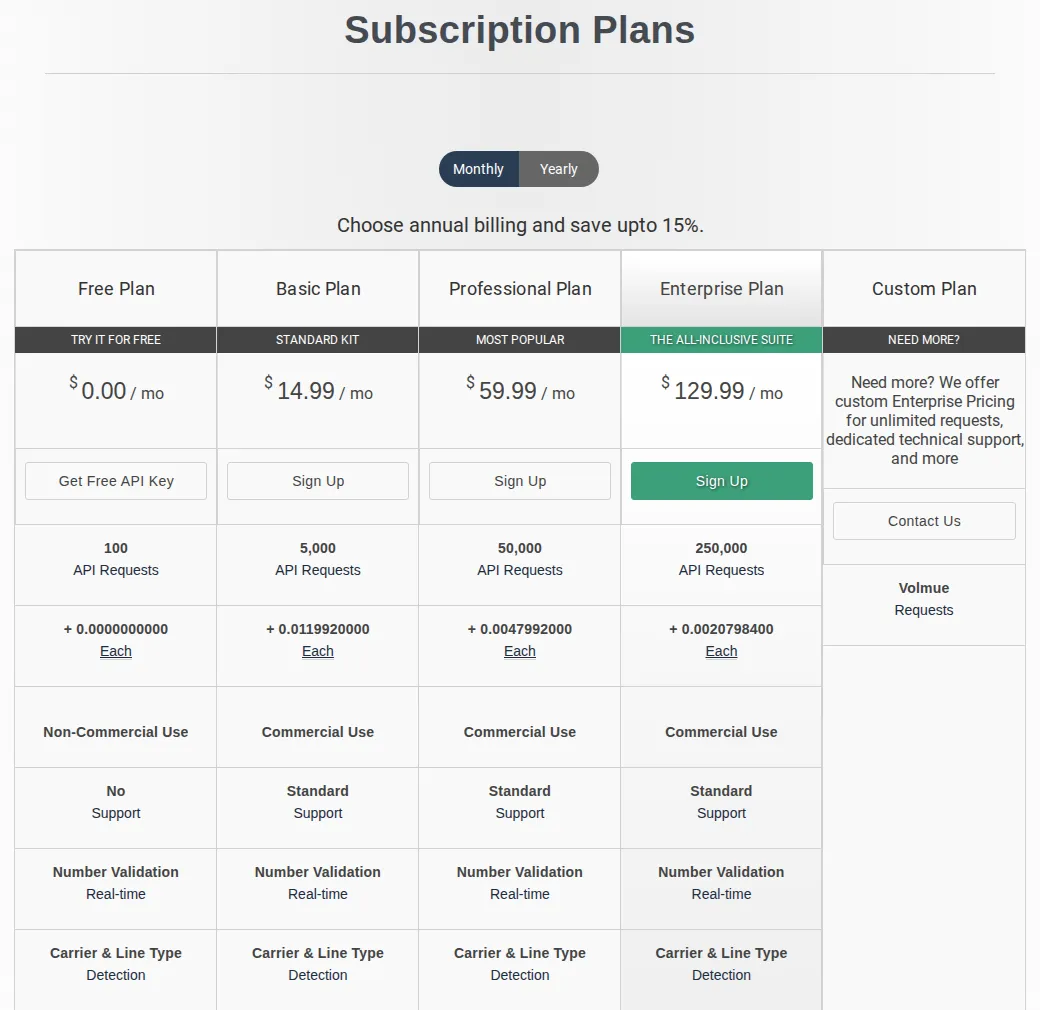
Numverify charges $14.99 to $129.99 a month for 5,000 to 250,000 requests, and 1Lookup plans start at $99 for 20,000 phone checks.
Numverify prices checked October 2026 on numverify.com/pricing. 1Lookup prices from 1lookup.io/pricing, where a phone validation costs 1 credit.
1Lookup plans, one credit balance for phone, email and IP
| Plan | Price a month | Credits | Per 1,000 checks |
|---|---|---|---|
| Starter | $99 | 20,000 | $4.95 |
| Growth | $299 | 85,000 | $3.52 |
| Professional | $799 | 250,000 | $3.20 |
| Enterprise | $1,999 | 1,000,000 | $2.00 |
Source: 1lookup.io/pricing. Email and IP checks draw from the same credits.
Numverify plans, priced by monthly request quota
| Plan | Price a month | Requests included | Each extra request | Per 1,000 included |
|---|---|---|---|---|
| Free | $0 | 100 | - | - |
| Basic | $14.99 | 5,000 | $0.011992 | $3.00 |
| Professional | $59.99 | 50,000 | $0.0047992 | $1.20 |
| Enterprise | $129.99 | 250,000 | $0.00207984 | $0.52 |
| Custom | Quoted by Numverify | Volume requests | - | - |
Source: numverify.com/pricing, checked October 2026. The Free plan is for non-commercial use and lists no support. The per 1,000 column is the monthly price divided by the included requests.
Each 1Lookup check also returns line status and a risk level, adds reachability and Do Not Call flags for US and Canada numbers, and shares its credits with email and IP checks. See Numverify at every volume or work out your own monthly cost.
Every phone check returns a risk level, not just valid or invalid.
A number can be well formed and still be disconnected, a VoIP line, or on the Do Not Call list. 1Lookup's phone validation returns a risk level with the reasons behind it, the line type, a VoIP flag and Do Not Call status on the same call, for 1 credit, and Phone Spam Check adds a spam score from 0 to 100, whether the number is reported as spam and whether it is flagged as a robocaller, for 1 more.
Risk level on every check
A risk level and the risk factors that set it, on every phone validation
Do Not Call status
Know a number is on the Do Not Call list before you call or text it
Spam and robocall flags
Phone Spam Check says whether a number is reported as spam and whether it is flagged as a robocaller
Example response
One credit balance
Every product below draws from the same credits, at $0.00200–$0.00495 per credit depending on plan.
- Phone validation1 credit
- Email verification1 credit
- IP intelligence1 credit
- Spam and risk score1 credit
Buy credits once, spend them on whatever you need to check
Most validation tools sell one channel, so a team checking phones, emails and IPs ends up with three vendors, three invoices and three unused balances. 1Lookup bills all of them from a single credit pool on a monthly plan, with no contract, and leftover credits carry into the next quarter instead of expiring at midnight.
Phone, email and IP on one API
One key, one balance, one integration
Phone data refreshed daily
From FCC and carrier sources
No contract
Monthly plans, with three-month credit rollover
A full line profile, not a status code.
Phone validation returns the carrier, line type, porting status and time zone for 1 credit, and HLR Lookup adds whether the mobile is switched on, the network it is on now and whether it is roaming, for 5. That is the difference between knowing a number is formatted correctly and knowing whether a message sent to it will arrive.
Complete Phone Profile
Moving from Numverify to 1Lookup changes four things in one request.
- 1
Point the request at the 1Lookup address.
http://apilayer.net/api/validatebecomeshttps://app.1lookup.io/api/v1/phone. - 2
Move the key out of the URL and into a header.
Numverify takes
access_keyas a URL parameter. 1Lookup takesAuthorization: Bearer YOUR_API_KEY. - 3
Send the number in a JSON body instead of the query string.
The
numberparameter becomes{"phone_number": "+14155552671"}in a POST body, and E.164 is the recommended format. - 4
Read the grouped response instead of ten flat fields.
Everything sits under
data. The table above shows where each Numverify field lands.
Simple Migration from Numverify
`http://apilayer.net/api/validate`
+ `?access_key=${apiKey}`
+ `&number=${phoneNumber}`
);
`https://app.1lookup.io/api/v1/phone`,
{
method: 'POST',
headers: {
'Authorization': `Bearer ${key}`,
'Content-Type': 'application/json'
},
body: JSON.stringify({phone_number: phoneNumber})
}
);
What migrating from Numverify actually involves
Both are REST APIs returning JSON, so the move is a URL, a key and a field mapping rather than a rewrite. The call above is the real shape of each request. Where the work usually goes is the response: our field names differ, and anything you were deriving from a status code may already be a field you can read directly.
One endpoint per channel
Phone, email and IP, same key and same balance
Email Support to Dedicated CSM
Support level rises with the plan, not with a separate fee
Try before you migrate
7-day free trial with credits, no contract to unwind
These are the questions people ask before choosing between Numverify and 1Lookup.
Numverify facts checked October 2026
What is numverify?
numverify is a phone number validation and lookup API from apilayer. Given a phone number, it checks whether the number is valid and returns details such as country, carrier, line type (mobile or landline), and location. Developers typically use it to clean phone lists and confirm formatting before sending SMS or placing calls. It is delivered as a REST API with a free plan of 100 requests per month for low-volume testing.
How much does numverify cost?
Checked October 2026, numverify prices by monthly request quota: Free is $0 for 100 requests (non-commercial use), Basic is $14.99 a month for 5,000 requests, Professional is $59.99 for 50,000 and Enterprise is $129.99 for 250,000, with a Custom plan quoted on request. Requests past the quota are billed per request: $0.011992 on Basic, $0.0047992 on Professional and $0.00207984 on Enterprise. Its pricing page says yearly billing saves up to 15%. Confirm current rates on numverify’s pricing page before committing.
How do numverify and 1Lookup prices compare?
A 1Lookup phone validation is 1 credit, about $4.95 per 1,000 on Starter, $3.52 on Growth, $3.20 on Professional and $2.00 on Enterprise, and each check returns line type and a risk level, with reachability and Do Not Call flags for US and Canada numbers. Live HLR status and email and IP checks draw from the same credits. When the included quota is used, numverify’s plans work out to about $3.00 per 1,000 requests on Basic, $1.20 on Professional and $0.52 on Enterprise (checked October 2026).
What does the numverify API return?
Each numverify response lists ten fields (checked October 2026): valid, number, local_format, international_format, country_prefix, country_code, country_name, location, carrier and line_type. The request is a GET to its validate endpoint with an access key and a number. A 1Lookup phone check returns grouped fields under data instead: line type, carrier type, number status, porting status, risk level and time zone, with reachability and Do Not Call flags for US and Canada numbers. The field-by-field table on this page maps each numverify field to its 1Lookup counterpart.
What is the best numverify alternative?
The best alternative depends on what you actually need to verify. If you only validate phone numbers, several APIs compete on price and country coverage; if you also verify emails and IP addresses, 1Lookup is a strong option because it handles phone, email, and IP validation through a single API and one universal credit system. It also offers carrier and HLR lookup, reverse lookup, and fraud and IP intelligence, plus a free trial so you can test it against your own data before switching.
How is 1Lookup different from numverify?
numverify focuses specifically on phone number validation and carrier lookup, while 1Lookup unifies phone, email, and IP verification in one API backed by a single, shared credit pool. 1Lookup refreshes its underlying data daily from FCC and carrier sources and adds carrier/HLR lookup, reverse lookup, and fraud and IP intelligence within the same platform. For teams that would rather use one vendor and one credit balance across several verification types, that consolidation is the main practical difference.
Does numverify check whether a phone number is active right now?
Its ten response fields include a valid flag but no live status or reachability field, and its pricing page lists no live carrier or HLR check (checked October 2026). 1Lookup’s HLR Lookup asks the mobile network whether a number is switched on and reachable, for 5 credits, and a standard 1Lookup phone validation returns reachability for US and Canada numbers.
How do I switch from numverify to 1Lookup?
Four changes to one request. Point it at https://app.1lookup.io/api/v1/phone instead of the numverify validate address. Move the key from the access_key URL parameter into an Authorization: Bearer header. Send the number as phone_number in a JSON POST body instead of the number query parameter, ideally in E.164 format. Then read the grouped response under data; the table on this page shows where each numverify field lands.
Can I try 1Lookup for free?
Yes. 1Lookup offers a 7-day free trial so you can validate your own phone numbers, emails, and IP addresses before committing to a plan. This lets you compare coverage and data quality against numverify on real records rather than sample inputs.
Is numverify worth it in 2026?
numverify is worth it for high-volume format and carrier checks on a tight budget: the effective rate drops to about $0.52 per 1,000 validations on the $129.99/mo Enterprise plan, coverage spans 232 countries, and the free plan of 100 requests per month has no time limit (all checked October 2026). Know what you are buying, though: validation is based on international numbering-plan and format databases, and the pricing page does not advertise live carrier or HLR checks of whether a number is currently active. Overage is also expensive relative to upgrading, at roughly $12 per 1,000 on the Basic plan versus about $3 per 1,000 in-quota, and the Platinum Support add-on comes pre-checked at checkout. If you need reachability signals or email and IP verification alongside phone, a multi-channel per-lookup API like 1Lookup covers those in one place.
Run your own phone numbers through 1Lookup and compare the results with Numverify's.
Line type, carrier, risk level, and reachability and Do Not Call flags for US and Canada numbers come back in one response, on the same key as email and IP checks.
7-day free trial • Phone, email and IP • One credit balance
1Lookup vs Numverify (APILayer): the same criteria, side by side
Both products measured on identical criteria, with Numverify (APILayer)’s numbers taken from its own published pricing.
- Numverify (APILayer) · Starts at
- $14.99/mo for 5,000 API requests (Basic plan; overage $0.011992 per extra request)
- 1Lookup: $99/mo for 20,000 credits ($4.95 per 1,000, down to $2.00 on Enterprise)
- Numverify (APILayer) · Free trial
- No separate time-limited trial; the free plan (100 requests/mo, unlimited duration) is positioned as the trial
- 1Lookup: 7-day free trial on every plan: $5 of credits on Starter, $20 on Growth, Professional, and Enterprise, with no payment today
- Numverify (APILayer) · Do credits expire?
- Not a credit-purchase model, monthly request quota resets each billing month; page does not offer rollover of unused requests
- 1Lookup: Unused monthly credits roll over for 3 months; separately purchased credits last 1 year
| Criteria | 1Lookup | Numverify (APILayer) |
|---|---|---|
| Contact-data coverage | EmailPhoneIP | EmailPhoneIP |
| Pricing model | Monthly plans with universal credits; core phone, email and IP lookups cost 1 credit, enrichment and intelligence products cost more | Monthly subscription tiers with a fixed API-request quota per month, plus per-call metered overage billing once the quota is exceeded (overage rate varies by plan) |
| Starting price | $99/mo for 20,000 credits ($4.95 per 1,000, down to $2.00 on Enterprise) | $14.99/mo for 5,000 API requests (Basic plan; overage $0.011992 per extra request) |
| Free option | Free single lookups via the online tools at 1lookup.io/tools, no account required | 100 API requests/mo free, no time limit, non-commercial use only, no support |
| Free trial | 7-day free trial on every plan: $5 of credits on Starter, $20 on Growth, Professional, and Enterprise, with no payment today | No separate time-limited trial; the free plan (100 requests/mo, unlimited duration) is positioned as the trial |
| Do credits expire? | Unused monthly credits roll over for 3 months; separately purchased credits last 1 year | Not a credit-purchase model, monthly request quota resets each billing month; page does not offer rollover of unused requests |
What Numverify (APILayer) costs at volume
| Volume | Numverify (APILayer) price | Per 1,000 |
|---|---|---|
| 10,000 validations/mo | $59.99/mo (Professional plan, which includes 50,000; Basic plus 5,000 overage requests would be $74.95) | $6.00 effective at 10k usage |
| 50,000 validations/mo | $59.99/mo (Professional plan quota) | $1.20 |
| 100,000 validations/mo | $129.99/mo (Enterprise plan, includes 250,000) | $1.30 effective at 100k usage |
| 250,000 validations/mo | $129.99/mo (Enterprise plan quota) | $0.52 |
For scale: 1Lookup’s plans work out to $4.95 per 1,000 lookups on Starter down to $2.00 per 1,000 on Enterprise, with every lookup type (phone, email, IP, spam) drawing from the same credits. Pricing models differ (subscription vs pay-as-you-go), so compare at your real monthly volume.
Here are Numverify (APILayer) and 1Lookup side by side on the terms you check before you sign.
The terms that decide what a year actually costs, rather than what the first month does. “Not listed” means we could not verify it on either product’s published pages, not that the answer is nothing.
| Term | 1Lookup | Numverify (APILayer) |
|---|---|---|
| Minimum commitment | None. Monthly plans with no contract and no minimum volume; cancel any time | None published. Monthly or yearly billing, paid by credit card. 'You can initiate a cancellation or downgrade by selecting a new plan and providing at least one reason for your decision. The customer service team will cancel or downgrade your plan. Downgrades are not effective immediately; your platinum subscription will remain active until the end of the current billing period.' |
| Going over your quota | Not listed | Billed per request past the monthly allowance rather than stopped: 'After reaching 100% of the allowance, overages fees will apply.' Rates are $0.0119920000 each on Basic, $0.0047992000 on Professional and $0.0020798400 on Enterprise. Users are notified by email and dashboard at 75%, 90% and 100% of allowance. The stated monthly volume excludes a '20% tolerance'. |
| API access | Included on every plan and during the free trial; there is no tier that unlocks it | API access on all tiers including Free, which allows 100 API requests per month. |
| Rate limit | 200 requests per 10 seconds for each API key on standard lookups and 1,000 requests a minute for each key on number type, HLR and MNP, and each account can make up to 1,000 requests a minute in total across all its keys; higher limits are available on request | No numeric rate limit published. The terms reserve a right to throttle: 'apilayer reserves the right to limit or throttle the number of network calls available to Your application(s) if apilayer (in its sole discretion) believes that such calls are being made for malicious reasons, or as the result of a technical error.' |
| Uptime SLA | Not listed | No contractual SLA. The FAQ states 'our API's uptime is at around 99.9%' and 'At the current stage we are not offering any public statistics, but we will be happy to provide you with recent uptime reports'. |
| Support | Starter: Email Support; Growth: Priority Email & Chat Support; Professional: Chat + Live Meeting; Enterprise: Dedicated CSM | Free plan shows 'No Support'. Basic, Professional and Enterprise show 'Standard Support', described as 'All paid subscription plans feature unlimited, personal and prioritised Technical Support.' Platinum Support is a separate paid add-on offering 'dedicated account management, priority bug fixes', priority email support, quarterly briefing calls and roadmap input. |
This is the Numverify (APILayer) fine print worth reading twice.
Published terms that change what Numverify (APILayer) costs or what you can do with it. Each one links to the Numverify (APILayer) page it was read on, because a claim about somebody else’s contract should be checkable in one click.
The Free plan is listed with 'No Support'; technical support begins on the paid tiers.
Read it on Numverify (APILayer)’s sitePlatinum Support is a separate annual add-on charged on top of the plan: $479.88 billed annually on Basic, $599.88 on Professional and $719.88 on Enterprise.
Read it on Numverify (APILayer)’s siteRequests past the monthly allowance are billed as overage fees per request rather than blocked, at $0.0119920000 each on Basic, $0.0047992000 on Professional and $0.0020798400 on Enterprise.
Read it on Numverify (APILayer)’s siteDowngrades take effect only at the end of the current billing period, so a downgrade does not stop the current charge.
Read it on Numverify (APILayer)’s siteThe advertised annual savings of up to 15% require paying yearly up front; monthly billing is $14.99, $59.99 and $129.99 versus yearly $161.99, $629.99 and $1,325.99.
Read it on Numverify (APILayer)’s site
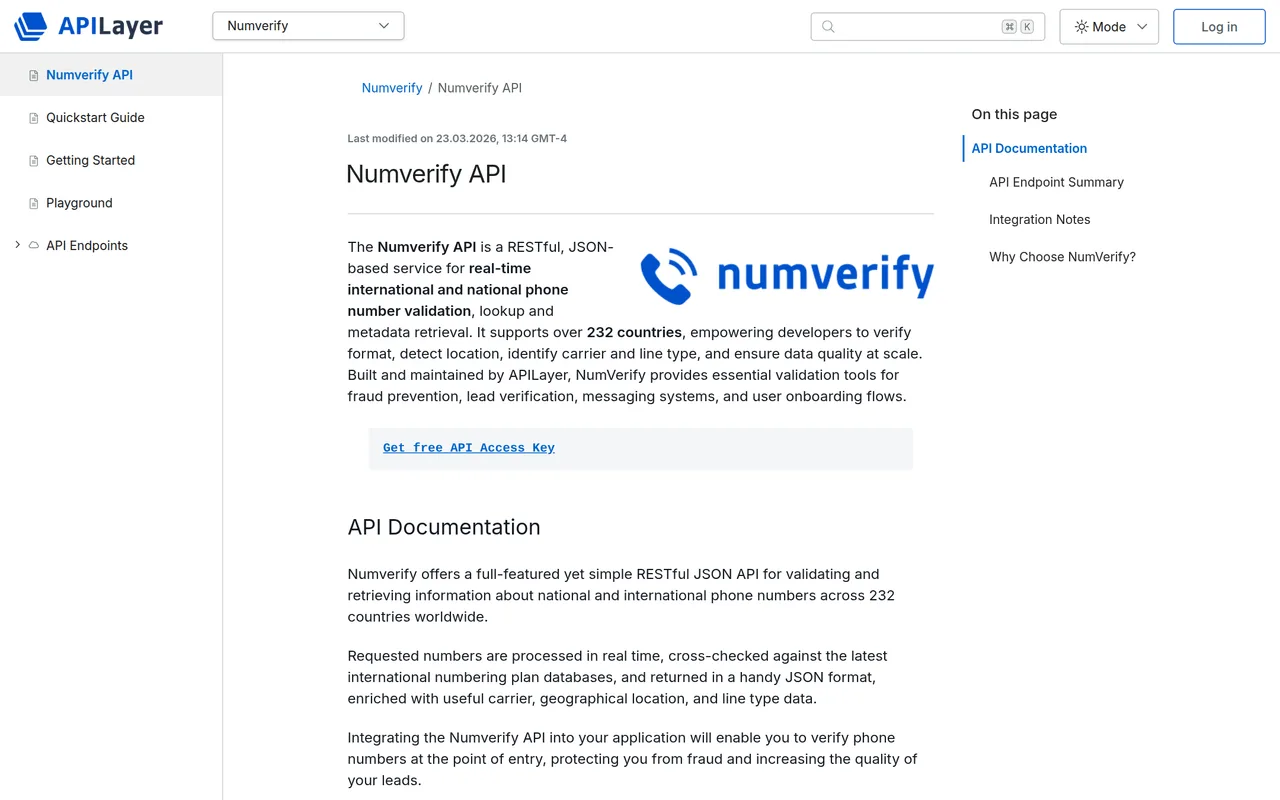
This is Numverify’s public API reference.
Their public developer documentation, so you can judge the integration before you start one.
1Lookup
Numverify
Where 1Lookup wins
- 76 data products on one API key and one credit balance: phone, email and IP checks, people and company data, social data and more
- Carrier, line type and a risk level on every phone validation, for 1 credit
- Live HLR status, DNC and TCPA litigator scrub, reverse phone lookup and skip trace on the same key
- An MCP server for AI agents, plus live Zapier, Make and n8n apps
- Self-serve up to 1,000,000 lookups a month at $0.0020 each, with no contract and 3-month credit rollover
Where Numverify (APILayer) wins
- Very low cost at volume, effective rate drops to ~$0.52 per 1,000 validations on the $129.99 Enterprise plan (250,000 requests)
- Broad international coverage: number validation, carrier, line-type, and country/location detection for 232 countries
- Free-forever tier (100 requests/mo, non-commercial use) with no time limit for testing before paying
- Automatic overage billing means service is never cut off mid-month when the quota is exceeded (with 75%/90%/100% usage alerts)
Numverify (APILayer) pricing and product facts verified against numverify.com as of October 2026. Prices change; always confirm on the vendor’s site. 1Lookup numbers come from the live rate card.
Who this is for
A quick, honest read on which tool fits your use case.
Choose 1Lookup if: you want more than phone formatting: email and IP validation, carrier and HLR data, line type, and fraud signals in one API, refreshed daily from FCC and carrier data.
Consider Numverify instead if: you only need a simple, free-tier API to check phone number format, country, carrier, and line type.