Check whether a phone number is a landline.
Enter any phone number to see whether it is a landline or a mobile number. It is free, with no signup.
Pick the country, then enter the number without the country code.
Free & rate-limited. No signup required to try.
A landline checker tells you whether a phone number sits on a landline or on a mobile, VoIP, toll-free or premium-rate line. 1Lookup's free checker reads the line type on record for any number and shows its validity, country and porting flag. A landline on record can still ring over a broadband line.
- Free, no signup
- Numbers from any country
- Never calls the number
- Says unknown when it cannot tell
You can check whether a number is a landline in under a minute.
Enter the number.
Type it with its country code, such as +1 for the US, or pick the country from the list.
Read the first line.
It says yes when the number is a landline, and no when it is a mobile, VoIP, toll-free or premium-rate number.
Read the line type and the porting flag.
The line type shows the exact kind, and the possibly ported flag shows whether the number may have moved to another network.
Remember that a landline on record can ring over broadband.
The record says the number is in a wireline range, and most home wireline connections in the US now run over internet calling.
Need this at scale? Phone Validation API
Sort a whole list into landline, mobile and VoIP before anyone dials or texts, one request per number.
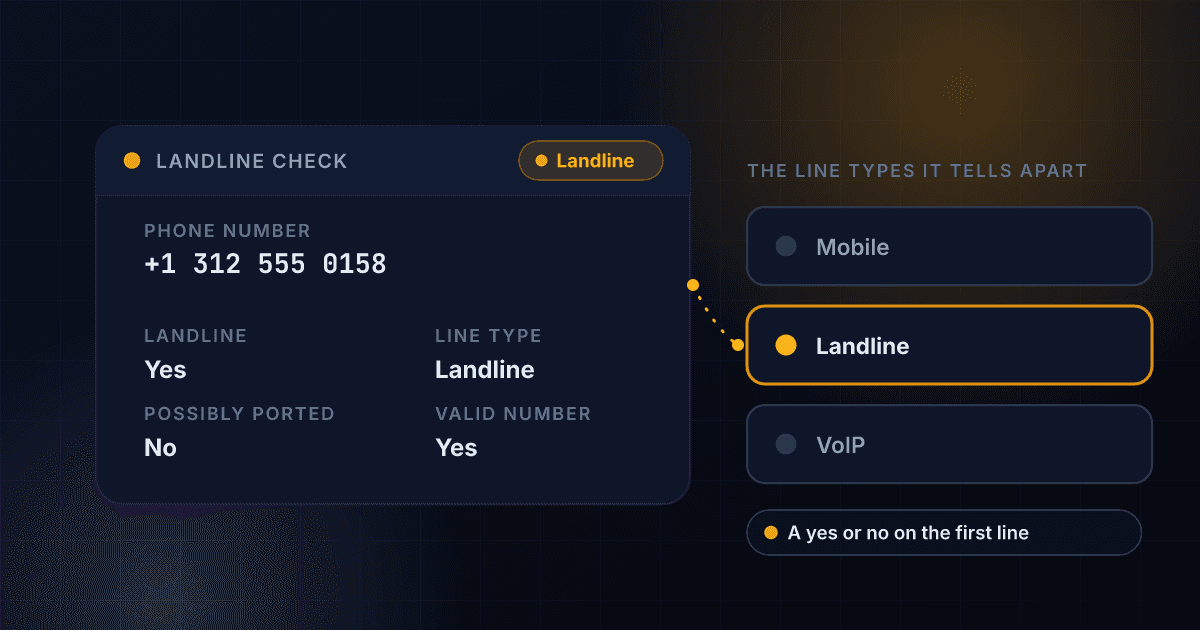
A landline is a number in a wireline range, and a line type check tells it apart from a mobile or VoIP number.
A landline number was first tied to a copper line from the phone company to a building, and a mobile number is tied to a SIM on a mobile network. Today the words describe the kind of service the number is recorded under. Most residential wireline phone connections in the US are now interconnected VoIP, which the FCC defines (47 CFR 9.3) as a service that enables real-time two-way voice, requires a broadband connection, requires IP-compatible equipment and lets users generally receive calls from and place calls to the regular phone network.
The line type is what a check can read. This checker looks up the record for the number and says yes when the line type is landline. A mobile, VoIP, toll-free or premium-rate number comes back as no, with its type named, and a number whose type cannot be told comes back as unknown, which is different from no. The digits alone do not decide it, because a landline and a mobile number can share an area code and a number can move to another kind of service when it is ported.
The answer matters when a call or a text has to land. A text to a landline may never arrive, and federal law treats calls to cellular numbers and to residential lines as two cases. The check reads a record, so it cannot see what the line does today: for a mobile number, a live HLR lookup can say whether it is switched on.
The phone validation API runs the same line type check on every number you collect.
When the check has to run on every signup or across a list, the number type endpoint returns the line type, validity and porting flag for 1 credit a lookup. See the phone validation API. To see the line type next to the carrier and the other number fields, use our free phone line type lookup. To see whether a number is on a VoIP line, use our free virtual number checker. To see whether a number is a mobile number, use our free mobile number checker. To see whether a mobile number is switched on and reachable right now, use our free HLR lookup. To read the guide behind this check, see our guide to phone number validation.
From 1Lookup research
Traditional phone companies hold 4.9% of the US number blocks assigned since 2021, against 26.9% of those assigned from 2001 to 2010.
We counted the 198,436 assigned number blocks in NANPA's central office code file of 1 October 2026 by the kind of carrier that holds each one. Of the 25,918 blocks assigned since January 2021, 4.9% went to traditional phone companies. Read the full study.
A landline check returns these fields, and each one answers a different question.
This is an invented result for a made-up number, laid out the way a check comes back. The first five fields are free on this page, and a free account opens the rest.
- LandlineYes
- Line typeLandline
- Valid numberYes
- CountryUnited States
- Possibly portedNo
Opens with a free trial
- The carrier name on recordSample Local Exchange
- Region detailIL
Landline
Yes when the line type on record is landline, no for mobile, VoIP, toll-free and premium rate, and unknown when the type cannot be told.
Line type
The kind of line the number is on: mobile, landline or VoIP, and for numbers outside the US and Canada also toll-free or premium rate.
Valid number
Whether the number follows the numbering rules of its country.
Country
The country the number belongs to.
Possibly ported
Whether the number may have moved to a different network since it was first assigned.
The carrier name on record
The network name on record for the number, shown as the record holds it.
Region detail
The state or region the number's range belongs to, where the record has one.
The checker reads the number's line type in three steps.
You enter a number.
Type it with its country code or pick the country. A number that is not valid in its country is told so.
We read its line type on record.
1Lookup looks up whether the number is a landline, a mobile or a VoIP number. Numbers outside the US and Canada can also come back as toll-free or premium rate. Nothing is dialed.
You read the verdict.
The result says whether the number is a landline and shows the line type, validity, country and porting flag. A free account opens the rest.
A landline check reads the line type on record, because the digits alone cannot show it.
Landlines, mobiles and VoIP lines are issued from the same area codes, so the line type has to be looked up.
- You enter the numberWith its country, so it is read in the right numbering plan.
- Its line type is readThe record says whether the number is a landline, a mobile or a VoIP number, and whether it is valid. Numbers abroad can also be toll-free or premium rate.
- The type becomes a verdictLandline is a yes. Mobile, VoIP, toll-free and premium rate are a no, with the type named. A type that cannot be told stays unknown.A number whose line type is not on record stays unknown
- You read the resultThe verdict, the line type, validity, country and porting flag. Whether the line runs over copper stays outside what a line type shows.
Adults living in a household with a landline fell from 23.5% to 19.6% between late 2023 and late 2025, and only 1.0% live in a household with a landline alone.
The CDC's National Health Interview Survey sorts adults by how their household gets phone service. A wireless-only household has mobile service and no landline, and a landline-only household has a landline and no mobile service. Two small groups with a partly unknown phone status are counted in the CDC's total and left out of the columns, so the columns can add to a little under 100. The 2025 periods rest on a smaller sample, because data collection paused during the federal government closure from 1 October to 12 November 2025.
- Wireless-only household
- Landline with wireless
- Landline-only household
| Period | Wireless-only household | Landline with wireless | Landline-only household | Phoneless | Total, as published |
|---|---|---|---|---|---|
| Jul to Dec 2023 | 76.0 | 22.2 | 1.3 | 0.5 | 100.0 |
| Jan to Jun 2024 | 77.1 | 21.1 | 1.2 | 0.4 | 100.0 |
| Jul to Dec 2024 | 78.7 | 19.8 | 0.9 | 0.5 | 100.0 |
| Jan to Jun 2025 | 78.9 | 19.5 | 0.9 | 0.5 | 100.0 |
| Jul to Dec 2025 | 80.0 | 18.6 | 1.0 | 0.4 | 100.0 |
75.2% of residential wireline connections in the US are internet-calling VoIP, and only 24.8% are traditional switched lines.
So a landline on record often means a number in a wireline range and not a copper line. The FCC counts the connections that providers report, in thousands, as of 30 June 2025. A switched access line is the traditional connection from a home to the local phone company's switch, and interconnected VoIP is phone service over a broadband connection. The incumbent phone companies, which were already providing local service in an area when the Telecommunications Act of 1996 became law, hold 93.7% of the residential switched lines. The FCC notes that figures may not sum to totals because of rounding.
- Switched access lines
- Interconnected VoIP
| Residential provider type | Switched access lines | Interconnected VoIP | All residential wireline |
|---|---|---|---|
| Incumbent phone companies | 6,011 | 4,328 | 10,339 |
| Other providers | 402 | 15,078 | 15,480 |
| All residential wireline | 6,413 | 19,405 | 25,819 |
Source: FCC, Voice Telephone Services: Status as of June 30, 2025, Figure 2.
Adults aged 65 and over are the likeliest to rely mostly or only on a landline, at 10.0% against 2.1% of those aged 45 to 64.
The CDC also sorts adults by their personal phone status, using its own labels, and this table shows the two groups that rely on a landline. The age group 18 to 24 is left out, because the CDC marks its landline-only estimate as one that does not meet its standards of reliability. These are percentages of adults in each age group for July to December 2025.
| Age group | Landline-mostly adults | Landline-only adults | Together |
|---|---|---|---|
| 25 to 29 | 0.0 | 0.3 | 0.3 |
| 30 to 34 | 0.1 | 0.8 | 0.9 |
| 35 to 44 | 0.1 | 0.4 | 0.5 |
| 45 to 64 | 0.9 | 1.2 | 2.1 |
| 65 and over | 6.5 | 3.5 | 10.0 |
Traditional phone companies hold 4.9% of the US number blocks assigned since 2021, against 26.9% of those assigned from 2001 to 2010.
Each assigned block is 10,000 numbers. The study sorts the 198,436 blocks in NANPA's file of 1 October 2026 by the kind of carrier that holds each one, in six groups. One group is the traditional phone companies. Most blocks carry no assignment date in the file, and the study shows them in their own row.
| When the block was assigned | Number blocks | Held by traditional phone companies |
|---|---|---|
| Assigned 2021 to 2026 | 25,918 | 4.9% |
| Assigned 2011 to 2020 | 28,774 | 14.8% |
| Assigned 2001 to 2010 | 30,442 | 26.9% |
| No date in the file | 113,302 | 60.3% |
Federal law restricts autodialed and prerecorded calls differently for cellular numbers and for residential lines, which is why a line type matters.
The Telephone Consumer Protection Act, in 47 U.S.C. 227(b)(1), sets rules for calls made with an automatic telephone dialing system or an artificial or prerecorded voice. This table restates four of its provisions in short form, so you can see which kinds of line they name.
| Provision of 47 U.S.C. 227(b)(1) | What it covers |
|---|---|
| Paragraph (A)(iii), cellular numbers | It is unlawful to call a number assigned to a paging service, cellular telephone service or other radio common carrier service with an automatic telephone dialing system or an artificial or prerecorded voice, other than for an emergency purpose or with the prior express consent of the called party, with the exceptions the statute lists. |
| Paragraph (B), residential lines | It is unlawful to initiate a call to a residential telephone line using an artificial or prerecorded voice to deliver a message without the prior express consent of the called party, with the exceptions the statute lists. |
| Paragraph (A)(i), emergency lines | The same restriction on automatic dialers and prerecorded voices applies to emergency telephone lines, including 911 lines and the emergency lines of hospitals and of fire protection or law enforcement agencies. |
| Paragraph (C), fax machines | It is unlawful to send an unsolicited advertisement to a fax machine, unless the sender has an established business relationship with the recipient and meets the other conditions the statute lists. |
The line type comes back as one of six values, and only a landline counts as a landline.
This is how the free result reads each value the line type record can hold. For US and Canadian numbers the record separates mobile, landline and VoIP and shows anything else as unknown. Numbers in other countries can also come back as toll-free or premium rate.
| Line type on record | Shown as | Landline |
|---|---|---|
| LANDLINE | Landline | Yes |
| MOBILE | Mobile | No |
| VOIP | VoIP (internet calling) | No |
| TOLL_FREE | Toll-free | No |
| PREMIUM | Premium rate | No |
| UNKNOWN | Unknown | Unknown |
A landline check can answer four questions about a number and cannot answer three others.
A line type record covers some questions, and other checks or the carrier cover the rest.
| Question | Can this check answer it? | Where the answer lives |
|---|---|---|
| Is the number on a landline? | Yes | The number's line type record |
| Is the number valid in its country? | Yes | The numbering rules of its country |
| Has the number possibly moved networks? | Yes | The porting flag on the record |
| Which country does the number belong to? | Yes | The number's country code |
| Does the line run over copper? | No | The carrier's own network records, which are not public |
| Is it a home line or a business line? | No | The record holds a line type and not who the customer is |
| Is the line working right now? | No | A live HLR lookup, which reads mobile numbers |
A landline check costs 1 credit, about $4.95 per 1,000 lookups on Starter and $2.00 on Enterprise.
These are the monthly plans on the pricing page. The line type and the porting flag come back on the same check. Every plan starts with a 7-day free trial, and the same credits pay for every other 1Lookup check.
| Plan | About per 1,000 lookups | Monthly price | Landline checks included |
|---|---|---|---|
| Starter | $4.95 | $99 | 20,000 |
| Growth | $3.52 | $299 | 85,000 |
| Professional | $3.20 | $799 | 250,000 |
| Enterprise | $2.00 | $1,999 | 1,000,000 |
You can check the line type of a whole list of numbers with one CSV file.
The free tool checks one number at a time. With a 1Lookup account you upload a CSV file, pick the column that holds the numbers and download the same file back with the line type filled in on every row. These are 5 of the columns it adds, with invented numbers.
| phone | NumberType | IsValid | IsPossiblyPorted | Carrier | Country |
|---|---|---|---|---|---|
| +1 312 555 0158 | LANDLINE | true | false | Sample Local Exchange | United States |
| +1 202 555 0136 | MOBILE | true | false | Sample Wireless | United States |
| +1 415 555 0124 | VOIP | true | false | Example Telecom, LLC | United States |
- 1 credit a number, the same price as one API lookup.
- Up to 2 million rows in one CSV file.
- Up to 1,000 API requests a minute on every account.
The number type API returns the line type as JSON from one request.
Send the number in E.164 format to the number type endpoint with your API key. Each request costs 1 credit, and every account can send up to 1,000 requests a minute. The line type is in classification.number_type, and a landline is the value LANDLINE. Whether the number may have moved is in classification.is_possibly_ported.
curl -X POST https://app.1lookup.io/api/v1/nt-lookup \
  -H "Authorization: Bearer YOUR_API_KEY" \
  -H "Content-Type: application/json" \
  -d '{"phone_number": "+13125550158"}'
import requests
response = requests.post(
"https://app.1lookup.io/api/v1/nt-lookup",
headers={"Authorization": "Bearer YOUR_API_KEY"},
json={"phone_number": "+13125550158"},
)
data = response.json()["data"]
print(data["classification"]["number_type"])const response = await fetch('https://app.1lookup.io/api/v1/nt-lookup', {
method: 'POST',
headers: {
'Authorization': 'Bearer YOUR_API_KEY',
'Content-Type': 'application/json'
},
body: JSON.stringify({ phone_number: '+13125550158' })
})
const { data } = await response.json()
console.log(data.classification.number_type)Response
{
  "success": true,
  "data": {
    "request": { "type": "nt_lookup", "input": "+13125550158" },
    "classification": {
      "number_type": "LANDLINE",
      "is_valid": true,
      "is_possibly_ported": false
    },
    "insights": {
      "nt_result": {
        "number_type": "LANDLINE",
        "carrier": "Sample Local Exchange",
        "country": "United States",
        "country_code": "US"
      }
    },
    "metadata": { "credits_used": 1, "credits_remaining": 9998 }
  }
}
To run the same check on every number you collect, see our phone validation API.
It gives a yes or a no on the first line.
The answer to the question you came with comes first, and the line type and the other fields sit under it.
It names the type when the answer is no.
A mobile, VoIP, toll-free or premium-rate number comes back as no with its type named, so you see what it is instead.
It says unknown when it cannot tell.
A number whose line type is not on record shows as unknown, because not knowing is not the same as a number being a landline.
It never calls or texts the number.
The check reads a record, so the number's owner is not contacted and does not know it was checked.
Who uses this tool
Sales and support teams sort a list before anyone calls.
Splitting a list by line type shows which numbers are landlines, which are mobiles and which are VoIP.
Teams that send texts check which numbers are mobile.
A landline answers no, so it can be kept out of a text campaign and called instead.
Signup and verification teams check the number before they send a code.
A landline may not be able to take a code by text, so the form can ask for a mobile number or offer a call.
People check a number a stranger gave them.
A number from a listing, a notice or a message can be checked in seconds to see which kind of line it is.
Frequently asked questions
How do I check whether a phone number is a landline?
Enter it in this checker with its country code. The first line says yes when the number is a landline and no when it is a mobile, VoIP, toll-free or premium-rate number, and the fields under it show the line type, validity, country and porting flag.
Can I tell a landline from a mobile number by looking at the digits?
Not by the digits alone. A landline and a mobile number can share an area code, and a number can move to another kind of service when it is ported, so the line type has to be looked up in a record.
Does a landline result mean the line runs over copper?
No. A landline on record means the number is in a wireline range. The FCC counted 19.4 million interconnected VoIP connections and 6.4 million switched access lines among US residential wireline connections in June 2025, so about three in four home wireline connections are internet calling.
How many people in the US still have a landline?
The CDC's National Health Interview Survey found that 19.6% of adults lived in a household with a landline in July to December 2025: 18.6% in a household that also had mobile phones and 1.0% in one with only a landline. Among adults aged 65 and over, 10.0% were landline-mostly or landline-only.
Is a landline the same as a residential line?
Not necessarily. A landline can be a home line or a business line, and the line type record does not say which. The FCC counted 6.4 million residential and 8.6 million business switched access lines in June 2025.
What does the checker show for a toll-free or VoIP number?
It answers no to the landline question and names the type: toll-free, VoIP (internet calling) or premium rate. A number whose type cannot be told shows as unknown.
What does possibly ported mean?
It means the number may have moved from the network it was first assigned to. A landline number can be ported to another provider or to a mobile or VoIP service, which is why the line type is read from a record and not from the digits.
Why does the line type matter for autodialed or prerecorded calls?
47 U.S.C. 227(b)(1) treats calls to cellular numbers and calls to residential lines as two cases, with a rule for each. The line type on record is the starting fact for which kind a number is, and the table on this page restates the provisions.
Does the landline checker work for numbers outside the US?
Yes. Enter the number with its country code or pick the country, and the check reads the line type on record for it. Where the line type cannot be confirmed, the result says unknown.
Why did a number I know is a landline come back as mobile?
The check reports the line type on record for the number, and a number can move to another kind of service when it is ported. In that case the record says what it holds, and the result follows the record.
Can this checker tell me whether a landline is working?
No. It reads the line type on record and does not call the number. A live HLR lookup can say whether a mobile number is switched on, and it is built for mobile numbers.
What is the difference between a landline checker and a phone line type lookup?
This page leads with the landline question and gives a yes or a no on the first line. The phone line type lookup shows the line type with validity, country and a vanity-number flag, and both read the same record.
Does the person know I checked their number?
No. The check reads records only. No call or text goes to the number, so its owner is never told.
How much does a landline check cost per number?
A landline check costs 1 credit per number in the API or a CSV upload. That is about $4.95 per 1,000 on the Starter plan, $3.52 on Growth, $3.20 on Professional and $2.00 on Enterprise. The free tool on this page checks one number at a time with no signup, and every plan starts with a 7-day free trial.
Is there an API that checks whether numbers are landlines in a list?
Yes. The number type endpoint of the phone validation API returns the line type for each number, 1 credit a request, and a CSV upload does the same for a whole list. Every account can send up to 1,000 requests a minute.
Is this landline checker really free?
Yes. Checking one number takes no signup. A free account opens the carrier name on record and the region, and checking whole lists by CSV or API uses credits.
These pages answer the question that comes after a landline check.
The first three digits of a US number tell you where it was assigned.
Every area code has its own page with the places it covers, the local time there, and what to do when a call from it looks spoofed. These are the codes people look up most.
- 213Los Angeles
- 646New York City
- 917New York City
- 202Washington
- 404Atlanta
- 702Las Vegas
- 786Miami
- 415San Francisco
- 206Seattle
- 954Fort Lauderdale
- 323Los Angeles
- 929New York City
Area code 213, downtown Los Angeles, also has a page for each of its 786 prefixes, with the company NANPA lists as the holder.
New area codes catch people out, because a number from one looks unfamiliar even when it is local. These are the newest working codes.
- 465New York, since Jun 2026
- 483Alabama, since Feb 2026
- 471Mississippi, since Jan 2026
- 679Michigan, since Nov 2025
- 457Louisiana, since Sep 2025
- 729Tennessee, since Sep 2025