Check whether a phone number is a virtual number.
Enter any phone number to see whether it is a virtual (VoIP) number. It is free, with no signup.
Pick the country, then enter the number without the country code.
Free & rate-limited. No signup required to try.
A virtual number checker tells you whether a phone number sits on an internet-calling (VoIP) line instead of a mobile network or a landline. 1Lookup's free checker reads the line type on record for any phone number and also shows whether it is valid, which country it belongs to and whether it is possibly ported.
- Free, no signup
- Numbers from any country
- Never calls the number
- Says unknown when it cannot tell
You can check whether a number is virtual in under a minute.
Enter the number.
Type it with its country code, such as +1 for the US, or pick the country from the list.
Read the first line.
It says yes when the number is on a VoIP line, and no when it is a mobile, landline, toll-free or premium-rate number.
Read the line type and the porting flag.
The line type shows the exact kind, and the possibly ported flag shows whether the number may have moved to another network.
Decide what the next step should be.
A VoIP number is a reason to look closer, such as asking for a second proof, and not a reason to block, because real people and businesses use VoIP.
Need this at scale? Phone Validation API
Screen every signup number for a VoIP line before you send a code to it, one request per number.
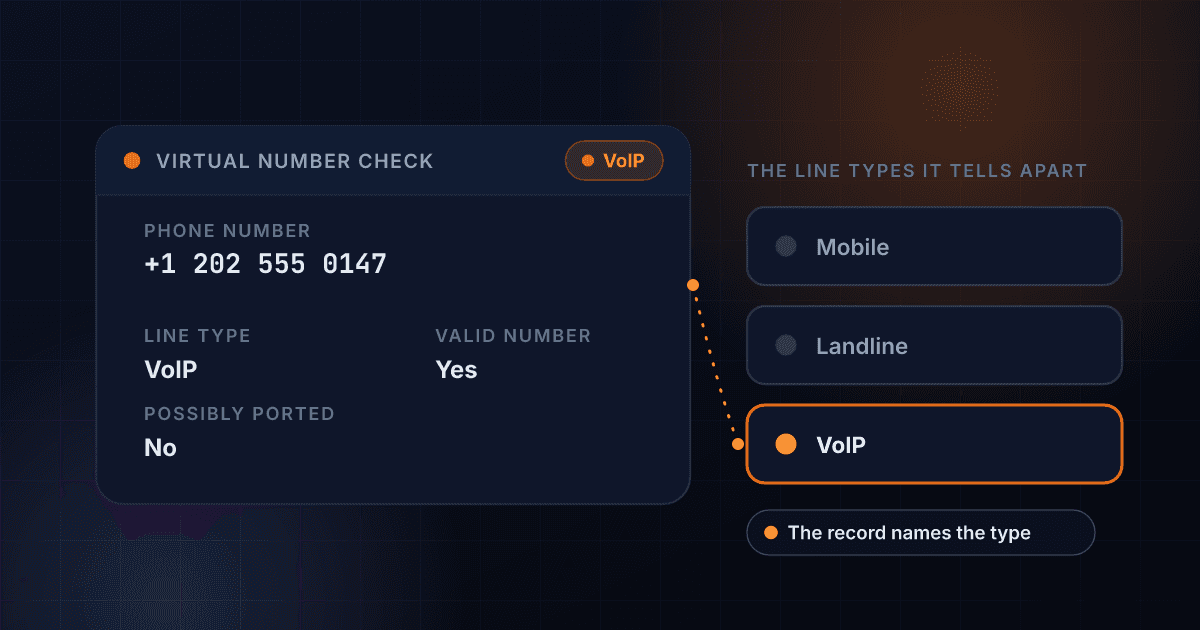
A virtual number is a phone number that works over the internet instead of through a SIM, and a line type check tells it apart.
A virtual number is a number that is not tied to a SIM or to a copper line. Calls and texts to it reach an app or a web service over the internet. The closest regulated service is interconnected VoIP, which the FCC defines by four elements: it enables real-time two-way voice, it needs a broadband connection, it needs IP-compatible equipment, and its users can generally receive calls from and place calls to the regular phone network (47 CFR 9.3).
The line type is what a check can read. This checker looks up the record for the number and says yes when the line type is VoIP. It does not name the app or the brand a person uses, because the record holds a line type and not an app name. A mobile or landline number comes back as no, and a number whose type cannot be told comes back as unknown, which is different from no.
It matters wherever a code goes to a phone. NIST's 2025 digital identity guidelines (SP 800-63B-4) drop the earlier ban on VoIP numbers for out-of-band codes, call a phone call or text a restricted option, and ask verifiers to consider risk signals such as a SIM change or number porting first. A line type check gives you the line type, and the possibly ported flag gives you the porting signal. It cannot see a SIM change or a swapped device.
The phone validation API runs the same line type check on every number you collect.
When the check has to run on every signup or across a list, the number type endpoint returns the line type, validity and porting flag for 1 credit a lookup. See the phone validation API. To see the line type next to the carrier and the other number fields, use our free VoIP checker. To see whether a number is reported as spam or flagged as a robocaller, use our free phone number fraud checker. To weigh a phone number together with an email address and an IP address, use our free fraud checker. To see whether a mobile number is switched on and reachable right now, use our free HLR lookup. To read the guide behind this check, see our guide to detecting fake phone numbers.
From 1Lookup research
At least 30.8% of the US number blocks assigned since 2021 went to app and internet-calling carriers.
We counted the 198,436 assigned number blocks in NANPA's central office code file of 1 October 2026 by the kind of carrier that holds each one. Of the 25,918 blocks assigned since January 2021, at least 30.8% went to carriers that supply numbers to apps and internet calling, against 5.6% of those assigned from 2001 to 2010. Read the full study.
A virtual number check returns these fields, and each one answers a different question.
This is an invented result for a made-up number, laid out the way a check comes back. The first five fields are free on this page, and a free account opens the rest.
- Virtual (VoIP) numberYes
- Line typeVoIP (internet calling)
- Valid numberYes
- CountryUnited States
- Possibly portedNo
Opens with a free trial
- The carrier name on recordExample Telecom, LLC
- Region detailDC
- Whether a live network check can say it is switched onNo
Virtual (VoIP) number
Yes when the line type on record is VoIP, no for mobile, landline, toll-free and premium rate, and unknown when the type cannot be told.
Line type
The kind of line the number is on: mobile, landline or VoIP, and for numbers outside the US and Canada also toll-free or premium rate.
Valid number
Whether the number follows the numbering rules of its country. An invalid number is not charged in the API.
Country
The country the number belongs to.
Possibly ported
Whether the number may have moved to a different network since it was first assigned.
The carrier name on record
The network name on record for the number, shown as the record holds it.
Region detail
The state or region the number's range belongs to, where the record has one.
Whether a live network check can say it is switched on
Yes when a live network (HLR) lookup can say if the line is active.
The checker reads the number's line type in three steps.
You enter a number.
Type it with its country code or pick the country. A number that is not valid in its country is told so.
We read its line type on record.
1Lookup looks up whether the number is mobile, landline or VoIP. Numbers outside the US and Canada can also come back as toll-free or premium rate. Nothing is dialed.
You read the verdict.
The result says whether the number is virtual and shows the line type, validity, country and porting flag. A free account opens the rest.
A virtual number check reads the line type on record, because the digits alone cannot show it.
VoIP providers issue numbers in the same area codes as mobiles and landlines, so the line type has to be looked up.
- You enter the numberWith its country, so it is read in the right numbering plan.
- Its line type is readThe record says whether the number is mobile, landline or VoIP, and whether it is valid. Numbers abroad can also be toll-free or premium rate.
- The type becomes a verdictVoIP is a yes. Mobile, landline, toll-free and premium rate are a no. A type that cannot be told stays unknown.A number whose line type is not on record stays unknown
- You read the resultThe verdict, the line type, validity, country and porting flag. Which app a person uses stays outside what a line type shows.
Interconnected VoIP connections fell 6.8% from June 2022 to June 2025, while mobile connections grew 7.6%.
The FCC collects voice connection counts from providers twice a year. These are millions of connections, not numbers, and one customer can hold several. The all-connections column is the sum of the three series before rounding.
- Mobile
- Interconnected VoIP
- Switched access lines
| Period | Mobile | Interconnected VoIP | Switched access lines | All voice connections |
|---|---|---|---|---|
| Jun 2022 | 366.7 | 68.0 | 27.2 | 462.0 |
| Dec 2022 | 372.6 | 66.2 | 24.4 | 463.3 |
| Jun 2023 | 378.9 | 65.7 | 22.0 | 466.6 |
| Dec 2023 | 386.1 | 64.4 | 20.7 | 471.2 |
| Jun 2024 | 388.3 | 64.7 | 18.2 | 471.2 |
| Dec 2024 | 391.0 | 63.9 | 16.4 | 471.3 |
| Jun 2025 | 394.5 | 63.4 | 15.0 | 472.9 |
Source: FCC, Voice Telephone Services: Status as of June 30, 2025, Figure 1.
Business customers held 69.4% of interconnected VoIP connections in June 2025, and residential customers held 30.6%.
So a VoIP line is mostly a business line. The FCC splits wireline connections by technology and customer type, and these are millions of connections as of 30 June 2025.
- Residential
- Business
| Wireline technology | Residential | Business | All customers |
|---|---|---|---|
| Interconnected VoIP | 19.4 | 44.0 | 63.4 |
| Switched access lines | 6.4 | 8.6 | 15.0 |
| All wireline | 25.8 | 52.6 | 78.4 |
Source: FCC, Voice Telephone Services: Status as of June 30, 2025, Figure 2.
At least 30.8% of the US number blocks assigned since 2021 went to app and internet-calling carriers, against 5.6% of those assigned from 2001 to 2010.
Each assigned block is 10,000 numbers. The study sorts the 198,436 blocks in NANPA's file of 1 October 2026 by the kind of carrier that holds them. The app share is a floor, because smaller carriers without a label are counted apart and many of them supply internet calling too.
| When the block was assigned | Number blocks | Held by app and internet-calling carriers |
|---|---|---|
| Assigned 2021 to 2026 | 25,918 | 30.8% |
| Assigned 2011 to 2020 | 28,774 | 26.8% |
| Assigned 2001 to 2010 | 30,442 | 5.6% |
| No date in the file | 113,302 | 4.3% |
NIST allows a call or text as a login step only as a restricted option, and it no longer bans VoIP numbers for it.
NIST SP 800-63B-4, the US government's rules for authentication, was finalized in 2025. This table lists what it says about sending a secret to a phone, in its own terms, and its section on the phone network is Sec. 3.1.3.3.
| Subject | What NIST SP 800-63B-4 says |
|---|---|
| A call or text as the delivery path | Use of the public switched telephone network for an out-of-band secret is restricted, and the organization must assess, understand and accept the risks. |
| VoIP numbers | The 2025 revision removes the earlier prohibition on VoIP phone numbers for out-of-band authentication. |
| Risk signals | Verifiers should consider risk indicators, such as device swap, SIM change and number porting, before sending a secret over the phone network. |
| Alternatives | Verifiers must make alternative authenticator types available to all subscribers. |
| Email must not be used for out-of-band authentication. | |
| The code itself | At least six decimal digits, usable once, and invalid unless completed within 10 minutes. |
Source: NIST SP 800-63B-4, Digital Identity Guidelines: Authentication and Authenticator Management.
The line type comes back as one of six values, and only VoIP counts as a virtual number.
This is how the free result reads each value the line type record can hold. For US and Canadian numbers the record separates mobile, landline and VoIP and shows anything else as unknown. Numbers in other countries can also come back as toll-free or premium rate.
| Line type on record | Shown as | Virtual (VoIP) number |
|---|---|---|
| VOIP | VoIP (internet calling) | Yes |
| MOBILE | Mobile | No |
| LANDLINE | Landline | No |
| TOLL_FREE | Toll-free | No |
| PREMIUM | Premium rate | No |
| UNKNOWN | Unknown | Unknown |
A virtual number check can answer four questions about a number and cannot answer three others.
A line type record covers some questions, and other checks cover the rest.
| Question | Can this check answer it? | Where the answer lives |
|---|---|---|
| Is the number on a VoIP line? | Yes | The number's line type record |
| Is the number valid in its country? | Yes | The numbering rules of its country |
| Has the number possibly moved networks? | Yes | The porting flag on the record |
| Which country does the number belong to? | Yes | The number's country code |
| Which app does the person use? | No | The record holds a line type and not an app name |
| Is the line switched on right now? | No | A live HLR lookup |
| Is the number reported as spam? | No | The phone number fraud checker |
A virtual number check costs 1 credit, about $4.95 per 1,000 lookups on Starter and $2.00 on Enterprise.
These are the monthly plans on the pricing page. The line type and the porting flag come back on the same check, every plan starts with a 7-day free trial, and the same credits pay for every other 1Lookup check.
| Plan | About per 1,000 lookups | Monthly price | Virtual number checks included |
|---|---|---|---|
| Starter | $4.95 | $99 | 20,000 |
| Growth | $3.52 | $299 | 85,000 |
| Professional | $3.20 | $799 | 250,000 |
| Enterprise | $2.00 | $1,999 | 1,000,000 |
You can check the line type of a whole list of numbers with one CSV file.
The free tool checks one number at a time. With a 1Lookup account you upload a CSV file, pick the column that holds the numbers and download the same file back with the line type filled in on every row. These are 5 of the columns it adds, with invented numbers.
| phone | NumberType | IsValid | IsPossiblyPorted | Carrier | Country |
|---|---|---|---|---|---|
| +1 202 555 0147 | VOIP | true | false | Example Telecom, LLC | United States |
| +1 312 555 0126 | MOBILE | true | false | Sample Wireless | United States |
| +1 415 555 0132 | LANDLINE | true | false | Sample Local Exchange | United States |
- 1 credit a number, the same price as one API lookup.
- Up to 2 million rows in one CSV file.
- Up to 1,000 API requests a minute on every account.
The number type API returns the line type as JSON from one request.
Send the number in E.164 format to the number type endpoint with your API key. Each request costs 1 credit, and every account can send up to 1,000 requests a minute. The line type is in classification.number_type, whether the number may have moved is in classification.is_possibly_ported, and a VoIP number comes back with the suggested action VERIFY rather than a block, because plenty of real people and businesses use VoIP.
curl -X POST https://app.1lookup.io/api/v1/nt-lookup \
  -H "Authorization: Bearer YOUR_API_KEY" \
  -H "Content-Type: application/json" \
  -d '{"phone_number": "+12025550147"}'
import requests
response = requests.post(
"https://app.1lookup.io/api/v1/nt-lookup",
headers={"Authorization": "Bearer YOUR_API_KEY"},
json={"phone_number": "+12025550147"},
)
data = response.json()["data"]
print(data["classification"]["number_type"])const response = await fetch('https://app.1lookup.io/api/v1/nt-lookup', {
method: 'POST',
headers: {
'Authorization': 'Bearer YOUR_API_KEY',
'Content-Type': 'application/json'
},
body: JSON.stringify({ phone_number: '+12025550147' })
})
const { data } = await response.json()
console.log(data.classification.number_type)Response
{
  "success": true,
  "data": {
    "request": { "type": "nt_lookup", "input": "+12025550147" },
    "classification": {
      "number_type": "VOIP",
      "is_valid": true,
      "is_possibly_ported": false
    },
    "insights": {
      "nt_result": {
        "number_type": "VOIP",
        "carrier": "Example Telecom, LLC",
        "country": "United States",
        "country_code": "US"
      }
    },
    "recommendations": { "primary_action": "VERIFY" },
    "metadata": { "credits_used": 1, "credits_remaining": 9998 }
  }
}
To run the same check on every number you collect, see our phone validation API.
It gives a yes or a no on the first line.
The answer to the question you came with comes first, and the line type and the other fields sit under it.
It says unknown when it cannot tell.
A number whose line type is not on record shows as unknown, because not knowing is not the same as a number being real.
It never names an app it cannot see.
The record holds a line type, so the result reports the line type and does not guess a brand.
It never calls or texts the number.
The check reads a record, so the number's owner is not contacted and does not know it was checked.
Who uses this tool
Signup and verification teams use it before they send a code.
A VoIP line is a reason to ask for a second proof, and a mobile number can go straight to a code by text.
Fraud teams use it as one signal on a new account.
A VoIP number on a new account is one signal, and it sits beside the porting flag, the email and the IP address.
Sales and support teams use it to sort a list.
Splitting a list by line type shows which numbers are mobile, which are landlines and which are VoIP before anyone calls.
People use it when a stranger gives them a number.
A number from a listing, a marketplace or a dating profile can be checked in seconds to see which kind of line it is.
Frequently asked questions
How do I check whether a phone number is a virtual number?
Enter it in this checker with its country code. The first line says yes when the number is on a VoIP line and no when it is a mobile, landline, toll-free or premium-rate number, and the fields under it show the line type, validity, country and porting flag.
What is a virtual phone number?
It is a number that is not tied to a SIM card or a physical line, so calls and texts to it reach an app or a web service over the internet. The closest regulated service is interconnected VoIP, which the FCC defines in 47 CFR 9.3.
Can this checker tell whether a number is TextNow or Google Voice?
Not by itself. The free result reports the line type on record, such as VoIP, and an app's name is never put on a number unless the record returns that name. A free account also shows the carrier name on record for the number, so you can see what the record holds.
Is a VoIP number the same as a virtual number?
For this checker, yes: a virtual number is a number on a VoIP line. The result says yes only when the line type on record is VoIP, and it does not call a mobile number virtual even when a person uses it through an app.
Does a VoIP result mean the number is fake or belongs to a scammer?
No. Plenty of real people and businesses use VoIP, and the FCC counted 44.0 million business interconnected VoIP connections in June 2025. A VoIP result is a reason to look closer, such as asking for a second proof.
Can a virtual number receive a verification code?
It depends on the service behind the number, and this check does not send a code to find out. The check reads the line type only, so use it to decide how much to ask for, and not to test delivery.
What does possibly ported mean?
It means the number may have moved from the network it was first assigned to. NIST lists number porting among the risk indicators a verifier should consider before it sends a code over the phone network, so the flag is worth reading.
Does NIST allow a text or a call as a login step?
Yes, as a restricted option. NIST SP 800-63B-4 says an organization must assess and accept the risks, offer an alternative that is not restricted and consider signals such as a SIM change or number porting. It also removes the earlier ban on VoIP numbers for these codes.
Does the virtual number checker work for numbers outside the US?
Yes. Enter the number with its country code or pick the country, and the check reads the line type on record for it. Where the line type cannot be confirmed, the result says unknown.
Why did a number I know is virtual come back as mobile?
The check reports the line type on record for the number, and a provider can issue virtual numbers from a range that is recorded as mobile. In that case the record says mobile, and the result follows the record.
How common are virtual numbers?
The FCC counted 63.4 million interconnected VoIP connections in the US in June 2025, against 394.5 million mobile connections and 15.0 million switched access lines. Our own study of NANPA's October 2026 file found that at least 30.8% of the number blocks assigned since 2021 went to app and internet-calling carriers.
Does the person know I checked their number?
No. The check reads records only. No call or text goes to the number, so its owner is never told.
How much does a virtual number check cost per number?
A virtual number check costs 1 credit per number in the API or a CSV upload. That is about $4.95 per 1,000 on the Starter plan, $3.52 on Growth, $3.20 on Professional and $2.00 on Enterprise. The free tool on this page checks one number at a time with no signup, and every plan starts with a 7-day free trial.
Is there an API that checks whether numbers are VoIP in a list?
Yes. The number type endpoint of the phone validation API returns the line type for each number, 1 credit a request, and a CSV upload does the same for a whole list. Every account can send up to 1,000 requests a minute.
Is this virtual number checker really free?
Yes. Checking one number takes no signup. A free account opens the carrier name on record and the region, and checking whole lists by CSV or API uses credits.
These pages answer the question that comes after a virtual number check.
- VoIP checkerThe line type next to the carrier, validity and the vanity flag.
- Phone number fraud checkerWhether a US or Canadian number is reported as spam or flagged as a robocaller.
- Fraud checkerA phone number, an email address and an IP address, read for fraud signals.
- HLR lookupWhether a mobile number is switched on and reachable right now.
The first three digits of a US number tell you where it was assigned.
Every area code has its own page with the places it covers, the local time there, and what to do when a call from it looks spoofed. These are the codes people look up most.
- 213Los Angeles
- 646New York City
- 917New York City
- 202Washington
- 404Atlanta
- 702Las Vegas
- 786Miami
- 415San Francisco
- 206Seattle
- 954Fort Lauderdale
- 323Los Angeles
- 929New York City
Area code 213, downtown Los Angeles, also has a page for each of its 786 prefixes, with the company NANPA lists as the holder.
New area codes catch people out, because a number from one looks unfamiliar even when it is local. These are the newest working codes.
- 465New York, since Jun 2026
- 483Alabama, since Feb 2026
- 471Mississippi, since Jan 2026
- 679Michigan, since Nov 2025
- 457Louisiana, since Sep 2025
- 729Tennessee, since Sep 2025