Check whether a US or Canadian phone number is reported as spam or flagged as a robocaller.
Enter a US or Canadian phone number to see its spam and robocaller record. It is free, with no signup.
Works for US and Canadian numbers. Enter 10 digits, such as (202) 555-0138.
Free & rate-limited. No signup required to try.
A phone number fraud checker tells you whether a number has a record of spam or scam calls. 1Lookup's free checker reads whether a US or Canadian number is reported as spam and whether it is flagged as a robocaller, then gives a risk rating and a suggested action. A number nobody has rated shows as not rated.
- Free, no signup
- US and Canadian numbers
- Never calls the number
- Says when a number is unrated
You can check a number for fraud in under a minute.
Enter the number.
Type the ten digits of a US or Canadian number, such as (202) 555-0138, with or without the +1.
Read the rating.
The result shows a risk rating from low to high, or says that the number is not rated.
Read the two signals.
Reported as spam and flagged as a robocaller are the two things the check reads, and each shows Yes, No or Not rated.
Report what you find.
Forward a spam text to 7726 (SPAM) and report it at ReportFraud.ftc.gov. The FTC says not to click links in an unexpected text that asks for personal details.
Need this at scale? Phone Spam Check API
Check every number in a list for spam reports and robocaller flags, one request per number.
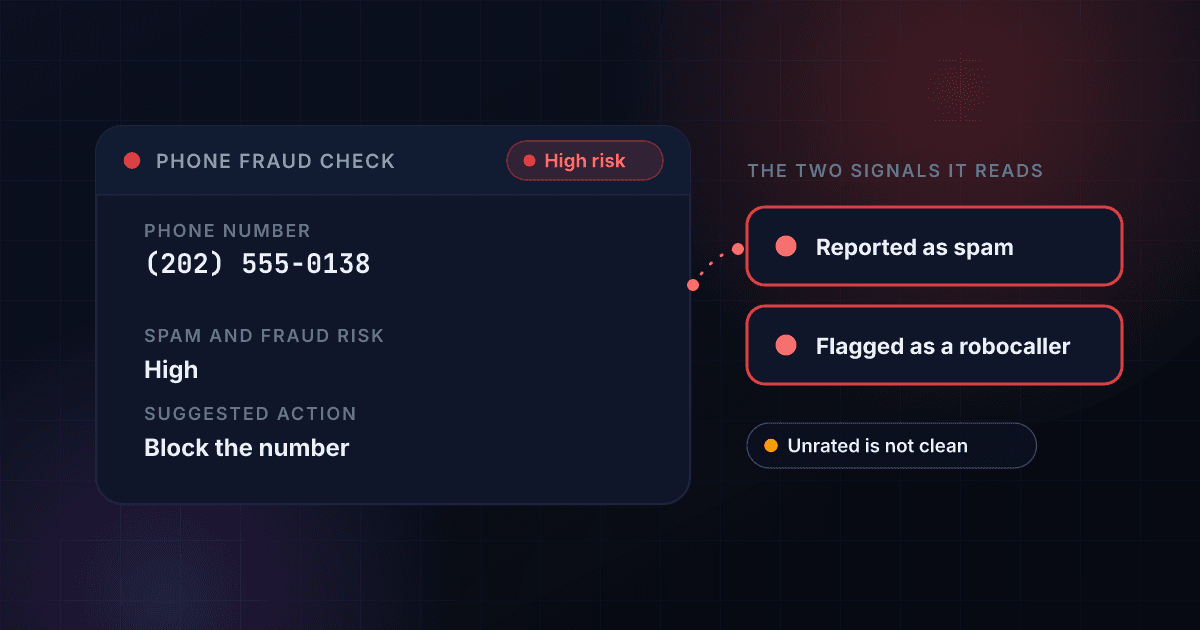
A phone number fraud check reads a number's reputation, because a number has no fraud flag of its own.
A phone number cannot be fraudulent by itself. What a check can read is its reputation: whether people have reported it as spam, and whether it is flagged as a robocaller. This checker reads those two signals for a US or Canadian number and turns them into a rating and a suggested action.
That is narrower than it sounds, and the page says so. A number that nobody has reported and that is on no robocaller list comes back as not rated, which is different from a clean rating. A new number has no history yet. And federal law bans sending misleading or inaccurate caller ID information with the intent to defraud, cause harm or wrongfully obtain anything of value (47 U.S.C. 227(e)), so the number on your screen is not always the number the call came from.
The stakes are real. The FTC's Consumer Sentinel data book counts 284,659 fraud reports in 2024 that began with a phone call and 246,784 that began with a text, and the median loss reported on a phone call was $1,500, the highest of any contact method. In 2025 the FTC reported about $16 billion lost to fraud overall, the highest on record.
The phone spam check API rates whole lists of numbers with the same two signals.
When the check has to run inside your own software or across a list, the API returns the rating, the 0 to 100 score and the risk factors for each US or Canadian number for 1 credit a lookup. See the phone spam check API. To see whether a number is mobile, landline or VoIP, use our free VoIP checker. To see the caller ID name and its legal ending, use our free business phone number lookup. To check a text message rather than a number, use our free scam text message checker. To find the likely owner of a US number, use our free reverse phone lookup.
A phone fraud check returns these fields, and each one answers a different question.
This is an invented result for a made-up number, laid out the way a check comes back. The first four fields are free on this page, and a free account opens the rest.
- Spam and fraud riskHigh
- Reported as spamYes
- Flagged as a robocallerNo
- Suggested actionBlock the number
Opens with a free trial
- The risk score behind the rating78 out of 100
- The risk factors behind the ratingSPAM_REPORTS
Spam and fraud risk
The rating, from low to high, or Not rated when the number has no reputation on record. It is the first field to read.
Reported as spam
Whether the number is reported as spam. No means its reputation is good, and Not rated means nobody has rated it.
Flagged as a robocaller
Whether the number is flagged as an automated caller. An automated line that people rate well can be flagged and still rate low.
Suggested action
A plain next step: no action needed, verify, review or block the number.
The risk score behind the rating
The 0 to 100 score the rating comes from.
The risk factors behind the rating
The reasons the rating lists, which are the signals that were raised.
The checker reads two reputation signals and rates the number in three steps.
You enter a US or Canadian number.
Type or paste ten digits, with or without +1. A number that is not a valid US or Canadian number is told so.
We read the number's reputation.
1Lookup checks whether the number is reported as spam and whether it is flagged as a robocaller. Nothing is dialed.
You read the rating and the action.
The result shows the risk rating, the two signals and a suggested action. A free account opens the score and the risk factors behind the rating.
A fraud check reads the number's reputation, then stops where proof of the caller begins.
This is the path one check takes. A number's reputation is what a lookup can answer, and who is really on the line is outside it.
- You enter the numberTen digits, read in the North American numbering plan.
- Its reputation is readWhether the number is reported as spam, and whether it is flagged as a robocaller.
- A rating is worked outThe two signals become a rating from low to high and a suggested action. No signal means not rated.A number with no reputation on record stays not rated
- You read the resultThe rating, both signals and the action. Who is really calling stays outside what a reputation can show.
A phone call carried the highest median reported loss of any contact method in 2024, at $1,500.
The FTC received 2,600,678 fraud reports in 2024, and 1,509,002 of them (58.0%) named how the scammer made contact. Calls and texts made up 531,443 of those, or 35.2%. The table is sorted by the median loss a victim reported.
| How the scammer made contact | Fraud reports | Total reported loss | Median reported loss |
|---|---|---|---|
| Phone call | 284,659 | $948 million | $1,500 |
| Text | 246,784 | $470 million | $1,000 |
| 42,108 | $90 million | $990 | |
| Other | 148,288 | $1,072 million | $633 |
| 371,651 | $502 million | $600 | |
| Social media | 186,826 | $1,858 million | $409 |
| Website or apps | 186,663 | $976 million | $200 |
| Online ad or pop-up | 42,023 | $246 million | $180 |
Source: FTC, Consumer Sentinel Network Data Book 2024, page 12.
Email was the most common way fraud began in 2024 at 24.6% of reports, ahead of phone calls and texts.
The same FTC table, ranked by how many reports named each contact method instead of by loss. Phone calls and texts together came to 35.2% of the 1,509,002 reports that named a method, so the contact method that costs most per report is not the one reported most.
| How the scammer made contact | Fraud reports | Share of reports that named a method |
|---|---|---|
| 371,651 | 24.6% | |
| Phone call | 284,659 | 18.9% |
| Text | 246,784 | 16.4% |
| Social media | 186,826 | 12.4% |
| Website or apps | 186,663 | 12.4% |
| Other | 148,288 | 9.8% |
| 42,108 | 2.8% | |
| Online ad or pop-up | 42,023 | 2.8% |
Source: FTC, Consumer Sentinel Network Data Book 2024, page 12.
People reported losing $3.5 billion to imposter scams in 2025, up from $2.95 billion in 2024.
An imposter scam is one where the caller pretends to be a business or a government agency. The 2025 figures are from the FTC's release of 15 June 2026, and the 2024 figures from its release of 10 March 2025 and the same June release.
| Type of imposter scam | Reported loss in 2025 | Reported loss in 2024 |
|---|---|---|
| All imposter scams | $3.5 billion | $2.95 billion |
| Business imposters | Nearly $1 billion | $866 million |
| Government imposters | About $920 million | $789 million |
Source: FTC, Data show people reported losing $3.5 billion to imposter scams in 2025, 15 June 2026.
Websites and apps, social media and phone calls led the 2025 reports that named a loss.
Among 2025 fraud reports that said money was lost and named a contact method, the FTC lists these shares. It excludes reports with no contact method, and it did not collect reports during the 2025 government shutdown. The shares are reports, not dollars.
| Contact method | Share of 2025 reports with a loss |
|---|---|
| Website or app | 31% |
| Social media | 28% |
| Phone call | 11% |
| 10% | |
| Text | 7% |
Source: FTC Data Spotlight, 27 April 2026.
Federal law puts a price on faking a caller ID, and the penalty is counted per violation.
47 U.S.C. 227 holds both the Truth in Caller ID rule and the robocall rules. These are the amounts it sets, in the words of the statute.
| Rule | What it covers | Amount set by the statute |
|---|---|---|
| Caller ID spoofing, subsection (e)(1) | Knowingly transmitting misleading or inaccurate caller ID information with the intent to defraud, cause harm or wrongfully obtain anything of value | Not a penalty: the prohibition itself |
| Civil forfeiture, subsection (e)(5)(A)(i) | A violation of the spoofing rule, determined by the FCC | Up to $10,000 per violation, or 3 times that for each day of a continuing violation, up to $1,000,000 for any single act |
| Criminal fine, subsection (e)(5)(B) | A willful and knowing violation of the spoofing rule, on conviction | A fine of up to $10,000 per violation, or 3 times that for each day of a continuing violation |
| Private action, subsection (b)(3) | A violation of the restrictions on automated telephone equipment in subsection (b) | Actual loss or $500 per violation, whichever is greater, and up to 3 times that when the violation was willful or knowing |
Source: 47 U.S.C. 227, Restrictions on use of telephone equipment.
The two signals combine into five possible results, and a number with no signal is not rated.
This is how the free result reads. A number can be flagged as a robocaller and still rate low, and a number with no signal at all is not rated.
| Reported as spam | Flagged as a robocaller | Rating shown | Suggested action |
|---|---|---|---|
| No | No | Low | No action needed |
| No | Yes | Low | No action needed |
| Yes | No | High | Block the number |
| Yes | Yes | High | Block the number |
| Not rated | Not rated | Not rated | No rating to act on |
The FTC gives three ways to report a spam text, and each one reaches a different place.
Reporting a spam text helps the next person. These are the FTC's steps, in its order.
| Way to report | What you do | Who gets the report |
|---|---|---|
| Forward to 7726 | Copy the message and forward it to 7726 (SPAM) | Your wireless provider, which can use it to spot and block similar messages |
| Report in your messaging app | Look for the option to report junk or spam | The messaging app you use |
| Report to the FTC | Report it at ReportFraud.ftc.gov | The FTC |
Source: FTC, How to Recognize and Report Spam Text Messages.
A fraud check can answer three questions about a number and cannot answer three others.
A number's reputation covers some questions, and other records cover the rest.
| Question | Can this check answer it? | Where the answer lives |
|---|---|---|
| Is the number reported as spam? | Yes | The number's reputation record |
| Is the number flagged as a robocaller? | Yes | The number's reputation record |
| Is the number rated low, medium or high risk? | Yes | The number's reputation record |
| Who owns the number? | No | Name and address records, through the reverse phone lookup |
| Is the number mobile, landline or VoIP? | No | The carrier record, through the VoIP checker |
| Was the number faked on this call? | No | The carriers that carried the call |
A phone number fraud check costs 1 credit, about $4.95 per 1,000 lookups on Starter and $2.00 on Enterprise.
These are the monthly plans on the pricing page. The rating and the suggested action come back on the same check, every plan starts with a 7-day free trial, and the same credits pay for every other 1Lookup check.
| Plan | About per 1,000 lookups | Monthly price | Phone number fraud checks included |
|---|---|---|---|
| Starter | $4.95 | $99 | 20,000 |
| Growth | $3.52 | $299 | 85,000 |
| Professional | $3.20 | $799 | 250,000 |
| Enterprise | $2.00 | $1,999 | 1,000,000 |
The phone spam check API returns the rating as JSON from one request.
Send the number in international format (+1 and ten digits) to the phone spam endpoint with your API key. Each request costs 1 credit for a US or Canadian number, and every account can send up to 1,000 requests a minute. The rating is in risk_assessment.risk_level, the 0 to 100 score in risk_assessment.fraud_score, the reasons in risk_assessment.risk_factors and the suggested action in recommendations.primary_action. The API's levels run LOW, MEDIUM, HIGH and CRITICAL, and the free result shows both of the top two as High.
curl -X POST https://app.1lookup.io/api/v1/phone-spam \
  -H "Authorization: Bearer YOUR_API_KEY" \
  -H "Content-Type: application/json" \
  -d '{"phone_number": "+12025550138"}'
import requests
response = requests.post(
"https://app.1lookup.io/api/v1/phone-spam",
headers={"Authorization": "Bearer YOUR_API_KEY"},
json={"phone_number": "+12025550138"},
)
data = response.json()["data"]
print(data["risk_assessment"]["risk_level"])const response = await fetch('https://app.1lookup.io/api/v1/phone-spam', {
method: 'POST',
headers: {
'Authorization': 'Bearer YOUR_API_KEY',
'Content-Type': 'application/json'
},
body: JSON.stringify({ phone_number: '+12025550138' })
})
const { data } = await response.json()
console.log(data.risk_assessment.risk_level)Response
{
  "success": true,
  "data": {
    "request": { "type": "phone_spam", "input": "+12025550138" },
    "risk_assessment": {
      "fraud_score": 78,
      "risk_level": "CRITICAL",
      "risk_factors": ["SPAM_REPORTS"]
    },
    "recommendations": { "primary_action": "BLOCK" },
    "metadata": { "credits_used": 1, "credits_remaining": 9998 }
  }
}
To run the same check on every number you call or sign up, see our phone spam check API.
It reads two real signals and shows both.
Reported as spam and flagged as a robocaller are each shown as Yes, No or Not rated, so you can see what the rating rests on.
It tells not rated apart from clean.
A number with no reputation on record is shown as not rated, because having no record is not the same as having a good one.
It never calls or texts the number.
The check reads a reputation record, so the number's owner is not contacted and does not know it was checked.
It ends with a plain next step.
The suggested action reads no action needed, verify, review or block the number, so the rating leads to something to do.
Who uses this tool
People use it to check a number that called or texted them.
A number reported as spam is a reason to let a call go to voicemail and to report the text, and a number with no rating is a reason to be careful rather than reassured.
Support and sales teams use it before calling a number back.
A missed call from an unknown number can be checked in seconds before anyone returns it.
Fraud teams use it as one signal on a signup.
A phone number given at signup that is reported as spam is one reason to ask for more proof. It sits beside the line type and the carrier, not in place of them.
Marketers use it to screen a list of US numbers.
Numbers reported as spam can be flagged before a campaign, with the API or a CSV upload for whole lists.
Frequently asked questions
How do I check whether a phone number is a scam?
Enter it in this checker to see whether it is reported as spam or flagged as a robocaller. Treat the result as one signal: a number nobody has reported shows as not rated, and a scammer can fake the number a call appears to come from.
What does a phone number fraud checker check?
This one reads two signals for a US or Canadian number: whether it is reported as spam and whether it is flagged as a robocaller. It then gives a risk rating from low to high and a suggested action.
What does not rated mean?
It means the reputation record has nothing on the number: nobody has reported it and it is on no robocaller list. That is not a clean rating, because a new number and a number the record has never seen look the same.
Can a number be flagged as a robocaller and still rate low?
Yes. An automated line that people rate well, such as an appointment reminder, can be flagged as a robocaller and still come back low risk. The two signals are shown separately for that reason.
Does the checker work for numbers outside the US and Canada?
No. This free page checks US and Canadian numbers only. Use our phone validator or carrier lookup for the validity, line type and carrier of a number in another country.
Can scammers fake the number I see on my screen?
Yes. Federal law bans transmitting misleading or inaccurate caller ID information with the intent to defraud, cause harm or wrongfully obtain anything of value (47 U.S.C. 227(e)), and the rule exists because it happens. A reputation check judges the number shown, not the caller behind it.
What should I do after a call or text from a flagged number?
Do not click links or reply. Forward a spam text to 7726 (SPAM), report it in your messaging app and report it at ReportFraud.ftc.gov. The FTC says legitimate companies will not ask for account information by text, and that you should contact a company at a number or website you know is real.
How many people lose money to phone scams?
The FTC's Consumer Sentinel data book for 2024 counts 284,659 fraud reports that began with a phone call, with $948 million reported lost, and 246,784 that began with a text, with $470 million reported lost. Those are reports to the FTC, not every scam.
Does a high rating mean the call was a scam?
It means the number is reported as spam. It is a reason to block the number or to check the caller through a number you know is real, and it is not a finding about the one call you just had.
What is the difference between spam and fraud?
Spam calls are unwanted calls, often sales or automated ones, while fraud calls aim to take money or information. A reputation check cannot tell the two apart from the number alone, so the rating covers both.
Does the checker tell me who owns the number?
No. It reads reputation only. For the likely owner of a US number use our reverse phone lookup, and for the caller ID name use our business phone number lookup.
Why did a number I know is a scam come back low or not rated?
A new number has no reports yet, and a number only a few people have met may not be in the record. A low or unrated result is a reason to be careful, not a clearance.
How much does a phone number fraud check cost per number?
A phone number fraud check costs 1 credit per US or Canadian number in the API or a CSV upload. That is about $4.95 per 1,000 on the Starter plan, $3.52 on Growth, $3.20 on Professional and $2.00 on Enterprise. The free tool on this page checks one number at a time with no signup, and every plan starts with a 7-day free trial.
Is there an API that checks phone numbers for spam in a list?
Yes. The 1Lookup phone spam check API checks one number per request in real time, and whole lists upload as a CSV file, starting with a 7-day free trial.
Is this phone number fraud checker really free?
Yes. The tool is free to use online and rate-limited for fair access, and it needs no signup. To see the score and risk factors behind a rating, or to check numbers in bulk, sign up for a 7-day free trial, then use the API as you scale.
These pages answer the question that comes after a phone number fraud check.
- Spam number lookupWhether a number is tied to spam, scams or robocalls.
- Business phone number lookupThe caller ID name on record for a US number and whether it ends in LLC or Inc.
- Reverse phone lookupThe likely owner and location behind a US number.
- VoIP checkerWhether a number is mobile, landline or VoIP, with its validity.
The first three digits of a US number tell you where it was assigned.
Every area code has its own page with the places it covers, the local time there, and what to do when a call from it looks spoofed. These are the codes people look up most.
- 213Los Angeles
- 646New York City
- 917New York City
- 202Washington
- 404Atlanta
- 702Las Vegas
- 786Miami
- 415San Francisco
- 206Seattle
- 954Fort Lauderdale
- 323Los Angeles
- 929New York City
Area code 213, downtown Los Angeles, also has a page for each of its 786 prefixes, with the company NANPA lists as the holder.
New area codes catch people out, because a number from one looks unfamiliar even when it is local. These are the newest working codes.
- 465New York, since Jun 2026
- 483Alabama, since Feb 2026
- 471Mississippi, since Jan 2026
- 679Michigan, since Nov 2025
- 457Louisiana, since Sep 2025
- 729Tennessee, since Sep 2025