Check whether any phone number is a mobile number in a few seconds.
Enter a number to see whether it is a mobile line, a landline or a VoIP number. It is free, with no signup.
Pick the country, then enter the number without the country code.
Free & rate-limited. No signup required to try.
A mobile number checker tells you whether a phone number is a mobile line, a landline, a VoIP number or another type. 1Lookup's free mobile number checker reads the number's type and answers yes or no, with the line type, whether the number is valid and its country. A free account opens the carrier and the ported flag.
- Any country
- No signup to try
- Clear yes or no
- Carrier and ported flag with a free account
You can tell whether a number is mobile in under a minute.
Enter the number with its country code.
Type it as you have it, such as +1 415 555 0132 or +44 7700 900123. A US number works without the +1.
Read the yes or no.
The first line of the result says whether the number is a mobile number, and the next lines give the line type, validity and country.
Treat a no as a reason to look at the line type.
A landline, a VoIP number, a toll-free number and a premium-rate number are all a no, and each is named.
Open the carrier if it matters.
Create a free account and the same check shows the carrier behind the number and whether it has been ported.
Need this at scale? Phone Validation API
Tell mobile from landline and VoIP across a whole list, with the carrier and ported flag for each number.
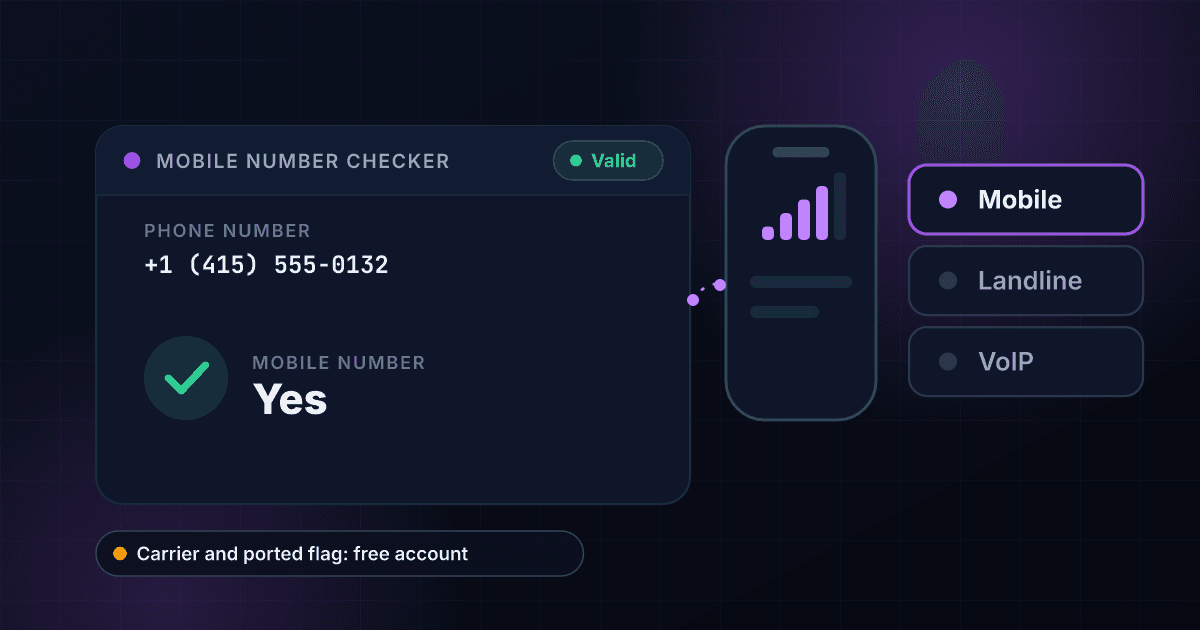
A mobile number checker answers one question, which is whether the number is a cell phone line.
A text message is meant for a mobile line, and a typical landline cannot receive one. A call to a mobile number reaches a person on the move, and a call to a landline reaches a desk or a household. Knowing which one you hold changes whether you send a text, when you call and how you read a signup.
Most people now live without a landline. The CDC's National Center for Health Statistics found that 80.0% of US adults lived in households with only wireless phones in July to December 2025, up from 11.8% in the last half of 2006. Outside the US the shift is just as complete: the World Bank counts 112.4 mobile subscriptions per 100 people in the United States and more than 100 in 13 of 16 large countries it tracks.
You cannot read the answer from the digits in the US and Canada. Mobile and landline numbers are assigned from the same area codes, and 71.8% of the 198,436 assigned prefixes are pooled, so one prefix can hold blocks for several carriers. A few countries do mark mobile numbers in the digits, such as the UK, where mobile numbers sit in the 07 range, but even there a prefix shows only the original operator because numbers can be ported.
This free tool reads the number's type record instead of guessing from its digits. It works for numbers from any country, one at a time, and the same check runs on whole lists through a CSV upload or the phone validation API.
The phone validation API classifies the line type of whole lists.
When the check has to run inside your own software or across thousands of numbers, the API returns the line type, validity, carrier and porting status of each one for 1 credit a lookup. See the phone validation API. To find out whether a number is VoIP, use our free VoIP checker. To see whether a mobile number is switched on right now, use our free HLR lookup. To see the carrier of any number, use our free carrier lookup. To find the likely owner of a US number, use our reverse phone lookup.
A mobile number check returns these fields, and each one answers a different question.
This is an invented result for a made-up number, laid out the way a check comes back. The first four fields are free on this page, and a free account opens the rest.
- Mobile numberYes
- Line typeMobile
- Valid numberYes
- CountryUnited States
Opens with a free trial
- CarrierT-Mobile USA, Inc.
- PortedNo
- Region and time zoneCalifornia, Pacific Time
Mobile number
The answer to the question on this page: whether the number is a mobile line. Anything else shows as no, with its type below.
Line type
Mobile, landline, VoIP, toll-free or premium rate. It decides whether a text can arrive and how the number is reached.
Valid number
Whether the number is real for its country. An invalid number is reported as invalid and is not charged.
Country
The country the number belongs to, read from its country code.
Carrier
The network behind the number, read from its record. A prepaid or reseller brand shows up under the network it runs on.
Ported
Whether the number may have moved to another network since it was issued.
Region and time zone
Where the number is registered and the time zone to call it in.
The check takes three steps and reads the number's type record.
You enter a phone number.
Type or paste it with its country code, such as +44 7700 900123. A US or Canada number works with or without the +1.
We read the number's type.
1Lookup parses the number by country, checks that it is valid and classifies it as mobile, landline, VoIP, toll-free or premium rate.
You read the yes or no.
The result says whether the number is mobile, then shows the line type, validity and country. A free account opens the carrier, the ported flag and the region and time zone.
A mobile number check reads the number's type, because its digits cannot say it.
This is the path one check takes. The country is read first, because each country marks its numbers differently, and then the number's type is read.
- You enter the numberWith its country code, or as a US number without one.
- The country and validity are readThe number is parsed against its own country's numbering plan.
- The type is readIt is classified as mobile, landline, VoIP, toll-free or premium rate.
- You get a yes or noThe free result shows the answer, the line type, validity and country. A free account opens the carrier and ported flag.
Six line types come back from a number check, and only one of them is a mobile number.
These are the values the number type API returns for a number, with what each one means and the answer this page gives.
| API value | What it is | Mobile number answer |
|---|---|---|
| MOBILE | A phone on a cellular network | Yes |
| LANDLINE | A fixed line at a home or an office | No |
| VOIP | A number delivered over the internet by an app or provider | No |
| TOLL_FREE | A business number the caller pays nothing to dial | No |
| PREMIUM | A paid-service number that charges the caller | No |
| UNKNOWN | A number whose type could not be confirmed | Unknown |
The share of US adults in wireless-only households grew from 11.8% in 2006 to 80.0% in 2025.
The CDC's National Center for Health Statistics measures it twice a year in the National Health Interview Survey. This is the share of adults living in households with only wireless phones, in five of its releases.
| Period | Adults in wireless-only households | Release |
|---|---|---|
| July to December 2006 | 11.8% | May 2007 |
| January to June 2018 | 55.2% | December 2018 |
| January to June 2021 | 68.0% | November 2021 |
| July to December 2023 | 76.0% | September 2026 |
| July to December 2025 | 80.0% | September 2026 |
Source: CDC National Center for Health Statistics, Wireless Substitution early release reports.
Mobile subscriptions outnumber people in 13 of 16 large countries, with 112.4 per 100 people in the United States.
The World Bank counts mobile cellular subscriptions for every 100 people. A figure above 100 means there are more subscriptions than people, because some people hold more than one. These are 16 large countries in 2023, the latest year with a figure for every one of them.
| Country | Mobile subscriptions per 100 people, 2023 |
|---|---|
| United Arab Emirates | 199.4 |
| Japan | 178.4 |
| South Africa | 171.5 |
| Israel | 153.3 |
| China | 128.2 |
| Indonesia | 125.2 |
| Germany | 124.7 |
| United Kingdom | 122.8 |
| France | 116.7 |
| Australia | 112.5 |
| United States | 112.4 |
| Mexico | 111.7 |
| Brazil | 101.0 |
| Nigeria | 98.5 |
| Canada | 94.1 |
| India | 80.6 |
Source: World Bank, Mobile cellular subscriptions (per 100 people), data of 8 October 2026.
A phone number's digits mark a mobile line in the UK but not in the US.
Countries number their phones differently, so the digits answer the question in some places and not in others. Where they do, a prefix still names only the operator that first held it.
| Country | Do the digits show a mobile number? | What the digits say |
|---|---|---|
| United Kingdom | Yes, in the 07 range | Mobile numbers are in 071 to 075, 077 to 079 and 07624. 070 is personal numbering and 076 is for pagers. |
| United Kingdom, after porting | Only the original operator | A mobile prefix can no longer be relied on to show the current operator. |
| United States and Canada | No | Mobile and landline numbers share area codes, and 71.8% of prefixes are pooled between carriers. |
A mobile number checker and an HLR lookup answer two different questions.
The checker is the first, cheap step. The HLR lookup is the live check that follows for a mobile number you plan to message or call.
| Question | Mobile number checker | HLR lookup |
|---|---|---|
| What does it answer? | Is this number a mobile line? | Is this mobile number switched on and reachable now? |
| Where does it look? | The number's type record | The mobile network itself |
| Credits a lookup | 1 | 5 |
| Does it work on a landline? | Yes, it names it as a landline | No, it is for mobile numbers |
| When is it the right check? | Cleaning a list before a text campaign | Confirming a mobile number before sending to it |
A mobile number check costs 1 credit, about $4.95 per 1,000 checks on Starter and $2.00 on Enterprise.
These are the monthly plans on the pricing page. The line type comes back on the same check as validity and country, every plan starts with a 7-day free trial, and the same credits pay for every other 1Lookup check.
| Plan | About per 1,000 checks | Monthly price | Mobile number checks included |
|---|---|---|---|
| Starter | $4.95 | $99 | 20,000 |
| Growth | $3.52 | $299 | 85,000 |
| Professional | $3.20 | $799 | 250,000 |
| Enterprise | $2.00 | $1,999 | 1,000,000 |
You can check a whole list of numbers for mobile lines with one CSV file.
The free tool checks one number at a time. With a 1Lookup account you upload a CSV file, pick the column that holds the numbers and download the same file back with the line type filled in on every row. These are 7 of the columns it adds, with invented numbers.
| phone | Carrier Full Name | Line Type | LRN | OCN | State | Rate Center | Porting Status |
|---|---|---|---|---|---|---|---|
| (305) 555-0171 | AT&T Mobility | Mobile | 3055550000 | 6534 | FL | MIAMI | NOT_PORTED |
| (305) 555-0108 | BellSouth Telecommunications | Landline | 3055550001 | 9417 | FL | MIAMI | NOT_PORTED |
| (720) 555-0155 | Onvoy, LLC | VoIP | 7205550000 | 649C | CO | DENVER | PORTED |
- 1 credit a number, the same price as one API lookup.
- Up to 2 million rows in one CSV file.
- Up to 1,000 API requests a minute on every account.
The number type API returns the line type as JSON from one request.
Send the number in international format to the nt-lookup endpoint with your API key. Each request costs 1 credit, an invalid number costs nothing and every account can send up to 1,000 requests a minute. The line type is in classification.number_type, and the original network is in insights.nt_result.carrier.
curl -X POST https://app.1lookup.io/api/v1/nt-lookup \
  -H "Authorization: Bearer YOUR_API_KEY" \
  -H "Content-Type: application/json" \
  -d '{"phone_number": "+447700900123"}'
import requests
response = requests.post(
"https://app.1lookup.io/api/v1/nt-lookup",
headers={"Authorization": "Bearer YOUR_API_KEY"},
json={"phone_number": "+447700900123"},
)
data = response.json()["data"]
print(data["classification"]["number_type"])const response = await fetch('https://app.1lookup.io/api/v1/nt-lookup', {
method: 'POST',
headers: {
'Authorization': 'Bearer YOUR_API_KEY',
'Content-Type': 'application/json'
},
body: JSON.stringify({ phone_number: '+447700900123' })
})
const { data } = await response.json()
console.log(data.classification.number_type)Response
{
  "success": true,
  "data": {
    "request": { "type": "nt", "input": "+447700900123" },
    "classification": {
      "lookup_type": "NT",
      "query_status": "OK",
      "number_type": "MOBILE",
      "is_valid": true,
      "is_possibly_ported": false,
      "qualifies_for_hlr_lookup": true
    },
    "insights": {
      "nt_result": {
        "number": "+447700900123",
        "number_type": "MOBILE",
        "is_valid": true,
        "country": "United Kingdom",
        "country_code": "GB"
      }
    },
    "metadata": { "credits_used": 1, "credits_remaining": 9998 }
  }
}
To run the same check from your own software, see our phone validation API.
It answers in plain yes or no.
The first field of the result is whether the number is mobile, so a visitor with one number does not have to decode a line type.
It names the other line types.
A number that is not mobile is called a landline, a VoIP number, a toll-free number or a premium-rate number, so a no always comes with a reason.
It works for numbers from any country.
The check parses the country code first, so a UK, German or Indian number is read against its own country's numbering plan.
The same check runs on whole lists.
Upload a CSV or call the API and every row returns with its line type, carrier, LRN and porting status, at 1 credit a lookup.
Who uses this tool
Marketing teams use it to find the numbers that can receive a text.
Texting a landline wastes a send, so a list is checked for mobile lines before a campaign.
Sales teams use it to reach the right line at the right time.
A mobile number reaches a person and an office line reaches a desk, so knowing which one a lead gave you shapes when and how you dial.
Signup and fraud teams use it to spot numbers that are not real phones.
A VoIP number given at signup is worth a second look, and an invalid number is caught before it is stored.
Support teams use it to tell a customer's phone from a switchboard.
A callback to a landline reaches a desk, and a callback to a mobile reaches a person, so the type decides how a ticket is followed up.
Frequently asked questions
How can I tell if a number is a mobile number?
Enter it in the checker above. The result answers yes or no and names the line type, so a number that is not mobile is shown as a landline, a VoIP number, a toll-free number or a premium-rate number. In the US and Canada you cannot tell from the digits alone.
Can I tell a mobile number from its digits?
In some countries yes: UK mobile numbers start with 07, though 070 is personal numbering and 076 is mostly pagers. In the US and Canada no, because mobile and landline numbers share area codes and 71.8% of prefixes are pooled. Even where the digits mark a mobile range, a prefix shows only the original operator.
What is the difference between a mobile number and a landline?
A mobile number belongs to a phone on a cellular network and goes with its owner. A landline belongs to a fixed line at a home or an office. A text message is meant for a mobile line, and a typical landline cannot receive one.
What does VoIP mean in the result?
VoIP means the number is delivered over the internet by an app or a calling provider, not by a mobile network or a copper line. It can look like any other number and may or may not receive texts, so the checker names it instead of calling it mobile.
Can a mobile number checker tell me who owns the number?
No. It names the type of line, not the person using it. For the likely owner of a US number, use the reverse phone lookup.
Does the free checker show the carrier?
The free result shows whether the number is mobile, its line type, whether it is valid and its country. The carrier behind the number, the ported flag and the region and time zone come with a free account on the same check.
Does the checker work for numbers outside the US?
Yes. It reads the country code and checks the number against that country's numbering plan, so it works for numbers from any country. Enter international numbers with the plus sign and the country code.
How many people use only a mobile phone?
In the United States, 80.0% of adults lived in households with only wireless phones in July to December 2025, according to the CDC's National Center for Health Statistics. In the last half of 2006 the figure was 11.8%.
Can a landline number receive text messages?
A typical landline cannot, because a text message is meant for a mobile line. The FCC says a toll-free number can receive texts only if it is text enabled, so the line type is a guide and not a guarantee.
What is the difference between a mobile number checker and an HLR lookup?
A mobile number checker says whether a number is of the mobile type. An HLR lookup asks the mobile network whether that mobile number is switched on and reachable right now, which is a different question and costs 5 credits instead of 1.
Does the answer change when a number is ported?
The type comes from the number's own record. The carrier behind the number and whether it may have been ported come with a free account on the same check. To see only whether a mobile number moved networks, use the portability lookup.
Why does a number show as unknown?
The numbering data did not say whether the number is mobile, landline or another type, so the checker does not guess. A number that is not valid is reported as not valid, and the API charges nothing for it.
Is this mobile number checker really free?
Yes. The tool is free to use online and rate-limited for fair access, and it needs no signup. To see the carrier and ported flag, or to check numbers in bulk, sign up for a 7-day free trial, then use the API as you scale.
How much does a mobile number check cost per number?
A mobile number check costs 1 credit in the API or a CSV upload. That is about $4.95 per 1,000 on the Starter plan, $3.52 on Growth, $3.20 on Professional and $2.00 on Enterprise. The free tool on this page checks one number at a time with no signup, and every plan starts with a 7-day free trial.
Is there a mobile number checker API for lists?
Yes. The 1Lookup phone validation API returns the line type, validity, carrier and porting status of each number, one at a time in real time or for whole lists from a CSV upload, starting with a 7-day free trial.
These pages answer the question that comes after a mobile number check.
The first three digits of a US number tell you where it was assigned.
Every area code has its own page with the places it covers, the local time there, and what to do when a call from it looks spoofed. These are the codes people look up most.
- 213Los Angeles
- 646New York City
- 917New York City
- 202Washington
- 404Atlanta
- 702Las Vegas
- 786Miami
- 415San Francisco
- 206Seattle
- 954Fort Lauderdale
- 323Los Angeles
- 929New York City
Area code 213, downtown Los Angeles, also has a page for each of its 786 prefixes, with the company NANPA lists as the holder.
New area codes catch people out, because a number from one looks unfamiliar even when it is local. These are the newest working codes.
- 465New York, since Jun 2026
- 483Alabama, since Feb 2026
- 471Mississippi, since Jan 2026
- 679Michigan, since Nov 2025
- 457Louisiana, since Sep 2025
- 729Tennessee, since Sep 2025
These carrier names show up on phone lookups, and each one has a page.
A lookup often names a company you have never seen on a bill. Each page below says what the company is and where it holds numbers.
- Onvoy, LLCSupplies numbers to VoIP and app-based phone services
- Level 3 Communications, LLCLumen's business and wholesale network
- Bandwidth.com CLEC, LLCSupplies numbers to VoIP and app-based phone services
- Neutral TandemWholesale phone carrier
- New Cingular Wireless PCS, LLCMobile network
- T-Mobile USA, Inc.Mobile network
- Peerless NetworkWholesale phone carrier
- Teleport Communications America, LLCAT&T's business phone network
To see who holds America's phone numbers overall, read our study Who Hands Out America's Phone Numbers in 2026.