Semrush API Alternative: SEO Data Without the Platform Subscription
Semrush is a superb SEO workflow platform. But if what you actually need is the data (authority scores, backlink profiles, keyword metrics) through an API, the economics look very different.
Semrush sells seat-based platform subscriptions, and its standard API is reserved for the top-tier plan with API units purchased separately on top. 1Lookup returns domain authority, backlink, and keyword data as individual flat-priced API lookups on universal credits shared with phone, email, and IP validation: no SEO platform plan, no seats, and no unit packages.
The Semrush data you need, as individual API calls
Each product below draws on the same class of search-index data Semrush's platform reports on, but is priced per lookup and available in bulk CSV: no platform seat required.
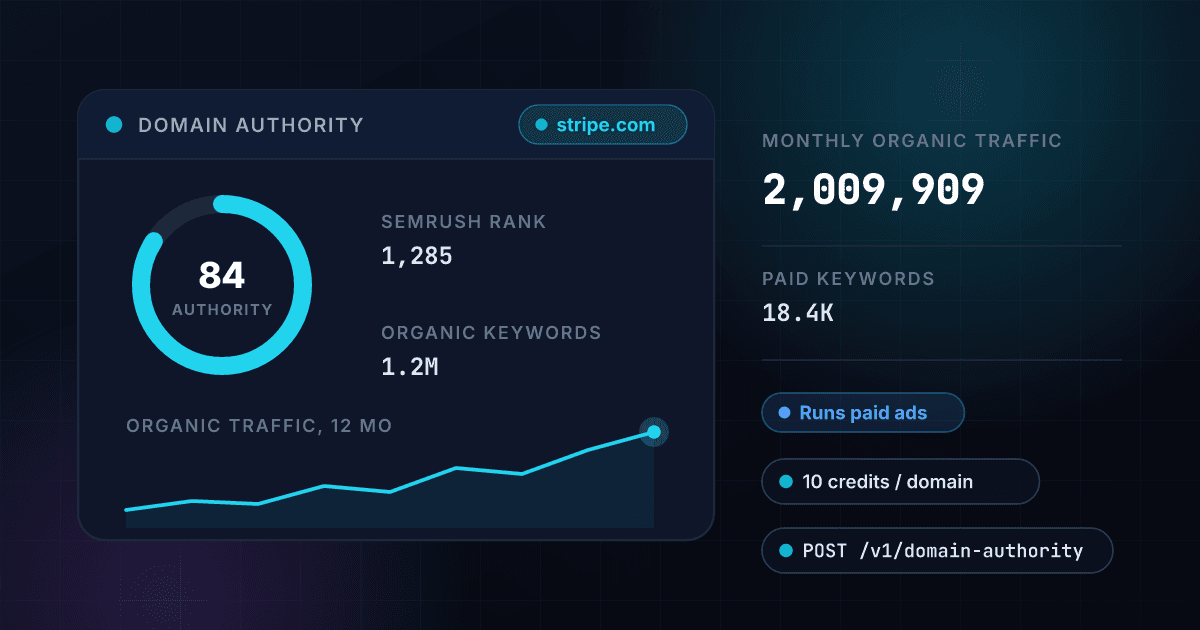
Domain Overview metrics
Domain Authority API
Authority score, Semrush rank, organic and paid keyword counts, traffic estimate and traffic value: one call per domain.
10 credits per domain
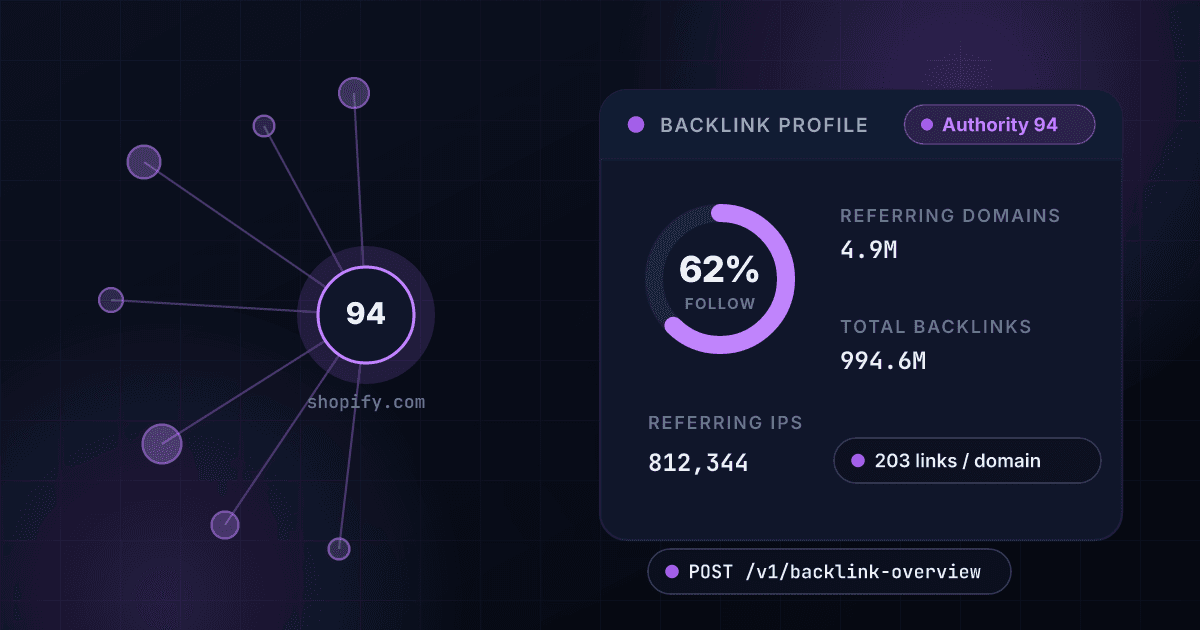
Backlink Analytics
Backlink Overview API
Authority Score, total backlinks, referring domains and IPs, and the follow/nofollow split with a computed ratio.
13 credits per domain
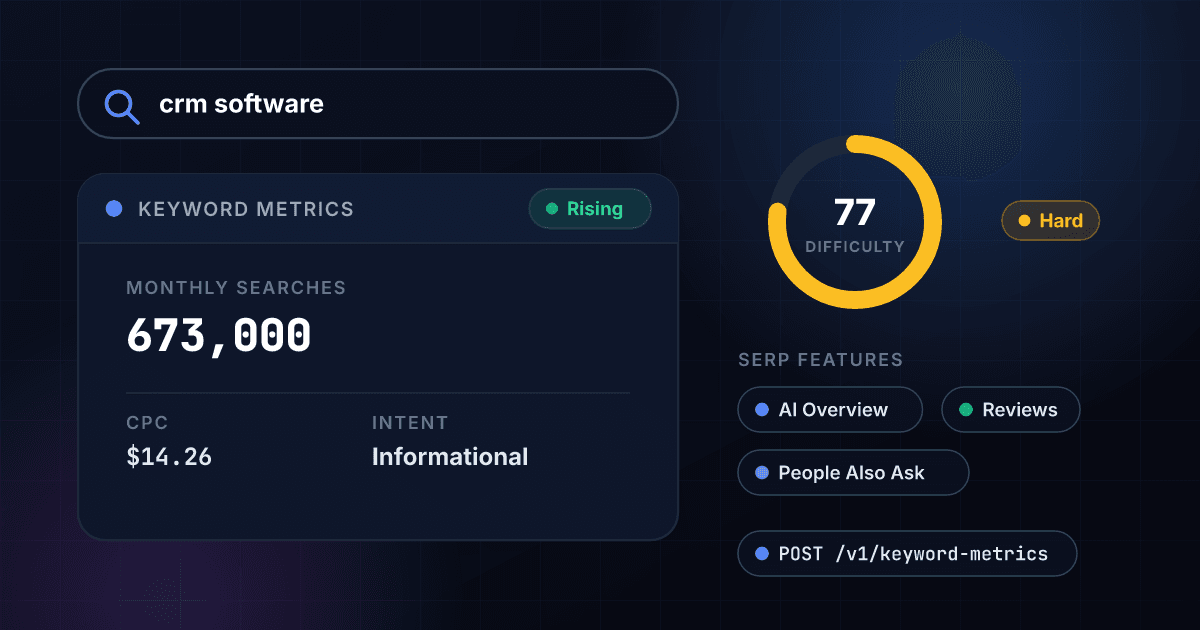
Keyword Overview
Keyword Metrics API
Volume, CPC, 0-100 difficulty with a plain-language band, intent, 12-month trend, and SERP features including AI Overviews.
6 credits per keyword
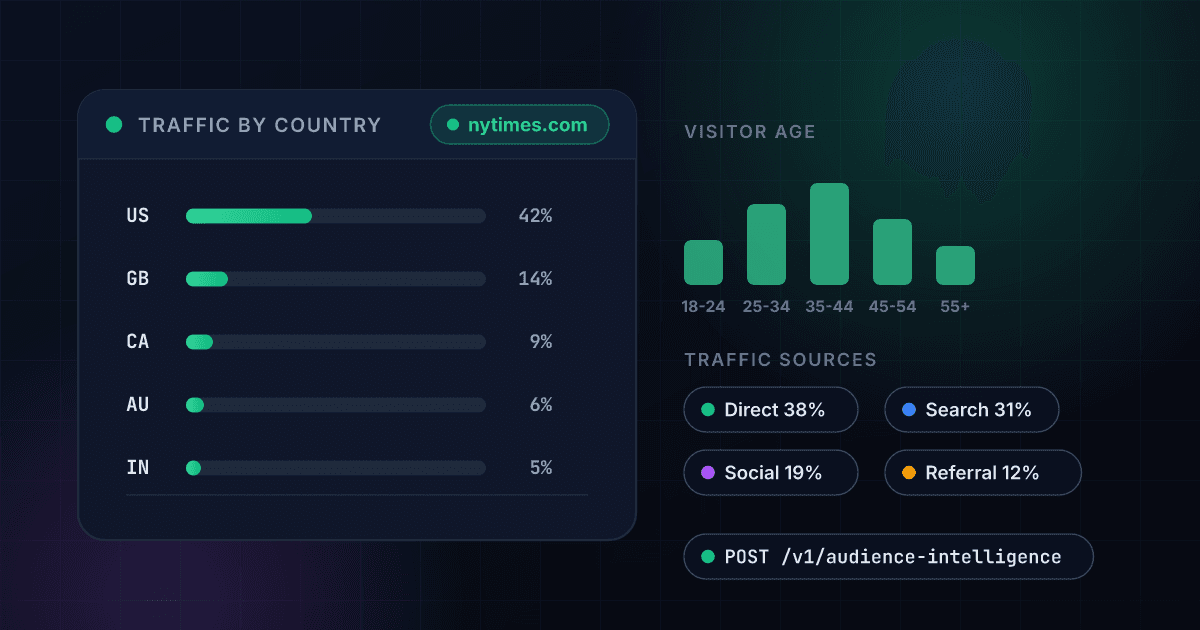
.Trends audience data
Audience Intelligence API
Traffic by country, visitor demographics, traffic sources and destinations for any website, one report per call.
86 credits per report
1Lookup vs Semrush: the same criteria, side by side
Both products measured on identical criteria, with Semrush’s numbers taken from its own published pricing.
| Criteria |  1Lookup 1Lookup |  Semrush Semrush |
|---|---|---|
| Pricing model | Monthly plans with universal credits; core phone, email and IP lookups cost 1 credit, enrichment and intelligence products cost more | Per-seat monthly/annual SaaS subscriptions. The 2026 lineup on the live pricing page is SEO ($139/mo), Starter ($199/mo), Pro+ ($299/mo) and Advanced ($549/mo), with annual billing saving up to 17%; paid add-ons include extra users (pricing page: 'starting at $45/mo'; Semrush's own June 2026 blog states $45-$100/user depending on plan), the Traffic & Market (.Trends) toolkit ($289/mo billed annually) and My Reports ($10-$20/mo per report). The API is not pay-per-lookup: it requires a top-tier subscription plus separately purchased API-unit packages whose dollar prices are only shown in-account. |
| Starting price | $99/mo for 20,000 credits ($4.95 per 1,000, down to $2.00 on Enterprise) | $139/mo for the entry "SEO" plan (5 websites to monitor, 500 keywords tracked daily; $117.33/mo billed annually). API access requires the $549/mo Advanced plan ($455.67/mo billed annually), with API units purchased separately on top. |
| Free option | Free single lookups via the online tools at 1lookup.io/tools, no account required | Free plan at $0/mo: '1 demo project', '10 reports per day across all vital tools', AI Visibility features; no credit card required. Semrush's own blog details the free limits further: 10 queries/day on analytics reports, 10 tracked keywords in Position Tracking, 100 URLs/mo in Site Audit. No free API access. |
| Free trial | 7-day free trial on every plan: $5 of credits on Starter, $20 on Growth, Professional, and Enterprise (card required, nothing charged up front) | 7-day free trial of paid plans ("Try Semrush free for seven days. Cancel anytime"); the Traffic & Market toolkit page shows the same seven-day trial offer. Activating the trial requires card details (per Semrush's own blog). |
| Do credits expire? | Unused monthly credits roll over for 3 months; separately purchased credits last 1 year | Yes for API units: per Semrush's API help page (kb/5-api), "The purchased units are included in your recurring subscription and renew on the same day as your plan. Unused units will expire instead of being added to the renewed amount." Plan report limits (e.g. 10 reports/day on Free) are daily/monthly allowances, not purchasable credits. |
What Semrush costs at volume
| Volume | Semrush price | Per 1,000 |
|---|---|---|
| Entry plan, 1 user (SEO plan: 5 websites, 500 keywords tracked daily) | $139/mo, or $117.33/mo billed annually | - |
| Cheapest publicly priced plan with API access, 1 user (Advanced: 40 websites, 5,000 keywords tracked daily) | $549/mo, or $455.67/mo billed annually - API units still sold separately on top | - |
| Traffic & Market (.Trends) competitive-intelligence toolkit (Pro plan) | $289/mo billed annually (only the annual-billed price is displayed; no monthly or per-user price shown on the live page) | - |
Semrush is priced per seat per month with API units on top; 1Lookup is priced per lookup (10 credits per domain-authority call, 13 per backlink overview, 6 per keyword). If you only need data pulls rather than a daily-use platform, compare what a month of your actual lookup volume costs on each model.
 Where Semrush wins
- All-in-one SEO platform on one subscription: rank tracking, site audit, backlink analytics, keyword research, competitor analysis, and (new in the 2026 lineup) AI search/visibility monitoring with daily tracked prompts
- Genuinely free entry points: a $0 free plan (1 demo project, 10 reports/day, no credit card) plus a 7-day free trial of paid plans
- API unit costs per report type are published transparently in the developer docs (e.g. keyword overview 10 units/line, backlinks reports 40 units/line, keyword difficulty 50 units/line), so heavy users can budget unit consumption precisely before buying
- Deep add-on ecosystem for market/competitive intelligence: the Traffic & Market (.Trends) toolkit adds traffic analytics, market landscape, and competitor alerts at a published $289/mo (billed annually)
 Where 1Lookup wins
- Flat per-lookup pricing on universal credits: no platform subscription, seats, or API unit packages
- Domain authority, backlinks, keywords, and website audience data alongside phone, email, and IP validation in one API
- Bulk CSV pipeline for scoring thousands of domains or keywords in one upload
- Credits are shared across every product and roll over for up to 3 months
Semrush pricing and product facts verified against semrush.com as of July 2026. Prices change; always confirm on the vendor’s site. 1Lookup numbers come from the live rate card.
Who this is for
A quick, honest read on which tool fits your use case.
Choose 1Lookup if: you need domain authority, backlink, or keyword numbers programmatically, priced per lookup, without buying an SEO platform subscription for the whole team.
Consider Semrush instead if: you want the full SEO workflow platform: rank tracking, site audits, content tools, and dashboards your marketing team lives in every day.
Frequently asked questions
How do I get API access to Semrush data without a Semrush plan?
1Lookup's Domain Authority, Backlink Overview, and Keyword Metrics products return Semrush-index data per API call, paid with the same universal credits as every other 1Lookup product. You need a 1Lookup plan (7-day free trial), not an SEO platform subscription, and there are no separate API unit packages to buy or track.
What does the Semrush API normally require?
Semrush's standard API is available on its top-tier subscription, with API units purchased separately on top of the plan price, and unused units expire when the subscription renews. The verified numbers are in the pricing table on this page.
Is 1Lookup a full replacement for Semrush?
No, and this page won't pretend it is. Semrush is an entire SEO workflow platform: rank tracking, site audits, content tools, and competitive research dashboards. 1Lookup replaces the data layer (programmatic authority, backlink, keyword, and audience lookups) for teams that build their own tooling or only need the numbers.
Where does 1Lookup's SEO data come from?
The Domain Authority, Backlink Overview, Keyword Metrics, and Audience Intelligence products are powered by Semrush's own index, accessed per call through a data-broker integration. You get the same class of numbers the platform reports, priced per lookup.
Can I run bulk domain or keyword analysis?
Yes. Every SEO data product works in 1Lookup's bulk CSV pipeline: upload a column of domains or keywords and get a results file back with every metric appended. Cost scales linearly with rows, and there are no volume tiers to negotiate.