Look up the area a US or Canadian phone number was assigned to.
Enter a US or Canadian phone number to see the state and rate center it was assigned to. It is free, with no signup.
Works for US and Canadian numbers. Enter 10 digits, such as (202) 555-0147.
Free & rate-limited. No signup required to try.
A phone number location lookup shows the area a number was assigned to, not where the phone is now. 1Lookup's free lookup reads the state or province, the rate center (the local exchange area) and the main time zone of the state for a US or Canadian number. It shows no street, and it cannot track a phone.
- Free, no signup
- US and Canadian numbers
- Shows the assigned area, not the phone's position
- Never calls the number
You can find the area of a phone number in under a minute.
Enter the number.
Type the 10 digits of a US or Canadian number, with or without the +1.
Read the headline.
It names the rate center and the state or province the number was assigned to.
Read the time zone and the line type.
The time zone is the main one of the state, and the line type says whether the number is mobile, a landline, VoIP or toll-free.
Treat the area as a hint.
A person can move or travel and keep a number, so the area tells you where the number began and not where the person is.
Need this at scale? Phone Validation API
Add the state, rate center and line type to every number in a list, one request per number.
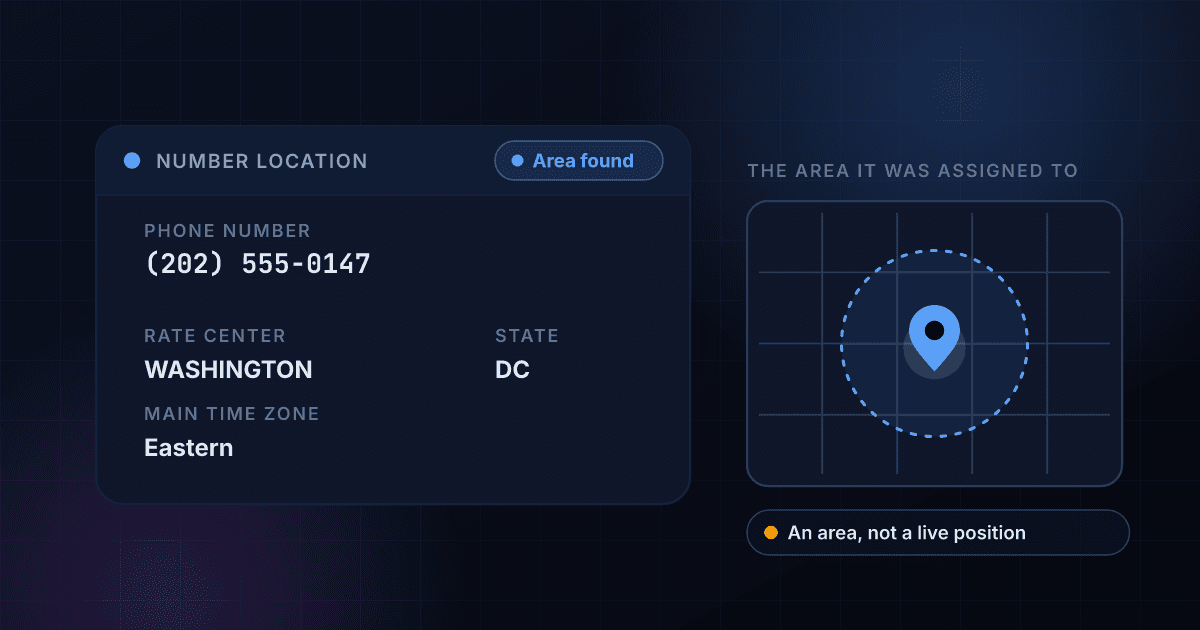
A phone number location lookup shows the area a number was assigned to, and the phone itself can be anywhere.
Every US and Canadian number starts with a three-digit area code and a three-digit exchange code. Together they were assigned to a carrier for one local exchange area, called a rate center, in one state or province. That assignment is what this lookup reads. It returns the state or province, the rate center and the main time zone of the state.
It does not show where the phone is today. The assignment stays with the number when its owner moves, and a mobile phone travels with whoever holds it. The Census Bureau counted 4.5 million Americans in 2023, 1.4% of the population, who lived in a different state than a year earlier, and a number's record does not change when its owner moves.
Live position is a different thing, and the law treats it differently. Cell-site records, which place a phone near a tower, are collected by carriers, and in Carpenter v. United States (2018) the Supreme Court held that getting them is a search that generally needs a warrant. This lookup uses none of that: it reads the assignment of the number and nothing else.
The carrier lookup API returns the state and rate center of every number you collect.
When the lookup has to run on every signup or across a list, the phone endpoint returns the state, the rate center and the line type for 1 credit a lookup. See the carrier lookup API. To see which carrier holds the number and whether it has been ported, use our free carrier lookup. To look up everything about one area code, use our free NPA NXX lookup. To see who the number is listed to, use our free reverse phone lookup. To see whether a number is reported as spam, use our free phone number fraud checker. To read the guide behind these lookups, see our guide to phone number research.
From 1Lookup research
California holds 22,086 number blocks and 41 area codes, the most of any state.
We counted the 198,436 assigned number blocks in the North American Numbering Plan Administrator's file of 1 October 2026 by state. The eight largest states hold 46.8% of them, and California alone has 41 area codes. Read the full study.
A location lookup returns these fields, and each one answers a different question.
This is an invented result for a made-up number, laid out the way a lookup comes back. The first five fields are free on this page, and a free account opens the rest.
- State or provinceDC
- Rate centerWASHINGTON
- Main time zone of the stateEastern (America/New_York)
- Line typeLandline
- CountryUS
Opens with a free trial
- The carrier that holds the numberExample Telecom, LLC
- Whether the number has moved networksNo
- Reachability and Do Not Call flagsNot on the list
State or province
The state or province the number was assigned to. It is the first field to read.
Rate center
The local exchange area the number was assigned in, shown as the carrier record spells it, which is often shortened.
Main time zone of the state
The main time zone of the state. It is worked out from the state, so a state that spans two zones shows its main one.
Line type
The kind of line the number is on: mobile, landline, VoIP or toll-free.
Country
The country the number belongs to.
The carrier that holds the number
The carrier that holds the number now.
Whether the number has moved networks
Yes when the number has been ported to a different carrier since it was assigned.
Reachability and Do Not Call flags
Whether the number is reachable and whether it is on a Do Not Call list.
The lookup reads the number's assignment in three steps.
You enter a number.
Type the 10 digits of a US or Canadian number. A number that is not valid in the North American numbering plan is told so.
We look up the exchange it sits in.
1Lookup finds the area code and exchange the number belongs to and reads the state or province and the rate center on record. Nothing is dialed.
You read the area.
The headline names the rate center and the state or province, with the main time zone of the state and the line type under it. A free account opens the rest.
A location lookup reads the number's assignment, because the digits alone do not say where a phone is.
The area code and the next three digits were assigned to a carrier for one rate center, and that assignment is the only location a number carries.
- You enter the numberWith its area code, such as 202.
- Its exchange is looked upThe area code and the next three digits were assigned to a carrier for one rate center in one state or province.
- The assignment becomes a resultThe state or province, the rate center and the main time zone of the state. A toll-free number has no home area.A toll-free number stops here with no home area
- You read the areaThe area the number was assigned to. Where the phone is today stays outside what a number shows.
About 1.4% of Americans lived in a different state in 2023 than a year earlier, which is 4.5 million people, down from 3.3% in 1990.
Every year the Census Bureau asks a sample of people where they lived a year earlier. A number's record does not change when its owner moves, so each of these moves widens the gap between a number's area and its owner's. The counts are in thousands of people.
| Survey year | People aged 1 and over (thousands) | Lived in a different state a year earlier (thousands) | Share |
|---|---|---|---|
| 1990 | 242,208 | 8,033 | 3.3% |
| 2000 | 270,219 | 8,428 | 3.1% |
| 2012 | 304,924 | 5,059 | 1.7% |
| 2019 | 320,667 | 4,738 | 1.5% |
| 2023 | 327,167 | 4,493 | 1.4% |
Source: US Census Bureau, Geographic Mobility: 1948 to 2023, Table A-1, Current Population Survey.
The eight largest states hold 46.8% of the 198,436 assigned number blocks, and California holds 22,086 of them across 41 area codes.
Each number block is 10,000 numbers assigned to one carrier in one rate center. The study counts the blocks in the numbering plan administrator's file of 1 October 2026 and sorts them by the state each block was assigned in.
| State | Area codes | Number blocks | Numbers assigned (millions) |
|---|---|---|---|
| California | 41 | 22,086 | 220.9 |
| Texas | 28 | 16,086 | 160.9 |
| New York | 21 | 12,046 | 120.5 |
| Florida | 23 | 11,180 | 111.8 |
| Illinois | 17 | 8,977 | 89.8 |
| Pennsylvania | 15 | 8,256 | 82.6 |
| Ohio | 14 | 7,301 | 73.0 |
| Michigan | 12 | 6,881 | 68.8 |
22 of the 378 area codes in service span two time zones, so a time zone is a guide for when to call and not a clock.
The numbering plan administrator lists a time zone for every area code. Most sit in one zone, and some cover two, which is why the time zone on a result is the main zone of the state and not a reading of the clock where the phone is. These are the letters the administrator uses, written out.
| Time zone of the area code | Area codes in service |
|---|---|
| Eastern | 168 |
| Central | 110 |
| Pacific | 52 |
| Mountain | 18 |
| Eastern and Central | 12 |
| Other zones and territories | 8 |
| Central and Mountain | 6 |
| Mountain and Pacific | 4 |
Source: NANPA area code report of 1 October 2026, time zone column, read by 1Lookup.
The Supreme Court held in 2018 that a phone's cell-site records generally need a warrant, and this lookup reads none of them.
Carpenter v. United States, decided on 22 June 2018, is the case that separates a phone's live position from the area of its number. This table sets out what the opinion's syllabus says, in its own terms.
| Subject | What the Court said |
|---|---|
| The records | Each time a phone connects to a cell site, it generates a time-stamped record known as cell-site location information, and wireless carriers collect and store it for their own business purposes. |
| The case | Prosecutors obtained 12,898 location points cataloging Carpenter's movements over 127 days, an average of 101 data points per day. |
| The holding | The Government's acquisition of Carpenter's cell-site records was a Fourth Amendment search. |
| What it generally takes | The Government will generally need a warrant to access cell-site records, and case-specific exceptions such as exigent circumstances may support a warrantless search. |
| What this lookup reads | None of it. The state, the rate center and the time zone come from the number's assignment. |
Source: Supreme Court of the United States, Carpenter v. United States, No. 16-402, June 22, 2018.
The area a result shows means something different for each line type.
This is how to read the state and rate center for each kind of line the lookup can return.
| Line type | What the area shows | What it cannot show |
|---|---|---|
| Landline | The local exchange area the line was assigned in | Which street the line is on |
| Mobile | The area where the number was first assigned | Where the phone is now |
| VoIP | The area the number was assigned to | Where the user connects from |
| Toll-free | No home area, because the owner can point it anywhere | Any location at all |
A phone number location lookup can answer four questions about a number and cannot answer four others.
The number's assignment covers some questions, and other checks cover the rest.
| Question | Can this lookup answer it? | Where the answer lives |
|---|---|---|
| Which state or province was the number assigned to? | Yes | The number's assignment record |
| Which rate center was it assigned in? | Yes | The number's assignment record |
| What is the main time zone of that state? | Yes | Worked out from the state |
| Is it mobile, a landline, VoIP or toll-free? | Yes | The number's line type record |
| Where is the phone right now? | No | Cell-site records held by carriers, which generally need a warrant |
| Which street does the owner live on? | No | A reverse phone lookup, for some US numbers |
| Who owns the number? | No | A reverse phone lookup |
| Is the line switched on right now? | No | A live HLR lookup |
A location lookup costs 1 credit, about $4.95 per 1,000 lookups on Starter and $2.00 on Enterprise.
These are the monthly plans on the pricing page. The state, the rate center and the line type come back on the same lookup, every plan starts with a 7-day free trial, and the same credits pay for every other 1Lookup check.
| Plan | About per 1,000 lookups | Monthly price | Location lookups included |
|---|---|---|---|
| Starter | $4.95 | $99 | 20,000 |
| Growth | $3.52 | $299 | 85,000 |
| Professional | $3.20 | $799 | 250,000 |
| Enterprise | $2.00 | $1,999 | 1,000,000 |
The phone API returns the state and rate center as JSON from one request.
Send the number in international format (+1 and ten digits) to the phone endpoint with your API key. Each request costs 1 credit, and every account can send up to 1,000 requests a minute. The state is in insights.raw_api_fields.state, the rate center in insights.raw_api_fields.ratecenter and the line type in classification.line_type.
curl -X POST https://app.1lookup.io/api/v1/phone \
  -H "Authorization: Bearer YOUR_API_KEY" \
  -H "Content-Type: application/json" \
  -d '{"phone_number": "+12025550147"}'
import requests
response = requests.post(
"https://app.1lookup.io/api/v1/phone",
headers={"Authorization": "Bearer YOUR_API_KEY"},
json={"phone_number": "+12025550147"},
)
data = response.json()["data"]
print(data["insights"]["raw_api_fields"]["state"])const response = await fetch('https://app.1lookup.io/api/v1/phone', {
method: 'POST',
headers: {
'Authorization': 'Bearer YOUR_API_KEY',
'Content-Type': 'application/json'
},
body: JSON.stringify({ phone_number: '+12025550147' })
})
const { data } = await response.json()
console.log(data.insights.raw_api_fields.state)Response
{
  "success": true,
  "data": {
    "request": { "type": "phone", "input": "+12025550147" },
    "classification": { "line_type": "LANDLINE" },
    "insights": {
      "raw_api_fields": {
        "network": "EXAMPLE TELECOM, LLC",
        "ratecenter": "WASHINGTON",
        "state": "DC"
      }
    },
    "metadata": { "credits_used": 1, "credits_remaining": 9998 }
  }
}
To run the same lookup from your own software, see our carrier lookup API.
It says assigned and never located.
The headline reads as the area the number was assigned to, because that is what the record holds.
It shows the rate center and not only the state.
The rate center is the local exchange area, so it narrows the state down to a part of it.
It says so when a number has no home area.
A toll-free number rings wherever its owner points it, so the result says it has no home area.
It never calls or texts the number.
The lookup reads a record, so the number's owner is not contacted and does not know it was looked up.
Who uses this tool
People use it to see where an unknown call began.
A number from an unknown caller can be checked in seconds to see which state and exchange area it was assigned to.
Sales and support teams use it to pick a good time to call.
The main time zone of the state helps decide when a number is worth dialing, with the caveat that some states span two zones.
Fraud and verification teams use it as a weak signal.
A number assigned in one state on an account that gives an address in another is a reason to look closer, and not a reason to refuse, because people move.
Developers use it to fill a region field.
The phone endpoint returns the state and rate center in the same call as the line type, for 1 credit a number.
Frequently asked questions
How do I find the location of a phone number?
Enter the number in this lookup. The headline names the rate center and the state or province the number was assigned to, and the fields under it show the main time zone of the state, the line type and the country.
Can a phone number location lookup show where the phone is right now?
No. It shows the area the number was assigned to. A phone's position comes from cell-site records that carriers keep, and a number alone does not give access to them.
What is a rate center?
It is the local exchange area a carrier assigns numbers in. A rate center sits inside one state or province and is usually named for a town or a part of a city, and the names are often shortened.
Can this lookup find a street address?
No. The result stops at the state or province and the rate center, and it has no street, no city block and no coordinates.
Why does the state not match where the person lives?
A number keeps the area it was assigned to when its owner moves, and a mobile phone goes wherever its owner goes. The Census Bureau counted 4.5 million Americans in 2023 who lived in a different state than a year earlier.
What does the time zone field show?
It shows the main time zone of the state the number was assigned to. A state that spans two time zones shows its main one, so use it as a guide for when to call and not as a clock.
What happens with a toll-free number?
A toll-free number has no home area, because its owner can point it anywhere. The lookup says so and shows the line type and country.
What about a VoIP number?
A VoIP number carries the area it was assigned to, and the person using it can be anywhere with an internet connection.
Does it work for numbers outside the US and Canada?
No. This lookup covers the North American numbering plan, which is the US, Canada and the places that share the +1 country code.
Can anyone get a phone's live location from its number?
Not from the number alone. Carriers hold cell-site location records, and the Supreme Court held in Carpenter v. United States (2018) that the government generally needs a warrant to get them.
Does the person know I looked up their number?
No. The lookup reads records only. No call or text goes to the number, so its owner is never told.
Which states have the most phone numbers assigned?
California, with 22,086 number blocks of 10,000 numbers and 41 area codes, then Texas with 16,086 and New York with 12,046, in our study of the North American Numbering Plan Administrator's file of 1 October 2026.
How much does a phone number location lookup cost per number?
A location lookup costs 1 credit per number in the API or a CSV upload. That is about $4.95 per 1,000 on the Starter plan, $3.52 on Growth, $3.20 on Professional and $2.00 on Enterprise. The free tool on this page checks one number at a time with no signup, and every plan starts with a 7-day free trial.
Is there an API that returns the state and rate center of a list of numbers?
Yes. The phone endpoint returns the state and the rate center with the line type for 1 credit a request, and a CSV upload does the same for a whole list. Every account can send up to 1,000 requests a minute.
These pages answer the question that comes after a location lookup.
The first three digits of a US number tell you where it was assigned.
Every area code has its own page with the places it covers, the local time there, and what to do when a call from it looks spoofed. These are the codes people look up most.
- 213Los Angeles
- 646New York City
- 917New York City
- 202Washington
- 404Atlanta
- 702Las Vegas
- 786Miami
- 415San Francisco
- 206Seattle
- 954Fort Lauderdale
- 323Los Angeles
- 929New York City
Area code 213, downtown Los Angeles, also has a page for each of its 786 prefixes, with the company NANPA lists as the holder.
New area codes catch people out, because a number from one looks unfamiliar even when it is local. These are the newest working codes.
- 465New York, since Jun 2026
- 483Alabama, since Feb 2026
- 471Mississippi, since Jan 2026
- 679Michigan, since Nov 2025
- 457Louisiana, since Sep 2025
- 729Tennessee, since Sep 2025