 vs
vs Waterfall batches vs synchronous per-lookup API
1Lookup is the FullEnrich alternative that returns a verified work email in the same request, not by a webhook that typically takes 30 to 90 seconds.
1Lookup returns a verified work email inside the request, charged only on a match, so the answer is there before your code moves on. FullEnrich routes each request through many vendors, then makes you post a batch and wait for a webhook.
FullEnrich sells waterfall enrichment: one request is routed through many contact-data vendors and stops at the first verified match, with credits spent on the data point found rather than the call made, and results returned asynchronously by webhook or polling. 1Lookup answers one lookup synchronously: a LinkedIn profile URL in, a verified work email out, 30 credits charged only on a match.
The FullEnrich data points, as synchronous lookups
FullEnrich charges per data point found across its vendor waterfall and returns them asynchronously. These are the same data points as single API calls on one shared credit balance, answered inside the request.
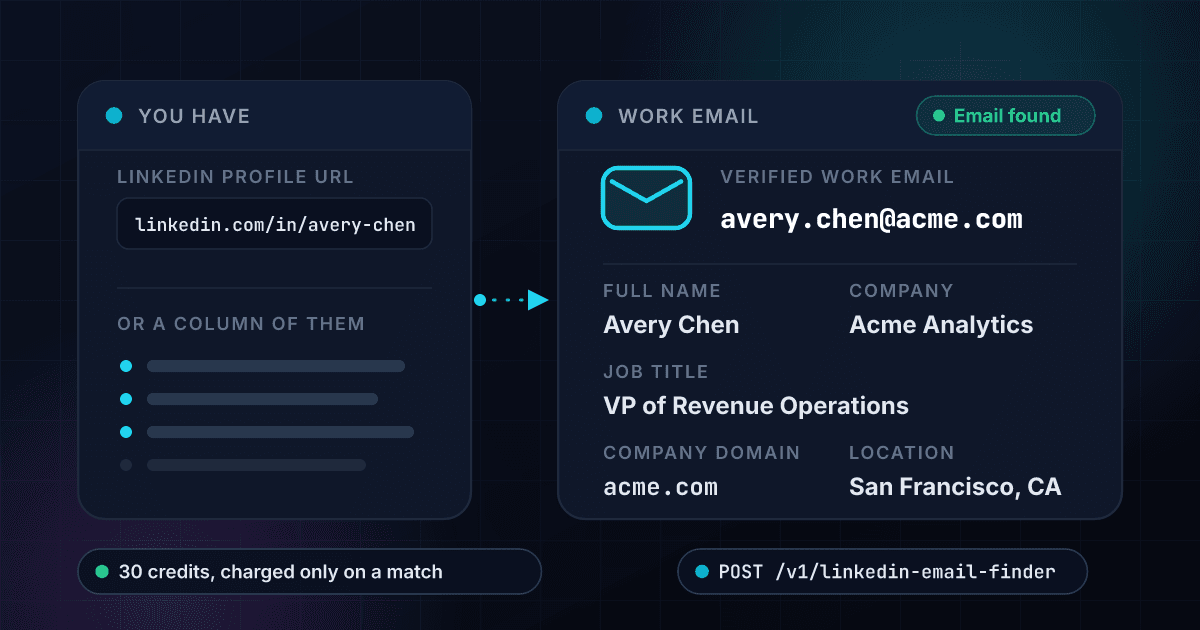
Work email from a LinkedIn URL
LinkedIn Email Finder API
A public LinkedIn profile URL in; a verified work email out in the same request, with full name, job title, company, company domain and location alongside it.
30 credits per match, charged only on a match
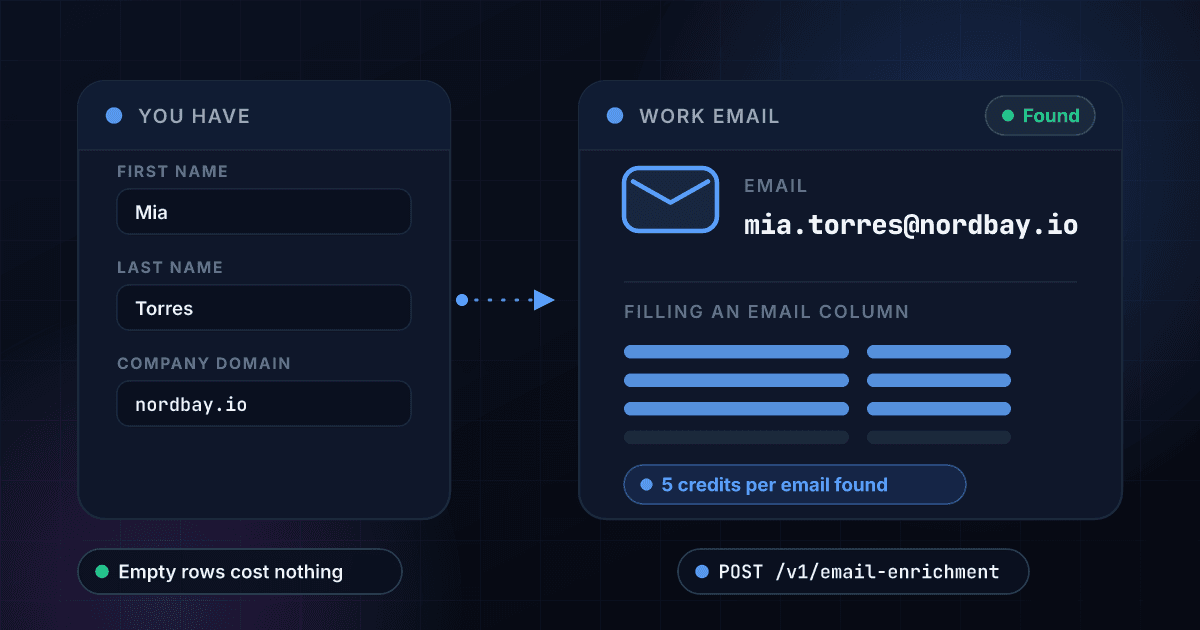
Work email from a name and a domain
Email Enrichment API
First name, last name and a company domain in; one work email out. The high-volume option when the list already has names and employers.
5 credits per match, free on a miss
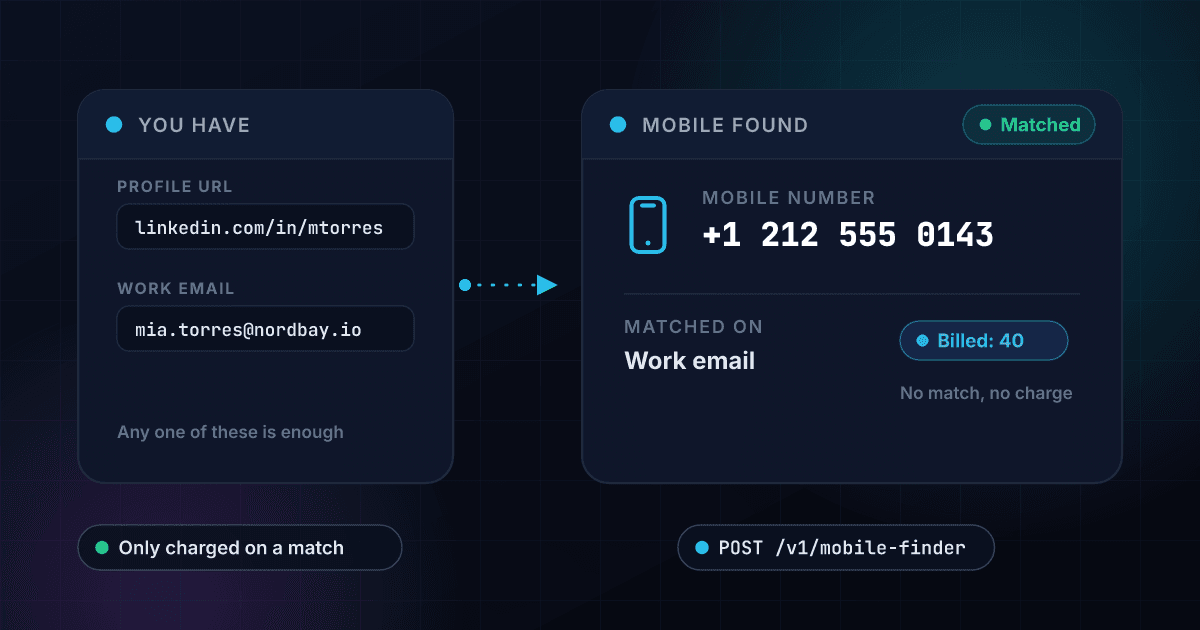
Mobile phone data point
Mobile Finder API
A profile URL, a work email or a personal email in; a mobile number out when one exists. Coverage is primarily US and the number is not dialled or line-checked.
40 credits per match, free on a miss
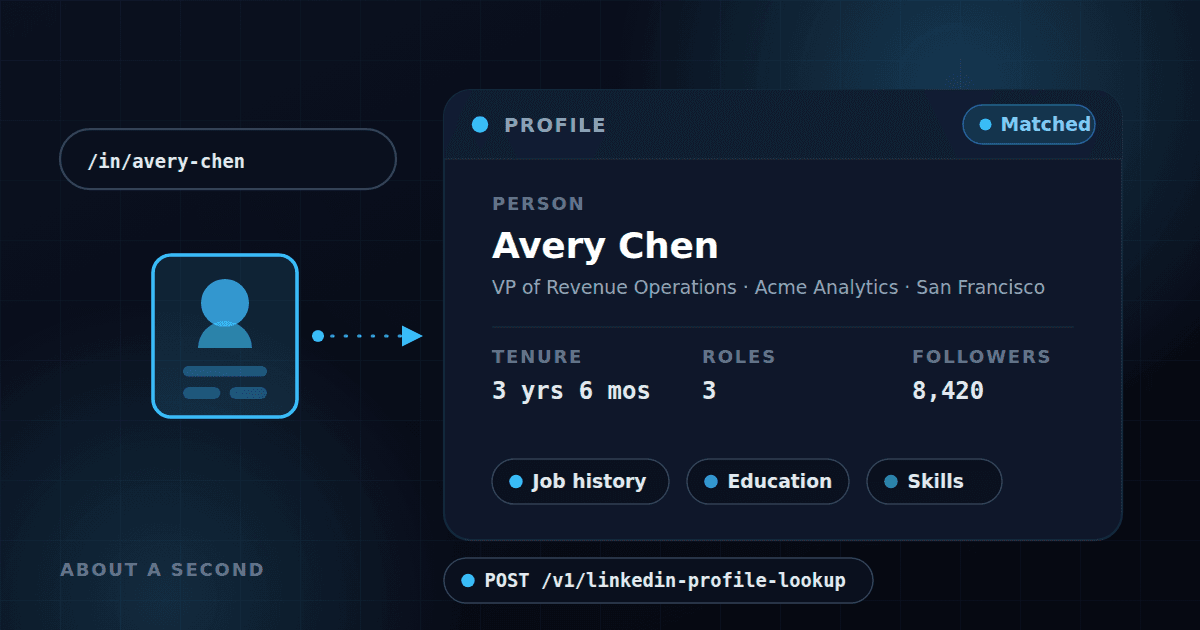
Person and company profile data points
LinkedIn Profile Lookup API
Name, headline, location, current role, dated job history, education and skills from a public LinkedIn URL, returned in about a second.
10 credits per profile found, free on a miss
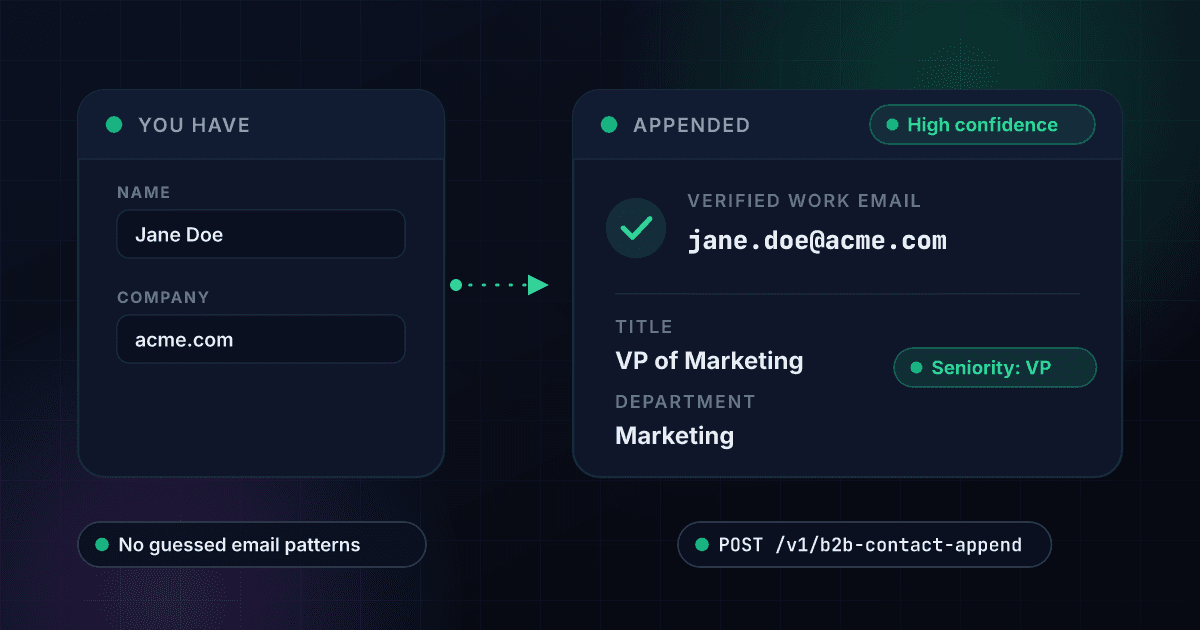
Full contact enrichment
B2B Contact Append API
The complete record: work email with a confidence rating plus job title, seniority, department, employer details and employment history.
75 credits per match, free on a miss
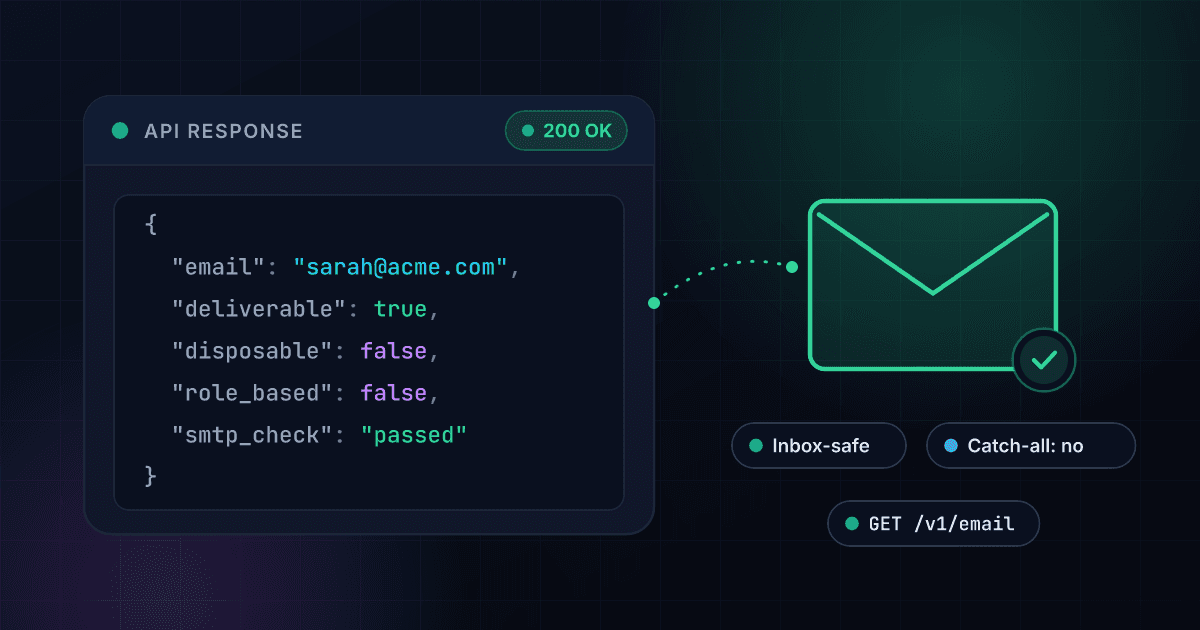
No standalone verification
Email Validation API
FullEnrich verifies only what its waterfall found. This takes an address you already hold and returns a verdict: syntax, MX, SMTP, disposable, role-account and catch-all detection.
1 credit per check
1Lookup vs FullEnrich: the same criteria, side by side
Both products measured on identical criteria, with FullEnrich’s numbers taken from its own published pricing.
 1lookup1lookup.ioMulti-channel validation
- Phone
- IP
 fullenrich.comB2B contact data
- Phone
- FullEnrich · Starts at
- $29/month for 500 credits ($0.058 a credit) on the Pro monthly ladder, which is up to 500 verified work emails found or 50 mobile numbers found. Billed yearly the entry rung is $312/year for 6,000 credits ($0.052 a credit). The pricing page's own slider defaults one rung up, at 1,000 credits a month for $55
- 1Lookup: $99/mo for 20,000 credits ($4.95 per 1,000, down to $2.00 on Enterprise)
- FullEnrich · Free trial
- The Free trial is the trial; there is no time-limited trial of a paid plan published. Monthly Pro subscriptions auto-renew and are cancelled self-serve from the workspace, effective on the last day of the current billing period
- 1Lookup: 7-day free trial on every plan: $5 of credits on Starter, $20 on Growth, Professional, and Enterprise (card required, nothing charged up front)
- FullEnrich · Do credits expire?
- Yes. Credits roll over and then expire: "Credits have a validity period of three (3) months from their date of addition to the Workspace" on monthly subscriptions and twelve (12) months on annual ones, with a one-time credit purchase carrying a six (6) month validity. Deleting a workspace forfeits any remaining credits: "the Credits are permanently lost and the Client cannot obtain a refund"
- 1Lookup: Unused monthly credits roll over for 3 months; separately purchased credits last 1 year
| Criteria | 1Lookup | |
|---|---|---|
| Contact-data coverage | EmailPhoneIP | EmailPhoneIP |
| Pricing model | Monthly plans with universal credits; core phone, email and IP lookups cost 1 credit, enrichment and intelligence products cost more | One credit pool, one plan family, priced on a monthly or annual volume slider. Three plans: a Free trial ($0, 50 credits, no card), Pro (self-serve, 11 published monthly volume tiers from 500 to 100,000 credits a month and 11 annual tiers from 6,000 to 1,200,000 credits a year) and Enterprise (quote-only, required above 100,000 credits a month). Credits are fungible and are the only unit: there is no separate verification pool and no separate finder pool. A credit buys a found data point, not a query - work email 1 credit, reverse email lookup 1 credit, personal email 3 credits, mobile phone 10 credits, a standalone person or company profile 0.25 credit and free when bundled with any enrichment. A lookup that returns nothing costs 0, and a landline returned instead of a mobile costs 0. Re-enriching a contact already enriched in the last 3 months costs 0. Per-credit price falls with volume, $0.058 at 500 credits a month down to $0.035 at 100,000, and $0.052 down to $0.032 on the annual ladder, with annual roughly 10% cheaper. Unused credits roll over 3 months on monthly plans and 12 months on annual plans, then expire. Unlimited users on every plan including the Free trial, with no per-seat fee. Verification (syntax, SMTP, catch-all deep-check, confidence score, landline and out-of-service removal, and US and Canada owner-name match) is bundled into that same credit and is not sold separately. |
| Starting price | $99/mo for 20,000 credits ($4.95 per 1,000, down to $2.00 on Enterprise) | $29/month for 500 credits ($0.058 a credit) on the Pro monthly ladder, which is up to 500 verified work emails found or 50 mobile numbers found. Billed yearly the entry rung is $312/year for 6,000 credits ($0.052 a credit). The pricing page's own slider defaults one rung up, at 1,000 credits a month for $55 |
| Free option | Free single lookups via the online tools at 1lookup.io/tools, no account required | Free trial: "50 credits to start", "No credit card", and extra credits for inviting team members. Full Pro feature access on it, including the API, MCP server, CRM integrations and bulk CSV. 50 credits is 50 work emails, or 5 mobile numbers at 10 credits each |
| Free trial | 7-day free trial on every plan: $5 of credits on Starter, $20 on Growth, Professional, and Enterprise (card required, nothing charged up front) | The Free trial is the trial; there is no time-limited trial of a paid plan published. Monthly Pro subscriptions auto-renew and are cancelled self-serve from the workspace, effective on the last day of the current billing period |
| Do credits expire? | Unused monthly credits roll over for 3 months; separately purchased credits last 1 year | Yes. Credits roll over and then expire: "Credits have a validity period of three (3) months from their date of addition to the Workspace" on monthly subscriptions and twelve (12) months on annual ones, with a one-time credit purchase carrying a six (6) month validity. Deleting a workspace forfeits any remaining credits: "the Credits are permanently lost and the Client cannot obtain a refund" |
What FullEnrich costs at volume
| Volume | FullEnrich price | Per 1,000 |
|---|---|---|
| 500 credits/month, the smallest published Pro tier (up to 500 work emails found) | $29/month at $0.058 a credit, monthly billing | $58.00 per 1,000 work emails found |
| 1,000 credits/month, where their pricing slider opens | $55/month at $0.055 a credit, monthly billing | $55.00 per 1,000 work emails found |
| 10,000 credits/month (up to 10,000 work emails found) | $499/month at $0.050 a credit, monthly billing | $49.90 per 1,000 work emails found |
| 100,000 credits/month, the largest published tier before Enterprise | $3,500/month at $0.035 a credit; above this the page says contact sales | $35.00 per 1,000 work emails found |
FullEnrich is priced as a credit tier where a credit buys a found data point and a mobile number costs many times a work email; 1Lookup is priced per lookup on one shared balance, 30 credits for a verified work email from a LinkedIn URL and nothing on a miss. Compare your real mix of data points, not just the headline credit count, since the two ladders bill different things.
Before you sign: FullEnrich and 1Lookup on the operational terms
The terms that decide what a year actually costs, rather than what the first month does. A blank means we could not verify it on either product’s published pages, not that the answer is nothing.
| Term | 1Lookup | FullEnrich |
|---|---|---|
| Minimum commitment | None. Monthly plans with no contract and no minimum volume; cancel any time | None on Pro. Monthly and annual subscriptions renew automatically and are cancelled by opposing the tacit renewal from the workspace, effective the last day of the current billing period; on an annual or one-time subscription the client "can request FullEnrich to refund amounts paid for the period after the Contract termination date". Enterprise is quote-only and required above 100,000 credits a month. |
| Cost per extra seat | — | None. "Unlimited users included" is a checked row on the Free, Pro and Enterprise columns of the plan table, and the pricing FAQ answers the per-seat question with "No. Unlimited users on every plan, including Free trial." Per-user credit limits, per-user credit monitoring and low-credit alerts are Pro and Enterprise only. |
| Going over your quota | — | No overage rate is published and there is no burst-past-the-allowance mechanic. Their FAQ answer to running out of credits mid-month is "Renew early or upgrade to a higher-volume tier (lower per-credit price). Both are self-serve." Unused credits roll over 3 months on monthly plans and 12 on annual ones instead. Running out blocks new enrichments, which is why they push a low-credit alert for production use. |
| API access | Included on every plan and during the free trial; there is no tier that unlocks it | API access, the Enrichment API, Search API, Reverse Email Lookup API and MCP server are all checked on Free, Pro and Enterprise in the plan comparison table, so the API is not gated behind a tier. Auth is a bearer token. Enrich and Reverse are asynchronous: a POST returns an ID and results come back by webhook or a GET poll, "typically 30-90 seconds per contact", with an HMAC-SHA1 signature header on every webhook. Bulk CSV enrichment is checked on every plan. Inputs accepted for an enrichment are first and last name plus a company domain or name, or a LinkedIn URL. HubSpot and Salesforce are live with several sub-features marked Soon. No Chrome extension is listed on their homepage, pricing feature table, integrations page or help centre. |
| Rate limit | 1,000 requests per minute on standard accounts, with higher limits available on request | 60 API calls per minute by default, applied across all endpoints, implemented as a fixed one-minute window so the full quota can be spent in one burst. Up to 100 contacts per bulk Enrich or Reverse request, which the docs describe as "up to 6,000 contacts per minute". Default queue size is 100 concurrent enrichments and 100 concurrent reverse lookups per workspace; Search is synchronous and does not queue. "Custom Rate Limit & Concurrency" is marked unavailable on Free and Pro and available on Enterprise only. |
| Uptime SLA | — | No contractual uptime SLA is published on any public page. Enterprise lists "Priority support", "Custom rate limits & priority queue" and a "Dedicated account manager", none of which is an uptime commitment. |
| Compliance | — | SOC 2 Type II with the report reachable through a public trust portal, plus GDPR and CCPA, a CAIQ Lite questionnaire and a pentest report offered on the security page, a published Data Processing Agreement and a sub-processor list. ISO 27001 is named only for their hosting provider, not for FullEnrich itself. No HIPAA claim appears. Enrichment results are stored for 3 months and then automatically deleted; enterprise SSO is a paid add-on and Google SSO is on every plan. |
| Support | Starter: Email Support; Growth: Priority Email & Chat Support; Professional: Chat + Live Meeting; Enterprise: Dedicated CSM | Published channels are email support and a help centre. "Priority support", a "Dedicated account manager" and a "Shared Slack support channel" are Enterprise-only rows on the plan table and are marked unavailable on Free and Pro. |
FullEnrich fine print worth reading twice
Published terms that change what FullEnrich costs or what you can do with it. Each one links to the FullEnrich page it was read on, because a claim about somebody else’s contract should be checkable in one click.
A mobile phone number costs 10 credits and a personal email 3, against 1 for a work email, so the headline per-credit rate is not the per-record rate. Their own worked example puts 1,000 contacts enriched with work email plus mobile at roughly 5,800 to 7,800 credits.
Read it on FullEnrich’s siteCredits expire after the rollover window: "Credits have a validity period of three (3) months from their date of addition to the Workspace" on monthly plans and twelve (12) months on annual plans.
Read it on FullEnrich’s siteDeleting a workspace forfeits any credits left in it: "when valid Credits remain associated with the deleted Workspace, the Credits are permanently lost and the Client cannot obtain a refund."
Read it on FullEnrich’s siteRedistributing the data you buy is prohibited without a separate agreement: the client may not "sell, resell, assign, transfer, distribute, license, sublicence or make available, in any way, the Enriched Data to third parties".
Read it on FullEnrich’s siteFullEnrich disclaims responsibility for data quality in its own terms: "The Client acknowledges that the quality of Enriched Data depends on the Providers and communicated Client Data and that FullEnrich is not responsible for it."
Read it on FullEnrich’s siteThe default API rate limit is 60 calls per minute with a 100-concurrent queue per workspace; "Custom Rate Limit & Concurrency" is marked unavailable on Free and Pro and available on Enterprise only, and queue size "is set based on your volume in the commercial agreement".
Read it on FullEnrich’s siteThe enrichment API is asynchronous: a POST returns an ID and results arrive by webhook or polling, with processing "typically 30-90 seconds per contact".
Read it on FullEnrich’s siteEnrichment results are retained for only 3 months: "If you try to fetch results with the same Enrichment ID after 3 months, you'll get an error", and a re-enrichment after that window costs credits again.
Read it on FullEnrich’s siteDeduplication is not guaranteed: FullEnrich does not deduplicate contacts within the same bulk, does not deduplicate simultaneous requests for the same contact, and does not deduplicate when the input identifiers differ.
Read it on FullEnrich’s siteSeveral advertised CRM and outreach integrations are not shipped. HubSpot's "Enrich Contacts Already In HubSpot" and "FullEnrich Inside HubSpot", and Salesforce's "Push Contacts & Companies" and "Enrich Contacts Already In Salesforce", are all marked Soon on the plan comparison table.
Read it on FullEnrich’s siteAbove 100,000 credits a month, or 1,200,000 credits a year, the published ladder ends and the price becomes "Contact sales".
Read it on FullEnrich’s site
1Lookup
FullEnrich
Where 1Lookup wins
- Synchronous by design: a profile URL in, JSON out in the same request, with nothing to poll and no webhook receiver to build before the first result
- Success billing with one visible price per job: 30 credits when a verified work email comes back from a profile URL, nothing when it does not
- Checking data you already hold is a product, not a by-product: email deliverability, phone line type, carrier and HLR status, and IP risk are their own endpoints
- One balance across finding, enriching and validating, with the same products available as bulk CSV jobs when the list is the job
Where FullEnrich wins
- The waterfall is the product and it is a real advantage on find rate: one request is routed through what they describe as "25+ sources" ("20+ premium vendors" in the homepage wording), stopping at the first verified match. That is a different purchase from one synchronous lookup, and buying those vendors separately means separate contracts
- Billing is pay-per-found, not pay-per-call: a lookup that returns nothing costs 0 credits, a landline found instead of a mobile costs 0, and re-enriching a contact already enriched within 3 months costs 0
- Mobile phone numbers, which a validation or per-lookup email API does not sell at all: 10 credits each, checked against the carrier network for out-of-service lines and, in the US and Canada, matched against the lead's name before the credit is charged
- Unlimited users on every plan including the Free trial, with no per-seat and no platform fee. Their FAQ is explicit: "No. Unlimited users on every plan, including Free trial"
- Credits roll over 3 months on monthly plans and 12 months on annual ones instead of resetting each cycle, so a lumpy campaign month does not burn the allowance
- Genuinely built for agents and for embedding: a documented REST API on every tier including Free, an MCP server, a public agent-skills repo, machine-readable pricing at /pricing.md and /pricing.json, plus Zapier, Make, n8n, Clay, HubSpot and Salesforce
- A real bulk pipeline for list work: up to 100 contacts per request, 100 concurrent enrichments per workspace, HMAC-SHA1-signed webhooks, and a per-contact webhook so results stream back as each one lands rather than at batch end
- SOC 2 Type II with the report reachable through a public trust portal, plus GDPR and CCPA, a published DPA and a sub-processor list
FullEnrich pricing and product facts verified against fullenrich.com as of August 2026. Prices change; always confirm on the vendor’s site. 1Lookup numbers come from the live rate card.
Who this is for
A quick, honest read on which tool fits your use case.
Choose 1Lookup if: you want one price per match, answered synchronously, on the same credits as validation, rather than posting a batch and waiting on a webhook for it to come back.
Consider FullEnrich instead if: coverage is what you are buying: routing one request through many vendors and stopping at the first verified match finds contacts a single source will not, and mobile numbers come from the same pool.
Frequently asked questions
What is waterfall enrichment?
Sending one request through a queue of contact-data vendors in order and stopping at the first verified match, so a contact one source misses can still be found by the next. FullEnrich built its product around it, routing each request through what it describes as more than twenty premium vendors and charging only for the data point that comes back. The trade is latency and shape: the work happens across several providers, so the answer arrives asynchronously rather than inside your request.
How does FullEnrich pricing work?
One fungible credit pool bought as a monthly or annual volume tier, where a credit buys a found data point rather than a call. A lookup that returns nothing costs nothing, a landline returned instead of a mobile costs nothing, and re-enriching a contact enriched recently costs nothing. Credits roll over for a set window and then expire, unused credits in a deleted workspace are forfeited, users are unlimited on every plan, and above the top published rung it is a quote. Every published rung and per-credit rate is in the verified pricing table on this page.
Is 1Lookup a waterfall?
No, and it should not be sold as one. 1Lookup answers a single lookup from a single request and returns the result synchronously. If maximum coverage on a hard list is the whole purchase, a waterfall routed through many vendors will find contacts a single lookup will not, and that is the honest reason to choose FullEnrich. 1Lookup is the better fit when the answer has to arrive inside the request, and when you also need to check data you already hold.
Can FullEnrich verify an email or phone number I already have?
No. The documented endpoints cover enrichment, reverse email lookup, people and company search, credit balance and key checks. There is no endpoint that takes an address or a number you already hold and returns a validity verdict, no phone validation, no line type or HLR data and no IP product. Verification runs only on data the waterfall itself found. 1Lookup's Email Validation is 1 credit per check, and phone line type, carrier and HLR status sit on the same key.
What is the best FullEnrich alternative?
If coverage across many sources is what you are buying, the alternatives are other waterfall and multi-source enrichment tools. If you already know the person and want one answer per call, 1Lookup's LinkedIn Email Finder takes a public profile URL and returns a verified work email for 30 credits, charged only on a match, synchronously, on the same balance as email, phone and IP validation.
Where does FullEnrich beat 1Lookup?
On coverage and on team economics. Routing one request through many vendors is a different purchase from one synchronous lookup, and buying those vendors separately means separate contracts. Billing is pay-per-found rather than pay-per-call, mobile numbers are checked against the carrier network and name-matched in the US and Canada before a credit is charged, users are unlimited on every plan including the free trial with no per-seat fee, credits roll over instead of resetting each cycle, and they publish SOC 2 Type II with the report reachable through a public trust portal. 1Lookup has no waterfall and no prospecting database.
Is FullEnrich worth it in 2026?
For batch enrichment of a hard list, it is one of the strongest options in this category, and the free trial needs no card. Check four things against your workload first: the enrichment API is asynchronous, with their own docs putting a contact at tens of seconds, which rules out inline use in a form or a checkout; the default rate limit and concurrent queue are modest and higher limits are an Enterprise line item; credits expire after their rollover window; and several HubSpot, Salesforce and sequencer integrations are marked as coming soon on their own plan table. Their terms also place data quality with the underlying providers rather than with FullEnrich.