B2BDataEnrichment:ABuyer'sGuide
What B2B data enrichment adds to a lead record, build versus buy, how enrichment feeds scoring and routing, and how to evaluate providers on match rate.

Robby Frank
CEO & Founder
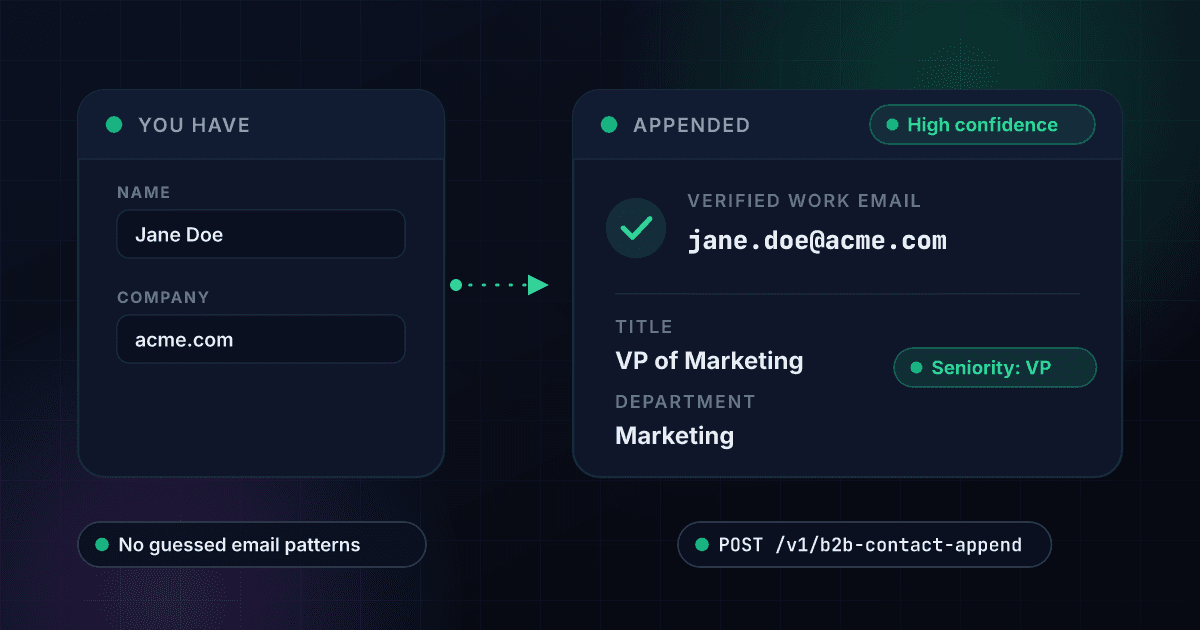
B2B data enrichment takes the thin record a lead actually gives you (an email, a name, maybe a company) and fills in the fields your sales process needs: verified work contact details, title and seniority, and the company's industry, size, revenue band, and technology stack. Done well, it is the difference between a form fill and a routable, scoreable, personalizable lead.
This guide covers what enrichment actually adds, the build-versus-buy decision, how enriched fields feed scoring and routing, and how to evaluate providers on the metrics that matter, match rate and freshness, rather than logo counts. For the scoring side specifically, the data enrichment and lead scoring guide goes deeper; this guide stays on the B2B pipeline and the APIs underneath it.
What enrichment adds to a record
B2B enrichment breaks into three layers, usually consumed together:
- Contact enrichment. From a name plus company, an email, or a LinkedIn URL, to a verified work email, direct phone, title, and seniority. This is the layer the B2B contact append API covers, and verification is the load-bearing word: an appended email that bounces is worse than no append at all.
- Company enrichment. From a domain to firmographics: industry and SIC/NAICS codes, employee count, revenue range, location, and funding signals, plus technographics, the technology stack the company runs. The company enrichment API returns these fields from a bare domain.
- Identity resolution. Reverse lookups that connect an identifier you have to the person behind it, like the reverse email lookup API turning a lone email address into a fuller contact record, or email enrichment deepening what you know about an address you already trust.
The practical test of any enrichment layer is whether a specific downstream decision consumes it. Fields nobody routes, scores, or personalizes on are decoration at a per-record price.
Build versus buy
Building enrichment in-house means licensing raw data, maintaining matching logic, and fighting decay forever. B2B data rots fast: people change jobs constantly, and every title change invalidates a contact record somewhere. The build path only makes sense at data-vendor scale.
For everyone else the real question is the buying shape, and there are two:
- Platform subscriptions. Enrichment bundled into a sales platform with seats, credits per month, and a UI. Right when reps live in that platform all day and volumes are steady.
- Per-lookup APIs. Enrichment as flat-priced calls, billed on successful match, wired into your own forms, CRM workflows, and pipelines. Right when usage is programmatic or spiky, when you want enrichment at the point of capture, and when paying for empty months feels wrong. This is 1Lookup's shape: contact append, company enrichment, and reverse lookups as API calls on one shared credit balance, charged only when a match comes back.
Plenty of teams run both: a platform for rep-driven prospecting, an API for everything automated.
How enrichment feeds scoring and routing
Enrichment earns its keep in the seconds after a lead arrives:
- At capture, keep forms short. Ask for the work email and little else; enrichment fills in company, size, and industry behind the scenes. Shorter forms convert better, and the enriched record is richer than what a long form would have collected anyway.
- Score on firmographic fit. Ideal customer profile (ICP) matching needs industry, headcount, and stack, which are exactly the enriched fields. A lead scoring model without firmographics is scoring on behavior alone, blind to fit.
- Route on ownership rules. Segment and territory routing (enterprise versus SMB, industry verticals, geo) runs on enriched company fields. Bad routing from missing data costs response time, and response time costs conversion.
- Personalize the first touch. Title, seniority, and stack determine which message a lead gets. "I saw you run X" only works when the technographic field is right.
- Re-enrich on triggers. Records decay, so re-enrich when signals suggest change: bounced emails, a job change, a funding event. Trigger-based refresh beats blanket quarterly re-enrichment on cost and catches the changes that matter.
Evaluating providers: match rate, freshness, honesty
Provider marketing leans on database size. Buying well means testing three things on your own data instead:
- Match rate on your records. Run a real sample of your leads through each candidate. Coverage differs sharply by segment (US enterprise versus European SMB versus technical founders), and only your mix tells you which provider covers your market. Success-based billing makes this test cheap: misses cost nothing.
- Freshness, not just presence. An appended email that bounces or a title from two jobs ago is a match on paper and a miss in practice. Verify appended emails through email validation as part of the test, and measure the verified match rate, which is the only one that predicts campaign outcomes.
- Honest nulls. A provider that returns confident-looking data on weak matches poisons your CRM slowly. Prefer APIs that return nothing on a miss, with billing that reflects it, over ones that always return something.
Weigh cost as effective cost per verified matched record, not sticker price per lookup. A cheaper rate with a lower verified match rate is frequently the more expensive product.
Frequently asked questions
What is the difference between lead enrichment and data enrichment?
Lead enrichment is data enrichment applied at the moment a lead enters the funnel: form fill, signup, or list import. The mechanics are the same; the timing is the point, because scoring and routing decisions happen in that moment and cannot wait for a batch job.
What is a good enrichment match rate?
There is no universal number, because it depends on your market's coverage. The useful benchmark is comparative: test providers on the same sample of your real records and compare verified match rates. Any provider quoting one global match rate for all customers is quoting marketing.
Does enrichment work on personal email addresses?
Much less well, by design. B2B enrichment keys on corporate identity, and a gmail.com address hides the company. Reverse lookup can sometimes bridge it, but B2B pipelines should capture work emails where possible, and treat personal-email leads as a separate, lower-confidence segment.
How often should CRM records be re-enriched?
On trigger rather than schedule: bounced email, detected job change, funding round, or a record entering an active sales cycle. Blanket re-enrichment mostly re-buys unchanged data; trigger-based refresh spends where change actually happened.
To test enrichment on your own leads, run a sample through the B2B contact append API and the company enrichment API, or start with the free trial and measure your verified match rate first.
Meet the Expert Behind the Insights
Real-world experience from building and scaling B2B SaaS companies

Robby Frank
Head of Growth at 1Lookup
"Calm down, it's just life"
About Robby
Self-taught entrepreneur and technical leader with 12+ years building profitable B2B SaaS companies. Specializes in rapid product development and growth marketing with 1,000+ outreach campaigns executed across industries.
Author of "Evolution of a Maniac" and advocate for practical, results-driven business strategies that prioritize shipping over perfection.