Run a free OCN lookup to see which carrier holds a US phone number.
Enter a US or Canada number to see the carrier that holds it, its line type and whether it was ported. It is free, with no signup.
Works for US & Canada numbers. Enter a 10-digit number, e.g. (415) 555-0132.
Free & rate-limited. No signup required to try.
An OCN lookup finds the Operating Company Number, the four-character code that identifies the phone company holding a number. 1Lookup's free OCN lookup reads the number's carrier record and shows the carrier, line type, state and ported status for US and Canada numbers. A free account opens the OCN itself and the routing number (LRN).
- US and Canada numbers
- No signup to try
- Shows ported numbers
- OCN and LRN with a free account
You can find a number's OCN in under a minute.
Enter the number.
Type the ten digits of a US or Canada number, with or without the +1.
Read the carrier.
The result names the carrier the number's own record points to, even when the number was ported away from the company its prefix suggests.
Open the OCN.
Create a free account and the same lookup shows the four-character OCN, the routing number and the rate center.
Check the prefix if you only need the first holder.
The tables below show how OCNs are spread across NANPA's public file, for a company or for a whole prefix.
Need this at scale? Carrier Lookup API
Get the carrier, OCN, LRN and rate center for whole lists through the API or bulk CSV.
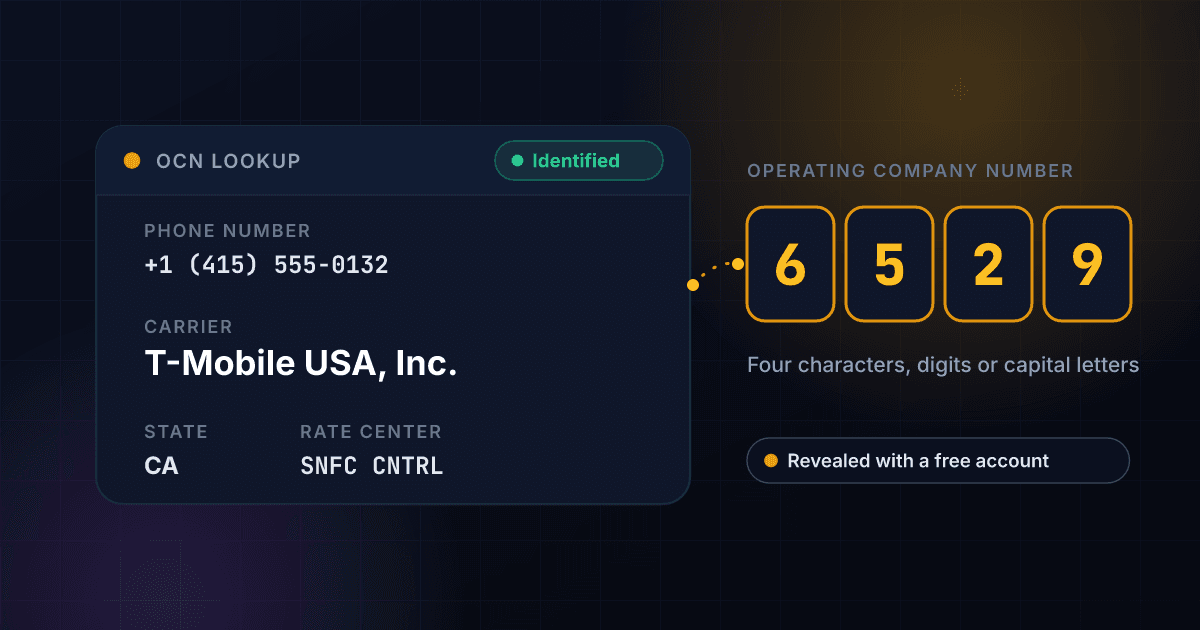
An OCN is the four-character code that names the company behind a number.
Every company that offers local phone service in North America has an Operating Company Number, or OCN: four characters of digits and capital letters, such as 6529. ATIS, the telecom standards body, defines it as a code that uniquely identifies providers of local telecommunications service, and notes that company codes assigned by the National Exchange Carrier Association (NECA) may be used as OCNs. Providers must give their OCN when they report how many numbers they use and expect to need.
Two different OCNs can sit behind one number, and they answer different questions. NANPA, which runs the North American numbering plan, publishes the OCN of the company each whole prefix (the first six digits, such as 415-555) was assigned to. A lookup instead reads the number's own carrier record, which reflects a port. That is why this tool starts from the number and not from its prefix: the prefix only says who was given the block first.
This free tool runs that lookup on one US or Canada number at a time. It shows the carrier, the line type, the state and whether the number was ported. Opening the OCN, the routing number (LRN) and the rate center takes a free account, and the same record comes back for whole lists through a CSV upload or the carrier lookup API.
Use this page when you hold one number and need to know whose line it is on the network: before a port request, when a call fails to route, or when a carrier name on an invoice does not match the company you expected.
The carrier lookup API returns the OCN and LRN for whole lists.
When the check has to run inside your own software or across thousands of numbers, the API returns the carrier, OCN, LRN and rate center on every US and Canada number for 1 credit a lookup. See the carrier lookup API. For the carrier of a number in any country, use our free carrier lookup. To see which of your numbers are VoIP, mobile or landline, use our free VoIP checker. To read what each company name in a lookup means, see our guide to carrier names. To see who holds the prefixes in an area code, open the area code lookup.
An OCN lookup returns these fields, and each one answers a different question.
This is an invented result for a made-up number, laid out the way a lookup comes back. The first four fields are free on this page, and a free account opens the rest.
- Carrier / networkT-Mobile USA, Inc.
- Line typeMobile
- StateCA
- PortedNo
Opens with a free trial
- OCN6529
- Routing number (LRN)4155550000
- Rate centerSNFC CNTRL
- Do Not CallNot listed
Carrier / network
The company that holds the number on the network today. A prepaid or reseller brand shows up under the network it runs on.
Line type
Mobile, landline or VoIP. It decides whether a text can arrive and which calling rules apply.
State
The state the number's area belongs to, read from its record.
Ported
Whether the number has moved away from the carrier that first held its prefix. Yes means the carrier above is the one it moved to.
OCN
The operating company number of the carrier above, four characters. In NANPA's file of 1 October 2026, 6529 is the OCN of T-Mobile USA, Inc. on 7,037 prefixes.
Routing number (LRN)
The ten-digit location routing number that calls to this number are sent to. For a ported number it points to the new carrier's switch, so it differs from the number itself.
Rate center
The geographic area the number is tied to in numbering records, written the way they abbreviate it (here, San Francisco).
Do Not Call
Whether the number is on the Do Not Call list, which matters before a sales call or text.
The lookup takes three steps and reads the number's own carrier record.
You enter a US or Canada number.
Type or paste the ten digits, with or without +1. OCNs exist only in the North American numbering plan, so numbers from other countries are not looked up here.
We read the carrier record.
1Lookup checks the number against its carrier record, which reflects ports, so the carrier shown is the one the number routes to now and not only the company its prefix was first given to.
You read the result and can open the OCN.
See the carrier, line type, state and ported flag right away. A free account opens the OCN, the LRN, the rate center and the Do Not Call status on the same lookup.
An OCN lookup reads the number's own record, because its prefix may name the wrong company.
This is the path one lookup takes for a US or Canada number. The prefix only says who was given the block first; the number's own record says who holds the number now.
- You enter the numberTen digits, so it is read in the North American numbering plan.
- Its prefix names the first holderThe six digits NPA-NXX were assigned to one company in NANPA's file, which may not hold the number any more.
- The number's record is readIt reflects a port and holds the carrier, the OCN, the LRN and the rate center.
- You get the resultThe free result shows the carrier, line type, state and ported flag. A free account opens the OCN, LRN and rate center.
Four identifiers get mixed up in a phone record, and each one names a different thing.
A number's record carries a prefix, an OCN, an LRN and a rate center. They look alike in a spreadsheet and mean different things, so this is what each one identifies and who issues it.
| Identifier | Looks like | What it identifies | Where it comes from |
|---|---|---|---|
| NPA-NXX | 415-555 | A block of 10,000 numbers: the area code and the next three digits | NANPA assigns each prefix to one company |
| OCN | 6529 | A company that provides local phone service, four digits or letters | A NECA company code, used as the OCN |
| LRN | 4155550000 | A switch, in the shape of a ten-digit phone number | Assigned for number portability, and it changes when a number is ported |
| Rate center | SNFC CNTRL | The geographic area a number is tied to in numbering records and rating | Listed by NANPA against every assigned prefix |
Level 3 (Lumen) holds 91 OCNs while T-Mobile holds just 1, so a company can have one OCN or dozens.
NANPA's file of 1 October 2026 lists the company and the OCN against each of 198,436 assigned prefixes across the states and territories it covers. These are ten companies with a name page on this site, with the OCNs they hold in that file. A pooled prefix shares blocks of 1,000 numbers with other carriers and any number can have been ported, so this counts prefixes, never numbers or customers.
| Company | OCNs it holds | Prefixes held | Its largest OCN | Prefixes on that OCN |
|---|---|---|---|---|
| Level 3 (Lumen) | 91 | 10,346 | 8826 | 929 |
| Onvoy | 50 | 13,033 | 649C | 1,518 |
| Bandwidth | 49 | 4,804 | 981E | 812 |
| UScellular | 20 | 1,160 | 6274 | 210 |
| AT&T Mobility | 4 | 18,705 | 6534 | 6,866 |
| BellSouth (AT&T) | 4 | 7,262 | 9417 | 4,138 |
| Southwestern Bell (AT&T) | 3 | 6,013 | 9533 | 5,963 |
| Qwest (Lumen) | 3 | 5,604 | 9636 | 2,837 |
| Pacific Bell (AT&T) | 2 | 4,958 | 9740 | 4,893 |
| T-Mobile | 1 | 7,037 | 6529 | 7,037 |
Source: NANPA central office code assignments, file of 1 October 2026.
882 of the 2,954 OCNs in use contain a letter, and they hold a quarter of all prefixes.
Every OCN in the file is exactly four characters long. 706 of them hold a single prefix, and 142,484 of the 198,436 prefixes (71.8%) are pooled, so the blocks of 1,000 numbers inside them can belong to other carriers. That is why one prefix does not settle who holds a number.
| OCN shape | Example | OCNs | Prefixes held | Share of prefixes |
|---|---|---|---|---|
| Digits only | 6529 (T-Mobile) | 2,072 | 149,063 | 75.1% |
| At least one letter | 649C (Onvoy) | 882 | 49,373 | 24.9% |
Source: NANPA central office code assignments, file of 1 October 2026.
A prefix record and a number lookup answer different questions.
NANPA's public file is the right source for who was given a prefix. A lookup is the right source for who holds one number. The two disagree most often on ported numbers and pooled prefixes.
| Question | NANPA's prefix file | An OCN lookup on one number |
|---|---|---|
| What does it describe? | A whole prefix of 10,000 numbers | One phone number |
| Whose OCN does it show? | The company the prefix was assigned to | The carrier that holds the number, from its own record |
| Does it show a port? | No, a ported number keeps its prefix | Yes, in the ported flag and the LRN |
| Does it handle pooled prefixes? | Only as a flag; 71.8% of prefixes are pooled | Yes, because it answers for the single number |
| When is it the right check? | Counting or listing who holds a prefix | Knowing whose line one number is on |
An OCN lookup costs 1 credit, about $4.95 per 1,000 lookups on Starter and $2.00 on Enterprise.
These are the monthly plans on the pricing page. The OCN, LRN and rate center come back on the same lookup as the carrier name and line type, every plan starts with a 7-day free trial, and the same credits pay for every other 1Lookup check.
| Plan | About per 1,000 lookups | Monthly price | OCN lookups included |
|---|---|---|---|
| Starter | $4.95 | $99 | 20,000 |
| Growth | $3.52 | $299 | 85,000 |
| Professional | $3.20 | $799 | 250,000 |
| Enterprise | $2.00 | $1,999 | 1,000,000 |
You can look up the OCN of a whole list of numbers with one CSV file.
The free tool checks one number at a time. With a 1Lookup account you upload a CSV file, pick the column that holds the numbers and download the same file back with the carrier columns filled in on every row. These are 7 of the columns it adds, with invented numbers.
| phone | Carrier Full Name | Line Type | LRN | OCN | State | Rate Center | Porting Status |
|---|---|---|---|---|---|---|---|
| (415) 555-0132 | T-Mobile USA, Inc. | Mobile | 4155550000 | 6529 | CA | SNFC CNTRL | NOT_PORTED |
| (312) 555-0187 | Onvoy, LLC | VoIP | 3125550000 | 649C | IL | CHICAGO | PORTED |
| (214) 555-0144 | Southwestern Bell | Landline | 2145550000 | 9533 | TX | DALLAS | NOT_PORTED |
- 1 credit a number, the same price as one API lookup.
- Up to 2 million rows in one CSV file.
- Up to 1,000 API requests a minute on every account.
The carrier lookup API returns the OCN and LRN as JSON from one request.
Send the number in international format (+1 and ten digits) to the phone endpoint with your API key. Each request costs 1 credit, and every account can send up to 1,000 requests a minute. The carrier name is in insights.raw_api_fields.network, the OCN in insights.raw_api_fields.ocn and the routing number in insights.routing.lrn.
curl -X POST https://app.1lookup.io/api/v1/phone \
  -H "Authorization: Bearer YOUR_API_KEY" \
  -H "Content-Type: application/json" \
  -d '{"phone_number": "+14155550132"}'
import requests
response = requests.post(
"https://app.1lookup.io/api/v1/phone",
headers={"Authorization": "Bearer YOUR_API_KEY"},
json={"phone_number": "+14155550132"},
)
data = response.json()["data"]
print(data["insights"]["raw_api_fields"]["ocn"])const response = await fetch('https://app.1lookup.io/api/v1/phone', {
method: 'POST',
headers: {
'Authorization': 'Bearer YOUR_API_KEY',
'Content-Type': 'application/json'
},
body: JSON.stringify({ phone_number: '+14155550132' })
})
const { data } = await response.json()
console.log(data.insights.raw_api_fields.ocn)Response
{
  "success": true,
  "data": {
    "request": { "type": "phone", "input": "+14155550132" },
    "classification": {
      "line_type": "MOBILE",
      "portability_status": "NOT_PORTED"
    },
    "insights": {
      "routing": { "lrn": "4155550000", "is_ported": false },
      "raw_api_fields": {
        "network": "T-MOBILE USA, INC.",
        "ocn": "6529",
        "ratecenter": "SNFC CNTRL",
        "state": "CA"
      }
    },
    "metadata": { "credits_used": 1, "credits_remaining": 9998 }
  }
}
To run the same lookup from your own software, see our carrier lookup API.
It names the carrier the number routes to today.
The result is read from the number's own record, not guessed from its prefix, so a number that moved to another network shows the network it moved to.
It shows whether the number was ported.
A ported number keeps its prefix forever, so the prefix names the wrong company. The ported flag tells you when to trust the carrier shown over the prefix.
A free account opens the OCN, LRN and rate center.
The four-character OCN, the ten-digit routing number and the rate center come with the same lookup once you sign up, along with the Do Not Call status.
The same record comes back for whole lists.
Upload a CSV or call the API and every row returns with its carrier, line type, OCN, LRN and rate center, at 1 credit a lookup.
Who uses this tool
Porting teams use it to confirm the holder before a request.
A port request goes to the carrier that holds the number. Checking the current holder first avoids a rejected request that named the company the prefix was first given to.
Telecom engineers use it to trace a call that fails to route.
When a call to one number fails, the carrier, OCN and routing number show which network and which switch the number lives on, and whether a port moved it.
Billing teams use it to match a carrier on an invoice to a number.
When an invoice names a carrier, looking up a sample of your numbers shows which of them belong to that carrier.
Fraud teams use it to spot numbers on wholesale VoIP carriers.
A number whose carrier is a company that supplies VoIP and app-based phone services is not a person's mobile line, which is worth a second look at signup.
Frequently asked questions
What does OCN stand for in a phone number lookup?
OCN stands for Operating Company Number. It is a four-character code, such as 6529, that identifies a company providing local telephone service in North America. The ATIS telecom glossary defines it as a code that uniquely identifies providers of local telecommunications service.
What is an OCN used for?
Providers give their OCN when they report number use to the numbering administrator, and the same code names the holder of each prefix in NANPA's public records. For you it is the exact, unambiguous name of the company behind a number, where a brand name such as a prepaid label can mean several networks.
How do I find the OCN of a phone number?
Enter the number in the lookup above and run it. The free result names the carrier, and a free account opens the OCN, the LRN and the rate center on the same lookup. For a whole prefix rather than one number, NANPA publishes the OCN of the company each prefix was assigned to.
What can the free OCN lookup not show?
The free tool stops at the carrier, line type, state and ported flag. The OCN, the routing number (LRN), the rate center and the Do Not Call status come with a free account, and lists go through a CSV upload or the API.
Is an OCN the same as a carrier name?
No. A company can hold one OCN or many. In the NANPA file of 1 October 2026, T-Mobile holds 1 OCN, AT&T Mobility holds 4, Bandwidth holds 49 and Level 3 (Lumen) holds 91. The OCN names a specific operating unit, and the carrier name is the company that unit belongs to.
Can two companies share one OCN?
Not in NANPA's file. Of the 2,954 OCNs in it, none appears under two company names, while 100 of the 2,765 company names hold more than one OCN. One OCN belongs to one company, and a company can hold several.
Who assigns OCNs?
The ATIS telecom glossary says that company codes assigned by NECA, the National Exchange Carrier Association, may be used as OCNs, and that every service provider must give its OCN when it reports number utilization and forecasts.
What is an LRN?
The ATIS telecom glossary defines a location routing number as the ten-digit number assigned to a switch and used for routing where numbers can be ported. When a number is ported, calls to it are sent to the LRN of the switch that now serves it, which is why a ported number has an LRN that differs from its own digits.
What is the difference between an OCN and an LRN?
An OCN names a company and has four characters. An LRN names a switch and has ten digits in the shape of a phone number. A lookup returns both: the OCN says who holds the number, and the LRN says where calls to it are routed.
What is the difference between an OCN lookup and a carrier lookup?
A carrier lookup tells you the network a number is on and its line type, for numbers in any country. An OCN lookup is the same check for US and Canada numbers with the OCN and routing number as the answer. They read the same carrier record, so one lookup returns both.
Does the OCN change when a number is ported?
The carrier a lookup shows comes from the number's own record, so for a ported number it names the carrier the number moved to. The OCN NANPA lists for the number's prefix does not change, because it names the company the whole prefix was first assigned to.
Does an OCN lookup work outside the US and Canada?
No. OCNs belong to the North American numbering plan, so numbers from other countries have none. For those numbers, the free carrier lookup names the network, and the HLR lookup checks whether a mobile is active.
What does a letter in an OCN mean?
NANPA's file does not explain it. 882 of the 2,954 OCNs have at least one letter, and together they hold 49,373 of 198,436 prefixes, about a quarter. The largest OCN of T-Mobile (6529) and AT&T Mobility (6534) is digits only, while that of Onvoy (649C) and that of Bandwidth (981E) end in a letter.
What is a rate center?
A rate center is the geographic area a number is tied to in numbering records and local rating, written in short forms such as SNFC CNTRL for San Francisco. NANPA's file lists one for every assigned prefix, and a free account shows the one for your number.
Can an OCN lookup show who owns a number?
No. The OCN names the phone company, not the person or business using the line. For the likely owner of a US number, use the reverse phone lookup.
Is this OCN lookup really free?
Yes. The tool is free to use online and rate-limited for fair access. Every free lookup returns the carrier, line type, state and ported flag. To open the OCN, the LRN and the rate center, or to process numbers in bulk, sign up for a 7-day free trial, then use the API as you scale.
How much does an OCN lookup cost per number?
An OCN lookup costs 1 credit in the API or a CSV upload. That is about $4.95 per 1,000 on the Starter plan, $3.52 on Growth, $3.20 on Professional and $2.00 on Enterprise. The free tool on this page checks one number at a time with no signup, and every plan starts with a 7-day free trial.
Is there an OCN lookup API for lists?
Yes. The same record is available through the 1Lookup carrier lookup API and through a CSV upload, with the OCN, the LRN and the rate center on every row. You can check numbers one at a time in real time or clean whole lists, starting with a 7-day free trial.
These pages answer the question that comes after an OCN lookup.
- Carrier lookupThe network and line type of any number, in any country.
- Carrier names in lookupsWhat each company name in a lookup means, with its prefixes by state.
- Area code lookupWhich companies hold the prefixes inside an area code.
- Number portability lookupWhether a mobile number moved to another network.
The first three digits of a US number tell you where it was assigned.
Every area code has its own page with the places it covers, the local time there, and what to do when a call from it looks spoofed. These are the codes people look up most.
- 213Los Angeles
- 646New York City
- 917New York City
- 202Washington
- 404Atlanta
- 702Las Vegas
- 786Miami
- 415San Francisco
- 206Seattle
- 954Fort Lauderdale
- 323Los Angeles
- 929New York City
Area code 213, downtown Los Angeles, also has a page for each of its 786 prefixes, with the company NANPA lists as the holder.
New area codes catch people out, because a number from one looks unfamiliar even when it is local. These are the newest working codes.
- 465New York, since Jun 2026
- 483Alabama, since Feb 2026
- 471Mississippi, since Jan 2026
- 679Michigan, since Nov 2025
- 457Louisiana, since Sep 2025
- 729Tennessee, since Sep 2025
These carrier names show up on phone lookups, and each one has a page.
A lookup often names a company you have never seen on a bill. Each page below says what the company is and where it holds numbers.
- Onvoy, LLCSupplies numbers to VoIP and app-based phone services
- Level 3 Communications, LLCLumen's business and wholesale network
- Bandwidth.com CLEC, LLCSupplies numbers to VoIP and app-based phone services
- Neutral TandemWholesale phone carrier
- New Cingular Wireless PCS, LLCMobile network
- T-Mobile USA, Inc.Mobile network
- Peerless NetworkWholesale phone carrier
- Teleport Communications America, LLCAT&T's business phone network
To see who holds America's phone numbers overall, read our study Who Hands Out America's Phone Numbers in 2026.