Check whether a number is toll-free and see when its code went into service.
Enter a number to see whether it is toll-free and when its code went into service. It is free, with no signup.
Works for US numbers. A toll-free number starts with 800, 833, 844, 855, 866, 877 or 888.
Free & rate-limited. No signup required to try.
A toll-free number lookup tells you whether a number is toll-free, which means the caller pays nothing and the business that holds the number pays for the call. 1Lookup's free toll-free lookup confirms the line type of a US number and shows when its code, 800, 888, 877, 866, 855, 844 or 833, went into service.
- Free, no signup
- All seven toll-free codes
- Dates from NANPA
- Says what it cannot show
You can check a toll-free number in under a minute.
Enter the number.
Type the ten digits, such as 833 555 0132, with or without the +1.
Read the verdict.
The result says whether the number is toll-free, which of the seven codes it uses and when NANPA put that code into service.
Know what a lookup cannot show.
Carrier records do not cover toll-free numbers, so no lookup can say who holds one or whether it answers today.
Find the holder in the toll-free registry.
The registry is run by Somos, and the business behind a number appears there as a responsible organization, or RespOrg.
Need this at scale? Phone Validation API
Sort a list of numbers into toll-free, mobile, landline and VoIP, with the carrier and Do Not Call flag on the rest.
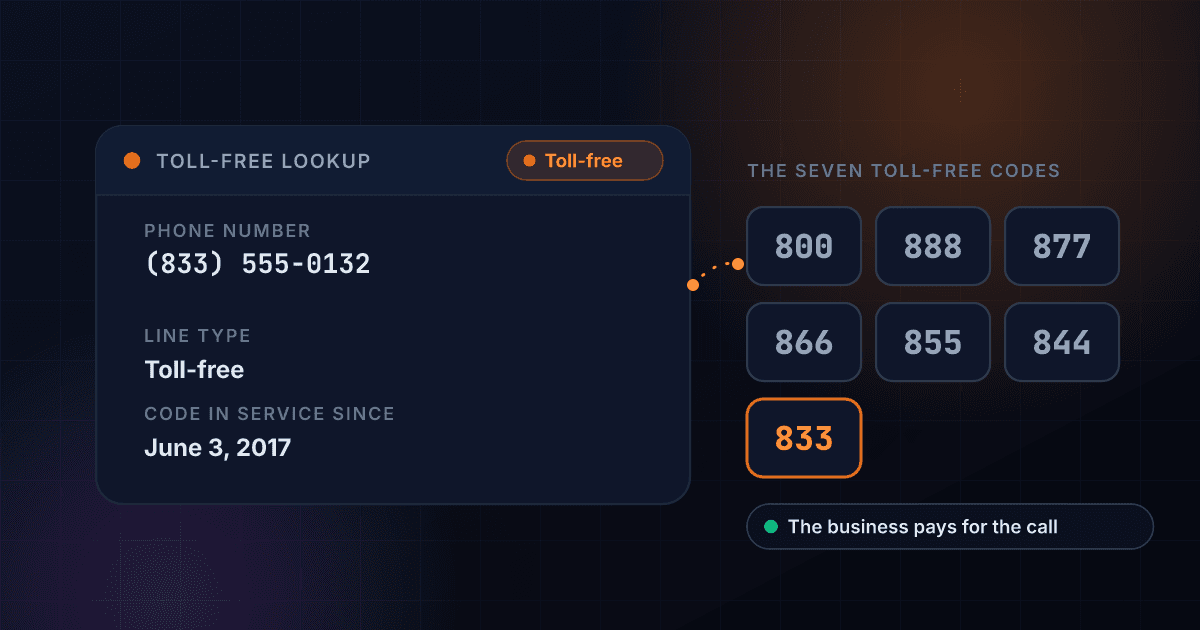
A toll-free number lets customers call a business without paying, and seven codes are in service for it.
A toll-free number is one where the caller pays nothing and the business that holds the number pays for the call. The FCC notes that wireless callers may still be charged airtime for the minutes unless they have an unlimited calling plan. Seven codes carry toll-free numbers today: 800, 888, 877, 866, 855, 844 and 833.
NANPA's area code report of 23 October 2026 dates each one: 800 goes back to 1966 and 833 went into service on June 3, 2017. It also lists 822 as assigned to toll-free service but not in service, and holds 880 to 887 and 889 set aside for toll-free use.
Toll-free numbers are handed out through a registry, not through a carrier's numbering file. The FCC says most numbers are assigned first come, first served, and that a business reserves one through a responsible organization, or RespOrg. Somos, the administrator of the toll-free registry, certifies RespOrgs. That registry is where the holder of a number is recorded, which is why a carrier-record lookup cannot show it.
This free tool does the part a lookup can do: it confirms from the number's record that it is toll-free and shows the date its code went into service. It says plainly what it cannot show, instead of guessing an owner.
The phone validation API classifies toll-free numbers in whole lists.
When the check has to run inside your own software or across thousands of numbers, the API returns the line type, validity and carrier details of each one for 1 credit a lookup. See the phone validation API. To tell mobile, landline and VoIP numbers apart, use our free VoIP checker. To find the likely owner of a local US number, use our reverse phone lookup. To see the carrier of any number, use our free carrier lookup. To read the prefix of a local number, use our free NPA-NXX lookup.
A toll-free lookup returns these fields, and each one answers a different question.
This is an invented result for a made-up number, laid out the way a lookup comes back. All five fields are free on this page, and the free account looks up the carrier details of other US numbers.
- Number833-555-0132
- Line typeToll-free
- Code in service sinceJune 3, 2017
- Numbering planNorth American (+1)
- Working todayCannot be checked from carrier records
Number
The number as the lookup read it, in ten digits.
Line type
The number's type from its own record. Toll-free means the business pays for the call and the caller pays nothing.
Code in service since
The date NANPA lists for the number's code, 833 here. It dates the code, not this one number.
Numbering plan
The numbering plan the number belongs to, which shares the +1 country code.
Working today
Whether the number is assigned and answering is recorded in the toll-free registry, not in carrier records, so the result says it cannot be checked here.
The lookup confirms the line type and dates the code in three steps.
You enter a US number.
Type or paste the ten digits, with or without +1. A number that is not toll-free is shown as such, with its line type.
We read the number's record.
1Lookup reads the number's line type and matches its first three digits against NANPA's list of toll-free codes.
You read the verdict and the date.
See whether the number is toll-free, the code it uses and when that code went into service. A free account looks up the carrier details of any other US number.
A toll-free lookup reads the line type and dates the code, then stops where the registry begins.
This is the path one lookup takes. The part a lookup can answer is the number's type and its code, and the holder is recorded in a different place.
- You enter the numberTen digits, read in the North American numbering plan.
- Its record is readThe number's line type says whether it is toll-free.
- Its code is datedThe first three digits are matched to NANPA's list, with the date that code went into service.
- You get the verdictToll-free or not, the code and its date. The holder and whether it answers sit in the toll-free registry.
Seven toll-free codes are in service, from 800 in 1966 to 833 in 2017.
NANPA's area code report of 23 October 2026 lists each code with the date it went into service. The last column counts the full years from that date to the report. 822 is assigned to toll-free service and is not in service, so it is left out.
| Code | In service since | Years in service |
|---|---|---|
| 800 | January 1, 1966 | 60 |
| 888 | March 1, 1996 | 30 |
| 877 | April 4, 1998 | 28 |
| 866 | July 29, 2000 | 26 |
| 855 | October 9, 2010 | 16 |
| 844 | December 7, 2013 | 12 |
| 833 | June 3, 2017 | 9 |
A toll-free call has four parties, and a carrier record shows only one of them.
The FCC describes who does what behind a toll-free number. The registry is where the business and its RespOrg are recorded, which is why a lookup of the number's carrier cannot name them.
| Party | What it does | Where it shows |
|---|---|---|
| The business that holds the number | Pays for the calls it receives | The toll-free registry |
| The RespOrg | Reserves the number and manages its records for the business | The toll-free registry |
| Somos | Administers the registry and certifies RespOrgs | Its own registry pages |
| The caller's carrier | Carries the call, and may charge airtime on a wireless plan | The caller's bill |
Source: FCC consumer guide, What Is a Toll-Free Number and How Does It Work.
Toll-free is one of several non-geographic services, and NANPA dates each one separately.
A number that does not belong to a place can be mistaken for another kind. These are four of the non-geographic services NANPA lists, with their dates, and a lookup reports toll-free and premium numbers as different line types.
| Code | NANPA's service name | In service since |
|---|---|---|
| 800, 888, 877, 866, 855, 844 and 833 | Toll-free | 1966 to 2017 |
| 900 | Premium services | January 1, 1971 |
| 700 | Interexchange carrier services | January 1, 1984 |
| 500 | Non-geographic services | May 19, 1994 |
Ten more codes are held for toll-free use, and none of them is in service yet.
NANPA's report lists seventeen codes as toll-free: the seven in service and these ten. Nine are set aside and one is assigned, and no number works on any of them.
| Code | Status in NANPA's report |
|---|---|
| 822 | Assigned to toll-free service, not in service |
| 880, 881, 882, 883, 884, 885, 886 and 887 | Set aside for toll-free use, not assigned |
| 889 | Set aside for toll-free use, not assigned |
A toll-free lookup can answer three questions and cannot answer three others.
A number's record and NANPA's lists cover some questions and the toll-free registry covers the rest. This is where each answer lives.
| Question | Can this lookup answer it? | Where the answer lives |
|---|---|---|
| Is the number toll-free? | Yes | The number's own record |
| Which toll-free code is it, and how old is the code? | Yes | NANPA's area code report |
| Is the number a local number instead? | Yes | The number's own record |
| Who holds the number? | No | The toll-free registry, as a RespOrg |
| Is the number assigned and answering today? | No | The toll-free registry and the number itself |
| Can the number receive texts? | No | Somos's toll-free texting registry |
Source: Somos, administrator of the toll-free number registry.
A toll-free number lookup costs 1 credit, about $4.95 per 1,000 lookups on Starter and $2.00 on Enterprise.
These are the monthly plans on the pricing page. The line type and carrier details come back on the same lookup, every plan starts with a 7-day free trial, and the same credits pay for every other 1Lookup check.
| Plan | About per 1,000 lookups | Monthly price | Toll-free lookups included |
|---|---|---|---|
| Starter | $4.95 | $99 | 20,000 |
| Growth | $3.52 | $299 | 85,000 |
| Professional | $3.20 | $799 | 250,000 |
| Enterprise | $2.00 | $1,999 | 1,000,000 |
You can classify a whole list of numbers with one CSV file.
The free tool checks one number at a time. With a 1Lookup account you upload a CSV file, pick the column that holds the numbers and download the same file back with the line type filled in on every row, so toll-free numbers are sorted out. These are 7 of the columns it adds, with invented numbers.
| phone | Carrier Full Name | Line Type | LRN | OCN | State | Rate Center | Porting Status |
|---|---|---|---|---|---|---|---|
| (833) 555-0132 | Toll-free | ||||||
| (206) 555-0114 | T-Mobile USA, Inc. | Mobile | 2065550000 | 6529 | WA | SEATTLE | NOT_PORTED |
| (415) 555-0163 | Pacific Bell | Landline | 4155550000 | 9740 | CA | SNFC CNTRL | NOT_PORTED |
- 1 credit a number, the same price as one API lookup.
- Up to 2 million rows in one CSV file.
- Up to 1,000 API requests a minute on every account.
The phone validation API returns the line type as JSON from one request.
Send the number in international format (+1 and ten digits) to the phone endpoint with your API key. Each request costs 1 credit, and every account can send up to 1,000 requests a minute. The line type is in classification.line_type, and a toll-free number comes back as TOLL_FREE.
curl -X POST https://app.1lookup.io/api/v1/phone \
  -H "Authorization: Bearer YOUR_API_KEY" \
  -H "Content-Type: application/json" \
  -d '{"phone_number": "+18335550132"}'
import requests
response = requests.post(
"https://app.1lookup.io/api/v1/phone",
headers={"Authorization": "Bearer YOUR_API_KEY"},
json={"phone_number": "+18335550132"},
)
data = response.json()["data"]
print(data["classification"]["line_type"])const response = await fetch('https://app.1lookup.io/api/v1/phone', {
method: 'POST',
headers: {
'Authorization': 'Bearer YOUR_API_KEY',
'Content-Type': 'application/json'
},
body: JSON.stringify({ phone_number: '+18335550132' })
})
const { data } = await response.json()
console.log(data.classification.line_type)Response
{
  "success": true,
  "data": {
    "request": { "type": "phone", "input": "+18335550132" },
    "classification": {
      "line_type": "TOLL_FREE",
      "is_valid": true
    },
    "metadata": { "credits_used": 1, "credits_remaining": 9998 }
  }
}
To run the same lookup from your own software, see our phone validation API.
It confirms the line type from the number's own record.
A number is reported as toll-free because its record says so, not because its first digits look familiar.
It dates the code from NANPA's own report.
800 is dated to 1966 and 833 to June 3, 2017, with the other five codes between, taken from the numbering administrator's report.
It tells a toll-free number from a local one.
A number whose code is geographic is shown as not toll-free, with its line type, so a mistyped digit is caught.
It is plain about what no lookup can show.
Who holds a toll-free number and whether it answers today live in the toll-free registry, and the result says so instead of inventing an owner.
Who uses this tool
Support teams use it to check a number a customer was given.
A customer who got a toll-free number from a letter or a website can confirm it is toll-free and not a premium-rate line before calling.
Marketers use it to split a list into toll-free and local numbers.
Toll-free numbers are business lines, so they are sorted out of a consumer list before a text or call campaign.
Analysts use it to date a number from its code.
A number cannot have worked before its code did, so no 833 number is older than June 3, 2017, while an 800 number can be much older.
Businesses use it to check a competitor or partner number.
The lookup confirms a number's type and the age of its code, and the registry is the next step for the holder.
Frequently asked questions
What is a toll-free number?
A toll-free number is one where the caller is not charged for the call and the business that holds the number pays instead. In the United States it starts with one of seven codes: 800, 888, 877, 866, 855, 844 or 833.
Who pays for a call to a toll-free number?
The business that holds the number pays. The FCC adds that wireless callers may still be charged for airtime minutes during a toll-free call unless they have an unlimited calling plan.
What are the toll-free codes?
Seven codes are in service: 800, 888, 877, 866, 855, 844 and 833. NANPA's area code report of 23 October 2026 lists them as in service since 1966, 1996, 1998, 2000, 2010, 2013 and 2017 in that order.
When did 833 become a toll-free code?
NANPA's report lists 833 as in service since June 3, 2017. The codes before it went into service in 1966 (800), 1996 (888), 1998 (877), 2000 (866), 2010 (855) and 2013 (844).
Is 800 older than 888?
Yes. NANPA lists 800 as in service since January 1, 1966, and 888 since March 1, 1996. 888 was the second toll-free code, followed by 877 in 1998.
What is 822?
822 is a code NANPA has assigned to toll-free service that is not in service yet. A number that begins with 822 does not work today, and the lookup says so instead of calling it toll-free.
Can a lookup tell me who owns a toll-free number?
No. Toll-free numbers are held through a registry run by Somos, where a business reserves a number through a responsible organization, or RespOrg. Carrier records do not cover them, so the owner cannot be read from a lookup.
What is a RespOrg?
A RespOrg, or responsible organization, is a company certified to reserve toll-free numbers and manage their records for a business. The FCC says RespOrgs may not reserve a number without an actual subscriber to hold it, and that toll-free numbers are portable between RespOrgs.
Can I tell whether a toll-free number is working?
Not from a carrier record. The free result confirms that the number's type is toll-free and that its code is in service, but whether the number is assigned and answering is recorded in the toll-free registry.
Can toll-free numbers receive text messages?
Only if they are text enabled. The FCC says customers can text a toll-free number as long as it is text enabled, and Somos runs a separate registry for toll-free texting.
How is a toll-free number different from a premium-rate number?
A toll-free number is paid for by the business, so the caller pays nothing. A premium-rate number charges the caller for the service. NANPA lists 900 as its premium services code, and a lookup reports the two as different line types.
Does 1Lookup look up who owns a toll-free number?
No, and the result says so. It confirms the line type and dates the code. For the likely owner of a US number that is not toll-free, use the reverse phone lookup.
Is this toll-free number lookup really free?
Yes. The tool is free to use online and rate-limited for fair access, and it needs no signup. To look up the carrier, OCN and routing number of other US numbers, or to process numbers in bulk, sign up for a 7-day free trial, then use the API as you scale.
How much does a toll-free number lookup cost per number?
A toll-free number lookup costs 1 credit in the API or a CSV upload. That is about $4.95 per 1,000 on the Starter plan, $3.52 on Growth, $3.20 on Professional and $2.00 on Enterprise. The free tool on this page checks one number at a time with no signup, and every plan starts with a 7-day free trial.
Is there an API that classifies toll-free numbers in a list?
Yes. The 1Lookup phone validation API returns the line type of each number, including toll-free, one at a time in real time or for whole lists from a CSV upload, starting with a 7-day free trial.
These pages answer the question that comes after a toll-free lookup.
The first three digits of a US number tell you where it was assigned.
Every area code has its own page with the places it covers, the local time there, and what to do when a call from it looks spoofed. These are the codes people look up most.
- 213Los Angeles
- 646New York City
- 917New York City
- 202Washington
- 404Atlanta
- 702Las Vegas
- 786Miami
- 415San Francisco
- 206Seattle
- 954Fort Lauderdale
- 323Los Angeles
- 929New York City
Area code 213, downtown Los Angeles, also has a page for each of its 786 prefixes, with the company NANPA lists as the holder.
New area codes catch people out, because a number from one looks unfamiliar even when it is local. These are the newest working codes.
- 465New York, since Jun 2026
- 483Alabama, since Feb 2026
- 471Mississippi, since Jan 2026
- 679Michigan, since Nov 2025
- 457Louisiana, since Sep 2025
- 729Tennessee, since Sep 2025