This free TCPA litigator check shows a number's Do Not Call status now, and a 7-day free trial adds the known-litigator flag.
Enter a US phone number to see whether it is on the Do Not Call Registry. The known-litigator flag comes from the phone scrub on a 7-day free trial.
Works for US numbers. Enter a 10-digit number, e.g. (212) 555-0142.
Free & rate-limited. No signup required to try.
A TCPA litigator list names phone numbers that belong to known litigators, serial complainers and the attorneys who file for them. 1Lookup's phone scrub flags those numbers at 10 credits for each matched number. This free page shows a US number's Do Not Call status, and a 7-day free trial runs the litigator flag.
- Free Do Not Call status
- Litigator flag on a 7-day free trial
- A match costs 10 credits, no match costs none
- US phone numbers
You can check a number against the litigator flag in four steps.
Check the Do Not Call status first.
Enter the US number above. Listed means leave it out of sales calls and texts unless you hold the person's signed written permission.
Start a 7-day free trial to run the litigator flag.
The phone scrub is the check that reads the known-litigator flag, on one number, a CSV file or the API.
Read the recommended action.
BLOCK is a number with a Do Not Call or litigator flag, APPROVE is a matched number with neither flag, and REVIEW is a number the scrub found no record of.
Keep the blocked numbers out of your dialer and your text sends.
Run the scrub again before each campaign, because a calling list changes.
Need this at scale? Phone Scrub API
Scrub whole calling lists against the Do Not Call Registry and known TCPA litigators, by CSV upload or API.
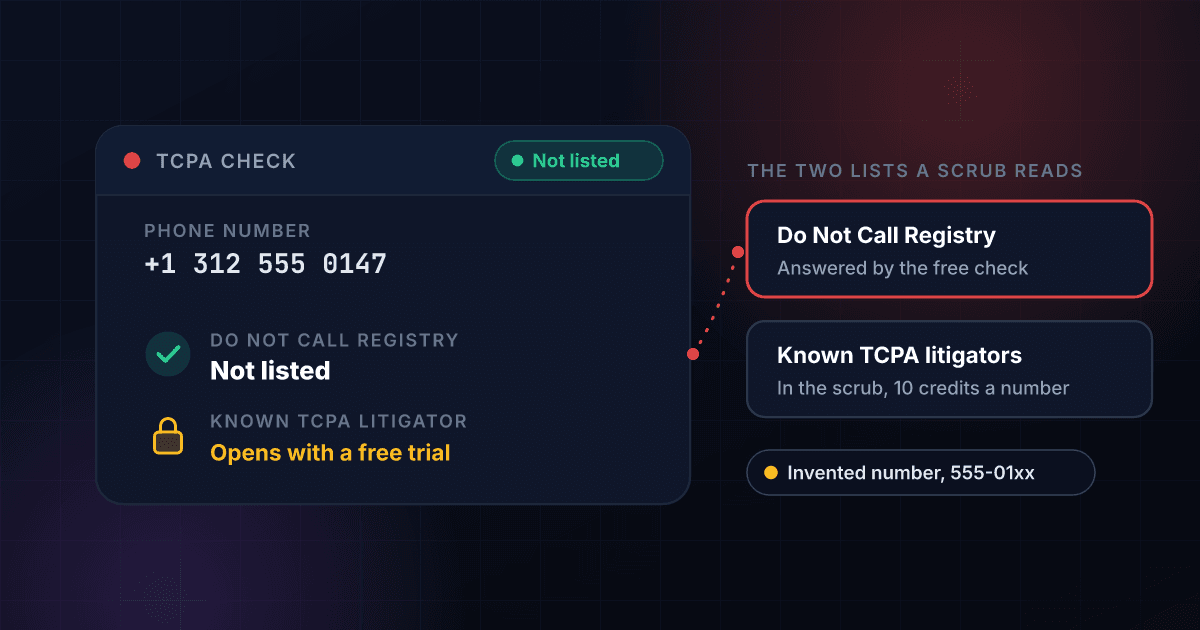
A TCPA litigator list names the numbers of people who sue over calls and texts, and a scrub keeps them off your calling list.
The Telephone Consumer Protection Act, 47 U.S.C. 227, lets a person who receives calls or texts that break its rules sue for $500 a violation or actual loss, whichever is greater, and a court may raise the award up to three times when the violation was willful or knowing. WebRecon counted 2,810 TCPA cases in US federal courts in 2025 and 2,096 in the first nine months of 2026. A litigator flag marks a number that belongs to a known litigator, serial complainer or attorney, so that a team can leave it out of a send.
A litigator flag and a Do Not Call flag answer different questions. The National Do Not Call Registry holds the numbers of people who asked not to get sales calls, and it says nothing about who has sued. A number can carry the litigator flag without being on the registry, which is why a scrub reads both and reports a number with either flag as BLOCK.
This page answers the registry question free. Enter a US number above for its Do Not Call status, line type, carrier and state. The litigator flag comes from the phone scrub, which a 7-day free trial runs on one number, on a CSV file or through the API, at 10 credits for each matched number and nothing for a number with no match.
Two guides and two free checks go with this one.
For how a litigator scrub works and how teams use one, read our guide to scrubbing a TCPA litigator list. For the wider rules a calling team works under, read our guide to avoiding TCPA violations. For the registry question alone, with the line type and carrier, use our free DNC check. To check a whole list of numbers for line type, carrier and Do Not Call status from one CSV file, use our free bulk phone number checker. To see whether a number is a mobile, a landline or VoIP, use our free phone line type lookup. To see how a number looks to the people you call, use our free spam number lookup.
A litigator scrub returns these fields, and each one answers a different question.
This is an invented result for a made-up number, laid out the way a check comes back. The first four fields are free on this page, and a 7-day free trial adds the three that come from the phone scrub.
- National Do Not Call RegistryNot listed
- Line typeMobile
- Carrier / networkSample Wireless
- StateFL
Opens with a free trial
- Known TCPA litigatorNo
- Matched recordYes
- Recommended actionAPPROVE
National Do Not Call Registry
Whether the number is on the list the FTC keeps of people who asked not to get sales calls. Listed means leave it out of sales calls and texts unless you hold the person's signed written permission.
Line type
Mobile, landline or VoIP. The TCPA sets a consent rule for autodialed or prerecorded calls and texts to a cellular number (47 U.S.C. 227(b)).
Carrier / network
The phone company that holds the number today, read from its carrier and porting record.
State
The state on the number's record. People keep a number when they move, so it does not prove where the person lives.
Known TCPA litigator
Whether the number belongs to a known litigator, serial complainer or attorney. A Yes comes back blocked even when the number is not on the registry.
Matched record
Whether the scrub found the number. A number with no match costs nothing and comes back as REVIEW.
Recommended action
BLOCK for a Do Not Call or litigator number, APPROVE for a matched number with neither flag, and REVIEW when nothing matched.
A litigator scrub takes four steps from list to result.
You give it the number or the list.
One number in the box above, a CSV file on the DNC & Compliance Check page of the dashboard, or one API request for each number.
Each number is matched against the Do Not Call and litigator records.
The scrub returns whether the number matched, its line type, the Do Not Call flag and the litigator flag. Nothing is sent to the number.
Each number gets a recommended action.
A number with either flag comes back BLOCK, a matched number with neither flag comes back APPROVE, and a number with no match comes back REVIEW.
You keep the numbers you can use and check the REVIEW ones by hand.
REVIEW does not mean clear. It means the scrub found no record of the number, so the number has no flag either way.
A litigator scrub reads two flags on every number and turns them into one recommended action.
This is the path one number takes through the phone scrub on a 7-day free trial. The free check above shows the Do Not Call flag only.
- A number from your listOne number in the box above, or every row of a CSV file or an API call on a 7-day free trial.
- Do Not Call flagA number with the flag comes back BLOCK.
- Litigator flagA number that belongs to a known litigator, serial complainer or attorney comes back BLOCK, whatever its registry status.A number with no record comes back REVIEW and costs nothing, and REVIEW does not mean the number is clear.
- Recommended actionBLOCK, APPROVE or REVIEW, with the line type and both flags.
The TCPA lets a person sue for $500 a violation or actual loss, and a court may raise the award up to three times.
From 47 U.S.C. 227 as published by the Legal Information Institute, read in October 2026. Subsection (b) covers autodialed and prerecorded calls, and subsection (c) covers the telephone solicitation rules that include the Do Not Call registry.
| Case | What the statute says | Where |
|---|---|---|
| Calls and texts that break the autodialer and prerecorded-voice rules | A person may bring an action to enjoin the violation, to recover actual monetary loss or $500 in damages for each violation, whichever is greater, or both. | 47 U.S.C. 227(b)(3)(A) to (C) |
| Telephone solicitations that break the Do Not Call rules | A person who has received more than one call within any 12-month period by or on behalf of the same entity may bring an action to enjoin the violation, to recover actual monetary loss or up to $500 in damages for each violation, whichever is greater, or both. | 47 U.S.C. 227(c)(5)(A) to (C) |
| Willful or knowing violations | The court may, in its discretion, increase the award to not more than 3 times the amount of the actual loss or damages. | 47 U.S.C. 227(b)(3) and (c)(5) |
| A defense to a solicitation claim | It is an affirmative defense that the defendant established and implemented, with due care, reasonable practices and procedures to effectively prevent telephone solicitations in violation of the rules. | 47 U.S.C. 227(c)(5) |
| Where a case is brought | In an appropriate court of a State, if the laws or rules of court of that State permit it. | 47 U.S.C. 227(b)(3) and (c)(5) |
WebRecon counted 2,810 TCPA cases in US federal courts in 2025, against 1,531 in 2022, and 2,096 in the first nine months of 2026.
WebRecon prints a TCPA line in its monthly litigation statistics for US federal courts. These are its December figures for 2021 to 2025 and its September 2026 year-to-date line, each as printed on its own page. WebRecon says its case volumes are the number of consumer plaintiffs represented, not the number of lawsuits, and it restates earlier months, so a later page may show a different figure for the same year. Its September 2026 page puts putative class actions at 68.6% of that month's TCPA cases.
| Period | TCPA cases counted |
|---|---|
| 2021 | 1,708 |
| 2022 | 1,531 |
| 2023 | 1,683 |
| 2024 | 2,788 |
| 2025 | 2,810 |
| 2026, January to September | 2,096 |
The National Do Not Call Registry held 258.5 million active registrations at the end of fiscal year 2025, up from 244.3 million in 2021.
The FTC's annual Data Book counts the numbers on the Registry and the organizations that access it. A fiscal year ends on 30 September. The Data Book also says that telemarketers and sellers must remove numbers added to the Registry from their call lists at least every 31 days.
| Fiscal year | Active registrations | Organizations accessing the Registry |
|---|---|---|
| 2021 | 244,302,202 | 12,107 |
| 2022 | 246,820,600 | 11,185 |
| 2023 | 249,498,621 | 10,347 |
| 2024 | 253,721,138 | 9,418 |
| 2025 | 258,515,050 | 9,725 |
Source: FTC, National Do Not Call Registry Data Book for Fiscal Year 2025, December 2025, page 5.
Consumers filed 2.6 million complaints about unwanted calls with the FTC in fiscal year 2025, up from 2.1 million in 2024 and down from 5.0 million in 2021.
The FTC counts the complaints consumers file about unwanted calls. The total includes complaints about robocalls, complaints about live callers and complaints where the call type was not reported, which were 214,322 in fiscal year 2025. The Data Book says its statistics are based on unverified complaints reported by consumers, not on a consumer survey, and that for a live caller the FTC verifies that the consumer's number was on the Registry before it takes the complaint.
| Fiscal year | All complaints | Robocall complaints | Live caller complaints |
|---|---|---|---|
| 2021 | 5,008,987 | 3,427,949 | 1,100,066 |
| 2022 | 3,054,237 | 1,844,210 | 889,891 |
| 2023 | 2,118,808 | 1,157,748 | 730,159 |
| 2024 | 2,085,410 | 1,099,229 | 764,138 |
| 2025 | 2,618,077 | 1,601,611 | 802,144 |
Source: FTC, National Do Not Call Registry Data Book for Fiscal Year 2025, December 2025, page 6.
A calling team works under these rules on calling hours, registry data, permission and do-not-call requests.
From the FCC's rule under the TCPA, 47 CFR 64.1200, and the FTC's Telemarketing Sales Rule, 16 CFR Part 310, as published at ecfr.gov and read on 23 October 2026. The FCC rule covers calls and texts under the TCPA, and the FTC rule covers telemarketing. State rules apply on top of both.
| Question | What the rule says | Where |
|---|---|---|
| When may a sales call be placed to a home? | A telephone solicitation to a residential subscriber may not be made before 8 a.m. or after 9 p.m., local time at the called party's location. | 47 CFR 64.1200(c)(1) |
| How fresh must the registry data be? | A seller is not liable for calling a registered number if it uses a process to prevent such calls that employs a version of the registry obtained no more than 31 days before the call, and it keeps records documenting the process. | 47 CFR 64.1200(c)(2)(i)(D) and 16 CFR 310.4(b)(3)(iv) |
| What permission lets a seller call a registered number? | The subscriber's prior express invitation or permission, shown by a signed, written agreement that says the consumer agrees to be contacted by this seller and includes the telephone number the calls may be placed to. | 47 CFR 64.1200(c)(2)(ii) |
| What consent do autodialed or prerecorded telemarketing calls to a cellular number need? | The called party's prior express written consent, with exceptions the rule lists for tax-exempt nonprofit organizations and for health care messages. | 47 CFR 64.1200(a)(1)(iii) and (a)(2) |
| How do the FCC and the FTC define an established business relationship? | The FCC counts a purchase or transaction in the 18 months before the call, or an inquiry or application in the 3 months before it. The FTC counts a purchase, rental, lease or financial transaction in the 540 days before the call, or an inquiry or application in the 90 days before it. | 47 CFR 64.1200(f)(5) and 16 CFR 310.2(q) |
| What must a seller's own do-not-call list do? | Record a request at the time it is made, honor it within a reasonable time that may not exceed 10 business days, and honor it for 5 years. | 47 CFR 64.1200(d)(3) and (d)(6) |
The FCC's consent rules have moved in steps since January 2025, and the newest step takes effect 30 days after Federal Register publication.
This is the order of the changes to the FCC's rules on consent and its revocation, read on 23 October 2026. The one-to-one rule required consent to be given to one seller at a time. The revoke-all requirement is the part of 47 CFR 64.1200(a)(10) that lets a person revoke consent to every call from a caller with one request.
| Date | What happened | Source |
|---|---|---|
| 24 January 2025 | The 11th Circuit vacated the FCC's one-to-one consent requirement in Insurance Marketing Coalition v. FCC. | 11th Circuit, No. 24-10277 |
| 11 April 2025 | The revocation rules other than the revoke-all requirement took effect: a person may revoke consent by any reasonable method, and a request must be honored within 10 business days. | 47 CFR 64.1200(a)(10) and FCC DA 25-312 |
| 29 August 2025 | The FCC reinstated the earlier definition of prior express written consent in the Federal Register. The one-to-one rule had not gone into effect. | Federal Register, 2025-16641 |
| 6 January 2026 | The FCC extended the delay of the revoke-all requirement to 31 January 2027. | FCC DA 26-12 |
| 30 September 2026 | The FCC adopted an order that lets a caller treat a revocation made in response to an informational call or text as covering only that category. A revocation made in response to a message with an advertisement or telemarketing revokes consent to all such future messages from that caller. | FCC 26-67, released 1 October 2026 |
A phone scrub returns one of four outcomes for each number, and a number with no match costs nothing.
This is read from the phone scrub endpoint's response and the OpenAPI spec of the 1Lookup API. REVIEW does not mean a number is clear: it means the scrub found no record of the number, so the number has no flag either way.
| Outcome | What comes back | Recommended action | Credits used |
|---|---|---|---|
| Known litigator, serial complainer or attorney | litigator is true, whatever the Do Not Call flag says | BLOCK, with DO_NOT_CONTACT | 10 |
| On a Do Not Call list | doNotCall is true | BLOCK, with DO_NOT_CONTACT | 10 |
| Matched, with neither flag | matched is true, and doNotCall and litigator are false | APPROVE | 10 |
| No match | matched is false | REVIEW, with MANUAL_VERIFICATION | 0 |
A phone scrub costs 10 credits, about $49.50 per 1,000 matched numbers on Starter and $19.99 on Enterprise.
These are the monthly plans on the pricing page. The Do Not Call flag, the litigator flag and the recommended action come back on the same scrub. Every plan starts with a 7-day free trial, and the same credits pay for every other 1Lookup check.
| Plan | About per 1,000 lookups | Monthly price | Matched numbers included |
|---|---|---|---|
| Starter | $49.50 | $99 | 2,000 |
| Growth | $35.20 | $299 | 8,500 |
| Professional | $32.00 | $799 | 25,000 |
| Enterprise | $19.99 | $1,999 | 100,000 |
The phone scrub API returns the litigator flag and the recommended action as JSON from one request.
Send the number with +1 and its ten digits to the phone scrub endpoint with your API key. A matched number uses 10 credits, a number with no match uses none, and standard lookups are limited to 200 requests per 10 seconds for each key. The litigator flag is in classification.litigator, the Do Not Call flag in classification.doNotCall and the suggested step in recommendations.primary_action. The response below is for an invented number.
curl -X POST https://app.1lookup.io/api/v1/phone-scrub \
  -H "Authorization: Bearer YOUR_API_KEY" \
  -H "Content-Type: application/json" \
  -d '{"phone_number": "+13055550118"}'
import requests
response = requests.post(
"https://app.1lookup.io/api/v1/phone-scrub",
headers={"Authorization": "Bearer YOUR_API_KEY"},
json={"phone_number": "+13055550118"},
)
data = response.json()["data"]
print(data["classification"]["litigator"])const response = await fetch('https://app.1lookup.io/api/v1/phone-scrub', {
method: 'POST',
headers: {
'Authorization': 'Bearer YOUR_API_KEY',
'Content-Type': 'application/json'
},
body: JSON.stringify({ phone_number: '+13055550118' })
})
const { data } = await response.json()
console.log(data.classification.litigator)Response
{
  "success": true,
  "data": {
    "request": { "type": "phone_scrub", "input": "+13055550118" },
    "classification": {
      "matched": true,
      "phoneTypeLabel": "LITIGATOR",
      "doNotCall": false,
      "litigator": true
    },
    "recommendations": {
      "primary_action": "BLOCK",
      "secondary_actions": ["DO_NOT_CONTACT"],
      "user_message": "Phone number flagged as a known litigator, serial complainer or attorney. Do not contact."
    },
    "metadata": { "credits_used": 10, "credits_remaining": 9990 }
  }
}
To scrub every number before it loads into your dialer, see our DNC and litigator scrubbing API.
It answers the registry question first.
Listed or Not listed comes back in plain words, with the line type, carrier and state, before you ask for anything else.
It keeps the litigator flag apart from the Do Not Call flag.
A number that is not on the registry can still come back blocked, because the scrub reads the two flags separately.
It says REVIEW, not clear, when nothing matches.
A number with no record carries no flag either way, so the scrub asks for a manual check and charges nothing.
It never calls or texts the number.
The check reads records, so the number's owner is not contacted and does not know it was checked.
Who uses this tool
Teams that buy leads scrub a list before it reaches the dialer.
Flagged numbers are blocked before the first call, instead of after a complaint.
Sales teams check a number before a rep calls it.
The registry status shows at once, and a 7-day free trial adds the litigator flag.
Teams that send marketing texts scrub the list before each send.
The line type separates mobile numbers from landlines, and the flags keep blocked numbers out of the send.
Compliance staff keep a record of what was checked and when.
A CSV file or an API call returns the flags and the recommended action for every number, ready to store with the campaign.
Frequently asked questions
What is a TCPA litigator list?
It is a list of phone numbers that belong to people who sue over unwanted calls and texts: known litigators, serial complainers and the attorneys who file for them. 1Lookup's phone scrub flags a number that belongs to a known litigator, serial complainer or attorney.
How do I check whether a phone number is a TCPA litigator?
Run it through a phone scrub. The scrub returns a litigator flag, a Do Not Call flag and a recommended action. The free check on this page shows the Do Not Call status, and a 7-day free trial runs the scrub on one number, a CSV file or the API.
Is there a free TCPA litigator check?
The Do Not Call status is free on this page, with no signup. The known-litigator flag is not part of the free result. It comes from the phone scrub, which a 7-day free trial runs.
What is the difference between a DNC check and a litigator scrub?
A DNC check answers whether a number is on the National Do Not Call Registry, the list of people who asked not to get sales calls. A litigator scrub also checks whether the number belongs to a known litigator, serial complainer or attorney, and a flagged number comes back BLOCK even when it is not on the registry.
What can a person recover under the TCPA?
For calls that break the autodialer and prerecorded-voice rules, $500 for each violation or actual monetary loss, whichever is greater. For calls that break the telephone solicitation rules, up to $500 for each violation. A court may raise either award up to three times when the violation was willful or knowing (47 U.S.C. 227(b)(3) and (c)(5)).
How many TCPA cases are filed each year?
WebRecon counted 1,708 TCPA cases in US federal courts in 2021, 2,788 in 2024 and 2,810 in 2025, and 2,096 in the first nine months of 2026. It counts the consumer plaintiffs represented, not the number of lawsuits.
What does REVIEW mean in a scrub result?
REVIEW means the scrub found no record of the number. It is not a clear result: the number has no flag either way, so check it by hand before you dial. A number with no match costs no credits.
Does a litigator scrub protect me from a TCPA lawsuit?
No. It keeps numbers that carry a flag off your list, and it does not decide whether your calls follow the rules. Anyone who receives a call or text that breaks the rules can bring a case, so a number that is not flagged is not a promise about its owner. Questions about your own calling program are for your own counsel.
How much does a TCPA litigator scrub cost per number?
A TCPA litigator scrub costs 10 credits for each matched number, and nothing for a number with no match. That is about $49.50 per 1,000 matched numbers on the Starter plan, $35.20 on Growth, $32.00 on Professional and $19.99 on Enterprise. Every plan starts with a 7-day free trial.
How often should I scrub my calling list?
Before each campaign. The rules expect a seller to use registry data obtained no more than 31 days before a call (47 CFR 64.1200(c)(2)(i)(D) and 16 CFR 310.4(b)(3)(iv)), and the litigator flag is read when you run the scrub.
When may a sales call be placed?
Not before 8 a.m. or after 9 p.m., local time at the called party's location (47 CFR 64.1200(c)(1)).
What is prior express written consent?
Under 47 CFR 64.1200(f)(9), it is an agreement in writing, bearing the signature of the person called, that clearly authorizes the seller to deliver advertisements or telemarketing messages using an autodialer or an artificial or prerecorded voice, and gives the telephone number they may be delivered to. The agreement must say that the person is not required to sign it as a condition of buying anything.
Did the FCC's one-to-one consent rule take effect?
No. The 11th Circuit vacated it on 24 January 2025, and on 29 August 2025 the FCC reinstated the earlier definition of prior express written consent in the Federal Register. The FCC said the revised rule had not gone into effect.
Can I scrub a whole calling list at once?
Yes. With an account, upload a CSV file on the DNC & Compliance Check page of the dashboard or call the phone scrub API. The file comes back with a Status and a Result column on every row, and each matched number uses 10 credits.
Can I run the scrub inside my CRM or dialer?
Yes, through the API. Send each number to the phone scrub endpoint before it loads, and keep out every number that comes back BLOCK. Each matched number uses 10 credits, and standard lookups are limited to 200 requests per 10 seconds for each API key.
Does the person know I checked their number?
No. The check reads records only. No call or text goes to the number, so its owner is never told.
These pages answer the question that comes after a litigator check.
- DNC checkWhether a US number is on the Do Not Call Registry, with its line type and carrier.
- Bulk phone number checkerOne CSV file checks a whole list for line type, carrier and Do Not Call status.
- Phone line type lookupWhether a number is a mobile, a landline or VoIP.
- Spam number lookupHow a number looks to the people it calls.
The first three digits of a US number tell you where it was assigned.
Every area code has its own page with the places it covers, the local time there, and what to do when a call from it looks spoofed. These are the codes people look up most.
- 213Los Angeles
- 646New York City
- 917New York City
- 202Washington
- 404Atlanta
- 702Las Vegas
- 786Miami
- 415San Francisco
- 206Seattle
- 954Fort Lauderdale
- 323Los Angeles
- 929New York City
Area code 213, downtown Los Angeles, also has a page for each of its 786 prefixes, with the company NANPA lists as the holder.
New area codes catch people out, because a number from one looks unfamiliar even when it is local. These are the newest working codes.
- 465New York, since Jun 2026
- 483Alabama, since Feb 2026
- 471Mississippi, since Jan 2026
- 679Michigan, since Nov 2025
- 457Louisiana, since Sep 2025
- 729Tennessee, since Sep 2025