This free SMS capable number checker reads a number's line type to show whether a text can reach it.
Enter a phone number with its country code to see what its line type means for texting. One check needs no signup.
Pick the country, then enter the number without the country code.
Free & rate-limited. No signup required to try.
To check whether a number can receive texts, read its line type. A mobile line can receive texts, a landline only when its provider offers a text service, and a VoIP or toll-free number only when its owner set that up. 1Lookup's free checker reads the line type and country of any number.
- Free single-number check
- Line type and country
- No text is sent
- Numbers from any country
Page checked
You can check whether a number can receive texts in three steps.
Enter the number with its country code.
Start with + and the country code, such as +44 7700 900123, so the number is read in the right country.
Read the line type and what it means for texting.
A mobile line receives texts, a landline only with a provider text service, and a VoIP or toll-free number only when its owner set it up.
Check a mobile number again before a big send.
The line type says the number can receive texts, and a live network check shows whether the phone is on right now.
Need this at scale? Phone Validation API
Sort a whole list into mobile, landline, VoIP and toll-free before a text campaign, one request per number.
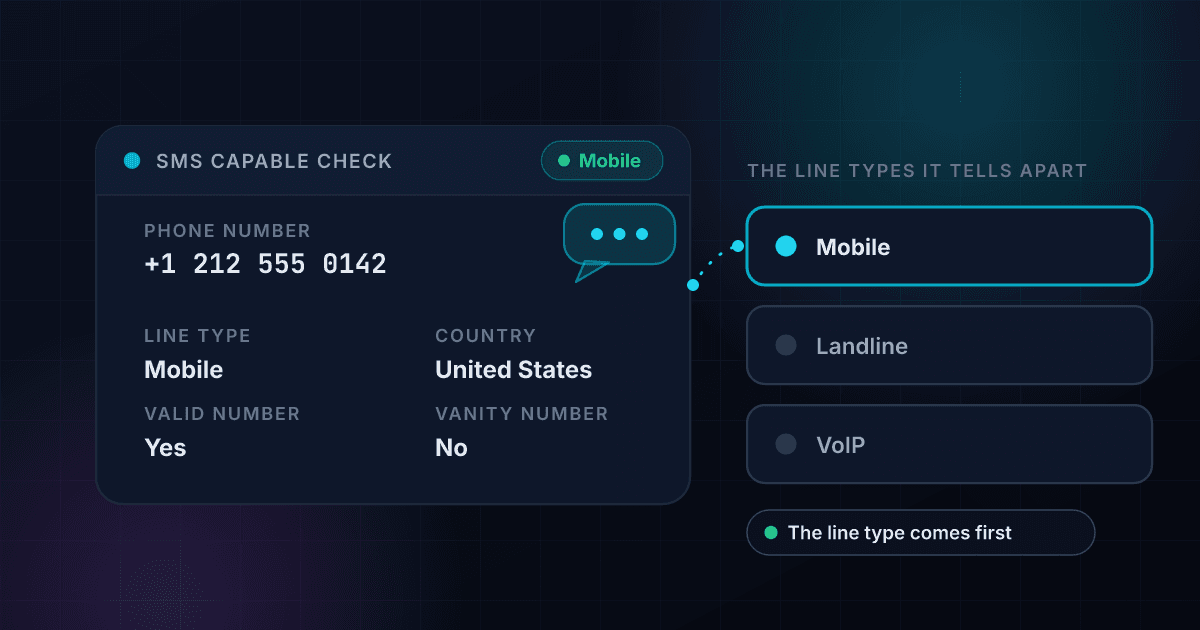
A number can receive a text when its line type is one that carries text messages, and the line type is the one thing a check can read.
A text message, or SMS, is a service of mobile networks. The standard that defines it, 3GPP TS 23.040, sets one message at up to 140 octets: 160 characters in the GSM alphabet or 70 in Unicode. A mobile line is the line type texts are sent to, so a mobile number can receive a text. The line type does not say that the phone is switched on right now, or that every message will be delivered.
A landline is different. The ETSI standard for texting on fixed lines, ES 201 912, describes two requirements: a phone that can send and show text, and a provider that offers the service. A landline number can receive a text only when both are in place, so the line type alone cannot promise it. A VoIP number receives texts only when the service behind it carries them, and a toll-free number only when its owner turned texting on for it (CTIA Messaging Principles and Best Practices, section 5.5.6, and FCC order 18-77).
The number type check reads the line type from the number itself, in any country, and this page turns it into a plain statement for texting. It does not send a text, so the owner is never contacted. For a mobile number, a live network check, which 1Lookup runs as an HLR lookup, adds whether the phone is on or out of coverage right now.
This free page checks one number at a time and shows the line type, what it means for texting, whether the number is valid and its country. A 7-day free trial adds the carrier on record, whether the number may have moved networks and whether a live network check is available, with whole-list checks by CSV or API at 1 credit a number.
Two guides and four free checks go with this one.
For the rules that apply before you text a mobile number, read our guide to avoiding TCPA violations. For the technical side of checking a list against those rules, read our TCPA compliance API guide. To see whether a mobile phone is on right now, use our free HLR lookup. To check whether a number is a landline, use our free landline checker. To see whether a number is VoIP, mobile or landline with its validity, use our free phone line type lookup. To see whether a mobile number is active, switched off or out of service, use our free disconnected number checker.
An SMS capable number check returns these fields, and each one answers a different question.
This is an invented result for a made-up UK mobile number, laid out the way a check comes back. The first four fields are free on this page, and a 7-day free trial opens the rest.
- Receives textsYes, a mobile line
- Line typeMobile
- Valid numberYes
- CountryUnited Kingdom
Opens with a free trial
- The carrier name on recordSample Mobile
- Possibly portedNo
- Eligible for a live network checkYes
Receives texts
What the line type means for texting. A mobile line is the kind texts are sent to. A landline needs a provider text service, a VoIP number depends on its service, and a toll-free number needs its owner to turn texting on.
Line type
The kind of line the number is on: mobile, landline, VoIP, toll-free or premium-rate.
Valid number
Whether the number follows the numbering rules of its country. A number that is not valid cannot receive a text.
Country
The country the number belongs to, read from its country code.
The carrier name on record
The network that first issued the number.
Possibly ported
Whether the number may have moved to another network, which is why its prefix can name the wrong carrier.
Eligible for a live network check
Whether an HLR lookup can give live status for this number: whether the phone is on, off or out of coverage right now.
The check takes three steps and never sends a text.
Type the number with its country code.
Start with + and the country code, such as +44 7700 900123, so the number is read in the right country.
1Lookup reads the line type.
The number type check classifies the number as mobile, landline, VoIP, toll-free or premium-rate, and checks that it is a valid number for its country.
You read what the line type means for texting.
The result states whether a text can reach that kind of line, with the country and whether the number is valid.
An SMS capable number check reads the line type and stops before any text is sent.
This is the path one check takes. The line type comes from the number's own range, so the check needs no message and no answer from the phone.
- You enter the numberIn E.164 format, with the + and the country code.
- 1Lookup reads the numberThe number type check finds its line type, country and validity.
- The line type is read for textingMobile, landline, VoIP, toll-free or premium-rate, each with its own statement.No text is sent and the phone is not contacted.
- You read the resultWhether a text can reach the line, with the country and whether the number is valid.
A text can reach a mobile line, and for the other line types it depends on the provider or the owner.
Each row is one line type the number type check returns, what it means for a text and what the line type does not show. The statements come from the standards and rules named under the table, and the last column is what this page's result says for that type.
| Line type | Can a text reach it? | What the line type does not show | What this page says |
|---|---|---|---|
| Mobile | Yes. Text messaging is a service of mobile networks, defined in 3GPP TS 23.040. | Whether the phone is on right now, or that every message is delivered. | Yes, a mobile line |
| Landline | Only when the provider offers a text service for the line and the phone can send and show text (ETSI ES 201 912). | Whether the provider offers texting on this line. | Only with a text service |
| VoIP | Only when the service behind the number carries text messages. | Which service is behind the number. | Depends on the provider |
| Toll-free | Only when the owner has text-enabled the number. In the US this needs the subscriber's authorization (CTIA principles, section 5.5.6, and FCC order 18-77). | Whether the owner turned texting on. | Only if enabled |
| Premium-rate | A premium-rate number connects to a paid service, so a text to it is not a message to a person. | What the paid service does. | A paid service line |
A single text holds up to 160 characters in the GSM alphabet and 70 in Unicode, and a longer one is split into linked parts of 153 or 67.
This is the size limit the SMS standard sets, as printed in 3GPP TS 23.040 and TS 23.038. A message that is longer than one text is sent as linked parts, and each part loses 7 characters of the GSM alphabet, 6 octets of 8-bit data or 3 characters of Unicode to a header that puts the parts in order. The table uses the common 8-bit reference header. A 16-bit reference header leaves 152, 133 and 66 per part instead. The last column is the standard's own maximum of 255 parts.
| Encoding | One text holds at most | Each part of a longer text holds | 255 linked parts hold at most |
|---|---|---|---|
| GSM 7-bit alphabet | 160 characters | 153 characters | 39,015 characters |
| 8-bit data | 140 octets | 134 octets | 34,170 octets |
| Unicode (UCS-2) | 70 characters | 67 characters | 17,085 characters |
Americans sent nearly 2.2 trillion texts in 2024, after 1.77 trillion in 2017.
CTIA, the US wireless industry association, counts the SMS and MMS messages sent over its members' networks in its annual survey. The 2017 to 2020 figures are the survey's printed counts. For 2024 the survey prints a rounded figure, nearly 2.2 trillion, and says only 2020 was higher, so the table shows 2,200 billion for the chart and the survey's own words beside it. The survey highlights for 2021 to 2023 print rounded counts only, so those years are left out.
| Year | Texts sent, billions | As CTIA prints it |
|---|---|---|
| 2017 | 1,767.7 | 1,767.7 billion |
| 2018 | 2,046.2 | 2,046.2 billion |
| 2019 | 2,097.8 | 2,097.8 billion |
| 2020 | 2,217.3 | 2,217.3 billion |
| 2024 | 2,200 | Nearly 2.2 trillion |
UK networks carried 21.51 billion texts in 2025, 71.0% fewer than the 74.11 billion of 2018.
Ofcom, the UK communications regulator, publishes the number of SMS and MMS messages sent that providers report to it. Ofcom restates earlier years slightly between editions, so each year here uses the newest edition that carries it. The third column is the change on the year before, our calculation.
| Year | SMS and MMS messages sent, billions | Change on the year before |
|---|---|---|
| 2018 | 74.11 | Not applicable |
| 2019 | 65.05 | -12.2% |
| 2020 | 48.68 | -25.2% |
| 2021 | 40.86 | -16.1% |
| 2022 | 36.63 | -10.4% |
| 2023 | 31.68 | -13.5% |
| 2024 | 28.03 | -11.5% |
| 2025 | 21.51 | -23.3% |
Fixed telephone lines fell from 36.1% of the world's mobile and fixed subscriptions in 2005 to 8.2% in 2025.
The International Telecommunication Union counts subscriptions worldwide. Its mobile count excludes data-only and machine-to-machine connections, and its fixed count includes fixed VoIP, fixed wireless and ISDN lines. Subscriptions per 100 people rose for mobile from 33.9 in 2005 to 111.5 in 2025 and fell for fixed from 19.1 to 9.9. Fixed subscriptions peaked at 1,260.9 million in 2006. In 2025 there were 11.25 mobile subscriptions for every fixed one. The last two columns are our sums.
- Mobile-cellular subscriptions, million
- Fixed-telephone subscriptions, million
| Year | Mobile-cellular subscriptions, million | Fixed-telephone subscriptions, million | Both, million | Fixed share of both |
|---|---|---|---|---|
| 2005 | 2,205.3 | 1,243.2 | 3,448.5 | 36.1% |
| 2010 | 5,290.1 | 1,229.0 | 6,519.1 | 18.9% |
| 2015 | 7,131.7 | 1,046.0 | 8,177.7 | 12.8% |
| 2020 | 8,268.4 | 903.1 | 9,171.5 | 9.8% |
| 2023 | 8,877.4 | 858.1 | 9,735.5 | 8.8% |
| 2024 | 9,005.0 | 833.5 | 9,838.5 | 8.5% |
| 2025 | 9,170.7 | 815.4 | 9,986.1 | 8.2% |
People in the United States reported losing $470 million to text scams in 2024, up from $86 million in 2020.
The Federal Trade Commission counts the fraud reports people file. This table is the reports that named text as the way the scammer made contact. The median loss is the middle amount among the reports that lost money, and the last column is the share of text reports that lost money.
| Year | Reports naming text | Reported losses | Median loss | Reports with a loss |
|---|---|---|---|---|
| 2020 | 334,524 | $86 million | $800 | 5% |
| 2021 | 377,840 | $131 million | $900 | 4% |
| 2022 | 321,374 | $326 million | $1,000 | 6% |
| 2023 | 230,407 | $372 million | $1,000 | 9% |
| 2024 | 246,784 | $470 million | $1,000 | 11% |
Source: Federal Trade Commission, Data Spotlight, Top text scams of 2024, April 2025, read 23 October 2026.
An SMS capable number check costs 1 credit, about $4.95 per 1,000 lookups on Starter and $2.00 on Enterprise.
These are the monthly plans on the pricing page. An invalid number is not charged, every plan starts with a 7-day free trial, and the same credits pay for every other 1Lookup check.
| Plan | About per 1,000 lookups | Monthly price | Lookups included |
|---|---|---|---|
| Starter | $4.95 | $99 | 20,000 |
| Growth | $3.52 | $299 | 85,000 |
| Professional | $3.20 | $799 | 250,000 |
| Enterprise | $2.00 | $1,999 | 1,000,000 |
The number type API returns the line type as JSON from one request.
Send the number in E.164 format to the number type endpoint with your API key. Each request costs 1 credit, each API key can send up to 1,000 requests a minute, and each account can make up to 1,000 requests a minute in total across all its keys. The line type is in classification.number_type, and a mobile line is the value MOBILE. Whether a live network check is available is in classification.qualifies_for_hlr_lookup. The response below is for an invented number.
curl -X POST https://app.1lookup.io/api/v1/nt-lookup \
  -H "Authorization: Bearer YOUR_API_KEY" \
  -H "Content-Type: application/json" \
  -d '{"phone_number": "+447700900123"}'
import requests
response = requests.post(
"https://app.1lookup.io/api/v1/nt-lookup",
headers={"Authorization": "Bearer YOUR_API_KEY"},
json={"phone_number": "+447700900123"},
)
data = response.json()["data"]
print(data["classification"]["number_type"])const response = await fetch('https://app.1lookup.io/api/v1/nt-lookup', {
method: 'POST',
headers: {
'Authorization': 'Bearer YOUR_API_KEY',
'Content-Type': 'application/json'
},
body: JSON.stringify({ phone_number: '+447700900123' })
})
const { data } = await response.json()
console.log(data.classification.number_type)Response
{
  "success": true,
  "data": {
    "request": { "type": "nt_lookup", "input": "+447700900123" },
    "classification": {
      "number_type": "MOBILE",
      "is_valid": true,
      "is_possibly_ported": false,
      "qualifies_for_hlr_lookup": true
    },
    "insights": {
      "nt_result": {
        "number_type": "MOBILE",
        "carrier": "Sample Mobile",
        "country": "United Kingdom",
        "country_code": "GB"
      }
    },
    "metadata": { "credits_used": 1, "credits_remaining": 9999 }
  }
}
To run the same check on every number you collect, see our phone validation API.
It states what each line type means for texting.
A mobile, landline, VoIP, toll-free or premium-rate number each gets its own plain statement, so you do not have to know the rules.
It reads the number and sends nothing.
The line type comes from the number itself, so no text is sent and the owner is never contacted.
It works for numbers from any country.
Start with + and the country code and the number is read in its own country, with that country named in the result.
It tells a valid number from a typo.
A number that does not follow its country's numbering rules is flagged first, because it cannot receive a text.
Who uses this tool
Sort a list before a text campaign.
Keep the mobile numbers for texting and route the landlines and VoIP numbers to calls or email.
Check a number before you send a verification code.
A code sent by text reaches a mobile line, so a landline in a signup form is a reason to ask for another number.
Choose the right channel for a contact.
A mobile number gets a text and a landline gets a call, so the channel matches the line.
Spot a number that was typed wrongly.
A number that is not valid for its country shows up before a message is queued for it.
Frequently asked questions
How do I check if a number can receive text messages?
Enter the number with its country code in the box above. The check reads its line type and tells you what that means for texting: a mobile line can receive texts, and a landline, VoIP or toll-free number only under the conditions the result states.
What is an SMS lookup?
An SMS lookup reads a number's line type, country and carrier to decide whether a text can be sent to it. This page reads the line type and country, and a live network check, which 1Lookup runs as an HLR lookup, adds whether the phone is on right now.
Can a landline receive texts?
Sometimes. A landline can receive a text only when its provider offers a text service for the line and the phone can send and show text, the two requirements ETSI standard ES 201 912 sets for texting on fixed lines. The line type cannot show whether the provider offers it.
Can a VoIP number receive texts?
Only when the service behind the number carries text messages. The line type says the number is VoIP, and the provider decides the rest.
Can a toll-free number receive texts?
Only when its owner has text-enabled it. In the US a toll-free number can be text-enabled with the subscriber's authorization, and the line type does not show whether that was done.
Does a mobile line type mean the text will be delivered?
It means the number is the kind of line texts are sent to. It does not show that the phone is on, that it has coverage or that a carrier will deliver every message. A live network check shows whether the phone is on or out of coverage right now.
Can this page tell me if a phone is switched on?
No. It reads the line type from the number, and a switched-off phone is still a mobile line. Our free HLR lookup asks the number's network whether the phone is active, unreachable or has no active line.
Does the checker send a text to the number?
No. It reads the number and sends nothing, so the owner is not contacted and nothing appears on their phone.
How long can one text be?
One text holds up to 160 characters in the GSM alphabet, 140 octets of 8-bit data or 70 characters in Unicode. A longer message is split into linked parts of 153, 134 or 67, and the standard allows up to 255 parts.
Do texting laws apply to texts sent to mobile numbers?
Yes. The FCC rule at 47 CFR 64.1200 names text messages in several of its paragraphs, including paragraph (e), which applies the Do Not Call rules to wireless numbers. Our free Do Not Call check and TCPA litigator check cover the lists that matter before a campaign.
Is the SMS capable number checker really free?
Yes. One check needs no signup, and the page is rate limited for fair use. The carrier on record, the ported flag, the live-check flag and whole-list checks come with a 7-day free trial.
How much does an SMS capable number check cost per 1,000 numbers?
A check costs 1 credit. That is about $4.95 per 1,000 lookups on the Starter plan, $3.52 on Growth, $3.20 on Professional and $2.00 on Enterprise. An invalid number is not charged, and every plan starts with a 7-day free trial.
Can I check a whole list of numbers?
Yes. With an account, upload a CSV file or call the number type API. Each lookup costs 1 credit, an invalid number is not charged, each API key can send up to 1,000 requests a minute, and each account can make up to 1,000 requests a minute in total across all its keys.
Are people still sending texts?
Yes. CTIA reports nearly 2.2 trillion SMS and MMS messages sent in the United States in 2024, and only 2020 was higher. In the United Kingdom, Ofcom's count fell from 74.11 billion messages in 2018 to 21.51 billion in 2025.
How many fixed telephone lines are left?
The International Telecommunication Union counted 815.4 million fixed telephone subscriptions worldwide in 2025, against 9,170.7 million mobile ones, and fixed subscriptions peaked at 1,260.9 million in 2006.
These pages answer the question that comes after an SMS capable number check.
The first three digits of a US number tell you where it was assigned.
Every area code has its own page with the places it covers, the local time there, and what to do when a call from it looks spoofed. These are the codes people look up most.
- 213Los Angeles
- 646New York City
- 917New York City
- 202Washington
- 404Atlanta
- 702Las Vegas
- 786Miami
- 415San Francisco
- 206Seattle
- 954Fort Lauderdale
- 323Los Angeles
- 929New York City
Area code 213, downtown Los Angeles, also has a page for each of its 786 prefixes, with the company NANPA lists as the holder.
New area codes catch people out, because a number from one looks unfamiliar even when it is local. These are the newest working codes.
- 465New York, since Jun 2026
- 483Alabama, since Feb 2026
- 471Mississippi, since Jan 2026
- 679Michigan, since Nov 2025
- 457Louisiana, since Sep 2025
- 729Tennessee, since Sep 2025