 vs
 Alpha by application vs open today
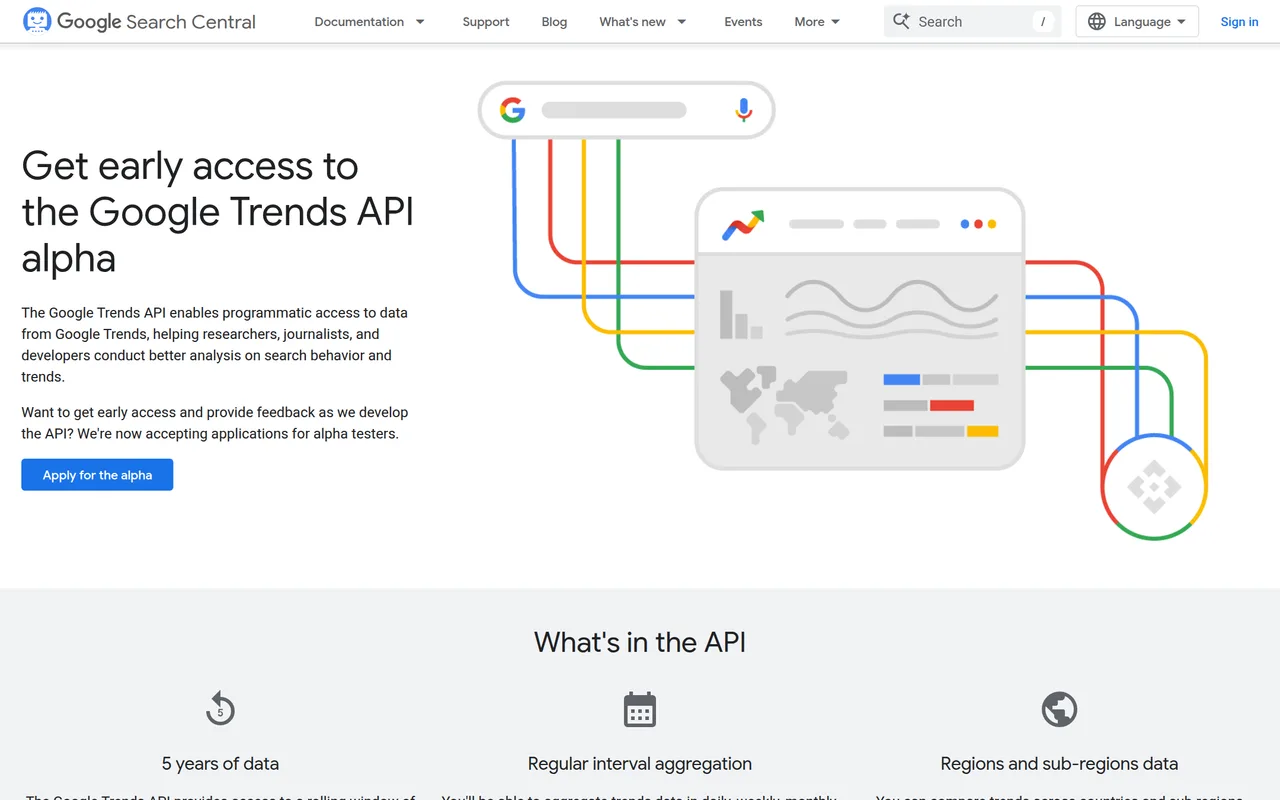
Google's own Trends API is open by application to a limited number of testers, and 1Lookup's Search Trends API is available now for $0.010 a comparison.
Google announced its Trends API as an alpha in July 2025 and still invites applications on its developer page, with no price, quota or general-availability date printed. 1Lookup returns the same kind of answer today: up to five keywords on one shared scale, for 2 credits.
The Google Trends API is Google's own programmatic access to Search Trends data, announced on the Google Search Central blog on 24 July 2025 as an alpha. Access opens on a rolling basis to a limited number of developers, Google calls the tools possibly not production-ready, and neither of its pages prints a price, quota, rate limit or general-availability date. 1Lookup's Search Trends API is open to any account, 2 credits per comparison, about $0.010 on the Starter plan.
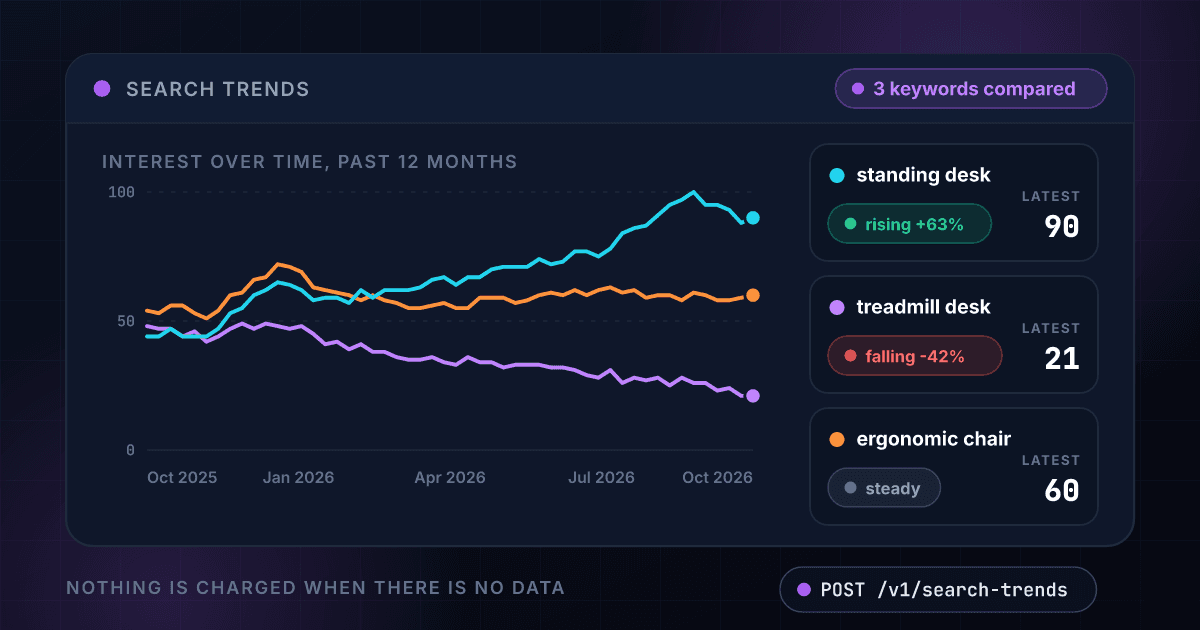
Google's alpha Trends API, as a request you can make today
Google's version is an application form and a wait. This is a comparison of keywords over time that you can request with an API key now.
1Lookup vs Google Trends API: the same criteria, side by side
Both products measured on identical criteria, with Google Trends API’s numbers taken from its own published pricing.
 1lookup1lookup.ioData and validation APIs
 google.comSearch trends data
| Criteria | 1Lookup | |
|---|---|---|
| Pricing model | Monthly plans with universal credits; core phone, email and IP lookups cost 1 credit, enrichment and intelligence products cost more | Not a product for sale yet: Google's pages print no price, quota or general-availability date. The Trends API is an alpha open by application to a limited number of testers |
| Starting price | $99/mo for 20,000 credits ($4.95 per 1,000, down to $2.00 on Enterprise) | No price is printed anywhere. Access is by application during the alpha |
| Free option | Free single lookups via the online tools at 1lookup.io/tools, no account required | No price or free allowance is printed. Access is by application during the alpha |
| Free trial | 7-day free trial on every plan: $5 of credits on Starter, $20 on Growth, Professional, and Enterprise, with no payment today | None published |
| Do credits expire? | Unused monthly credits roll over for 3 months; separately purchased credits last 1 year | Not published |
Before you sign: Google Trends API and 1Lookup on the operational terms
The terms that decide what a year actually costs, rather than what the first month does. “Not listed” means we could not verify it on either product’s published pages, not that the answer is nothing.
| Term | 1Lookup | Google Trends API |
|---|---|---|
| Minimum commitment | None. Monthly plans with no contract and no minimum volume; cancel any time | Not listed |
| API access | Included on every plan and during the free trial; there is no tier that unlocks it | By application only: the developer page says 'We're now accepting applications for alpha testers' and the blog says access opens 'on a rolling basis to a limited number of developers'. No plan or key tiers are printed. |
| Rate limit | 1,000 requests per minute on standard accounts, with higher limits available on request | Not listed |
| Support | Starter: Email Support; Growth: Priority Email & Chat Support; Professional: Chat + Live Meeting; Enterprise: Dedicated CSM | Feedback to the Google Trends team is the stated route for testers (the page asks for direct feedback on using the API); no support channel or response time is printed. |
Google Trends API fine print worth reading twice
Published terms that change what Google Trends API costs or what you can do with it. Each one links to the Google Trends API page it was read on, because a claim about somebody else’s contract should be checkable in one click.
Access is not guaranteed: applications are reviewed and Google says it is prioritizing developers who know what they want to do, can start doing it soon and will give feedback, so a buyer may not be admitted.
Read it on Google Trends API’s siteTesters are expected to give direct feedback, and Google says the alpha tools might not be production-ready, so building a product on it carries change risk.
Read it on Google Trends API’s site
1Lookup
Google Trends API
Where 1Lookup wins
- Open to any account today: a key and $0.010 a comparison on Starter, where Google's Trends API is an alpha by application with no price printed
- Up to five keywords on one shared 0 to 100 scale, with the average, peak, latest score, change and rising, falling or steady direction worked out for each
- Ranges from the past day to the past 5 years, for the world or any of 29 countries, and a comparison with no data costs nothing
- A CSV upload runs a whole list of comparisons in one go, one row per comparison
Where Google Trends API wins
- It is Google's own API for Search Trends data, announced on the Google Search Central blog on Thursday, July 24, 2025.
- Data is 'consistently scaled' rather than rescaled from 0 to 100 on every request, so results from multiple requests can be joined, compared and merged, and a monitored term needs only the latest period pulled.
- It is built for comparing dozens of terms; the pages contrast this with the Trends website's comparison limit (the developer page says eight terms, the blog post says 5 terms).
- It offers daily, weekly, monthly and yearly aggregation, over a rolling window of the last 5 years (1800 days) that runs up to just 2 days ago.
- It offers region and sub-region breakdowns defined by ISO 3166-2, and the page says comparisons across countries and sub-regions are supported.
Google Trends API pricing and product facts verified against developers.google.com as of October 2026. Prices change; always confirm on the vendor’s site. 1Lookup numbers come from the live rate card.
Who this is for
A quick, honest read on which tool fits your use case.
Choose 1Lookup if: you need Google Trends comparisons in a dashboard, a report or an alert this month, with an API key and a price instead of an application and a wait.
Consider the Google Trends API instead if: you research long, consistently scaled series, can wait for an invitation and want Google's own source with sub-region breakdowns and comparisons of many terms.
Frequently asked questions
Is there an official Google Trends API?
Google announced one on 24 July 2025 on the Google Search Central blog, as an alpha. Its developer page still said on 23 October 2026 that Google is accepting applications for alpha testers, and the blog says access opens on a rolling basis to a limited number of developers. Google describes the alpha as for tools that might not be production-ready.
How much does the Google Trends API cost?
Neither the developer page nor the announcement prints a price, a free allowance, a quota, a rate limit, an uptime commitment or a general-availability date, so a cost cannot be planned from them. That is the main difference to a product with a price list. 1Lookup's Search Trends API is priced per request.
What does Google's Trends API return?
Search interest for a term, scaled consistently rather than rescaled from 0 to 100 on every request, so results from several requests can be joined and compared. It offers daily, weekly, monthly and yearly aggregation over a rolling window of the last 5 years that ends about 2 days ago, region and sub-region breakdowns by ISO 3166-2, and comparisons of many terms; the two pages disagree on how many terms, five and eight.
How much does 1Lookup charge for a comparison?
2 credits per comparison that returns readings, free when there are no readings, whatever the number of keywords up to five. On the Starter plan ($99 a month for 20,000 credits) that is about $0.010 a comparison, 10,000 comparisons a month and $9.90 per 1,000. The ranges run from the past day to the past 5 years, for the world or any of 29 countries.
Where does Google's Trends API beat 1Lookup?
On being Google's own source and on how the numbers are scaled. Its values stay consistent between requests, so a monitored term needs only its latest period pulled and long series can be stitched together. It is built for comparing dozens of terms and breaks results down by region and sub-region. 1Lookup's scores sit on one scale only within a single comparison, so compare keywords in the same request.
Can I rely on the alpha for a product?
Not on what Google prints today. Applications are reviewed, Google says it is prioritizing developers who can start soon and give feedback, testers are expected to send feedback, and nothing says the alpha will become a general release. A product with a date to meet needs an API it can call now.
Is the Google Trends API worth waiting for in 2026?
If you do research on long consistently scaled series and can wait for an invitation, apply: it is the official route. If you need trends in a dashboard, a report or an alert this month, an API with a key and a price removes the wait. The two are not exclusive: you can use a request-based API now and move later.