Check whether a phone number is valid or fake.
Enter any phone number to see whether it is valid or fake. It is free, with no signup.
Pick the country, then enter the number without the country code.
Free & rate-limited. No signup required to try.
A fake phone number checker tells you whether a number follows the numbering rules of its country and what kind of line it is on. 1Lookup's free checker shows the number's validity, line type, country and whether it is possibly ported. A valid number can still go unanswered, and the checker never calls the number.
- Free, no signup
- Numbers from any country
- Never calls the number
- Says unknown when it cannot tell
You can check whether a number is valid in under a minute.
Enter the number.
Type it with its country code, such as +1 for the US, or pick the country from the list.
Read the headline.
It says whether the number is valid and what kind of line it is on, or that it is not valid, or that it could not be confirmed.
Read the line type and the porting flag.
The line type shows the exact kind, and the possibly ported flag shows whether the number may have moved to another network.
Remember that valid does not mean answered.
A valid number follows the numbering rules, and only a call can show that someone picks up, which this check never makes.
Need this at scale? Phone Validation API
Drop numbers that cannot exist and flag throwaway lines on every signup, one request per number.
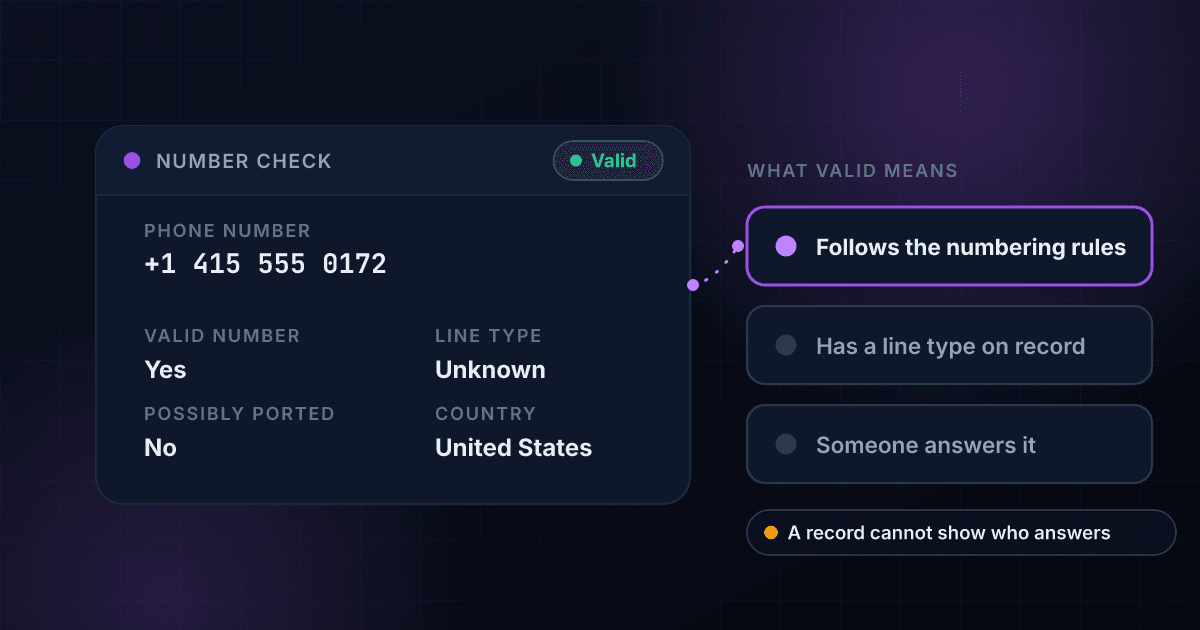
A fake number check reads validity and line type, and it cannot tell whether anyone answers.
A number is valid when it follows the numbering rules of its country, such as the right length and a code the country uses. A number can fail that test, which means it is unlikely to be a working number. It can also pass and still reach no one, because it was never given to a subscriber, was disconnected or belongs to a throwaway service. So a check can show that a number is probably not real, and a pass is a first filter and not a proof.
This checker looks the number up and gives one of four answers: valid with a known line type, valid with an unknown line type, not valid, or not confirmed. It also shows the country and whether the number may have been ported. It never calls or texts the number, and it does not call a valid number real, because a record cannot show that someone answers.
Fiction is the clearest case of a number that is not real. NANPA, which administers US and Canadian numbers, reserves 555-0100 through 555-0199 as fictitious, non-working numbers for entertainment and advertising. For a number that is valid and still suspect, the next step is a spam check or a live network check.
The phone validation API runs the same validity and line type check on every number you collect.
When the check has to run on every signup or across a list, the number type endpoint returns validity, line type and the porting flag for 1 credit a lookup. See the phone validation API. To check a number's validity and line type in one place, use our free phone validator. To see whether a US or Canadian number is reported as spam or flagged as a robocaller, use our free phone number fraud checker. To see whether a number is on a VoIP line, use our free virtual number checker. To see whether a mobile number is switched on and reachable right now, use our free HLR lookup. To read the guide behind this check, see our guide to detecting fake phone numbers.
A fake number check returns these fields, and each one answers a different question.
This is an invented result for a made-up number, laid out the way a check comes back. The made-up number fits the numbering rules, and no line type is on record for it. The first four fields are free on this page, and a free account opens the rest.
- Valid numberYes
- Line typeUnknown
- CountryUnited States
- Possibly portedNo
Opens with a free trial
- The carrier name on recordN/A
- Region detailN/A
Valid number
Whether the number follows the numbering rules of its country. It does not say that anyone answers the number.
Line type
The kind of line the number is on: mobile, landline or VoIP, and for numbers outside the US and Canada also toll-free or premium rate. Unknown when no type is on record.
Country
The country the number belongs to.
Possibly ported
Whether the number may have moved to a different network since it was first assigned.
The carrier name on record
The network name on record for the number, shown as the record holds it.
Region detail
The state or region the number's range belongs to, where the record has one.
The checker reads a number's validity and line type in three steps.
You enter a number.
Type it with its country code or pick the country. A number that is not valid in its country is told so.
We read its validity and line type on record.
1Lookup checks whether the number follows the numbering rules of its country and looks up its line type. Nothing is dialed.
You read the answer.
The headline says whether the number is valid and what kind of line it is on, and the fields show the line type, country and porting flag. A free account opens the rest.
A fake number check reads validity and line type from records, and it never rings the number.
A record can show that a number is not valid, and only a call can show that someone answers.
- You enter the numberWith its country, so it is read in the right numbering plan.
- Its validity and line type are readThe record says whether the number follows the numbering rules of its country and what kind of line it is on.
- The record becomes one of four answersValid with a known line type, valid with an unknown line type, not valid, or not confirmed. A VoIP line is shown in a caution colour.A record that does not say whether the number is valid gives no answer
- You read the resultThe answer, the line type, the country and the porting flag. Whether anyone answers stays outside what a record shows.
NANPA reserves the 100 numbers from 555-0100 to 555-0199 for entertainment and advertising, and it calls them fictitious and non-working.
NANPA administers phone numbers in the US, Canada and part of the Caribbean. Its page on 555 line numbers says they were made available from 1994 for reaching a wide variety of information services. This table restates what that page says about the 555 numbers today.
| 555 line number | Status | What NANPA says |
|---|---|---|
| 555-0100 through 555-0199 | Fictitious and non-working | These numbers remain reserved for entertainment and advertising. |
| 555-1212 | In use | NANPA lists it as directory assistance for national use. |
| 555-4334 | In use | NANPA lists it as assigned for national use. |
| Every other 555 line number | Returned to inventory | Nearly 8,000 555 line numbers were assigned after they became available in 1994 and were never placed in service. In May 2016 the Industry Numbering Committee decided that other technologies had met the purpose, and the FCC approved the decision in September 2016. |
Source: NANPA, 555 Line Numbers.
314 of the 800 possible area codes from 200 to 999 are not in service, and no working number can start with them.
A US or Canadian number starts with a three-digit area code, and NANPA publishes the status of every code from 200 to 999 in a report dated 23 October 2026. A number that starts with a code that is not in service cannot be a working number, whatever its other digits are. The codes in service include the toll-free codes and the codes for non-geographic services.
| Status of the area code | Codes | Share of the 800 codes from 200 to 999 |
|---|---|---|
| In service | 486 | 60.8% |
| Reserved and not assigned | 172 | 21.5% |
| Open for assignment, not assigned or reserved | 124 | 15.5% |
| Not assignable, such as 911, 555, 950 and 988 | 11 | 1.4% |
| Assigned, not in service yet | 7 | 0.9% |
The FCC logged 1,530,638 unwanted call complaints in ten years, peaking at 231,494 in 2018 and falling to 96,463 in 2023 before rising again.
The FCC publishes the consumer complaints it receives as open data, and Unwanted Calls is one of its issue categories. These are complaints that consumers filed, and one caller can draw many. The table covers 23 October 2016 to 23 October 2026, so the first and last years are partial.
| Year | Unwanted call complaints |
|---|---|
| 2016 (from 23 October) | 20,147 |
| 2017 | 185,328 |
| 2018 | 231,494 |
| 2019 | 193,182 |
| 2020 | 156,474 |
| 2021 | 163,264 |
| 2022 | 118,528 |
| 2023 | 96,463 |
| 2024 | 120,234 |
| 2025 | 125,197 |
| 2026 (to 23 October) | 120,327 |
Source: FCC, Consumer Complaints Data, issue Unwanted Calls, read 23 October 2026.
A prerecorded voice was the type of call in 33.4% of the unwanted call complaints, ahead of live voice at 24.8%.
The complaint form asks what kind of call it was. 20.5% of the complaints do not say, and the shares below are of all 1,530,638 complaints from 23 October 2016 to 23 October 2026.
| Type of call | Complaints | Share of all complaints |
|---|---|---|
| Prerecorded voice | 510,784 | 33.4% |
| Live voice | 379,729 | 24.8% |
| Abandoned call | 174,408 | 11.4% |
| Text message | 152,695 | 10.0% |
| Type not stated | 313,022 | 20.5% |
Source: FCC, Consumer Complaints Data, issue Unwanted Calls, read 23 October 2026.
The checker gives one of four answers, and it says so when it cannot tell.
This is how the free result reads each case the validity and line type record can hold.
| Result | Headline | What it means |
|---|---|---|
| Valid, line type known | This number is valid and is a mobile number | The same sentence names a landline, a VoIP number, a toll-free number or a premium-rate number when the record says so. A VoIP line is shown in a caution colour, because internet calling is a reason to look closer and not a reason to block. |
| Valid, line type unknown | This number is valid, but its line type could not be confirmed | The number follows the numbering rules and no line type is on record. |
| Not valid | This number is not valid, so it is unlikely to be a working number | The number does not fit the numbering rules or number ranges of its country, so it is unlikely to be a working number. |
| Not confirmed | The number could not be confirmed | The record did not say whether the number is valid, so nothing is assumed. |
A fake number check can answer four questions about a number and cannot answer four others.
A validity and line type record covers some questions, and other checks or a call cover the rest.
| Question | Can this check answer it? | Where the answer lives |
|---|---|---|
| Is the number valid in its country? | Yes | The numbering rules of its country |
| What kind of line is it on? | Yes | The number's line type record |
| Which country does it belong to? | Yes | The number's country code |
| Has it possibly moved networks? | Yes | The porting flag on the record |
| Does anyone answer it? | No | A call, which this check never makes |
| Is the owner who they say they are? | No | Only the owner or the carrier can confirm that |
| Is it reported for spam or scams? | No | The phone number fraud checker |
| Is a mobile line switched on right now? | No | A live HLR lookup |
A fake number check costs 1 credit, about $4.95 per 1,000 lookups on Starter and $2.00 on Enterprise.
These are the monthly plans on the pricing page. The validity, the line type and the porting flag come back on the same check. Every plan starts with a 7-day free trial, and the same credits pay for every other 1Lookup check.
| Plan | About per 1,000 lookups | Monthly price | Fake number checks included |
|---|---|---|---|
| Starter | $4.95 | $99 | 20,000 |
| Growth | $3.52 | $299 | 85,000 |
| Professional | $3.20 | $799 | 250,000 |
| Enterprise | $2.00 | $1,999 | 1,000,000 |
The number type API returns validity and line type as JSON from one request.
Send the number in E.164 format to the number type endpoint with your API key. Each request costs 1 credit, and every account can send up to 1,000 requests a minute. Whether the number follows the numbering rules is in classification.is_valid, the line type is in classification.number_type, and a type that cannot be told comes back as UNKNOWN.
curl -X POST https://app.1lookup.io/api/v1/nt-lookup \
  -H "Authorization: Bearer YOUR_API_KEY" \
  -H "Content-Type: application/json" \
  -d '{"phone_number": "+14155550172"}'
import requests
response = requests.post(
"https://app.1lookup.io/api/v1/nt-lookup",
headers={"Authorization": "Bearer YOUR_API_KEY"},
json={"phone_number": "+14155550172"},
)
data = response.json()["data"]
print(data["classification"]["is_valid"])const response = await fetch('https://app.1lookup.io/api/v1/nt-lookup', {
method: 'POST',
headers: {
'Authorization': 'Bearer YOUR_API_KEY',
'Content-Type': 'application/json'
},
body: JSON.stringify({ phone_number: '+14155550172' })
})
const { data } = await response.json()
console.log(data.classification.is_valid)Response
{
  "success": true,
  "data": {
    "request": { "type": "nt_lookup", "input": "+14155550172" },
    "classification": {
      "number_type": "UNKNOWN",
      "is_valid": true,
      "is_possibly_ported": false
    },
    "insights": {
      "nt_result": {
        "number_type": "UNKNOWN",
        "country": "United States",
        "country_code": "US"
      }
    },
    "metadata": { "credits_used": 1, "credits_remaining": 9998 }
  }
}
To run the same check on every number you collect, see our phone validation API.
It says whether the number is valid on the first line.
The answer to the question you came with comes first, and the line type and the other fields sit under it.
It never calls a valid number real.
Valid means the number follows the numbering rules, and the headline says exactly that and nothing about who answers.
It says unknown when it cannot tell.
A number whose line type is not on record shows as unknown, because not knowing is not the same as a number being fake.
It never calls or texts the number.
The check reads a record, so the number's owner is not contacted and does not know it was checked.
Who uses this tool
Signup and verification teams filter numbers before they send a code.
A number that is not valid can be turned away at the form, before a code is sent to it.
Sales teams clean a list before they call.
Numbers that are not valid can be removed from a list, and the line type shows which of the rest are mobile or landline.
Fraud teams use it as one signal on a new account.
An invalid or VoIP number is one signal, and it sits beside the email, the IP address and the device.
People check a number a stranger gave them.
A number from a listing, a message or a profile can be checked in seconds to see whether it is valid.
Frequently asked questions
How do I check whether a phone number is real?
Enter it in this checker with its country code. The headline says whether the number is valid and what kind of line it is on. Valid means it follows the numbering rules of its country, and only a call can show that someone answers, which this check never makes.
What does a valid number mean?
It means the number follows the numbering rules of its country. It does not mean the number is assigned to a person, working today or answered by anyone.
Can a valid number still be fake?
Yes. A number can pass the numbering rules and still belong to no one, belong to a throwaway service or have been disconnected. A valid result is a first filter, and the line type and the porting flag are the next signals.
Can this checker tell me whether a number is a scam number?
No. It does not read spam or scam reports. The free phone number fraud checker shows whether a US or Canadian number is reported as spam or flagged as a robocaller.
Are 555 phone numbers fake?
The numbers 555-0100 through 555-0199 are. NANPA reserves them for entertainment and advertising and calls them fictitious and non-working. NANPA also says all 555 line numbers have been returned to its inventory, and only 555-1212 and 555-4334 remain in use.
Why do movies and TV shows use 555 numbers?
Because 555-0100 through 555-0199 are reserved for entertainment and advertising, and NANPA calls them fictitious and non-working. A number from that range shown on screen is not a real person's number.
Can a fake number have a real area code?
Yes. Anyone can write a number with an area code that is in service. The area code passing says nothing about the other digits or about whether the number was ever assigned.
Which area codes are not in service?
In NANPA's report of 23 October 2026, 486 of the 800 codes from 200 to 999 are in service and 314 are not: 172 reserved and not assigned, 124 open for assignment but not assigned, 11 not assignable, such as 911 and 555, and 7 assigned but not in service yet.
What does a VoIP line type tell me?
It tells you the number is on an internet-calling line. Plenty of real people and businesses use VoIP, and the FCC counted 63.4 million interconnected VoIP connections in June 2025. The result shows VoIP in a caution colour and does not treat it as a block.
What does it mean when the line type is Unknown?
It means the record holds no line type for the number. The result then says the number is valid but its line type could not be confirmed, which is not the same as the number being fake or real.
How many unwanted call complaints does the FCC get?
The FCC logged 1,530,638 unwanted call complaints from 23 October 2016 to 23 October 2026, with the most in 2018 (231,494) and the fewest in 2023 (96,463). These are complaints that consumers filed.
Does the fake phone number checker work for numbers outside the US?
Yes. Enter the number with its country code or pick the country, and the check reads its validity and line type for that country. Where the line type cannot be confirmed, the result says unknown.
What does possibly ported mean?
It means the number may have moved from the network it was first assigned to. A ported number is not a fake one, and the flag is one more signal to read next to the line type.
Does the person know I checked their number?
No. The check reads records only. No call or text goes to the number, so its owner is never told.
How much does a fake number check cost per number?
A fake number check costs 1 credit per number in the API or a CSV upload. That is about $4.95 per 1,000 on the Starter plan, $3.52 on Growth, $3.20 on Professional and $2.00 on Enterprise. The free tool on this page checks one number at a time with no signup, and every plan starts with a 7-day free trial.
Is there an API that checks whether numbers are valid in a list?
Yes. The number type endpoint of the phone validation API returns validity, line type and the porting flag for each number, 1 credit a request. Every account can send up to 1,000 requests a minute.
Is this fake phone number checker really free?
Yes. Checking one number takes no signup. A free account opens the carrier name on record and the region, and checking whole lists by API uses credits.
These pages answer the question that comes after a fake number check.
- Phone validatorA number's validity, line type and carrier in one check.
- Phone number fraud checkerWhether a US or Canadian number is reported as spam or flagged as a robocaller.
- Virtual number checkerWhether a number is on a VoIP line.
- HLR lookupWhether a mobile number is switched on and reachable right now.
The first three digits of a US number tell you where it was assigned.
Every area code has its own page with the places it covers, the local time there, and what to do when a call from it looks spoofed. These are the codes people look up most.
- 213Los Angeles
- 646New York City
- 917New York City
- 202Washington
- 404Atlanta
- 702Las Vegas
- 786Miami
- 415San Francisco
- 206Seattle
- 954Fort Lauderdale
- 323Los Angeles
- 929New York City
Area code 213, downtown Los Angeles, also has a page for each of its 786 prefixes, with the company NANPA lists as the holder.
New area codes catch people out, because a number from one looks unfamiliar even when it is local. These are the newest working codes.
- 465New York, since Jun 2026
- 483Alabama, since Feb 2026
- 471Mississippi, since Jan 2026
- 679Michigan, since Nov 2025
- 457Louisiana, since Sep 2025
- 729Tennessee, since Sep 2025