DebtCollectionSkipTracing:Right-PartyContact
How debt collection skip tracing locates current phone numbers for account holders, how to raise right-party contact rates, and the compliance guardrails.

Robby Frank
CEO & Founder
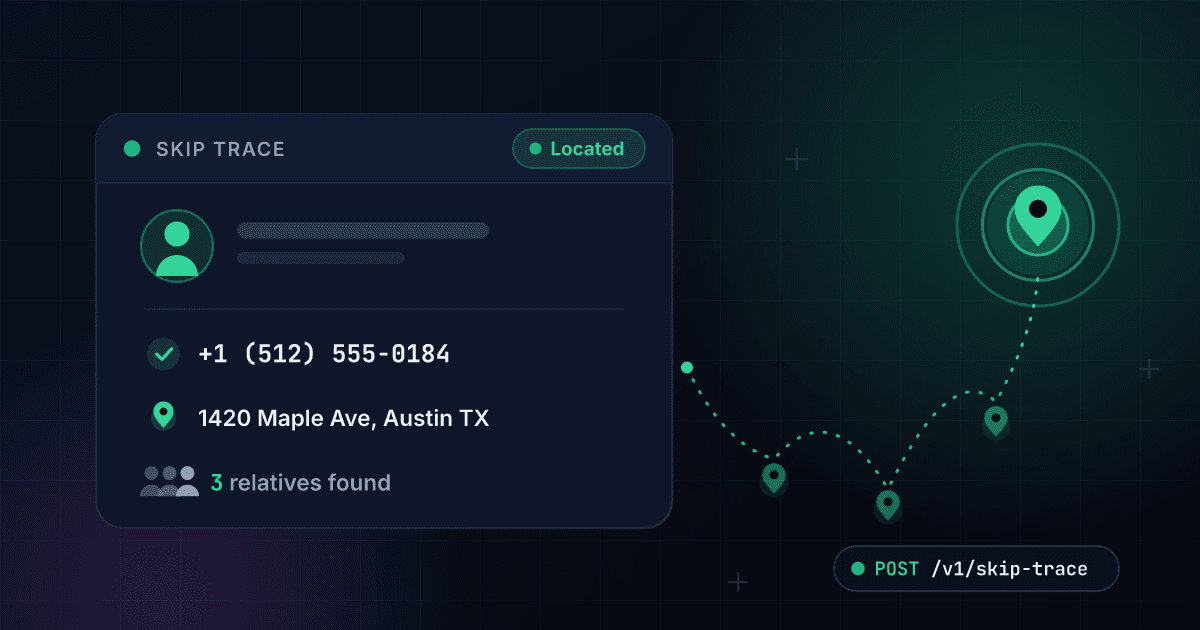
Debt collection skip tracing is the process of locating current, accurate contact information for an account holder whose details on file have gone stale. Its goal is measured in one number: right-party contact rate, the share of connection attempts that actually reach the person who owes the account rather than a relative, a stranger, or a dead line.
This guide covers how skip tracing works in a collections context, the workflow that raises right-party contact rates, where batch processing fits, and the compliance guardrails that make wrong numbers an operational and legal problem rather than just an annoyance.
Why collections data goes stale so fast
Collection files age badly by nature. Accounts arrive months or years after origination, and the people behind them move, change carriers, and abandon phone numbers at above-average rates precisely during periods of financial stress. A portfolio's contact data starts decaying the day it is placed, and every recycled phone number in the file is a future conversation with the wrong person.
That last part is the expensive one. In collections, a wrong number is not just a wasted dial. Repeated calls to a number that no longer belongs to the debtor create liability exposure under the TCPA and FDCPA, and they burn agent time on conversations that can never resolve an account.
The skip tracing workflow for collections
- Start from what the file gives you. Name, last known addresses, prior phone numbers, sometimes an email. More input identifiers mean tighter matches, especially on common names.
- Trace the account. The skip tracing API returns current phone numbers and addresses with confidence indicators per match, so accounts can be worked strongest-match first.
- Validate every returned number. Before a number enters the dialer, phone validation confirms it is active and identifies line type. Disconnected and invalid numbers drop out before they waste an attempt, and the mobile-versus-landline split drives which numbers may be contacted by which channel.
- Scrub for compliance. Run the callable file through a phone scrub for do-not-call status and risk flags before campaigns launch, and re-scrub on a schedule. The DNC glossary entry explains the registries involved.
- Re-trace on triggers, not timers. When attempts to a previously good number start failing, or mail returns, that account goes back through the trace. Re-tracing an entire portfolio monthly is expensive; re-tracing on failure signals is not.
Batch skip tracing for portfolios
New placements arrive as files, not single accounts, and batch processing is how they get worked. Uploading a placement file as a CSV batch through the skip tracing API traces every account in one pass and returns an enriched file ready for validation and scrubbing. Success-based billing matters here: collections files include accounts that cannot be located, and paying only on match keeps the economics predictable on older paper.
A practical sequencing tip: trace, then validate, then scrub, in that order, as one pipeline per placement. Teams that scrub before validating waste scrub checks on numbers that turn out to be disconnected; teams that dial before scrubbing take compliance risk they did not need to take.
Compliance guardrails
None of this is legal advice, but the operational outlines are well established in the industry:
- Wrong-party calls are the core risk. Recycled numbers mean yesterday's right party is today's stranger. Validating before dialing, and treating repeated no-connects as a re-trace trigger, keeps recycled numbers out of rotation.
- Do-not-call and consent rules still apply. Collections has its own rulebook layered on top of general calling rules, and phone-channel consent does not transfer when a number changes hands. Scrubbing before every campaign, not once at placement, is the standard.
- Document the chain. When a number was traced, validated, scrubbed, and attempted. Disputes in collections are routine, and the process record is what answers them.
- Honor channel preferences and opt-outs immediately, across every portfolio and system, not just the one where the request landed.
Frequently asked questions
What is a right-party contact rate?
The share of connected attempts that reach the actual account holder. It is the cleanest measure of contact-data quality: tracing, validation, and scrubbing all exist to push it up while keeping compliance intact.
How is collections skip tracing different from real estate skip tracing?
Same underlying data discipline, different stakes. Real estate tracing optimizes for reaching more owners cheaply; collections tracing operates under stricter contact rules where a wrong number is a liability, so validation and scrubbing carry more weight in the workflow.
How often should accounts be re-traced?
On signal, not schedule. Failed attempts to a previously connecting number, returned mail, or a bounced email are the triggers that justify a fresh trace. Blanket monthly re-traces of a full portfolio mostly re-buy data that has not changed.
Does skip tracing guarantee the number belongs to the debtor?
No. Traces return matches with confidence levels, not certainties. That is exactly why validation and strongest-match-first working policies exist, and why wrong-party handling procedures belong in every collections playbook.
Working a placement file now? Run it through the skip tracing API and validate the results with phone validation, or start on the free trial with a sample of accounts.
Meet the Expert Behind the Insights
Real-world experience from building and scaling B2B SaaS companies

Robby Frank
Head of Growth at 1Lookup
"Calm down, it's just life"
About Robby
Self-taught entrepreneur and technical leader with 12+ years building profitable B2B SaaS companies. Specializes in rapid product development and growth marketing with 1,000+ outreach campaigns executed across industries.
Author of "Evolution of a Maniac" and advocate for practical, results-driven business strategies that prioritize shipping over perfection.