How to clean a phone number list before an SMS campaign
Clean a phone number list in this order: put every number in one format, remove the duplicates, drop numbers with the wrong length, find the landlines and VoIP numbers, check which mobiles are still switched on, check which numbers moved carrier, then remove everyone who opted out. The first two steps are free in a spreadsheet. The next four are live checks that the 1Lookup bulk phone number checker runs on a whole CSV file during the 7-day free trial.
The order matters because each step makes the next one cheaper: you pay for each live check once, and only where it can work.
No payment today.
- The list as you collected it10,000 rows
- 1.One format9,940 left
60 blank or text rows.
- 2.No duplicates9,300 left
640 repeats.
- 3.Right length only9,150 left
150 wrong-length numbers.
- 4.No landlines or VoIP7,400 left
1,320 landlines, 430 VoIP or toll-free.
- 5.Live mobiles only6,950 left
400 dead lines, 50 to recheck.
- 6.Current carriers6,950 left
620 get their new carrier.
- 7.No opt-outs6,720 left
230 opt-outs.
An invented 10,000-row example, not a benchmark. Your own counts will differ.
A phone list goes stale even when nobody touches it.
The FCC estimated in 2018 that about 35 million US phone numbers were disconnected and made available for reassignment each year, and its numbering report counts over 963 million numbers ported between 2003 and 2024. A number that was right when you collected it can be switched off, reassigned or on a new carrier today, and a text to it is a send you pay for and never deliver.
1.Put every number in the same format first.
Use E.164, the international standard: a plus sign, the country code and the digits, with no spaces, dashes or brackets. A US number becomes +14155550132 and a UK mobile becomes +447700900123.
Do this first because (415) 555-0132, 415.555.0132 and 4155550132 are the same number, and you cannot see that until they match. A checker also needs the country code to apply the right country's rules.
In Google Sheets, this formula in the next column strips everything but digits and adds +1 to a 10-digit number, so it assumes a number with no country code is US or Canadian. Fill it down and paste the results back as values.
=IF(LEN(REGEXREPLACE(A2,"[^0-9]",""))=10,"+1","+")®EXREPLACE(A2,"[^0-9]","")2.Remove the duplicates next, on the formatted column.
A spreadsheet can find the repeats once every number is written the same way. In Google Sheets use Data, then Data cleanup, then Remove duplicates. In Excel use Data, then Remove Duplicates.
Sort first so the row you want to keep, such as the newest sign-up, sits on top. Do this before any paid check, because a duplicate is a lookup you pay for twice and a person who gets two texts.
3.Drop the numbers that are too short or too long for their country.
Each country has its own number lengths, so a number with a digit missing or added is a typo that nobody can repair by guessing. A US or Canadian number has 10 digits after +1, so a nine-digit entry is wrong. Blank rows and rows with text such as “call after 5” go too.
The free phone validator checks one number against its country's rules, and the bulk checker does the same for every row of a file.
4.Find the landlines and VoIP numbers before you text anyone.
Line type tells you what kind of service a number is: mobile, landline, VoIP, toll-free or premium-rate. A text reaches a mobile line, a landline only when its provider offers a text service, and a VoIP or toll-free number only when its owner set that up. VoIP numbers are also cheap to create, so they carry more risk of being throwaway sign-up numbers.
To remove landlines from an SMS list, run the line type check and filter the file, and keep the landlines in a separate sheet for voice campaigns. The line type is the one on record, so treat the filter as a guide, not a promise. Check one number free with the phone line type lookup.
| Line type | Can it get a text? | What to do |
|---|---|---|
| Mobile | Yes. | Keep it and run the live network check next. |
| Landline | Only if its provider offers a text service. | Take it off the SMS list and keep it for calls. |
| VoIP | Only if its owner set that up. | Set it aside and review it. |
| Toll-free | Only if its owner turned texting on. | Set it aside and review it. |
5.Check that each mobile number is still switched on.
A live network check, called an HLR lookup, asks the mobile number's own network whether the SIM is active. HLR stands for home location register, the database each mobile network keeps about its own SIMs. Nothing is sent to the phone, so it does not ring and no text arrives.
It works on mobile lines only, so run line type first and never pay to check a landline. Try one number free in the HLR lookup.
| HLR answer | What it means | What to do |
|---|---|---|
| Active | On and reachable. | Keep it. |
| Temporarily unreachable | Off or out of coverage. | Set it aside and check it before the next send. |
| No active line | No subscriber on the number. | Remove it. |
| Unknown | No clear answer. | Set it aside and check it again later. |
In the US and Canada the carriers do not answer live queries, so the lookup reads number records and tells you whether the number is assigned, not whether the phone is on right now.
6.Check which numbers moved to another carrier.
Number portability lets someone keep their number when they change carrier, so a ported number is still valid and still gets texts. Check your own records, because the carrier in your file may be out of date and anything you route, price or report by carrier needs the current one.
The free phone portability lookup shows whether a mobile number has moved, and the carrier lookup shows the carrier it is on today. In a bulk file the porting status comes back on every US row.
7.Remove everyone who opted out, then check the Do Not Call question with your counsel.
Take out anyone who replied STOP and anyone on your own suppression list, and do it last, with your freshest copy, because it changes after every send. US numbers come back from the bulk checker with a Do Not Call flag, and the free DNC check shows one number's registry status.
Check the TCPA rules for your kind of message with your counsel.
This is what the seven steps do to a small sample list.
| Row as collected | What is wrong | What happens to it |
|---|---|---|
| (415) 555-0132 | Brackets and spaces. | Kept as +14155550132, an active mobile. |
| 415.555.0132 | The same number, with dots. | Removed as a duplicate. |
| +1 415 555 01 | Too short. | Removed as invalid. |
| (212) 555-0114 | A landline. | Moved off the SMS list. |
| +1 202 555 0188 | A VoIP number. | Set aside for review. |
| +1 305 555 0166 | A mobile with no active line. | Removed after the live check. |
| +44 7700 900123 | A UK mobile that moved carrier. | Kept, with its new carrier. |
| +1 312 555 0143 | Replied STOP. | Removed as an opt-out. |
Every number is invented. The 555-01XX and 07700 900XXX ranges are set aside for fiction.
This is what each check catches, which 1Lookup tool does it and what it costs.
| Check | What it catches | 1Lookup tool | What it costs |
|---|---|---|---|
| 1. Same format | Unreadable numbers, hidden repeats. | A spreadsheet formula. | Free. |
| 2. Duplicates | Double sends and lookups. | A spreadsheet. | Free. |
| 3. Valid length | Typos and impossible numbers. | Phone validator | One free. In a file, 1 credit a number. |
| 4. Line type | Landlines, VoIP, toll-free. | Phone line type lookup | One free. In a file, part of the 1 credit check. |
| 5. Live status | Switched-off mobiles. | HLR lookup | One free. In a file, 5 credits a number. |
| 6. Portability | Numbers that changed carrier. | Phone portability lookup and carrier lookup | One free. US rows in a file come with the 1 credit check. |
| 7. Opt-outs | People who said stop. | Your own list and the DNC check | Free. US rows in a file carry the Do Not Call flag. |
On the Starter plan a 1 credit check is $0.00495 and a 5 credit HLR lookup is $0.02475.
The bulk checker runs the checks on the whole file at once.
Save the cleaned list as a CSV with one number on each row, open the batch upload page after you sign up, pick the column with the numbers and download the results. Every row comes back with its line type, carrier and location, plus Do Not Call and porting status on US numbers, for up to 2 million rows a file.
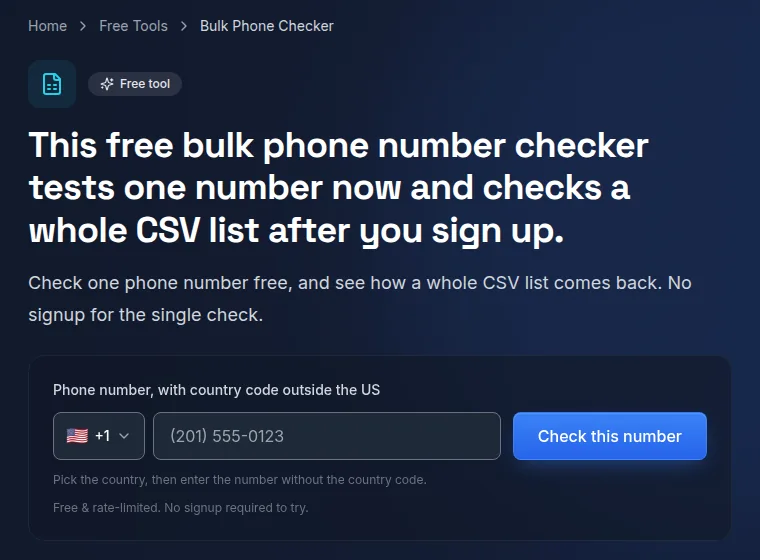
The 7-day free trial comes with $5 of credits on Starter, about 1,000 checks, enough to run a sample of your own list and read the results file.
Clean the list again before every big send.
A list that was clean in spring is not clean in winter. Run this routine before each big campaign, and check each new sign-up as it arrives so a bad number never joins the list. The phone validation API runs the same check on every number as it comes in.
These are the questions people ask before they clean a list.
- Does checking a number ring it or send it a text?
- No. The checks read carrier and network records, so nothing is called or texted and nobody is told.
- Should I delete the landlines or keep them?
- Keep them in a separate file for voice campaigns and take them off the SMS list.
- Is a ported number a bad number?
- No. It is valid and still gets texts, but its carrier changed, so update that column.
Check one number free, then run your whole list.
No payment today.
These are the next questions buyers ask.
- How do I clean my phone list before an SMS campaign?
- How do I check a list of phone numbers in bulk for mobile, landline or VoIP?
See all the questions answered in the help section.