What a home location register is and what an HLR lookup reads from it
A home location register, or HLR, is the database a mobile network keeps about its own SIMs. For each SIM it records the phone number, the SIM's ID, what the plan allows and whether the phone is switched on and in coverage. It is how a network knows where to send a call or a text.
An HLR lookup asks that register about one number and reports what it says, without calling or texting the phone. The register records no name, no address and no GPS position of the owner.
No payment today.
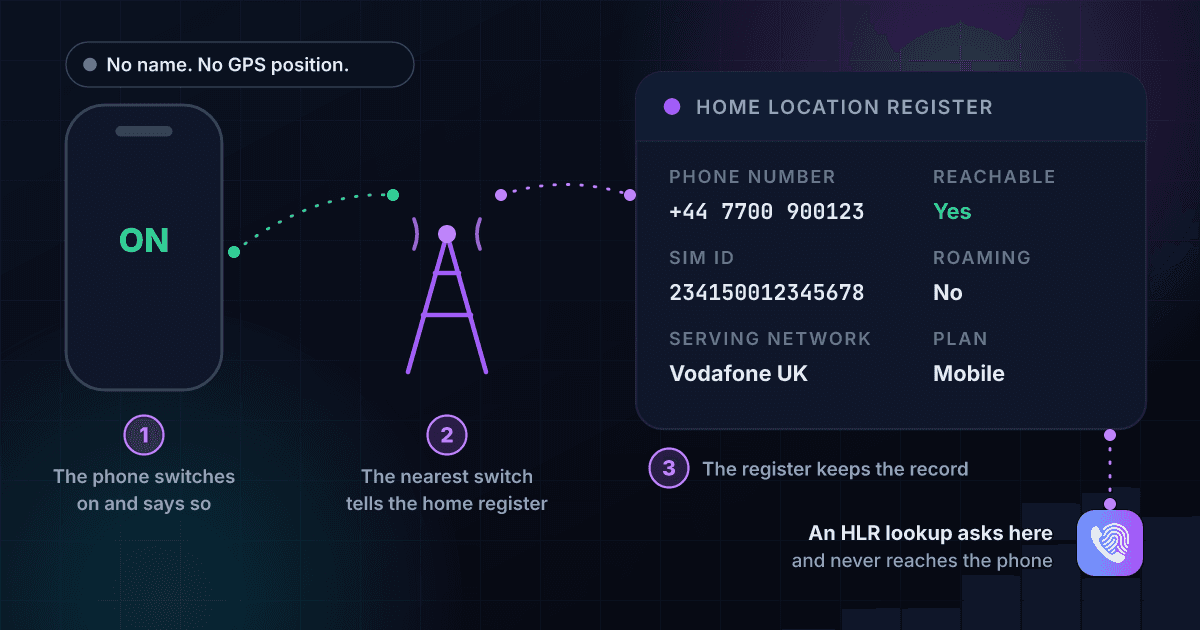
Every mobile network keeps one register for its own customers.
A phone company has to find any of its customers in a second, wherever they are. So it keeps a master record for every SIM it has issued, and that record is the home location register. Home means the network that issued the SIM, even when the phone is abroad.
The same job has a different name in each generation of mobile network. It is the HLR on 2G and 3G, the HSS on 4G and the UDM on 5G. The name HLR stuck, and a lookup of any of the three is still called an HLR lookup.
The register learns where a phone is each time the phone switches on.
When a phone switches on or moves to a new area, it tells the nearest network switch. That switch reports to the phone's home register, which notes that the phone is reachable and which switch is serving it.
When someone sends the phone a text, the network asks the register where to deliver it. If the phone is off, the register says so and the text waits or fails.
These are the facts the register keeps and the ones it never has.
| Fact | In the register? | What it is used for |
|---|---|---|
| Phone number | Yes. | Matches the number to the SIM. |
| SIM ID, called the IMSI | Yes. | The network's own ID for the SIM. |
| Service plan | Yes. | What the SIM may do, such as calls and texts. |
| Switched on and in coverage | Yes. | Decides whether a text can be delivered now. |
| Network now serving the phone | Yes. | Where to send a call or text, and whether the phone is roaming. |
| Owner's name or address | No. | Kept elsewhere by the carrier. |
| GPS position | No. | The register knows the serving switch, not the street. |
| Calls and texts | No. | The register never sees what they say. |
An HLR lookup asks the register the question a text would ask.
A lookup sends the register the same kind of routing question the network asks before it delivers a text, and stops there. The register answers with its record, and 1Lookup turns that answer into a status, a country, the carrier and a ported flag. Nothing reaches the phone, so it does not ring, no text arrives and the owner is not told. The free HLR lookup shows the answer for one number with no signup.
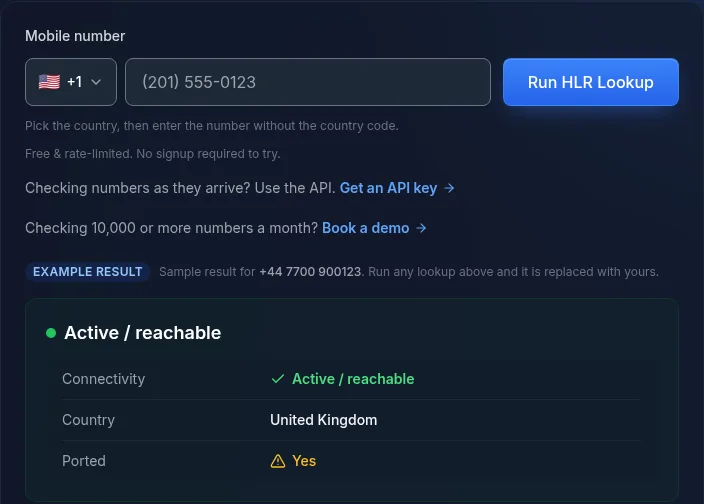
This is where each field of a lookup result comes from.
| Result field | What it tells you | Where it comes from |
|---|---|---|
| Connectivity | Active, unreachable or no active line. | Whether the register shows the SIM as on and in coverage. |
| Country | The country the number belongs to. | The number's country code. |
| Ported | Whether the number moved to another network. | Which network answers for the number now, against the one that first issued it. |
| Current and original carrier | Who serves the number now and who issued it. | The network that answers for the number and its original range. |
| MCC / MNC | The two codes that name one network. | The codes of the network that serves the phone. |
| Roaming | Whether the phone is on a foreign network. | The serving network, against the home network. |
| IMSI | The network's ID for the SIM. | The register's own record of the SIM. |
The first three are free on the tool page, and a free trial opens the rest. See every field in a sample HLR lookup result.
A register lookup has limits you should know before you rely on it.
- It works on mobile lines only, because a landline has no SIM and no register entry.
- In the US and Canada the carriers do not answer live queries, so the lookup reads number records and tells you whether the number is assigned, not whether the phone is on.
- An answer is true at the moment of the lookup, so check a list again before every big send.
To use the register on a list, see the HLR lookup API and the MCC and MNC lookup for the network codes it returns.
These are the questions people ask about the register.
- Is the home location register the same as a phone's location?
- No. It records which network switch is serving the phone, not where the phone is on a map, and an HLR lookup returns no GPS position.
- Does an HLR lookup need access to the phone?
- No. It asks the network's register, so the phone is never contacted and the owner is not told.
- Why is it called a home register?
- Home is the network that issued the SIM. A phone abroad is still recorded in its home register.
Read one number's record with a free HLR lookup.
No payment today.
These are the next pages to read.
- What each HLR lookup status means and what to do with each number
- How to tell if a phone is switched off or the number is disconnected
- How can I check if a phone number is still active without calling it?
See all the questions answered in the help section.